
Opening your dashboard
Class 9 Physics Chapter 10: Magnetism Solutions
72 textbook questions with step-by-step answers, free to read, for ICSE 2026-27.
Get talked through Ch 10, not just shown the answer
Reading a finished solution is not the same as being able to do it. The AI tutor takes one question at a time and works it with you, in your own words, until you can.
- Ask it out loud, in your own words
- It gives you the next step, not the answer
- Stuck on part (ii)? Start there
72 questions with solutions
1–5 marks · Mixed difficulty
- 11 mark
Question 1
The first known magnets were pieces of :
Solve with AIAnswer
(A) bauxite
- Correct
(B) lodestone
(C) limestone
(D) None of the above
Answer: (B) lodestone
Concept: Lodestone (magnetite, an ore of iron oxide, ) is a natural magnet: it attracts small pieces of iron and, when suspended freely, rests in the north-south direction. Magnets made by people from iron or steel, in a chosen shape and strength, are artificial magnets.
Step 1 — Recall the first magnets.
The first magnets people knew were not made by them; they were found in nature as pieces of a black iron ore, first in large amounts in Magnesia, in Asia Minor.
Step 2 — Name the ore.
This ore is lodestone, a form of iron oxide (, also called magnetite). It attracts small pieces of iron and, when hung freely, sets itself in the north-south direction, so it was the first known magnet.
Why the other options are wrong:
- (A) bauxite: Bauxite is the ore of aluminium (hydrated aluminium oxide); it is not a magnet.
- (C) limestone: Limestone is calcium carbonate; it is not a magnet.
- (D) None of the above: One of the listed materials, lodestone, is the right answer, so 'none of the above' is wrong.
Therefore, the first known magnets were pieces of lodestone, option (B).
- 21 mark
Question 2
If a magnet is suspended with a silk thread such that it is free to rotate in a horizontal plane, it sets itself always pointing in the :
Solve with AIAnswer
(A) geographic east-west direction
(B) magnetic east-west direction
- Correct
(C) geographic north-south direction
(D) None of the above
Answer: (C) geographic north-south direction
Concept: The earth behaves like a huge magnet. Its magnetic south pole lies near the geographic north and its magnetic north pole near the geographic south. So a freely suspended magnet rests along the magnetic meridian, very nearly the geographic north-south line, with its N pole towards the geographic north.
Step 1 — See what turns the magnet.
A magnet hung by a silk thread can turn freely in a horizontal plane. The earth's magnetic field pulls its N pole towards the earth's magnetic south pole (near the geographic north) and its S pole the other way.
Step 2 — Find where it comes to rest.
So the magnet always comes to rest along the north-south line, with its N pole towards the geographic north. (Strictly it rests along the magnetic meridian, which differs from the geographic north-south line by only a few degrees at most places.)
Watch out: A magnet never rests east-west; the east-west line is at right angles to the earth's field.
Why the other options are wrong:
- (A) geographic east-west direction: The geographic east-west line is at right angles to the earth's horizontal field, so the magnet turns away from it.
- (B) magnetic east-west direction: The magnetic east-west line is also at right angles to the earth's horizontal field, so the magnet does not rest along it.
- (D) None of the above: Option (C) is correct, so 'none of the above' is wrong.
Therefore, a freely suspended magnet rests in the geographic north-south direction, option (C).
- 31 mark
Question 3
The ........ magnetism acquired by a magnetic material when it is kept near a magnet is called ...... magnetism.
Solve with AIAnswer
- Correct
(A) temporary, induced
(B) permanent, induced
(C) temporary, permanent
(D) None of the above
Answer: (A) temporary, induced
Concept: Magnetic induction: A piece of magnetic material (soft iron, steel) placed near or in contact with a magnet itself becomes a magnet. The end nearer the inducing pole gets the opposite polarity and the farther end gets the similar polarity. This induced magnetism is temporary: it lasts only while the magnet is near.
Step 1 — Decide how long the magnetism lasts.
A piece of iron near a magnet attracts iron filings, but drops them as soon as the magnet is taken away. So the magnetism it gains is temporary.
Step 2 — Name this magnetism.
Magnetism produced in a material only because a magnet is near it is called induced magnetism.
Why the other options are wrong:
- (B) permanent, induced: The first blank cannot be 'permanent': the iron loses this magnetism when the magnet is removed.
- (C) temporary, permanent: The second blank is the name of the effect, 'induced'; 'permanent' contradicts the first blank.
- (D) None of the above: Option (A) completes the sentence correctly, so 'none of the above' is wrong.
Therefore, the temporary magnetism acquired near a magnet is called induced magnetism, option (A).
- 41 mark
Question 4
Two like magnetic poles :
Solve with AIAnswer
- Correct
(A) repel each other
(B) attract each other
(C) first attract each other, then repel
(D) neither attract nor repel.
Answer: (A) repel each other
Concept: Like poles repel each other (N and N, or S and S) and unlike poles attract each other (N and S).
Step 1 — Identify the poles.
'Like' poles are two poles of the same kind: two N poles or two S poles.
Step 2 — Apply the law of poles.
Like poles always repel each other. This repulsion is the surest test of a magnet, because a piece of plain iron is attracted by both poles but never repelled.
Watch out: Attraction alone does not prove that a bar is a magnet; only repulsion does.
Why the other options are wrong:
- (B) attract each other: Attraction happens between unlike poles (N and S), not like poles.
- (C) first attract each other, then repel: Like poles repel from the start; there is no attraction first.
- (D) neither attract nor repel: Like poles do exert a force on each other: they repel.
Therefore, two like magnetic poles repel each other, option (A).
- 51 mark
Question 5
A magnetic pole induces .......... polarity on the near end and a .......... polarity on the farther end of the iron bar.
Solve with AIAnswer
(A) opposite, opposite
(B) similar, similar
- Correct
(C) opposite, similar
(D) similar, opposite
Answer: (C) opposite, similar
Concept: Magnetic induction: A piece of magnetic material (soft iron, steel) placed near or in contact with a magnet itself becomes a magnet. The end nearer the inducing pole gets the opposite polarity and the farther end gets the similar polarity. This induced magnetism is temporary: it lasts only while the magnet is near.
Step 1 — Look at the near end.
The pole of the magnet induces the opposite polarity on the end of the iron bar nearest to it. Near an N pole, the near end becomes S.
Step 2 — Look at the far end.
The two ends of the bar always have opposite poles, so the far end gets the similar polarity (N, in this example).
Step 3 — Check with attraction.
With an unlike pole closest, the attraction is stronger than the repulsion of the farther like pole, so the bar is pulled towards the magnet, as observed.
Why the other options are wrong:
- (A) opposite, opposite: Both ends cannot be 'opposite': the two ends of the bar always have opposite poles to each other.
- (B) similar, similar: Both ends cannot be 'similar' for the same reason.
- (D) similar, opposite: This is the reverse: a similar pole on the near end would make the magnet repel the iron, which never happens.
Therefore, a magnetic pole induces opposite polarity on the near end and similar polarity on the farther end, option (C).
- 61 mark
Question 6
Out of the following, the incorrect statement(s) is/are :
(i) Magnetic field lines are open and continuous curves.
(ii) Outside the magnet, magnetic field lines are directed from the south pole to the north pole of the magnet.
Solve with AIAnswer
(A) (i)
(B) (ii)
- Correct
(C) both (i) and (ii)
(D) none of the above
Answer: (C) both statements i and ii
Concept: A magnetic field line is a continuous curve such that the tangent at any point gives the direction of the magnetic field there (the direction in which the N pole of a small compass needle points). Outside a magnet the lines run from N to S, inside it from S to N, so each line is a closed curve.
Step 1 — Test statement i.
Field lines start at the N pole, run outside to the S pole and continue inside the magnet back to the N pole. Each line is a closed curve, not an open one, so statement i is incorrect.
Step 2 — Test statement ii.
Outside the magnet the lines run from the north pole to the south pole, not from south to north, so statement ii is also incorrect.
Step 3 — Choose the option.
Both statements are incorrect, and the question asks for the incorrect ones.
Watch out: The question asks for the INCORRECT statements. Inside the magnet the lines do run from S to N, but statement ii is about the outside.
Why the other options are wrong:
- (A) statement i only: Statement ii is also incorrect, so naming statement i alone is not enough.
- (B) statement ii only: Statement i is also incorrect, so naming statement ii alone is not enough.
- (D) none of the above: Both statements are incorrect, so 'none' is wrong.
Therefore, both statements i and ii are incorrect, option (C).
- 71 mark
Question 7
An iron rod buried inside the earth along ............ direction becomes a magnet.
Solve with AIAnswer
(A) east-west
(B) equatorial
- Correct
(C) north-south
(D) any direction
Answer: (C) north-south
Concept: The earth behaves like a huge magnet. Its magnetic south pole lies near the geographic north and its magnetic north pole near the geographic south. So a freely suspended magnet rests along the magnetic meridian, very nearly the geographic north-south line, with its N pole towards the geographic north.
Magnetic induction: A piece of magnetic material (soft iron, steel) placed near or in contact with a magnet itself becomes a magnet. The end nearer the inducing pole gets the opposite polarity and the farther end gets the similar polarity. This induced magnetism is temporary: it lasts only while the magnet is near.
Step 1 — Find the direction of the earth's field.
The horizontal part of the earth's magnetic field runs along the north-south line, from the geographic south to the geographic north.
Step 2 — Place the rod along it.
An iron rod buried along the north-south direction lies along this field. Over some days it is magnetised by induction along its length and becomes a weak magnet. This is one evidence that the earth behaves like a magnet.
Why the other options are wrong:
- (A) east-west: A rod lying east-west is at right angles to the earth's horizontal field, so it is not magnetised along its length.
- (B) equatorial: The 'equatorial' direction is the east-west direction, across the earth's field, so it does not work either.
- (D) any direction: The direction matters: only a rod along the field (north-south) is magnetised along its length.
Therefore, an iron rod buried along the north-south direction becomes a magnet, option (C).
- 81 mark
Question 8
The sum of all magnetic fields adds up to zero at the :
Solve with AIAnswer
(A) north pole
(B) south pole
(C) equator
- Correct
(D) neutral points
Answer: (D) neutral points
Concept: A neutral point is a point where the field of a magnet is equal in magnitude and opposite in direction to the earth's horizontal field, so the resultant field is zero. A compass needle placed there rests in any direction, and in a field-line plot it is marked with a cross (×).
Step 1 — Ask where fields cancel.
The resultant of two magnetic fields is zero only where they are equal in size and opposite in direction.
Step 2 — Name such a point.
Near a magnet in the earth's field, such points are called neutral points. A compass needle placed there rests in any direction.
Why the other options are wrong:
- (A) north pole: Near the north pole of a magnet the field is strongest, not zero.
- (B) south pole: Near the south pole of a magnet the field is also strong, not zero.
- (C) equator: At the earth's magnetic equator the earth's field is horizontal but not zero.
Therefore, the magnetic fields add up to zero at the neutral points, option (D).
- 91 mark
Question 9
In a uniform magnetic field, the field lines are :
Solve with AIAnswer
(A) curved
- Correct
(B) parallel and equidistant straight lines
(C) parallel, but non-equispaced straight lines
(D) nothing can be said.
Answer: (B) parallel and equidistant straight lines
Concept: A uniform magnetic field has the same strength and direction everywhere, so its field lines are parallel, equidistant straight lines (the earth's field in a limited space, such as a table top). A non-uniform field changes from place to place, so its lines are curved and unequally spaced.
Step 1 — Use the meaning of 'uniform'.
In a uniform field the direction is the same everywhere, so the lines are parallel straight lines.
Step 2 — Use the strength.
The strength is also the same everywhere, so the lines are equally crowded everywhere: they are equidistant.
Why the other options are wrong:
- (A) curved: Curved lines show a field whose direction changes from place to place, so it is non-uniform.
- (C) parallel, but non-equispaced straight lines: Unequal spacing shows a field whose strength changes from place to place, so it is non-uniform.
- (D) nothing can be said: The shape of the lines of a uniform field is known: parallel and equidistant.
Therefore, the field lines of a uniform magnetic field are parallel and equidistant straight lines, option (B).
- 101 mark
Question 10
The magnetic field lines in a non-uniform magnetic field are :
Solve with AIAnswer
- Correct
(A) either converging or diverging
(B) parallel and equispaced
(C) only converging
(D) only diverging
Answer: (A) either converging or diverging
Concept: A uniform magnetic field has the same strength and direction everywhere, so its field lines are parallel, equidistant straight lines (the earth's field in a limited space, such as a table top). A non-uniform field changes from place to place, so its lines are curved and unequally spaced.
Two field lines never intersect: at a crossing the field would have two directions at one point, which is impossible. Where the lines are crowded the field is strong; where they spread out it is weak.
Step 1 — Use the spacing.
In a non-uniform field the strength changes from place to place, so the lines crowd together (converge) where the field is getting stronger and spread apart (diverge) where it is getting weaker.
Step 2 — Look at a bar magnet.
Around a bar magnet the lines converge towards the poles and diverge away from them, so a non-uniform field may show either behaviour.
Why the other options are wrong:
- (B) parallel and equispaced: Parallel, equispaced lines represent a uniform field, not a non-uniform one.
- (C) only converging: Lines can also diverge in a non-uniform field (for example, as they leave a pole), so 'only converging' is wrong.
- (D) only diverging: Lines can also converge in a non-uniform field (for example, near a pole), so 'only diverging' is wrong.
Therefore, the field lines of a non-uniform field are either converging or diverging, option (A).
- 111 mark
Question 11
The magnetic field lines of the earth are .......... to the earth's surface near the magnetic poles and ....... to the earth's surface near the magnetic equator.
Solve with AIAnswer
(A) parallel, normal
- Correct
(B) normal, parallel
(C) normal, normal
(D) parallel, parallel
Answer: (B) normal, parallel
Concept: The earth's field lines are vertical (normal to the surface) at the magnetic poles, horizontal (parallel to the surface) at the magnetic equator and inclined in between. A magnet free to turn in a vertical plane sets itself along these lines.
Step 1 — Near the magnetic poles.
A needle free to turn in a vertical plane stands vertical at a magnetic pole, so the field lines there are normal to the earth's surface.
Step 2 — Near the magnetic equator.
At the magnetic equator the same needle lies horizontal, so the field lines there are parallel to the surface.
Watch out: The order of the blanks matters: poles first, equator second.
Why the other options are wrong:
- (A) parallel, normal: This is the reverse order: the lines are normal at the poles and parallel at the equator.
- (C) normal, normal: The lines cannot be normal at both places: at the magnetic equator they are horizontal.
- (D) parallel, parallel: The lines cannot be parallel at both places: at the magnetic poles they are vertical.
Therefore, the earth's field lines are normal to the surface near the magnetic poles and parallel to it near the magnetic equator, option (B).
- 121 mark
Question 12
The direction of a magnetic field at a point on a magnetic field line is given by :
Solve with AIAnswer
- Correct
(A) a tangent at that point
(B) a normal bisector at that point
(C) both tangent and normal bisector at that point
(D) None of the above
Answer: (A) a tangent at that point
Concept: A magnetic field line is a continuous curve such that the tangent at any point gives the direction of the magnetic field there (the direction in which the N pole of a small compass needle points). Outside a magnet the lines run from N to S, inside it from S to N, so each line is a closed curve.
Step 1 — Recall the definition.
A field line is drawn so that at every point its tangent points along the field.
Step 2 — Check with a compass.
A small compass needle placed on a field line sets itself along the tangent to the line at that point.
Why the other options are wrong:
- (B) a normal bisector at that point: The normal is at right angles to the tangent, so it is at right angles to the field.
- (C) both tangent and normal bisector at that point: The field has only one direction at a point, so it cannot lie along both the tangent and the normal.
- (D) None of the above: Option (A) is correct, so 'none of the above' is wrong.
Therefore, the direction of the field at a point is given by the tangent to the field line there, option (A).
- 131 mark
Question 13
A soft iron bar is tied by a thread in the middle and is suspended from a rigid support such that it is free to rotate in a horizontal plane. It shall come to rest :
Solve with AIAnswer
(A) along north-south direction
(B) along east-west direction
(C) equally inclined to N-S and E-W directions
- Correct
(D) in any direction
Answer: (D) in any direction
Concept: The earth behaves like a huge magnet. Its magnetic south pole lies near the geographic north and its magnetic north pole near the geographic south. So a freely suspended magnet rests along the magnetic meridian, very nearly the geographic north-south line, with its N pole towards the geographic north.
Step 1 — Ask whether the bar is a magnet.
Soft iron that has not been magnetised has no poles of its own.
Step 2 — See what the earth's field does.
The earth's field is far too weak to give a horizontally hung soft iron bar any turning effect towards one direction. So the bar stays wherever it happens to stop: it comes to rest in any direction. Only a magnet always settles north-south, and this is a test for a magnet.
Watch out: Do not confuse a soft iron bar with a magnet; the iron has no poles until a magnet induces them.
Why the other options are wrong:
- (A) along north-south direction: Only a magnet rests along the north-south direction.
- (B) along east-west direction: Nothing turns an unmagnetised bar towards the east-west direction.
- (C) equally inclined to N-S and E-W directions: Nothing turns an unmagnetised bar towards a direction between N-S and E-W either.
Therefore, a suspended soft iron bar comes to rest in any direction, option (D).
- 141 mark
Question 14
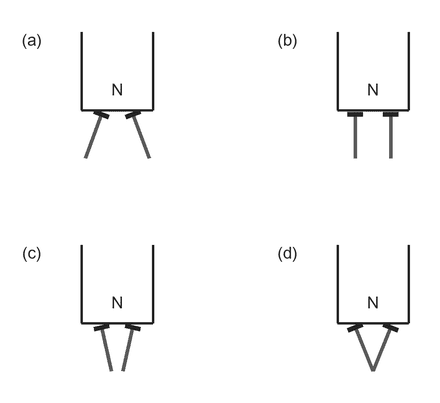
The figure given below shows two iron nails attached to the end of a magnet. Choose the correct figure.
 Solve with AI
Answer
- Correct
(A) Figure (a)
(B) Figure (b)
(C) Figure (c)
(D) Figure (d)
Answer: (A) Figure (a)
Concept: Magnetic induction: A piece of magnetic material (soft iron, steel) placed near or in contact with a magnet itself becomes a magnet. The end nearer the inducing pole gets the opposite polarity and the farther end gets the similar polarity. This induced magnetism is temporary: it lasts only while the magnet is near.
Like poles repel each other (N and N, or S and S) and unlike poles attract each other (N and S).
Step 1 — Find the induced poles.
Each nail hangs from the N pole, so each becomes a magnet by induction. Its head, touching the N pole, becomes an S pole and its pointed end becomes an N pole.
Step 2 — Compare the two pointed ends.
Both pointed ends are N poles, that is, like poles, so they repel each other.
Step 3 — Choose the picture.
Repulsion pushes the free pointed ends apart, so the nails spread out, as in figure (a).
Why the other options are wrong:
- (B) Figure (b): Parallel nails would mean no force between the points, but their like poles repel.
- (C) Figure (c): Points moving towards each other would need attraction, but like poles repel.
- (D) Figure (d): Points touching would need attraction, but like poles repel.
Therefore, the nails spread apart, as in figure (a), option (A).
- 151 mark
Question 15
A freely suspended bar magnet is taken to the north pole of the earth. It comes to rest :
Solve with AIAnswer
(A) in any direction
(B) parallel to the earth's surface
- Correct
(C) nearly vertical with the south pole in a downward direction
(D) nearly vertical with the north pole in a downward direction
Answer: (C) nearly vertical with the south pole in a downward direction
Concept: The earth's field lines are vertical (normal to the surface) at the magnetic poles, horizontal (parallel to the surface) at the magnetic equator and inclined in between. A magnet free to turn in a vertical plane sets itself along these lines.
The earth behaves like a huge magnet. Its magnetic south pole lies near the geographic north and its magnetic north pole near the geographic south. So a freely suspended magnet rests along the magnetic meridian, very nearly the geographic north-south line, with its N pole towards the geographic north.
Step 1 — Decide the angle.
At a magnetic pole of the earth the field lines are vertical, so a freely suspended magnet hangs nearly vertical there.
Step 2 — Decide which end points down (printed key).
The key reads 'north pole of the earth' as the earth's magnetic north pole. There the earth's field lines come out of the ground, pointing upward. The magnet lines up with the field, N pole up, so its south pole points downward, attracted by the magnetic north pole below it.
Step 3 — Check the other reading.
If the phrase is read as the geographic north pole, the pole found there is the earth's magnetic south pole. The field lines go into the ground, so the magnet would hang with its north pole downward, which is option (D).
Watch out: The earth's magnetic south pole lies near its geographic north pole; mixing these up flips the answer.
Note: the stem can be read two ways. At the geographic north pole (the earth's magnetic south pole) the magnet would hang with its north pole downward, option (D). The printed key (C) is kept.
Why the other options are wrong:
- (A) in any direction: At a magnetic pole the field is strong and vertical, so the magnet does not rest in any direction.
- (B) parallel to the earth's surface: A magnet lies parallel to the surface only near the magnetic equator, where the field is horizontal.
- (D) nearly vertical with the north pole in a downward direction: This is the answer only if 'north pole' means the geographic north pole; the printed key takes it as the earth's magnetic north pole.
Therefore, on the printed key's reading the magnet hangs nearly vertical with its south pole downward, option (C).
- 161 mark
Question 16
Which of the following is not a correct statement for a magnet placed in the earth's magnetic field ?
Solve with AIAnswer
(A) Neutral points are always at an equal distance from the magnet.
(B) The position of neutral points depends on the direction of the magnet in the earth's magnetic field.
- Correct
(C) The position of neutral points does not depend on the direction of the magnet
(D) The magnetic field strength is zero at the neutral points.
Answer: (C) The position of neutral points does not depend on the direction of the magnet
Concept: A neutral point is a point where the field of a magnet is equal in magnitude and opposite in direction to the earth's horizontal field, so the resultant field is zero. A compass needle placed there rests in any direction, and in a field-line plot it is marked with a cross (×).
Where the neutral points lie depends on how the magnet is placed. The magnet's field is opposite to the earth's (south-to-north) field on the east-west line through its centre when its N pole points north, and on its axis beyond the two ends when its N pole points south.
Step 1 — Test statement (C).
With the N pole towards the north, the neutral points lie on the east-west line through the centre. With the N pole towards the south, they lie on the axis beyond the ends. So their position does depend on the direction of the magnet, and statement (C) is not correct.
Step 2 — Test the others.
Statement (B) says the same thing the right way round, so it is correct. Statement (D) is correct, because the two fields cancel at a neutral point. Statement (A) is taken as correct: the two neutral points always lie symmetrically, at equal distances from the magnet's centre.
Watch out: The question asks for the statement that is NOT correct.
Note: statement (A) is loosely worded. It is true that the two neutral points are equidistant from the centre, but that distance itself changes with the magnet's strength and placing.
Why the other options are wrong:
- (A) Neutral points are always at an equal distance from the magnet: The two neutral points are always at equal distances from the centre of the magnet, so this is counted as a correct statement.
- (B) The position of neutral points depends on the direction of the magnet in the earth's magnetic field: This is a correct statement: the neutral points move when the magnet is turned.
- (D) The magnetic field strength is zero at the neutral points: This is a correct statement: the resultant field at a neutral point is zero.
Therefore, the incorrect statement is (C), option (C).
- 172 marks
Question 17
Fill in the blanks to complete the sentences :
(a) Two ends of a magnet are called ...........
(b) Unlike poles of a magnet ............. each other.
(c) Like poles of a magnet ................. each other.
(d) A freely suspended magnet rests in the geographic .................. direction.
Solve with AIWritten solution
Solution:
Concept: A magnet attracts iron and, when suspended freely, comes to rest in a definite direction. Its two ends, where the attraction is strongest, are its poles: the north (N) pole points towards the geographic north and the south (S) pole towards the geographic south.
Like poles repel each other (N and N, or S and S) and unlike poles attract each other (N and S).
Step 1 — Fill blank (a).
The two ends of a magnet, where its attraction is strongest, are its poles.
(a) Two ends of a magnet are called poles.
Step 2 — Fill blanks (b) and (c).
By the law of magnetic poles, unlike poles attract and like poles repel.
(b) Unlike poles of a magnet attract each other.
(c) Like poles of a magnet repel each other.
Step 3 — Fill blank (d).
The earth's field turns a freely hung magnet until it lies along the north-south line.
(d) A freely suspended magnet rests in the geographic north-south direction.
Therefore, the blanks are: (a) poles, (b) attract, (c) repel, (d) north-south.
- 182 marks
Question 18
Complete the following sentences :
(a) If the field lines in a magnetic field are parallel and equidistant, the magnetic field is .............
(b) At a neutral point, the resultant magnetic field is ..................
(c) The neutral points of a bar magnet kept with its north pole pointing towards geographic north are located ..........................
Solve with AIWritten solution
Solution:
Concept: A uniform magnetic field has the same strength and direction everywhere, so its field lines are parallel, equidistant straight lines (the earth's field in a limited space, such as a table top). A non-uniform field changes from place to place, so its lines are curved and unequally spaced.
A neutral point is a point where the field of a magnet is equal in magnitude and opposite in direction to the earth's horizontal field, so the resultant field is zero. A compass needle placed there rests in any direction, and in a field-line plot it is marked with a cross (×).
Step 1 — Fill blank (a).
Parallel, equally spaced lines show the same direction and strength everywhere.
(a) If the field lines in a magnetic field are parallel and equidistant, the magnetic field is uniform.
Step 2 — Fill blank (b).
At a neutral point the two fields are equal and opposite, so they cancel.
(b) At a neutral point, the resultant magnetic field is zero.
Step 3 — Fill blank (c).
With the N pole towards the north, the magnet's field on the line through its centre at right angles to its axis points south, opposite to the earth's field, so the fields cancel there.
(c) The neutral points of a bar magnet kept with its north pole pointing towards geographic north are located on the east-west line through the centre of the magnet, one on each side (east and west), at equal distances from it.
Watch out: In (c) the neutral points are NOT on the axis; they are on the axis only when the N pole points south.
Therefore, the blanks are: (a) uniform, (b) zero, (c) to the east and west of the magnet, on the line through its centre.
- 191 mark
Question 19
Where is the magnetic south pole of the earth located?
Solve with AIWritten solution
Solution:
Concept: The earth behaves like a huge magnet. Its magnetic south pole lies near the geographic north and its magnetic north pole near the geographic south. So a freely suspended magnet rests along the magnetic meridian, very nearly the geographic north-south line, with its N pole towards the geographic north.
Step 1 — Use the earth-magnet picture.
A compass needle's north pole points towards the geographic north. Since unlike poles attract, the earth's magnetic pole near the geographic north must be a magnetic south pole.
Step 2 — Say where it is today.
This pole lies close to the geographic north pole, in the Arctic. It keeps drifting slowly: it was in northern Canada in the 1800s and 1900s, and it is now in the Arctic Ocean, about 500 km from the geographic north pole, moving towards Siberia.
Watch out: The pole near the geographic NORTH is magnetically a SOUTH pole.
Note: older books place it in northern Canada, about 2240 km from the geographic north pole; that was its position long ago, and it has since moved much closer to the geographic pole.
Therefore, the earth's magnetic south pole is located near the geographic north pole (in the Arctic).
- 201 mark
Question 20
What kind of magnetic field is represented by parallel and equidistant lines ?
Solve with AIWritten solution
Solution:
Concept: A uniform magnetic field has the same strength and direction everywhere, so its field lines are parallel, equidistant straight lines (the earth's field in a limited space, such as a table top). A non-uniform field changes from place to place, so its lines are curved and unequally spaced.
Step 1 — Read the pattern.
Parallel lines mean the field has the same direction everywhere, and equal spacing means it has the same strength everywhere.
Step 2 — Name the field.
A field with the same strength and direction at every point is a uniform magnetic field. The earth's field over a table top is an example.
Therefore, parallel and equidistant field lines represent a uniform magnetic field.
- 211 mark
Question 21
What is the angle between the magnetic axis of the earth and the axis of rotation of the earth ?
Solve with AIWritten solution
Solution:
Concept: The earth's magnetic axis (the line joining its magnetic poles) is not the same as its axis of rotation (the line joining its geographic poles); the two are inclined to each other.
Step 1 — Recall the textbook value.
The textbook gives the angle between the two axes as nearly 17°. This is why the magnetic poles do not coincide with the geographic poles.
Step 2 — Compare with today's measurement.
Present-day measurements of the earth's magnetic (dipole) axis give a tilt of about 9.5° to the axis of rotation, and the value changes slowly over the years.
Watch out: The magnetic poles are close to, but not at, the geographic poles; the angle is small, not 90°.
Note: use the textbook value, 17°, in the examination; the smaller value is today's measured tilt.
Therefore, the angle is about 17° by the textbook (about 9.5° by today's measurements).
- 222 marks
Question 22
What is a lodestone ?
Solve with AIWritten solution
Solution:
Concept: Lodestone (magnetite, an ore of iron oxide, ) is a natural magnet: it attracts small pieces of iron and, when suspended freely, rests in the north-south direction. Magnets made by people from iron or steel, in a chosen shape and strength, are artificial magnets.
Step 1 — Say what lodestone is.
Lodestone is a naturally occurring ore of iron oxide (, magnetite). It was found in large amounts in Magnesia, in Asia Minor, and it was the first known magnet.
Step 2 — Give its two properties.
Lodestone shows the two properties of a magnet:
- it attracts small pieces of iron;
- when suspended freely, it comes to rest in a definite direction (geographic north-south).
Step 3 — Name it.
Because it is a magnet that occurs in nature, a piece of lodestone is called a natural magnet. The word 'magnet' comes from Magnesia.
Therefore, lodestone is a natural magnet: an iron oxide ore that attracts iron and rests north-south when suspended freely.
- 233 marks
Question 23
What is a natural magnet ? State two limitations of a natural magnet.
Solve with AIWritten solution
Solution:
Concept: Lodestone (magnetite, an ore of iron oxide, ) is a natural magnet: it attracts small pieces of iron and, when suspended freely, rests in the north-south direction. Magnets made by people from iron or steel, in a chosen shape and strength, are artificial magnets.
Step 1 — Define a natural magnet.
A natural magnet is a magnet found in nature, such as a piece of lodestone. It attracts iron and sets itself north-south when suspended freely.
Step 2 — State two limitations.
Natural magnets are not useful in practice for two reasons:
- Irregular shape: they are found in odd, irregular shapes and cannot be given a convenient form;
- Weak magnetism: they are not strong enough for practical use.
Therefore, a natural magnet is a magnet found in nature (lodestone); its limitations are its irregular shape and its weak magnetism.
- 243 marks
Question 24
What is an artificial magnet ? State two reasons why do we need artificial magnets.
Solve with AIWritten solution
Solution:
Concept: Lodestone (magnetite, an ore of iron oxide, ) is a natural magnet: it attracts small pieces of iron and, when suspended freely, rests in the north-south direction. Magnets made by people from iron or steel, in a chosen shape and strength, are artificial magnets.
Step 1 — Define an artificial magnet.
An artificial magnet is a magnet made by people from a magnetic material such as iron or steel, in a convenient size and shape. Bar magnets, horse-shoe magnets, magnetic needles and electromagnets are examples.
Step 2 — Give two reasons we need them.
Natural magnets do not meet our needs, so we make artificial ones:
- natural magnets have odd shapes, while artificial magnets can be made in any convenient shape and size for a particular use;
- natural magnets are weak, while artificial magnets can be made much stronger (and an electromagnet's strength can even be controlled).
Therefore, an artificial magnet is a man-made magnet of iron or steel; we need it because it can be given any convenient shape and made much stronger than a natural magnet.
- 252 marks
Question 25
How will you test whether a given rod is made of iron or copper ?
[Hint : Iron rod gets magnetised when placed near a bar magnet by magnetic induction, while copper rod does not get magnetised]
Solve with AIWritten solution
Solution:
Concept: Iron is a magnetic material and copper is not. Magnetic induction: A piece of magnetic material (soft iron, steel) placed near or in contact with a magnet itself becomes a magnet. The end nearer the inducing pole gets the opposite polarity and the farther end gets the similar polarity. This induced magnetism is temporary: it lasts only while the magnet is near.
Step 1 — Magnetise the rod by induction.
Bring one end of a bar magnet near (or touching) one end of the rod. Then bring some iron filings or small pins near the other end of the rod.
Step 2 — Read the result.
Look at what the far end of the rod does:
- if it attracts the filings while the magnet is near, the rod has become a magnet by induction, so it is made of iron;
- if it does not attract them, it has not been magnetised, so it is made of copper.
Step 3 — A quicker check.
Simply bringing the magnet near the rod also works: an iron rod is attracted by the magnet and a copper rod is not.
Watch out: Copper is a good conductor but is NOT magnetic; a magnet neither attracts nor magnetises it.
Therefore, the rod is iron if it is magnetised by a nearby magnet (and attracts filings or is attracted), and copper if it is not.
- 262 marks
Question 26
Explain the term induced magnetism.
Solve with AIWritten solution
Solution:
Concept: Magnetic induction: A piece of magnetic material (soft iron, steel) placed near or in contact with a magnet itself becomes a magnet. The end nearer the inducing pole gets the opposite polarity and the farther end gets the similar polarity. This induced magnetism is temporary: it lasts only while the magnet is near.
Step 1 — Describe what is seen.
Place a bar of soft iron near, or touching, a pole of a magnet. The bar now attracts iron filings at its ends, so it has become a magnet.
Step 2 — Remove the magnet.
When the magnet is taken away, the filings fall off: the bar loses its magnetism.
Step 3 — State the polarity.
The end of the bar nearer the magnet gets the opposite polarity and the far end gets the similar polarity. Near an N pole, the near end becomes S and the far end becomes N.
Step 4 — Define the term.
The temporary magnetism acquired by a magnetic material when it is kept near (or in contact with) a magnet is called induced magnetism.
Therefore, induced magnetism is the temporary magnetism a magnetic material gets while a magnet is near it, with opposite polarity on the near end.
- 273 marks
Question 27
Explain the following :
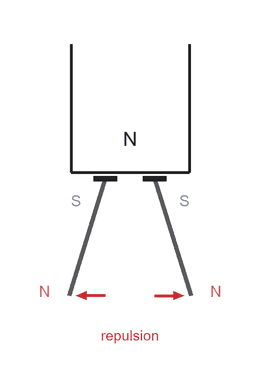
(a) When two pins are hung by their heads from the same pole of a magnet, their pointed ends move apart.
(b) Several soft iron pins can cling, one below the other, from the pole of a magnet.
(c) The north end of a freely suspended magnetic needle gets attracted towards a piece of soft iron placed a little distance away from the needle.
Solve with AIWritten solution
Solution:
Concept: Magnetic induction: A piece of magnetic material (soft iron, steel) placed near or in contact with a magnet itself becomes a magnet. The end nearer the inducing pole gets the opposite polarity and the farther end gets the similar polarity. This induced magnetism is temporary: it lasts only while the magnet is near.
Like poles repel each other (N and N, or S and S) and unlike poles attract each other (N and S).
Step 1 — Part (a): pointed ends move apart.
Each pin becomes a magnet by induction. If the pins hang from an N pole, the head of each pin (the near end) becomes S and its pointed end (the far end) becomes N. The two pointed ends are like poles, so they repel and move apart.
Step 2 — Part (b): pins cling one below the other.
The magnet magnetises the first pin by induction and holds it. This pin, now a magnet, magnetises the second pin by induction and holds it, the second holds the third, and so on, so a chain forms. It grows until the magnet can no longer hold the weight of all the pins below the first one.
Step 3 — Part (c): the needle turns towards soft iron.
The N end of the needle magnetises the soft iron by induction. The end of the iron nearer the needle becomes S (opposite polarity). Unlike poles attract, so the N end of the needle is pulled towards the iron. The iron is first magnetised and only then attracts: induction precedes attraction.
Watch out: In (c) the soft iron is not a magnet to start with; the needle itself magnetises it.
Therefore, (a) the pointed ends become like (N) poles and repel, (b) each pin magnetises the next by induction, and (c) the soft iron gets an induced S pole facing the needle's N pole and attracts it.
- 282 marks
Question 28
'Induced magnetism is temporary'. Comment on this statement.
Solve with AIWritten solution
Solution:
Concept: Magnetic induction: A piece of magnetic material (soft iron, steel) placed near or in contact with a magnet itself becomes a magnet. The end nearer the inducing pole gets the opposite polarity and the farther end gets the similar polarity. This induced magnetism is temporary: it lasts only while the magnet is near.
Step 1 — Make a chain of nails.
Bring one pole of a bar magnet near some small iron nails. They form a chain: the magnet magnetises the first nail by induction, that nail magnetises the next, and so on.
Step 2 — Remove the magnet.
Hold the top nail with your fingers and take the magnet away. All the nails fall down. Without the magnet, the top nail loses its magnetism; then each of the others loses its magnetism too, so they no longer hold each other and fall under gravity.
Step 3 — Draw the conclusion.
The magnetism gained by induction lasts only as long as the inducing magnet is near. So the statement is correct, especially for soft iron (steel keeps a little of it).
Therefore, the statement is correct: induced magnetism lasts only while the inducing magnet is nearby, as the falling chain of nails shows.
- 292 marks
Question 29
'Induction precedes attraction'. Explain the statement.
Solve with AIWritten solution
Solution:
Concept: Magnetic induction: A piece of magnetic material (soft iron, steel) placed near or in contact with a magnet itself becomes a magnet. The end nearer the inducing pole gets the opposite polarity and the farther end gets the similar polarity. This induced magnetism is temporary: it lasts only while the magnet is near.
A magnet attracts a piece of iron only after it has first made the iron a magnet by induction, with an unlike pole on the near end. This is summed up as induction precedes attraction.
Step 1 — Induction first.
When a piece of iron is brought near a pole of a magnet, the near end of the iron gets the opposite polarity by induction, and the far end the similar polarity.
Step 2 — Attraction next.
Unlike poles attract, and the unlike pole is the nearer one, so the attraction is stronger than the repulsion on the far end. The iron is pulled towards the magnet.
Step 3 — Put the two together.
So the iron first becomes a magnet by induction and then is attracted. Without induction there would be no attraction.
Therefore, 'induction precedes attraction' means a magnet attracts iron only after first making it a magnet by induction.
- 302 marks
Question 30
What do you understand by the term magnetic field lines ?
Solve with AIWritten solution
Solution:
Concept: A magnetic field line is a continuous curve such that the tangent at any point gives the direction of the magnetic field there (the direction in which the N pole of a small compass needle points). Outside a magnet the lines run from N to S, inside it from S to N, so each line is a closed curve.
Step 1 — See the lines.
Sprinkle iron filings on a sheet of cardboard over a magnet and tap the sheet gently. The filings arrange themselves along definite curves running from one pole to the other. These curves are the magnetic field lines.
Step 2 — Define a field line.
A magnetic field line is a continuous curve in a magnetic field such that the tangent at any point of it gives the direction of the magnetic field at that point.
Step 3 — Give its direction.
A compass needle placed on the line sets itself along it. The arrow on the line is drawn from the needle's S end to its N end, which is the direction of the field.
Therefore, magnetic field lines are continuous curves whose tangent at every point gives the direction of the magnetic field there.
- 313 marks
Question 31
State four properties of magnetic field lines.
Solve with AIWritten solution
Solution:
Concept: A magnetic field line is a continuous curve such that the tangent at any point gives the direction of the magnetic field there (the direction in which the N pole of a small compass needle points). Outside a magnet the lines run from N to S, inside it from S to N, so each line is a closed curve.
Two field lines never intersect: at a crossing the field would have two directions at one point, which is impossible. Where the lines are crowded the field is strong; where they spread out it is weak.
Step 1 — List the properties.
Field lines have these properties:
- they are closed, continuous curves;
- outside the magnet they run from the north pole to the south pole (inside, from S to N);
- the tangent at any point gives the direction of the field there;
- they never intersect, because the field cannot have two directions at one point.
Step 2 — Add one more if needed.
They are crowded where the field is strong (near the poles) and spread out where it is weak; parallel, equidistant lines show a uniform field.
Therefore, four properties are: field lines are closed curves, run from N to S outside the magnet, have the field along their tangent, and never intersect.
- 322 marks
Question 32
Explain why iron filings which are sprinkled on a sheet of cardboard placed over a bar magnet, take up a definite pattern when cardboard is slightly tapped.
Solve with AIWritten solution
Solution:
Concept: Magnetic induction: A piece of magnetic material (soft iron, steel) placed near or in contact with a magnet itself becomes a magnet. The end nearer the inducing pole gets the opposite polarity and the farther end gets the similar polarity. This induced magnetism is temporary: it lasts only while the magnet is near.
A magnetic field line is a continuous curve such that the tangent at any point gives the direction of the magnetic field there (the direction in which the N pole of a small compass needle points). Outside a magnet the lines run from N to S, inside it from S to N, so each line is a closed curve.
Step 1 — Each filing becomes a tiny magnet.
Every iron filing is magnetised by induction by the bar magnet, so it behaves like a tiny compass needle and is turned to lie along the field at its position.
Step 2 — Why the tapping is needed.
Friction with the cardboard stops the filings from turning by themselves. Tapping lifts them for an instant, so they are free to turn and settle along the field lines.
Step 3 — The pattern.
Lined up end to end, the filings form curves running from one pole of the magnet to the other: the pattern of the field lines.
Therefore, each filing is magnetised by induction and, freed by tapping, turns along the field, so the filings trace the field lines.
- 332 marks
Question 33
Can two magnetic field lines intersect each other ? Give reason to your answer.
Solve with AIWritten solution
Solution:
Concept: A magnetic field line is a continuous curve such that the tangent at any point gives the direction of the magnetic field there (the direction in which the N pole of a small compass needle points). Outside a magnet the lines run from N to S, inside it from S to N, so each line is a closed curve.
Step 1 — Suppose two lines crossed.
Suppose two field lines crossed at a point P. Each line has its own tangent at P, so there would be two tangents, that is, two directions of the field at P.
Step 2 — Test with a compass.
A compass needle placed at P would then have to point in two directions at the same time, which is impossible. The field at a point has only one direction.
Step 3 — Conclude.
So the supposition is false: two field lines can never cross.
Therefore, no, two magnetic field lines can never intersect, because the field at a point has only one direction.
- 343 marks
Question 34
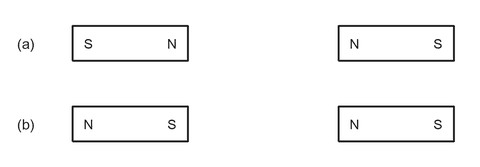
In Fig. 10.12, draw at least two magnetic field lines between the two magnets.
 Solve with AI
Written solution
Solution:
Concept: A magnetic field line is a continuous curve such that the tangent at any point gives the direction of the magnetic field there (the direction in which the N pole of a small compass needle points). Outside a magnet the lines run from N to S, inside it from S to N, so each line is a closed curve.
Like poles repel each other (N and N, or S and S) and unlike poles attract each other (N and S).
Step 1 — Part (a): north poles facing each other.
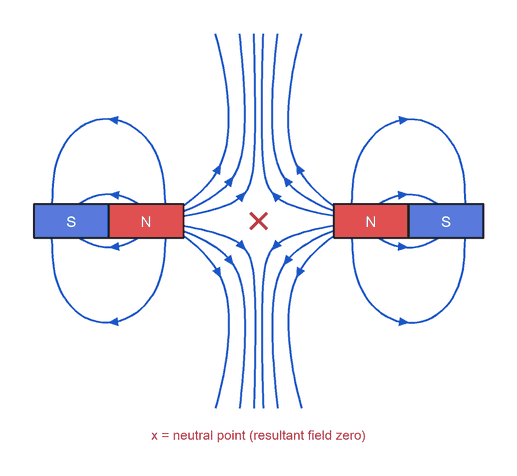
The two N poles are like poles. Lines leave both N poles, bend away from each other and turn up and down, going back round to their own S poles. No line goes from one magnet to the other. Midway between the N poles the two fields are equal and opposite, so there is a neutral point (×).
Step 2 — Part (b): S pole of one magnet facing the N pole of the other.
These are unlike poles. The lines go across the gap from the N pole of the right magnet to the S pole of the left magnet. Near the middle they are nearly straight; towards the edges they bulge outwards. The magnets attract each other.
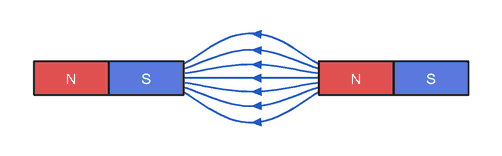
Watch out: Every line needs an arrow pointing away from N and towards S, and no two lines may cross.
Therefore, in (a) the lines from the two N poles turn away from each other with a neutral point midway, and in (b) the lines run straight across the gap from N to S.
- 352 marks
Question 35
State two evidences of the existence of earth's magnetic field.
Solve with AIWritten solution
Solution:
Concept: The earth behaves like a huge magnet. Its magnetic south pole lies near the geographic north and its magnetic north pole near the geographic south. So a freely suspended magnet rests along the magnetic meridian, very nearly the geographic north-south line, with its N pole towards the geographic north.
Step 1 — Evidence 1: a suspended magnet.
A freely suspended magnetic needle always comes to rest in the geographic north-south direction. This can happen only if a magnet inside the earth pulls its poles: a magnetic S pole near the geographic north and a magnetic N pole near the geographic south.
Step 2 — Evidence 2: a buried iron rod.
An iron rod buried in the ground along the north-south direction becomes a magnet after some days. This is possible only if the earth itself behaves like a magnet and magnetises the rod by induction.
Step 3 — Other evidence.
Neutral points appear when the field lines of a magnet are plotted, and a needle free to turn in a vertical plane rests at different angles to the horizontal at different places.
Therefore, two evidences are: a freely suspended magnet always rests north-south, and an iron rod buried north-south becomes a magnet.
- 363 marks
Question 36
Sketch four magnetic field lines as obtained in a limited space on a horizontal plane in the earth's magnetic field alone.
Solve with AIWritten solution
Solution:
Concept: A uniform magnetic field has the same strength and direction everywhere, so its field lines are parallel, equidistant straight lines (the earth's field in a limited space, such as a table top). A non-uniform field changes from place to place, so its lines are curved and unequally spaced.
In a limited space the earth's magnetic field is uniform. Its horizontal part points from the geographic south to the geographic north, the way the N pole of a compass needle points.
Step 1 — Decide the shape.
Over a limited space the earth's field is uniform, so the lines are parallel, equidistant straight lines.
Step 2 — Decide the direction.
The lines point from the geographic south to the geographic north, the way the N pole of a compass needle points.
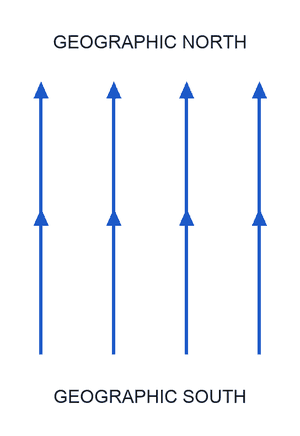
Watch out: Keep the four lines equally spaced and straight; curved or unequal lines would show a non-uniform field.
Therefore, the sketch shows four parallel, equidistant straight lines with arrows pointing from south to north.
- 372 marks
Question 37
What conclusion is drawn regarding the magnetic field at a point if a compass needle at that point rests in any direction ? Give reason for your answer.
Solve with AIWritten solution
Solution:
Concept: A neutral point is a point where the field of a magnet is equal in magnitude and opposite in direction to the earth's horizontal field, so the resultant field is zero. A compass needle placed there rests in any direction, and in a field-line plot it is marked with a cross (×).
Step 1 — See what a needle normally does.
A compass needle normally turns until it lies along the magnetic field at its position, and returns there when disturbed.
Step 2 — Interpret 'rests in any direction'.
If the needle stays in whatever direction it is set, no field acts on it. So the resultant field there is zero.
Step 3 — Explain why.
The earth's field cannot vanish by itself, so at that point it has been cancelled by an equal and opposite field from some magnet or magnetised material nearby. Such a point is a neutral point.
Therefore, the resultant magnetic field at that point is zero: it is a neutral point, where the earth's field is cancelled by an equal and opposite field.
- 383 marks
Question 38
What is a neutral point ? How is the position of a neutral point located with the use of a compass needle ?
Solve with AIWritten solution
Solution:
Concept: A neutral point is a point where the field of a magnet is equal in magnitude and opposite in direction to the earth's horizontal field, so the resultant field is zero. A compass needle placed there rests in any direction, and in a field-line plot it is marked with a cross (×).
Where the neutral points lie depends on how the magnet is placed. The magnet's field is opposite to the earth's (south-to-north) field on the east-west line through its centre when its N pole points north, and on its axis beyond the two ends when its N pole points south.
Step 1 — Define a neutral point.
A neutral point is a point where the field of a magnet and the earth's horizontal field are equal in magnitude but opposite in direction, so the net field is zero.
Step 2 — Set up the magnet.
Fix a sheet of paper on a drawing board and place the magnet on it with its axis along the magnetic meridian (north-south line).
Step 3 — Search with the compass.
Move a small compass slowly over the region where a neutral point is expected: east and west of the magnet if its N pole points north, or beyond its ends if its N pole points south.
Step 4 — Recognise the point.
At most places the needle points in a definite direction. At the neutral point it rests in any direction: if the compass box is turned gently, the needle does not swing back to one direction. Mark that point with a cross (×).
Therefore, a neutral point is where the resultant magnetic field is zero, and it is located as the spot where a compass needle rests in any direction.
- 392 marks
Question 39
State the positions of neutral points when a magnet is placed with its axis in the magnetic meridian and with its north pole (i) pointing towards the geographic north, (ii) pointing towards the geographic south.
Solve with AIWritten solution
Solution:
Concept: A neutral point is a point where the field of a magnet is equal in magnitude and opposite in direction to the earth's horizontal field, so the resultant field is zero. A compass needle placed there rests in any direction, and in a field-line plot it is marked with a cross (×).
In a limited space the earth's magnetic field is uniform. Its horizontal part points from the geographic south to the geographic north, the way the N pole of a compass needle points.
Step 1 — Case (i): N pole towards geographic north.
On the line through the centre of the magnet at right angles to its axis, the magnet's field points from N to S outside it, that is, towards the south. There it is opposite to the earth's field (south to north). So the two neutral points lie in the east-west direction, one on each side of the magnet, at equal distances from its centre.
Step 2 — Case (ii): N pole towards geographic south.
On the axis beyond each end, the magnet's field points away from its N pole and towards its S pole, which is towards the south on both sides. Again it is opposite to the earth's field, so the two neutral points lie on the axis of the magnet (north-south line), one beyond each end, at equal distances from its centre.

Watch out: The earth's horizontal field always points from south to north; the neutral points are where the magnet's field points from north to south.
Therefore, (i) the neutral points are east and west of the magnet, on the line through its centre; (ii) they are on the axis, beyond the north and south ends.
- 405 marks
Question 40
(a) Draw the pattern of magnetic field lines near a bar magnet placed with its north pole pointing towards the geographic north. Indicate the position of neutral points by marking ×.
(b) State whether the magnetic field lines in part (a) represent a uniform magnetic field or non-uniform magnetic field ?
Solve with AIWritten solution
Solution:
Concept: A neutral point is a point where the field of a magnet is equal in magnitude and opposite in direction to the earth's horizontal field, so the resultant field is zero. A compass needle placed there rests in any direction, and in a field-line plot it is marked with a cross (×).
Where the neutral points lie depends on how the magnet is placed. The magnet's field is opposite to the earth's (south-to-north) field on the east-west line through its centre when its N pole points north, and on its axis beyond the two ends when its N pole points south.
Step 1 — Part (a): the pattern.
The pattern is the combined effect of the magnet's field and the earth's field (south to north):
- close to the magnet the lines are curved, from the N pole round to the S pole, because the magnet's field is strong there;
- far from the magnet the lines become nearly parallel straight lines from south to north, because the earth's field is the stronger one there;
- on the east-west line through the centre, the magnet's field points south and the earth's field points north. Where they are equal they cancel, giving two neutral points (×), one east and one west of the magnet.
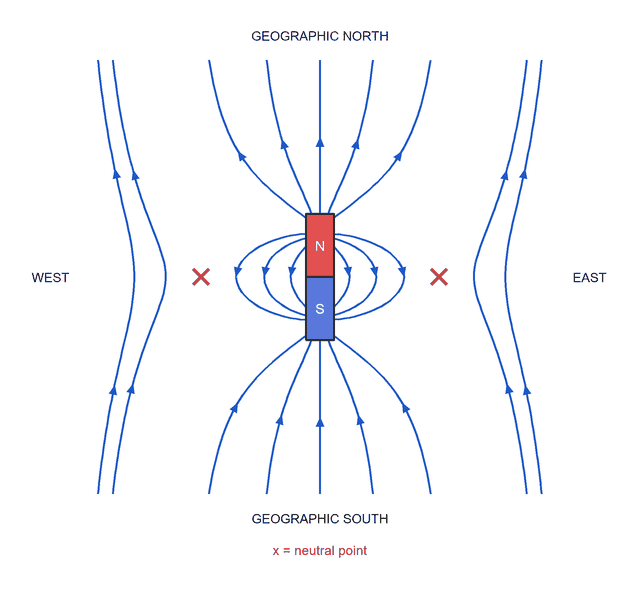
Step 2 — Part (b): uniform or not.
The lines are curved and unequally spaced (crowded near the poles, spread out farther away), so the field is non-uniform.
Watch out: Do not put the crosses on the axis; with the N pole pointing north they lie east and west of the magnet.
Therefore, (a) the neutral points (×) lie east and west of the magnet, and (b) the field lines represent a non-uniform magnetic field.
- 415 marks
Question 41
Fig. 10.13 shows a bar magnet placed on the table top with its north pole pointing towards south. The arrow shows the north-south direction. There are no other magnets or magnetic material nearby.
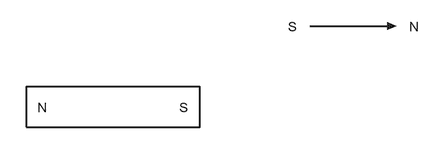
(a) Insert two magnetic field lines on either side of the magnet using arrow head to show the direction of each field line.
(b) Indicate by crosses, the likely positions of the neutral points.
(c) What is the magnitude of the magnetic field at each neutral point? Give a reason for your answer.
Solve with AIWritten solution
Solution:
Concept: A neutral point is a point where the field of a magnet is equal in magnitude and opposite in direction to the earth's horizontal field, so the resultant field is zero. A compass needle placed there rests in any direction, and in a field-line plot it is marked with a cross (×).
Where the neutral points lie depends on how the magnet is placed. The magnet's field is opposite to the earth's (south-to-north) field on the east-west line through its centre when its N pole points north, and on its axis beyond the two ends when its N pole points south.
Step 1 — Read the figure.
The arrow points from S to N, so north is to the right. The magnet's N pole is at the left end, pointing south, and the earth's horizontal field points to the right (south to north).
Step 2 — Part (a): the field lines.
Close to the magnet, the lines leave its N pole (left end), curve round above and below it and enter its S pole (right end); the arrows point from N to S. Farther away the lines are the earth's field lines, nearly straight and pointing from left to right (south to north).

Step 3 — Part (b): the neutral points.
On the axis beyond either end, the magnet's field points to the left (towards the south), opposite to the earth's field. Where the two are equal they cancel, so the neutral points (×) lie on the axis of the magnet, one beyond each end, at equal distances from its centre.
Step 4 — Part (c): the field at a neutral point.
At each neutral point the magnet's field is equal in magnitude and opposite in direction to the earth's horizontal field, so they cancel and the resultant field is zero. A compass needle placed there rests in any direction.
Watch out: With the N pole pointing south the neutral points are on the axis, not to the east and west.
Therefore, (b) the neutral points lie on the axis beyond the two ends, and (c) the magnetic field at each neutral point is zero, because there the magnet's field cancels the earth's horizontal field.
- 424 marks
Question 42
You are provided with two similar bars, one is a magnet and the other is a soft iron bar. How will you distinguish between them without the use of any other magnet or bar?
[Hint : A magnet when suspended freely will rest only in north-south direction, but soft iron bar will rest in any direction]
Solve with AIWritten solution
Solution:
Concept: Only a magnet has poles; a soft iron bar has none until a magnet induces them. The ends of a magnet are its strongest parts, and its middle has almost no magnetic effect.
Step 1 — Method 1: hang each bar freely.
Hang each bar in turn by a silk thread tied at its middle, so that it can turn freely in a horizontal plane.
- The bar that always comes to rest in the geographic north-south direction, and returns to it when disturbed, is the magnet.
- The bar that comes to rest in any direction is the soft iron bar, because it has no poles.
Step 2 — Method 2: use the bars on each other.
Lay one bar (A) on the table and touch one end of the other bar (B) to the middle of A.
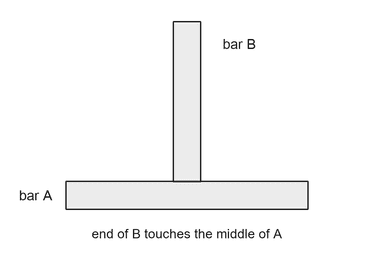
- If B is strongly attracted, B is the magnet: the end of a magnet attracts soft iron anywhere.
- If there is little or no attraction, B is the soft iron bar and A is the magnet, because the middle of a magnet has almost no magnetic strength.
Watch out: Simple attraction between the two bars proves nothing, because a magnet and soft iron always attract each other; use the middle of one bar.
Therefore, the bar that always rests north-south when suspended (or whose end attracts the middle of the other bar) is the magnet; the other is the soft iron bar.
- 435 marks
Question 43
A small magnet is suspended by a silk thread from a rigid support such that the magnet can freely swing. How will it rest ? Draw a diagram to show it.
Solve with AIWritten solution
Solution:
Concept: The earth behaves like a huge magnet. Its magnetic south pole lies near the geographic north and its magnetic north pole near the geographic south. So a freely suspended magnet rests along the magnetic meridian, very nearly the geographic north-south line, with its N pole towards the geographic north.
The earth's field lines are vertical (normal to the surface) at the magnetic poles, horizontal (parallel to the surface) at the magnetic equator and inclined in between. A magnet free to turn in a vertical plane sets itself along these lines.
Step 1 — Find the direction it points.
The magnet turns until it lies along the earth's magnetic field, so it rests in the geographic north-south direction with its N pole towards the geographic north. Its N pole is attracted by the earth's magnetic south pole, which lies near the geographic north.
Step 2 — Find its tilt.
Since it can also swing in a vertical plane, it does not stay level. At most places the earth's field lines are inclined to the horizontal, so the magnet rests inclined to the horizontal. In most of India (northern hemisphere) its N pole dips a little below the horizontal.

Therefore, the magnet rests in the geographic north-south direction with its north pole towards the north, inclined slightly to the horizontal.
- 444 marks
Question 44
Explain what do you understand by magnetic induction. What role does it play in attraction of a piece of iron by a magnet ?
Solve with AIWritten solution
Solution:
Concept: Magnetic induction: A piece of magnetic material (soft iron, steel) placed near or in contact with a magnet itself becomes a magnet. The end nearer the inducing pole gets the opposite polarity and the farther end gets the similar polarity. This induced magnetism is temporary: it lasts only while the magnet is near.
A magnet attracts a piece of iron only after it has first made the iron a magnet by induction, with an unlike pole on the near end. This is summed up as induction precedes attraction.
Step 1 — Define magnetic induction.
Magnetic induction is the process in which a piece of magnetic material acquires magnetic properties temporarily because a magnet is near it.
Step 2 — Give an example.
Place an unmagnetised iron bar AB near the N pole of a magnet. The near end A becomes S (opposite polarity) and the far end B becomes N (similar polarity). The bar holds iron filings while the magnet is near and drops them when it is removed.
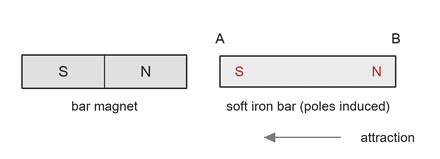
Step 3 — Its role in attraction.
When a piece of iron is brought near a pole of a magnet, the magnet first magnetises it by induction, with the opposite pole on the near end. Unlike poles attract, and the unlike pole is nearer than the like pole, so the attraction wins and the iron is pulled towards the magnet.
Step 4 — Sum up.
So induction is the cause of the attraction: the iron is first made a magnet and only then attracted.
Therefore, magnetic induction is the temporary magnetisation of a magnetic material near a magnet, and it causes the attraction: induction precedes attraction.
- 454 marks
Question 45
Explain the mechanism of attraction of iron nails by a magnet when brought near them.
Solve with AIWritten solution
Solution:
Concept: Magnetic induction: A piece of magnetic material (soft iron, steel) placed near or in contact with a magnet itself becomes a magnet. The end nearer the inducing pole gets the opposite polarity and the farther end gets the similar polarity. This induced magnetism is temporary: it lasts only while the magnet is near.
A magnet attracts a piece of iron only after it has first made the iron a magnet by induction, with an unlike pole on the near end. This is summed up as induction precedes attraction.
Step 1 — Induction.
When a pole of the magnet, say the N pole, is brought near an iron nail, the nail becomes a magnet by induction. Its end nearer the magnet becomes an S pole and its far end an N pole.
Step 2 — Attraction.
The N pole of the magnet and the near S end of the nail are unlike poles, so they attract. The repulsion between the N pole and the far N end is weaker because that end is farther away. So the nail is pulled to the magnet and clings to it.
Step 3 — A chain of nails.
The clinging nail is now a magnet itself. It magnetises the next nail by induction and attracts it, and so on, so a chain of nails hangs from the pole. The chain stops growing when the magnet can no longer hold the weight of the nails below the first one.
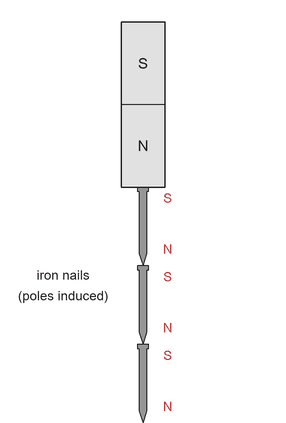
Step 4 — Removing the magnet.
If the magnet is removed, the nails lose their induced magnetism and fall apart.
Therefore, the magnet first magnetises each nail by induction (opposite pole nearest) and then attracts it, so induction precedes attraction.
- 465 marks
Question 46
A small iron bar is kept near the north pole of a bar magnet. How does the iron bar acquire magnetism ? Draw a diagram to show the polarity on the iron bar. What will happen if the magnet is removed ?
Solve with AIWritten solution
Solution:
Concept: Magnetic induction: A piece of magnetic material (soft iron, steel) placed near or in contact with a magnet itself becomes a magnet. The end nearer the inducing pole gets the opposite polarity and the farther end gets the similar polarity. This induced magnetism is temporary: it lasts only while the magnet is near.
Step 1 — How the bar becomes a magnet.
The iron bar acquires magnetism by magnetic induction. The N pole of the magnet induces an opposite (S) pole on the near end of the bar and a similar (N) pole on its far end. The bar now behaves as a magnet and is attracted towards the magnet.
Step 2 — Diagram.
The diagram shows the poles induced on the bar.
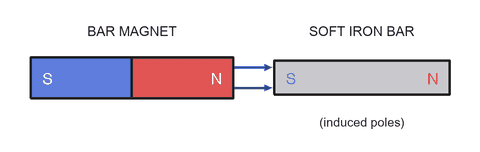
Step 3 — If the magnet is removed.
The bar loses its magnetism almost completely, because induced magnetism is temporary; any iron filings clinging to it fall off. (Soft iron loses nearly all of it; a steel bar would keep a little.)
Therefore, the bar is magnetised by induction with S on the end near the magnet's N pole and N on the far end, and it loses this magnetism when the magnet is removed.
- 474 marks
Question 47
Explain the method of plotting magnetic field lines by using a small compass needle.
Solve with AIWritten solution
Solution:
Concept: A compass needle always sets itself along the field line through its position, so a chain of short needle positions traces out a field line.
Step 1 — Set up.
Fix a sheet of white paper on a drawing board with brass pins (brass is non-magnetic, so it does not disturb the field). Find the north-south line with the compass and draw it.
Step 2 — Place the magnet.
Place the bar magnet on this line (say with its N pole towards the north) and draw its outline with a sharp pencil.
Step 3 — Mark the first two dots.
Place the compass close to the N pole of the magnet. Looking from above, mark two dots exactly at the two ends of the needle.
Step 4 — Step the compass along.
Move the compass so that one end of the needle is over the second dot, and mark a new dot at the other end. Repeat this until the S pole of the magnet (or the edge of the paper) is reached.
Step 5 — Draw the line.
Join the dots with a smooth curve. This is one field line. Draw an arrow on it in the direction from the needle's S end to its N end.
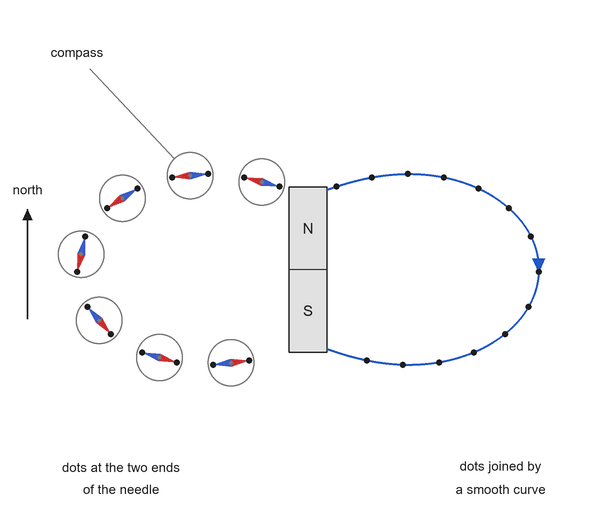
Step 6 — Repeat.
Start from different points near the N pole to draw several field lines. The pattern shows the combined field of the magnet and the earth; points where the needle rests in any direction are the neutral points, marked with crosses.
Watch out: Use brass (not iron) pins, and keep other magnets and iron objects away, or the plot will be wrong.
Therefore, the field lines are plotted by marking the ends of a small compass needle step by step from the N pole and joining the dots with a smooth curve.
- 481 mark
Question 48
An electromagnet is a temporary strong magnet made from :
Solve with AIAnswer
(A) steel
(B) aluminium
(C) copper
- Correct
(D) soft iron
Answer: (D) soft iron
Concept: An electromagnet is a temporary strong magnet made by passing a current through a coil of insulated copper wire wound on a soft iron core. Soft iron is strongly magnetised while the current flows and loses almost all its magnetism as soon as the current is switched off.
Soft iron is magnetised easily and strongly (high permeability) and loses its magnetism almost completely when the magnetising current stops (low retentivity). Steel is harder to magnetise but keeps its magnetism, so it is used for permanent magnets.
Step 1 — List what the core must do.
The core must become a strong magnet as soon as the current flows and lose its magnetism as soon as the current stops, so that the electromagnet is a temporary magnet.
Step 2 — Choose the material.
Soft iron does both: it is magnetised strongly and easily and keeps almost no magnetism when the current is switched off.
Why the other options are wrong:
- (A) steel: Steel keeps its magnetism after the current stops, so it is used for permanent magnets, not electromagnets.
- (B) aluminium: Aluminium is non-magnetic, so it cannot be made into a strong magnet.
- (C) copper: Copper is non-magnetic; it is used for the coil wire, not the core.
Therefore, an electromagnet is made from soft iron, option (D).
- 491 mark
Question 49
Look at the figure and answer the following questions:
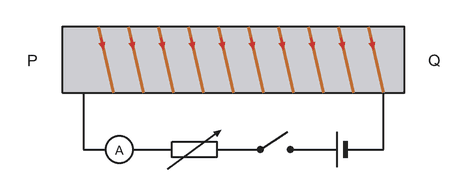
(i) The end P becomes :
Solve with AIAnswer
- Correct
(A) south pole
(B) north pole
(C) cannot say
(D) none of the above
Answer: (A) south pole
Concept: Clock rule: Look at one end of the coil from outside. If the current there flows clockwise, that end becomes a south (S) pole; if it flows anticlockwise, that end becomes a north (N) pole. The two ends of a coil always have opposite poles.
Step 1 — Read the current from the figure.
In the figure, the arrows on the front of every turn point downward, so the current flows down the front face of the coil.
Step 2 — Look at the end P.
Look at the end P from outside (from the left). The front of the coil is then on your right, and the current there flows downward: the current goes round clockwise.
Step 3 — Apply the clock rule.
An end at which the current is clockwise becomes a south pole.
Watch out: Look at each end from OUTSIDE the coil; viewed from the other side the sense of rotation is reversed.
Why the other options are wrong:
- (B) north pole: The north pole forms where the current looks anticlockwise, which is the end Q.
- (C) cannot say: The arrows give the direction of the current, so the polarity can be found.
- (D) none of the above: Option (A) is correct, so 'none of the above' is wrong.
Therefore, the end P becomes a south pole, option (A).
- 501 mark
Question 50
Look at the figure and answer the following questions:
(ii) The end Q becomes :
Solve with AIAnswer
(A) south pole
- Correct
(B) north pole
(C) cannot say
(D) none of the above
Answer: (B) north pole
Concept: Clock rule: Look at one end of the coil from outside. If the current there flows clockwise, that end becomes a south (S) pole; if it flows anticlockwise, that end becomes a north (N) pole. The two ends of a coil always have opposite poles.
Step 1 — Read the current from the figure.
In the figure, the arrows on the front of every turn point downward, so the current flows down the front face of the coil.
Step 2 — Look at the end Q.
Look at the end Q from outside (from the right). The front of the coil is now on your left, and the current there flows downward: the current goes round anticlockwise.
Step 3 — Apply the clock rule.
An end at which the current is anticlockwise becomes a north pole. This agrees with P being a south pole, since the two ends always have opposite poles.
Why the other options are wrong:
- (A) south pole: The south pole is at P, where the current looks clockwise.
- (C) cannot say: The arrows give the direction of the current, so the polarity can be found.
- (D) none of the above: Option (B) is correct, so 'none of the above' is wrong.
Therefore, the end Q becomes a north pole, option (B).
- 511 mark
Question 51
Look at the figure and answer the following questions:
(iii) The given bar shows magnetic properties only when. ........ through the solenoid and it loses the magnetic properties as soon as the ................ .
Solve with AIAnswer
(A) current is switched off, current is switched on
- Correct
(B) current is switched on, current is switched off
(C) current is switched on, current is switched on
(D) both (a) and (b)
Answer: (B) current is switched on, current is switched off
Concept: An electromagnet is a temporary strong magnet made by passing a current through a coil of insulated copper wire wound on a soft iron core. Soft iron is strongly magnetised while the current flows and loses almost all its magnetism as soon as the current is switched off.
Soft iron is magnetised easily and strongly (high permeability) and loses its magnetism almost completely when the magnetising current stops (low retentivity). Steel is harder to magnetise but keeps its magnetism, so it is used for permanent magnets.
Step 1 — When the bar is magnetic.
The soft iron bar is magnetised only while the current is switched on and flows through the solenoid.
Step 2 — When it stops.
Soft iron keeps almost no magnetism, so it loses its magnetic properties as soon as the current is switched off. This is why an electromagnet is a temporary magnet.
Why the other options are wrong:
- (A) current is switched off, current is switched on: This is the reverse: with no current there is no magnetism.
- (C) current is switched on, current is switched on: The bar cannot lose its magnetism when the current is switched on; it gains it then.
- (D) both (a) and (b): Options (A) and (B) contradict each other, so they cannot both be right.
Therefore, the bar is magnetic only when the current is switched on and loses it when the current is switched off, option (B).
- 521 mark
Question 52
The magnetic field of an electromagnet can be increased by ......... in the solenoid and by ....... through the solenoid.
Solve with AIAnswer
(A) increasing the number of turns, decreasing the current.
(B) decreasing the number of turns, increasing the current.
(C) decreasing the number of turns, decreasing the current.
- Correct
(D) increasing the number of turns, increasing the current.
Answer: (D) increasing the number of turns, increasing the current
Concept: The strength of an electromagnet increases with the number of turns of the coil and with the current in it. Reversing the current reverses the poles but does not change the strength.
Step 1 — The first blank.
Each turn adds its own field, so more turns give a stronger field.
Step 2 — The second blank.
The field of every turn grows with the current, so more current gives a stronger field.
Why the other options are wrong:
- (A) increasing the number of turns, decreasing the current: Decreasing the current weakens the electromagnet.
- (B) decreasing the number of turns, increasing the current: Decreasing the number of turns weakens the electromagnet.
- (C) decreasing the number of turns, decreasing the current: Decreasing both weakens the electromagnet even more.
Therefore, the field is increased by increasing the number of turns and increasing the current, option (D).
- 531 mark
Question 53
Which of the following statements are correct ?
(i) An electromagnet produces a permanent magnetic field.
(ii) An electromagnet can produce a strong magnetic field.
(iii) The polarity of electromagnet can be reversed by reversing the direction of current in the solenoid.
Solve with AIAnswer
(A) all of the above
(B) (i) and (ii)
- Correct
(C) (ii) and (iii)
(D) (i) and (iii)
Answer: (C) statements ii and iii
Concept: An electromagnet is a temporary strong magnet made by passing a current through a coil of insulated copper wire wound on a soft iron core. Soft iron is strongly magnetised while the current flows and loses almost all its magnetism as soon as the current is switched off.
The strength of an electromagnet increases with the number of turns of the coil and with the current in it. Reversing the current reverses the poles but does not change the strength.
Step 1 — Test statement i.
An electromagnet's field lasts only while current flows in its coil, so its field is temporary, not permanent. Statement i is wrong.
Step 2 — Test statement ii.
With many turns and a large current, an electromagnet can produce a very strong field. Statement ii is correct.
Step 3 — Test statement iii.
Reversing the current reverses the sense of the current at each end, so the poles interchange. Statement iii is correct.
Why the other options are wrong:
- (A) all three statements: Statement i is wrong, so 'all of the above' is wrong.
- (B) statements i and ii: This pair includes the wrong statement i.
- (D) statements i and iii: This pair includes the wrong statement i.
Therefore, statements ii and iii are correct, option (C).
- 541 mark
Question 54
The strength of an electromagnet can be increased by
Solve with AIAnswer
(A) reversing the directions of current
(B) using alternating current of high frequency
- Correct
(C) increasing the current in the coil
(D) decreasing the number of turns of coil.
Answer: (C) increasing the current in the coil
Concept: The strength of an electromagnet increases with the number of turns of the coil and with the current in it. Reversing the current reverses the poles but does not change the strength.
Step 1 — Recall the factors.
The strength of an electromagnet depends on the current in its coil and on the number of turns.
Step 2 — Pick the option.
Only option (C), increasing the current, makes the electromagnet stronger.
Why the other options are wrong:
- (A) reversing the directions of current: Reversing the current only interchanges the poles; the strength stays the same.
- (B) using alternating current of high frequency: Alternating current keeps reversing the poles; it does not make the magnet stronger (at a high frequency the coil even passes less current).
- (D) decreasing the number of turns of coil: Fewer turns make the electromagnet weaker.
Therefore, the strength is increased by increasing the current in the coil, option (C).
- 551 mark
Question 55
A soft iron piece is in the form of a closed ring (no free ends). A wire is wound over it to make it an electromagnet. What happens when current is passed in the wire ?
Solve with AIAnswer
(A) It does not get magnetised.
(B) It gets temporarily magnetised.
- Correct
(C) It becomes magnetised.
(D) It can be magnetised if broken into two parts.
Answer: (C) It becomes magnetised
Concept: An electromagnet is a temporary strong magnet made by passing a current through a coil of insulated copper wire wound on a soft iron core. Soft iron is strongly magnetised while the current flows and loses almost all its magnetism as soon as the current is switched off.
Step 1 — See what the current does.
Current in the wire wound on the ring magnetises the soft iron. The field runs round and round inside the ring, along the closed loop of iron.
Step 2 — Why no poles appear.
Poles form only where the field leaves or enters the iron. A closed ring has no free ends, so no N or S pole appears, and the ring does not attract filings from outside.
Step 3 — Conclude.
Even though no poles are seen, the iron is magnetised.
Watch out: No visible poles does not mean no magnetism.
Note: option (B) is also a true statement, because soft iron keeps its magnetism only while the current flows. The printed key (C) is kept.
Why the other options are wrong:
- (A) It does not get magnetised: The ring is magnetised even though no poles appear on it.
- (B) It gets temporarily magnetised: This is also true, since soft iron stays magnetised only while the current flows; the key, 'It becomes magnetised', makes the point that a closed ring is magnetised at all.
- (D) It can be magnetised if broken into two parts: Breaking is not needed to magnetise the ring; breaking it would only make poles appear at the broken ends.
Therefore, the soft iron ring becomes magnetised, option (C).
- 561 mark
Question 56
Which of the following devices does not use an electromagnet ?
Solve with AIAnswer
- Correct
(A) Magnetic compass
(B) Electric fan
(C) Relay
(D) Microphone
Answer: (A) Magnetic compass
Concept: An electromagnet is a temporary strong magnet made by passing a current through a coil of insulated copper wire wound on a soft iron core. Soft iron is strongly magnetised while the current flows and loses almost all its magnetism as soon as the current is switched off.
Step 1 — Look inside each device.
A device uses an electromagnet if it has a current-carrying coil on a soft iron core.
Step 2 — Find the one without.
A magnetic compass is just a small permanent magnet (the needle) on a pivot. It has no coil and no current, so it does not use an electromagnet.
Why the other options are wrong:
- (B) Electric fan: An electric fan is driven by an electric motor, whose current-carrying coils on iron cores are electromagnets.
- (C) Relay: A relay is a switch worked by an electromagnet.
- (D) Microphone: The book counts the microphone among devices that use electromagnetism (a common moving-coil microphone has a coil in a magnet's field); in any case a compass, with no coil at all, is the clear answer.
Therefore, the magnetic compass does not use an electromagnet, option (A).
- 571 mark
Question 57
The magnetic polarity at the two ends of a horse-shoe magnet depends on :
Solve with AIAnswer
(A) the strength of current in the coil
(B) the number of turns in the coil
(C) the material on which the coil is wound
- Correct
(D) the direction of current at the ends of the magnet.
Answer: (D) the direction of current at the ends of the magnet
Concept: Clock rule: Look at one end of the coil from outside. If the current there flows clockwise, that end becomes a south (S) pole; if it flows anticlockwise, that end becomes a north (N) pole. The two ends of a coil always have opposite poles.
Step 1 — Apply the clock rule at each end.
At each free end of the horse-shoe magnet, the end where the current looks clockwise becomes S and the end where it looks anticlockwise becomes N.
Step 2 — See what decides it.
So the polarity of each end depends only on the direction of the current round that end.
Why the other options are wrong:
- (A) the strength of current in the coil: The current's size changes how strong the magnet is, not which end is N.
- (B) the number of turns in the coil: The number of turns changes the strength, not the polarity.
- (C) the material on which the coil is wound: The core material decides whether the magnet is temporary or permanent, not which end is N.
Therefore, the polarity depends on the direction of the current at the ends, option (D).
- 581 mark
Question 58
Is an electromagnet used as a permanent magnet ?
Solve with AIWritten solution
Solution:
Concept: An electromagnet is a temporary strong magnet made by passing a current through a coil of insulated copper wire wound on a soft iron core. Soft iron is strongly magnetised while the current flows and loses almost all its magnetism as soon as the current is switched off.
Step 1 — Ask how long it stays magnetic.
An electromagnet is magnetised only while current flows in its coil; its soft iron core loses the magnetism when the current is switched off.
Step 2 — Conclude.
So it is used as a temporary magnet, not as a permanent one.
Therefore, no, an electromagnet is not used as a permanent magnet; it is a temporary magnet.
- 591 mark
Question 59
Name the material used for preparing an electromagnet.
Solve with AIWritten solution
Solution:
Concept: Soft iron is magnetised easily and strongly (high permeability) and loses its magnetism almost completely when the magnetising current stops (low retentivity). Steel is harder to magnetise but keeps its magnetism, so it is used for permanent magnets.
Step 1 — Name the core.
The core must magnetise strongly at once and lose its magnetism at once, so it is made of soft iron.
Step 2 — Name the winding.
The coil wound on it is of insulated copper wire.
Therefore, an electromagnet is made of soft iron (with a coil of insulated copper wire).
- 602 marks
Question 60
A coil of insulated copper wire is wound around a piece of soft iron and current is passed in the coil from a battery. What name is given to the device so obtained ? Give one use of the device mentioned by you.
Solve with AIWritten solution
Solution:
Concept: An electromagnet is a temporary strong magnet made by passing a current through a coil of insulated copper wire wound on a soft iron core. Soft iron is strongly magnetised while the current flows and loses almost all its magnetism as soon as the current is switched off.
Step 1 — Name the device.
Soft iron with a current-carrying coil round it becomes a strong temporary magnet: an electromagnet.
Step 2 — Give a use.
It is used in an electric bell (also in relays and in cranes that lift iron scrap).
Therefore, the device is an electromagnet; one use is in an electric bell.
- 611 mark
Question 61
Name one device that uses an electromagnet.
Solve with AIWritten solution
Solution:
Concept: An electromagnet is a temporary strong magnet made by passing a current through a coil of insulated copper wire wound on a soft iron core. Soft iron is strongly magnetised while the current flows and loses almost all its magnetism as soon as the current is switched off.
Step 1 — Think of a device with a coil on soft iron.
An electric bell has a coil wound on a soft iron core, which pulls the armature when current flows.
Step 2 — Other examples.
Others are an electric relay, an electric motor and a crane for lifting iron scrap.
Therefore, an electric bell is one device that uses an electromagnet.
- 622 marks
Question 62
Why is soft iron used as the core of the electromagnet in an electric bell ?
Solve with AIWritten solution
Solution:
Concept: Soft iron is magnetised easily and strongly (high permeability) and loses its magnetism almost completely when the magnetising current stops (low retentivity). Steel is harder to magnetise but keeps its magnetism, so it is used for permanent magnets.
In an electric bell, an electromagnet pulls a soft iron armature whose hammer strikes the gong. The movement breaks the circuit at the contact screw, the electromagnet lets go, a spring strip pulls the armature back, the circuit is made again, and the cycle repeats many times a second.
Step 1 — Quick to magnetise.
Soft iron is strongly magnetised as soon as current flows in the coil, so it pulls the armature at once.
Step 2 — Quick to demagnetise.
It loses its magnetism almost at once when the circuit breaks at the contact screw, so the spring pulls the armature back at once.
Step 3 — Why this matters.
This quick make-and-break lets the hammer strike the gong again and again. A steel core would stay magnetised, hold the armature, and the bell would not keep ringing.
Therefore, soft iron is used because it magnetises strongly at once and loses its magnetism at once, so the armature moves to and fro.
- 632 marks
Question 63
What is an electromagnet ?
Solve with AIWritten solution
Solution:
Concept: An electromagnet is a temporary strong magnet made by passing a current through a coil of insulated copper wire wound on a soft iron core. Soft iron is strongly magnetised while the current flows and loses almost all its magnetism as soon as the current is switched off.
Step 1 — Define it.
An electromagnet is a temporary strong magnet made from a piece of soft iron by passing current through a coil wound around it. It is an artificial magnet.
Step 2 — Its features.
It is a magnet only while current flows. Its strength changes with the current (and the number of turns), and its poles reverse when the current reverses. Electromagnets are made I-shaped (bar) or U-shaped (horse-shoe).
Therefore, an electromagnet is a soft iron core made a temporary strong magnet by a current in a coil wound round it.
- 643 marks
Question 64
Fig. 10.18 shows alongside a coil wound around a soft iron bar XY.

(a) State the polarity at the ends X and Y as the switch is pressed.
(b) Suggest one way of increasing the strength of the electromagnet so formed.
Solve with AIWritten solution
Solution:
Concept: Clock rule: Look at one end of the coil from outside. If the current there flows clockwise, that end becomes a south (S) pole; if it flows anticlockwise, that end becomes a north (N) pole. The two ends of a coil always have opposite poles.
The strength of an electromagnet increases with the number of turns of the coil and with the current in it. Reversing the current reverses the poles but does not change the strength.
Step 1 — Trace the current.
The long plate (+) of the battery is on the left. When the switch is pressed, the current flows from the + plate through the switch into the coil at the end X, along the coil, and leaves at the end Y through the rheostat back to the battery.
Step 2 — Find its sense on the front.
With the winding shown, this current flows down the front face of every turn.
Step 3 — Part (a): apply the clock rule.
Seen from the end X (from the left), the front is on your right and the current there flows down, so it is clockwise: X becomes a south pole. Seen from Y (from the right), it is anticlockwise: Y becomes a north pole.
Step 4 — Part (b): make it stronger.
Increase the current in the coil, for example by reducing the resistance of the rheostat. Increasing the number of turns of the coil also works.
Watch out: If the coil were wound the other way, or the battery reversed, the poles would interchange.
Note: in the printed figure the sense of the winding is not clear; the figure here is drawn with the winding that gives the printed answer (X south, Y north).
Therefore, (a) X becomes a south pole and Y a north pole; (b) the electromagnet can be made stronger by increasing the current (or the number of turns).
- 652 marks
Question 65
State two ways through which the strength of an electromagnet can be increased.
Solve with AIWritten solution
Solution:
Concept: The strength of an electromagnet increases with the number of turns of the coil and with the current in it. Reversing the current reverses the poles but does not change the strength.
Step 1 — Way 1.
Increase the number of turns of the winding in the solenoid: each turn adds its own field.
Step 2 — Way 2.
Increase the current through the solenoid: the field of every turn grows with the current.
Watch out: Reversing the current does not make it stronger; it only interchanges the poles.
Therefore, the strength is increased by increasing the number of turns and by increasing the current.
- 662 marks
Question 66
State two advantages of an electromagnet over a permanent magnet.
Solve with AIWritten solution
Solution:
Concept: An electromagnet is a temporary strong magnet made by passing a current through a coil of insulated copper wire wound on a soft iron core. Soft iron is strongly magnetised while the current flows and loses almost all its magnetism as soon as the current is switched off.
The strength of an electromagnet increases with the number of turns of the coil and with the current in it. Reversing the current reverses the poles but does not change the strength.
Step 1 — Advantage 1.
An electromagnet can produce a very strong magnetic field, much stronger than a permanent magnet of the same size.
Step 2 — Advantage 2.
Its strength can be changed easily by changing the current (or the number of turns).
Step 3 — More advantages.
Its poles can be reversed by reversing the current, and it can be switched off at will.
Therefore, two advantages are: an electromagnet can produce a very strong field, and its strength can be changed easily.
- 673 marks
Question 67
How is the working of an electric bell affected, if alternating current is used instead of direct current ?
Solve with AIWritten solution
Solution:
Concept: In an electric bell, an electromagnet pulls a soft iron armature whose hammer strikes the gong. The movement breaks the circuit at the contact screw, the electromagnet lets go, a spring strip pulls the armature back, the circuit is made again, and the cycle repeats many times a second.
Magnetic induction: A piece of magnetic material (soft iron, steel) placed near or in contact with a magnet itself becomes a magnet. The end nearer the inducing pole gets the opposite polarity and the farther end gets the similar polarity. This induced magnetism is temporary: it lasts only while the magnet is near.
Step 1 — What changes with a.c.
With alternating current the soft iron core is still magnetised whenever current flows, but its poles reverse each time the current reverses.
Step 2 — Why the armature is still pulled.
The soft iron armature is magnetised by induction with the opposite pole facing the core each time, so it is attracted whatever the polarity of the core.
Step 3 — The result.
So the armature is still pulled, the circuit still breaks at the contact screw, and the hammer still strikes the gong: the bell still rings. It may hum a little because of the rapid reversals.
Watch out: The armature is soft iron, not a magnet, so reversing the poles does not stop the attraction.
Therefore, the working of the bell is not affected: it still rings with alternating current.
- 682 marks
Question 68
Name the material used for making the armature of an electric bell. Give a reason for your answer.
Solve with AIWritten solution
Solution:
Concept: Soft iron is magnetised easily and strongly (high permeability) and loses its magnetism almost completely when the magnetising current stops (low retentivity). Steel is harder to magnetise but keeps its magnetism, so it is used for permanent magnets.
In an electric bell, an electromagnet pulls a soft iron armature whose hammer strikes the gong. The movement breaks the circuit at the contact screw, the electromagnet lets go, a spring strip pulls the armature back, the circuit is made again, and the cycle repeats many times a second.
Step 1 — Name the material.
The armature is made of soft iron.
Step 2 — Give the reason.
Soft iron is magnetised easily by induction, so it is strongly attracted when the electromagnet is on. It also loses its magnetism at once when the current is cut off, so the spring strip can pull it back immediately. This quick to-and-fro movement makes the hammer strike the gong again and again. A steel armature would stay magnetised and stick to the electromagnet.
Therefore, the armature is made of soft iron, because it is magnetised easily and loses its magnetism at once.
- 694 marks
Question 69
How is an electromagnet made ? Name two factors on which the strength of the magnetic field of an electromagnet depends.
Solve with AIWritten solution
Solution:
Concept: An electromagnet is a temporary strong magnet made by passing a current through a coil of insulated copper wire wound on a soft iron core. Soft iron is strongly magnetised while the current flows and loses almost all its magnetism as soon as the current is switched off.
Clock rule: Look at one end of the coil from outside. If the current there flows clockwise, that end becomes a south (S) pole; if it flows anticlockwise, that end becomes a north (N) pole. The two ends of a coil always have opposite poles.
Step 1 — Take the core.
Take a straight soft iron bar.
Step 2 — Wind the coil.
Wind a thin insulated copper wire closely around it, in the form of a solenoid of many turns.
Step 3 — Complete the circuit.
Join the ends of the wire to a cell (or battery) through a switch (key). An ammeter and a rheostat may also be joined in series to measure and control the current; they are left out of the simple diagram below.
Step 4 — Switch on.
When the switch is closed, current flows in the coil and the bar becomes a strong magnet. The end at which the current looks clockwise becomes S and the end at which it looks anticlockwise becomes N. When the switch is opened, the bar loses its magnetism.
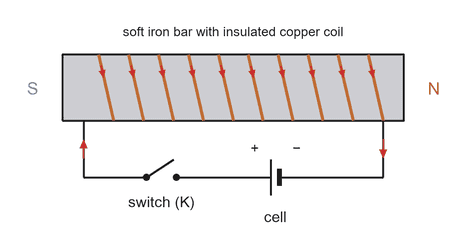
Step 5 — Factors on which the strength depends.
The strength of the field depends on:
- the number of turns of the winding: more turns, stronger field;
- the current in the coil: more current, stronger field.
Therefore, an electromagnet is made by winding insulated copper wire on a soft iron bar and passing a current; its strength depends on the number of turns and on the current.
- 705 marks
Question 70
You are required to make an electromagnet from a soft iron bar by using a cell, an insulated coil of copper wire and a switch. (a) Draw a circuit diagram to represent the process. (b) Label the poles of the electromagnet.
Solve with AIWritten solution
Solution:
Concept: Clock rule: Look at one end of the coil from outside. If the current there flows clockwise, that end becomes a south (S) pole; if it flows anticlockwise, that end becomes a north (N) pole. The two ends of a coil always have opposite poles.
Step 1 — Part (a): the circuit.
Wind the insulated copper wire closely round the soft iron bar and join its two ends to the cell through the switch, all in series.
Step 2 — Trace the current.
The long plate (+) of the cell is on the left, so the current goes up the left lead into the left end of the coil and flows down the front of each turn (red arrows).
Step 3 — Part (b): label the poles.
Seen from the left end, the current is clockwise, so the left end is the south pole (S). Seen from the right end, it is anticlockwise, so the right end is the north pole (N).
Watch out: If the cell is reversed, the current is reversed and the poles interchange.
Therefore, with the circuit shown, the left end of the electromagnet is S and the right end is N.
- 714 marks
Question 71
State two differences between an electromagnet and a permanent magnet.
Solve with AIWritten solution
Solution:
Concept: An electromagnet is a temporary strong magnet made by passing a current through a coil of insulated copper wire wound on a soft iron core. Soft iron is strongly magnetised while the current flows and loses almost all its magnetism as soon as the current is switched off.
Soft iron is magnetised easily and strongly (high permeability) and loses its magnetism almost completely when the magnetising current stops (low retentivity). Steel is harder to magnetise but keeps its magnetism, so it is used for permanent magnets.
Step 1 — Compare the two.
The table below compares an electromagnet with a permanent magnet.
Electromagnet Permanent magnet It is made of soft iron. It is made of steel. It gives a magnetic field only while current flows in its coil (temporary). It gives a permanent magnetic field. Its field strength can be changed. Its field strength cannot be changed. Its polarity can be reversed. Its polarity cannot be reversed. Step 2 — Answer the question.
Any two of these rows answer the question.
Therefore, an electromagnet (soft iron) is temporary and adjustable in strength and polarity, while a permanent magnet (steel) is permanent and fixed.
- 725 marks
Question 72
Show with the aid of a diagram how a wire is wound on a U-shaped piece of soft iron in order to make it an electromagnet. Complete the circuit diagram and label the poles of the electromagnet.
Solve with AIWritten solution
Solution:
Concept: The winding on the two arms must be in opposite senses as seen from their free ends, so that one free end becomes N and the other S. Clock rule: Look at one end of the coil from outside. If the current there flows clockwise, that end becomes a south (S) pole; if it flows anticlockwise, that end becomes a north (N) pole. The two ends of a coil always have opposite poles.
Step 1 — Wind the arms.
Wind thin insulated copper wire spirally on one arm (Q) of the U-shaped soft iron core, take it across to the other arm (P) and wind that arm too. Seen from its free end, the current goes round arm P clockwise and round arm Q anticlockwise. (If the U were straightened into a bar, this would be one solenoid wound in one sense throughout.)
Step 2 — Complete the circuit.
Join the two ends of the wire to a cell through a key K (an ammeter and a rheostat may also be included in series).
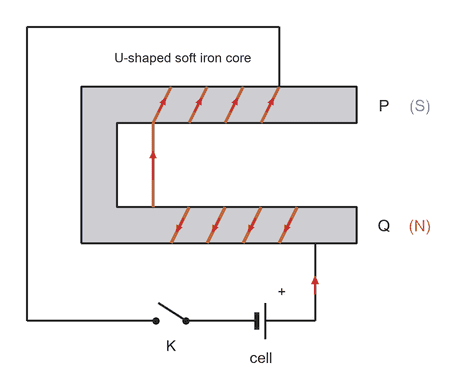
Step 3 — Label the poles.
When the key is closed:
- at the free end of arm P the current is clockwise, so it becomes the south pole (S);
- at the free end of arm Q the current is anticlockwise, so it becomes the north pole (N).
Step 4 — The result.
A strong field is produced in the gap between the two poles. It vanishes as soon as the current is switched off.
Watch out: If both arms were wound in the same sense as seen from their ends, both ends would get the same pole and the fields would cancel round the core.
Therefore, with the arms wound in opposite senses, the free end of arm P becomes S and that of arm Q becomes N.
What Class 9 Physics Ch 10 covers
The sections of the chapter, in the order the book takes them. Every question above comes from one of these.
- 01Induced Magnetism
- 02Lines of Magnetic Field
- 03Magnetic Field of Earth
- 04Plotting of Uniform Magnetic Field Lines of Earth
- 05Plotting of Non Uniform Magnetic Field of a Bar Magnet
- 06Neutral Points
More ways to study this chapter
The same chapter asked three other ways. Practise it, revise it, and see what the board has set on Ch 10 before.
Class 9 Physics Ch 10 questions students ask
How many questions are there in Class 9 Physics Ch 10?
72 questions. Every one is solved step by step on this page.
Are these Class 9 Physics solutions free?
Yes. Every question and its full working is free to read, with no account needed.
Can I download the Class 9 Physics Ch 10 solutions as a PDF?
There is no PDF to download. Every solution is on this page instead, which means it is searchable, always the current syllabus, and readable on a phone. Use your browser's print option if you want it on paper.