Solution:
Concept: Only a magnet has poles; a soft iron bar has none until a magnet induces them. The ends of a magnet are its strongest parts, and its middle has almost no magnetic effect.
Step 1 — Method 1: hang each bar freely.
Hang each bar in turn by a silk thread tied at its middle, so that it can turn freely in a horizontal plane.
- The bar that always comes to rest in the geographic north-south direction, and returns to it when disturbed, is the magnet.
- The bar that comes to rest in any direction is the soft iron bar, because it has no poles.
Step 2 — Method 2: use the bars on each other.
Lay one bar (A) on the table and touch one end of the other bar (B) to the middle of A.
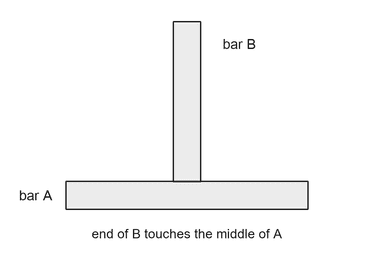
- If B is strongly attracted, B is the magnet: the end of a magnet attracts soft iron anywhere.
- If there is little or no attraction, B is the soft iron bar and A is the magnet, because the middle of a magnet has almost no magnetic strength.
Watch out: Simple attraction between the two bars proves nothing, because a magnet and soft iron always attract each other; use the middle of one bar.
Therefore, the bar that always rests north-south when suspended (or whose end attracts the middle of the other bar) is the magnet; the other is the soft iron bar.
