Solution:
Concept: A neutral point is a point where the field of a magnet is equal in magnitude and opposite in direction to the earth's horizontal field, so the resultant field is zero. A compass needle placed there rests in any direction, and in a field-line plot it is marked with a cross (×).
Where the neutral points lie depends on how the magnet is placed. The magnet's field is opposite to the earth's (south-to-north) field on the east-west line through its centre when its N pole points north, and on its axis beyond the two ends when its N pole points south.
Step 1 — Read the figure.
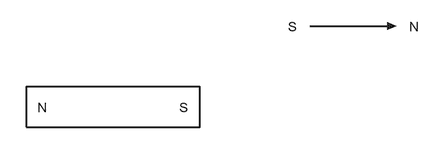
The arrow points from S to N, so north is to the right. The magnet's N pole is at the left end, pointing south, and the earth's horizontal field points to the right (south to north).
Step 2 — Part (a): the field lines.
Close to the magnet, the lines leave its N pole (left end), curve round above and below it and enter its S pole (right end); the arrows point from N to S. Farther away the lines are the earth's field lines, nearly straight and pointing from left to right (south to north).

Step 3 — Part (b): the neutral points.
On the axis beyond either end, the magnet's field points to the left (towards the south), opposite to the earth's field. Where the two are equal they cancel, so the neutral points (×) lie on the axis of the magnet, one beyond each end, at equal distances from its centre.
Step 4 — Part (c): the field at a neutral point.
At each neutral point the magnet's field is equal in magnitude and opposite in direction to the earth's horizontal field, so they cancel and the resultant field is zero. A compass needle placed there rests in any direction.
Watch out: With the N pole pointing south the neutral points are on the axis, not to the east and west.
Therefore, (b) the neutral points lie on the axis beyond the two ends, and (c) the magnetic field at each neutral point is zero, because there the magnet's field cancels the earth's horizontal field.