Solution:
Concept: A neutral point is a point where the field of a magnet is equal in magnitude and opposite in direction to the earth's horizontal field, so the resultant field is zero. A compass needle placed there rests in any direction, and in a field-line plot it is marked with a cross (×).
Where the neutral points lie depends on how the magnet is placed. The magnet's field is opposite to the earth's (south-to-north) field on the east-west line through its centre when its N pole points north, and on its axis beyond the two ends when its N pole points south.
Step 1 — Part (a): the pattern.
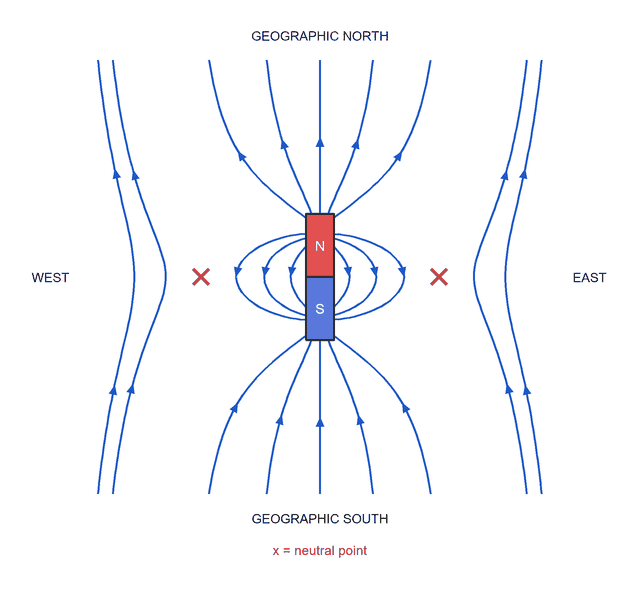
The pattern is the combined effect of the magnet's field and the earth's field (south to north):
- close to the magnet the lines are curved, from the N pole round to the S pole, because the magnet's field is strong there;
- far from the magnet the lines become nearly parallel straight lines from south to north, because the earth's field is the stronger one there;
- on the east-west line through the centre, the magnet's field points south and the earth's field points north. Where they are equal they cancel, giving two neutral points (×), one east and one west of the magnet.
Step 2 — Part (b): uniform or not.
The lines are curved and unequally spaced (crowded near the poles, spread out farther away), so the field is non-uniform.
Watch out: Do not put the crosses on the axis; with the N pole pointing north they lie east and west of the magnet.
Therefore, (a) the neutral points (×) lie east and west of the magnet, and (b) the field lines represent a non-uniform magnetic field.
