
Opening your dashboard
Class 9 Physics Chapter 10 Magnetism: Practice Questions
41 questions on Chapter 10, each worked through on its own page with the AI tutor. Class 9 Physics, ICSE 2026-27.
41 questions
1–5 marks · Mixed difficulty
- 11 mark
Question 1
Bloom's level: Remember
The word 'magnet' has been derived from :
- 21 mark
Question 2
Bloom's level: Remember
Permanent magnets are used in :
- 31 mark
Question 3
Bloom's level: Understand
The south pole of a bar magnet is brought near the end X of an unmagnetised soft iron bar XY. While the magnet is near, the bar :
- 41 mark
Question 4
Bloom's level: Apply
A coil is wound on a soft iron bar PQ and connected to a battery. Looking at the end P face-on, the current in the coil appears to flow anticlockwise. The end P becomes :
- 51 mark
Question 5
Bloom's level: Apply
A bar magnet is placed on a table with its axis along the magnetic meridian (north-south line). On plotting its field lines, the two neutral points are found on its axis, one beyond each end. The magnet was placed with :
- 61 mark
Question 6
Bloom's level: Understand
In a field-line diagram of a magnet, the lines are crowded together near point P and are far apart near point Q. This shows that :
- 71 mark
Question 7
Bloom's level: Analyse
A magnetic needle, free to rotate in a vertical plane, is taken to different places on the earth. At place X it rests vertical; at place Y it rests horizontal. Places X and Y are :
- 81 mark
Question 8
Bloom's level: Evaluate
Riya says, "In a scrap yard, a crane should use a strong permanent magnet instead of an electromagnet, because a permanent magnet never needs current." Which is the best judgement of her idea ?
- 91 mark
Question 9
Bloom's level: Apply
Four electromagnets are made with identical soft iron cores. Which one will have the strongest magnetic field ?
- 101 mark
Question 10
Bloom's level: Understand
Read the Assertion (A) and the Reason (R) and choose the correct option.
Assertion (A): An iron nail is attracted by a magnet brought near it.
Reason (R): The magnet first induces an opposite polarity on the near end of the nail.
- 111 mark
Question 11
Bloom's level: Analyse
Read the Assertion (A) and the Reason (R) and choose the correct option.
Assertion (A): Two magnetic field lines never intersect each other.
Reason (R): Magnetic field lines are closed and continuous curves.
- 121 mark
Question 12
Bloom's level: Understand
Read the Assertion (A) and the Reason (R) and choose the correct option.
Assertion (A): Permanent magnets are made of steel.
Reason (R): Steel loses its magnetism as soon as the magnetising current is switched off.
- 132 marks
Question 13
Bloom's level: Remember
State the two properties of lodestone that were known in ancient times.
- 142 marks
Question 14
Bloom's level: Remember
The earth's magnetic field at a place has two components. Name them and state the direction of each.
- 152 marks
Question 15
Bloom's level: Analyse
A student plots the earth's magnetic field lines on her desk with a small compass needle. Instead of parallel, equidistant lines, she finds that the lines bend and come closer together near one corner of the desk. What can she conclude, and what should she do to get the correct pattern ?
- 162 marks
Question 16
Bloom's level: Apply
Two identical bar magnets are placed in a line with their north poles facing each other, 20 cm apart. Ignore the earth's field.
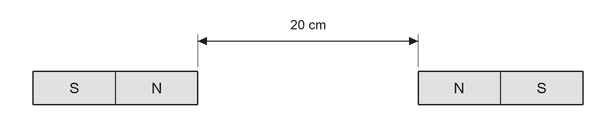
(a) Where will the neutral point be ?
(b) If one magnet is replaced by a much stronger magnet, will the neutral point move towards the stronger magnet or towards the weaker one ? Give a reason.
- 172 marks
Question 17
Bloom's level: Apply
A soft iron bar AB lies with end A near the north pole of a bar magnet. A second soft iron bar CD is placed in line with it, with end C touching end B.
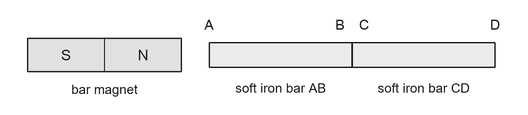
State the polarity at A, B, C and D.
- 182 marks
Question 18
Bloom's level: Understand
A student winds bare (uninsulated) copper wire closely round an iron nail, the turns touching one another, and joins it to a cell. The nail hardly picks up any pins. Explain why, and state the change she must make.
- 192 marks
Question 19
Bloom's level: Understand
While plotting the field lines of a bar magnet on a sheet of paper, a student notices that the lines are curved near the magnet but become nearly parallel straight lines near the edges of the paper. Explain why.
- 202 marks
Question 20
Bloom's level: Analyse
In an electric bell, a technician wrongly connects the coil so that the current no longer passes through the contact between the spring strip and the adjusting screw; the circuit stays closed as long as the switch is pressed. What will happen when the switch is pressed ? Explain.
- 212 marks
Question 21
Bloom's level: Understand
Classify each of the following as a temporary or a permanent magnet, with a reason : (a) iron nails clinging in a chain below a magnet, (b) a compass needle, (c) the electromagnet of a crane, (d) a lodestone.
- 222 marks
Question 22
Bloom's level: Apply
A student places a small compass at each corner of her table, far from any magnet, and finds that the needle points in exactly the same direction at every corner. What does this tell her about the magnetic field over the table ? How would its field lines look ?
- 234 marks
Question 23
Bloom's level: Apply
Case study: At a steel plant, a crane carries a large flat electromagnet. The operator lowers it onto a heap of iron scrap, switches on the current, lifts the scrap, swings it over a railway wagon and then drops it.
(a) Why is the core of the crane's magnet made of soft iron and not of steel ?
(b) Seen from below, the current in the coil flows clockwise. What is the polarity of the bottom face of the magnet ?
(c) How does the operator drop the scrap into the wagon ?
(d) The magnet cannot lift a very heavy girder. State two ways of making it stronger.
- 244 marks
Question 24
Bloom's level: Analyse
The figure shows the magnetic field lines plotted around a bar magnet lying on a table, with no other magnets nearby. The direction labels have been left out.
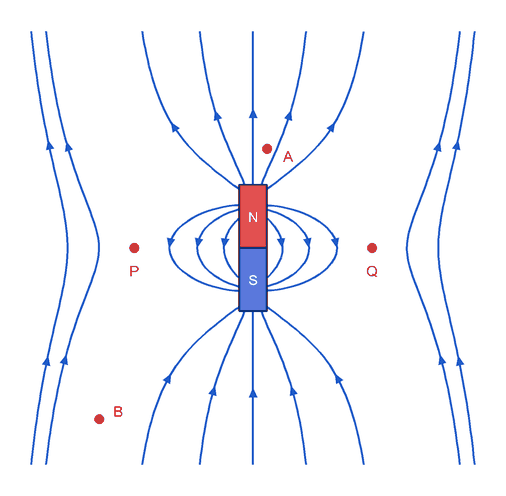
(a) Which way (up or down the page) is geographic north ? Give your evidence. Which way does the N pole of the magnet point ?
(b) What are the points marked P and Q ? What will a compass needle do if placed at P ?
(c) Compare the strength of the magnetic field at A and at B. How can you tell from the figure ?
(d) In which directions from the centre of the magnet do P and Q lie ? Is this what you expect for this placing of the magnet ?
- 254 marks
Question 25
Bloom's level: Evaluate
Arjun draws the magnetic field lines of a bar magnet and writes these notes beside his sketch. Judge each note as correct or incorrect, and correct the wrong ones.
(i) Outside the magnet, my lines go from the S pole to the N pole.
(ii) Two of my lines cross each other near the N pole, where the field is strongest.
(iii) I have drawn the lines equally far apart everywhere, to keep the sketch neat.
(iv) The tangent to a line at any point shows the direction in which the N pole of a compass needle would point there.
- 265 marks
Question 26
Bloom's level: Create
Design a fair experiment to find out how the number of turns of the coil affects the strength of an electromagnet. Include :
(a) the apparatus and a labelled description of the circuit,
(b) how you will measure the 'strength' of the electromagnet,
(c) which quantities you will keep the same, and why,
(d) a blank results table and your prediction.
- 275 marks
Question 27
Bloom's level: Create
Case study: A town's recycling centre receives a mixed heap of waste: steel and iron cans, aluminium cans, plastic bottles and glass jars, all on one conveyor belt. The manager wants to separate the iron and steel automatically.
(a) Design a system that uses an electromagnet to pick out the iron and steel. Say where you will place the electromagnet and what it will do.
(b) Explain how the picked-up iron will be dropped into a separate bin.
(c) Will the aluminium cans be picked up ? Give a reason.
(d) Suggest how the system could be adjusted to pick out a heavier iron object that it fails to lift.
- 284 marks
Question 28
Bloom's level: Apply
A bar magnet is placed on a table with its north pole pointing towards the geographic north. Its two neutral points are found 8 cm from its centre.
(a) In which directions from the centre do the neutral points lie ?
(b) Why is the resultant magnetic field zero at these points ?
(c) The magnet is turned round so that its north pole points towards the geographic south. Where will the neutral points now be found ?
(d) The magnet is replaced by a stronger magnet of the same size, placed with its north pole towards the north. Will the neutral points be nearer than 8 cm or farther ? Give a reason.
- 294 marks
Question 29
Bloom's level: Evaluate
Check each statement. Say whether it is correct or incorrect, and rewrite each incorrect one correctly.
(i) A soft iron nail attracted by a magnet stays magnetised after the magnet is taken away.
(ii) Outside a bar magnet, the field lines are directed from its north pole to its south pole.
(iii) The earth's magnetic north pole lies near its geographic north pole.
(iv) The polarity of an electromagnet can be reversed by reversing the direction of the current in its coil.
- 304 marks
Question 30
Bloom's level: Apply
A horse-shoe (U-shaped) electromagnet has arms P and Q. Seen from below, the current in the winding on arm P flows clockwise, and on arm Q it flows anticlockwise.
(a) State the polarity of the ends P and Q.
(b) The battery is connected the other way round. What are the polarities now ?
(c) Why is the winding on the two arms done in opposite senses ?
(d) Where is the magnetic field of this electromagnet strongest, and what happens to it when the current is switched off ?
- 314 marks
Question 31
Sketch the pattern of the magnetic field lines due to a bar magnet. Also state the properties of magnetic field lines.
- 321 mark
Question 32
Which of the following correctly describes the magnetic field lines of a bar magnet ?
- 331 mark
Question 33
Steel, and not soft iron, is used for making a permanent magnet because steel :
- 341 mark
Question 34
Assertion (A): The core of an electromagnet is made of soft iron and not of steel.
Reason (R): Soft iron is strongly magnetised while the current flows in the coil and loses almost all of its magnetism as soon as the current is switched off.
- 352 marks
Question 35
Three soft iron paper clips hang one below the other, in a chain, from the south pole of a bar magnet.
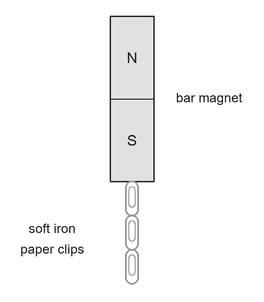
(i) State the polarity of the upper end and of the lower end of the lowest clip.
(ii) The top clip is held between the fingers and the magnet is slowly taken away. State what happens to the two lower clips. Give a reason.
- 362 marks
Question 36
A student fixes a sheet of paper on a drawing board kept on a wooden table, far away from all magnets and iron objects. She plots the magnetic field lines on the sheet with a small compass needle.
(i) Describe the field lines that she obtains, and state the direction of the arrows marked on them.
(ii) What do these lines tell about the earth's magnetic field in that space ? Give a reason.
- 372 marks
Question 37
At a point X near a bar magnet lying on a table, the magnetic field of the magnet is equal in magnitude to the horizontal component of the earth's magnetic field. Let this magnitude be .
(i) Find the resultant magnetic field at X if the field of the magnet at X is directed towards the geographic south. What name is given to such a point ?
(ii) Find the magnitude and the direction of the resultant magnetic field at X if, instead, the field of the magnet at X is directed towards the geographic north.
- 382 marks
Question 38
The electromagnet of an electric bell attracts a soft iron armature which carries the hammer.
(i) State what happens to the circuit, and to the magnetism of the electromagnet, at the moment the armature is pulled towards the electromagnet.
(ii) Explain why the hammer strikes the gong again and again for as long as the switch is kept pressed.
- 394 marks
Question 39
The figure shows an insulated copper wire wound on a soft iron bar AB and joined to a battery through a key K and a rheostat. The parts of the turns in front of the bar are drawn as thick lines and the parts behind the bar as dashed lines.
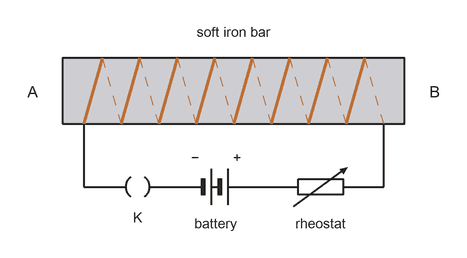
(i) The key K is closed. State the polarity produced at the end A and at the end B. Name the rule that you have used.
(ii) The sliding contact of the rheostat is now moved so that the resistance in the circuit decreases. How does the strength of the electromagnet change ? Give a reason.
(iii) The connections at the two terminals of the battery are interchanged. State the effect, if any, on the polarity at the end A and on the strength of the electromagnet.
- 404 marks
Question 40
A bar magnet is placed on a sheet of paper on a table with its north pole pointing towards the geographic north, as shown in the figure. X is a point on the line through the centre of the magnet at right angles to its length, and Y is a point on the axis of the magnet beyond its north pole.
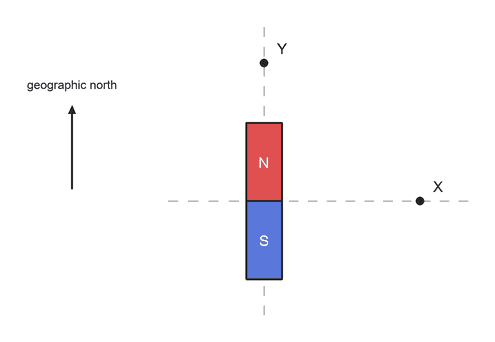
(i) State the direction of the magnetic field of the magnet alone at X and at Y.
(ii) Along which of the two dashed lines, the one through X or the one through Y, can a neutral point be found ? Give a reason.
(iii) The magnet is now turned round so that its north pole points towards the geographic south. State, with a reason, whether the neutral points now lie on the axis of the magnet or on the line at right angles to it.
- 413 marks
Question 41
A magnetic needle is suspended from its centre of gravity so that it is free to turn in the horizontal plane as well as in the vertical plane. It is kept far away from other magnets and iron objects.
(i) At a place in India the needle always comes to rest along one fixed line. Name the direction of this line, and state what this observation shows about the earth.
(ii) The magnetic axis of the earth does not coincide with its axis of rotation. State the approximate angle between the two, and name the geographic pole near which the earth's magnetic south pole lies.
(iii) State how the needle will rest near a magnetic pole of the earth and at the magnetic equator.