Solution:
Concept: Magnetic induction: A piece of magnetic material (soft iron, steel) placed near or in contact with a magnet itself becomes a magnet. The end nearer the inducing pole gets the opposite polarity and the farther end gets the similar polarity. This induced magnetism is temporary: it lasts only while the magnet is near.
Like poles repel each other (N and N, or S and S) and unlike poles attract each other (N and S).
Step 1 — Part (a): pointed ends move apart.
Each pin becomes a magnet by induction. If the pins hang from an N pole, the head of each pin (the near end) becomes S and its pointed end (the far end) becomes N. The two pointed ends are like poles, so they repel and move apart.
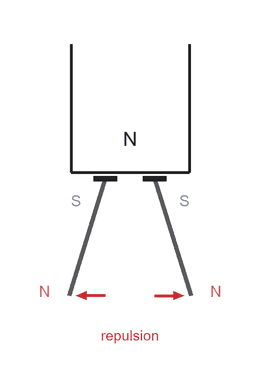
Step 2 — Part (b): pins cling one below the other.
The magnet magnetises the first pin by induction and holds it. This pin, now a magnet, magnetises the second pin by induction and holds it, the second holds the third, and so on, so a chain forms. It grows until the magnet can no longer hold the weight of all the pins below the first one.
Step 3 — Part (c): the needle turns towards soft iron.
The N end of the needle magnetises the soft iron by induction. The end of the iron nearer the needle becomes S (opposite polarity). Unlike poles attract, so the N end of the needle is pulled towards the iron. The iron is first magnetised and only then attracts: induction precedes attraction.
Watch out: In (c) the soft iron is not a magnet to start with; the needle itself magnetises it.
Therefore, (a) the pointed ends become like (N) poles and repel, (b) each pin magnetises the next by induction, and (c) the soft iron gets an induced S pole facing the needle's N pole and attracts it.
