
Opening your dashboard
Class 9 Physics Chapter 10 Magnetism: Competency-Based Questions (CBQ)
40 questions on Chapter 10, each worked through on its own page with the AI tutor. Class 9 Physics, ICSE 2026-27.
40 questions
1–5 marks · Mixed difficulty
- 11 mark
Question 1
Competency: Application & Analysis
Meera has three grey metal rods P, Q and R that look exactly alike. She brings each end of each rod, in turn, close to the north pole of a freely suspended magnetic needle. Her observations are given in the table.
Rod One end brought near the north pole of the needle Other end brought near the north pole of the needle P the needle is attracted the needle is repelled Q the needle is attracted the needle is attracted R no effect no effect Which conclusion fits all her observations ?
- 21 mark
Question 2
Competency: Analysis
Two bar magnets are placed in one line on a table with their ends X and Y facing each other. The figure shows the magnetic field lines plotted around them with a small compass needle (the earth's magnetic field is neglected). M is the point midway between X and Y.

Which statement is correct ?
- 31 mark
Question 3
Competency: Understanding & Application
A trekker's compass has a magnetic needle pivoted so that it can turn in a horizontal plane only. It settles quickly in a fixed direction in India. On an expedition close to the earth's magnetic pole in the Arctic, the same needle swings lazily and does not settle in any definite direction. Which is the best explanation ?
- 41 mark
Question 4
Competency: Application & Analysis
Anil makes an electromagnet by winding insulated copper wire on a soft iron bar PQ. By mistake he joins the coil to a low-voltage 50 Hz a.c. supply instead of a battery. He then tests the end P with some iron pins and with a compass. What should he expect ?
- 51 mark
Question 5
Competency: Analysis
Assertion (A): When a bar magnet is placed in the magnetic meridian with its north pole pointing towards the geographic north, no neutral point is found on the axis of the magnet beyond its two ends.
Reason (R): At points on the axis beyond the ends of this magnet, the magnetic field of the magnet and the horizontal component of the earth's magnetic field are in the same direction.
- 61 mark
Question 6
Competency: Understanding
Assertion (A): Steel is a better material than soft iron for the core of the electromagnet of a scrap-yard crane.
Reason (R): Steel, once it has been magnetised, does not lose its magnetism easily.
- 72 marks
Question 7
Competency: Evaluation
Asha and Bilal each plot the magnetic field lines of the earth with a small compass needle on separate sheets of paper fixed to the same large wooden table, far from any magnet or iron object. Asha starts her lines from points 2 cm apart, and Bilal starts his from points 0.5 cm apart. Both get straight, parallel lines. Bilal says, "My lines are closer together than Asha's, so the earth's magnetic field is stronger on my sheet."
(a) Is Bilal's claim justified ? Give a reason.
(b) What do the two plots correctly show about the earth's magnetic field over the table ? In which direction should the arrows on the lines point ?
- 82 marks
Question 8
Competency: Application
Two identical soft iron nails hang by their heads, side by side, from the north pole of a strong bar magnet. Their pointed ends hang a little apart from each other. A second, much weaker bar magnet is now brought up slowly from below, midway between the two pointed ends, without touching them.

(a) What happens to the gap between the pointed ends when the pole brought up is a south pole ? Give a reason.
(b) What happens to the gap when the pole brought up is a north pole ? Give a reason.
- 92 marks
Question 9
Competency: Application & Analysis
Ravi and Sana plot the magnetic field lines of the same bar magnet by the method of marking dots at the two ends of a compass needle and joining the dots.
(a) Ravi uses a compass with a needle 4 cm long and Sana uses one with a needle 1 cm long. Whose lines will show the true shape of the field more closely in the region near the poles ? Give a reason.
(b) When her plot is half complete, Sana turns the drawing board through about 30° without noticing; the magnet stays in place on the paper. Explain why the lines she plots afterwards will not fit in with the lines she plotted earlier.
- 102 marks
Question 10
Competency: Analysis & Evaluation
Two rods X and Y of the same size are made of different materials. Each is placed in turn inside the same coil, the same current is passed, and the number of identical iron pins that one end of the rod can hold is counted. The count is repeated one minute after the current is switched off. The results are given in the table.
Rod Pins held while the current flows Pins held one minute after the current is switched off X 30 1 Y 18 15 (a) One rod is soft iron and the other is steel. Identify each, giving a reason from the table.
(b) Which rod is the better choice for (1) the needle of a magnetic compass, (2) the core of the electromagnet of an electric bell ? Justify each choice.
- 113 marks
Question 11
Competency: Analysis
A bar magnet is hidden inside a closed wooden box, lying along its length. The ends of the box are marked L and R. Six small compasses are placed round the box on a table. The figure shows how their needles come to rest; the arrowhead is the north pole of each needle. The field of the magnet is much stronger than the earth's field at all these places, so the earth's field may be neglected.
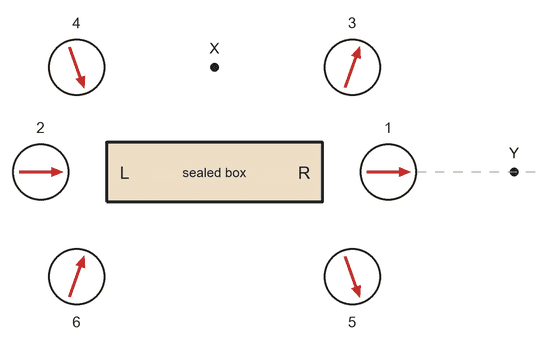
(a) Which end of the box, L or R, holds the north pole of the magnet ? Give a reason from the figure.
(b) A seventh compass is placed at X, above the middle of the box in the figure. In which direction will the north pole of its needle point ? Give a reason.
(c) Compass 1 is now moved along the same line to the point Y. Is the magnetic field at Y stronger or weaker than at the first position of compass 1 ? How would a diagram of the field lines of the magnet show this ?
- 123 marks
Question 12
Competency: Analysis & Application
Case study: While laying a new road, workers dig up some old iron rods, each about 40 cm long, that had been buried as boundary markers many years ago. The rods at site 1 had been lying along the north-south direction and those at site 2 along the east-west direction. An engineer marks the ends of one rod from each site and brings each end close to the north pole of a compass needle. Her observations are given in the table.
Rod taken from End tested Effect on the north pole of the compass needle Site 1 (lay north-south) end that pointed north repelled Site 1 (lay north-south) end that pointed south attracted Site 2 (lay east-west) end that pointed east attracted Site 2 (lay east-west) end that pointed west attracted (a) Which rod has become a magnet ? Which single observation in the table proves it, and why is that observation a sure test ?
(b) No magnet was ever kept near the rods. Explain how the rod named in (a) became magnetised. What does this tell us about the earth ?
(c) The magnetised rod is hung from a thread tied at its middle so that it can turn freely in a horizontal plane, and it is first held along the east-west direction and then let go. In which direction will it come to rest, and which of its marked ends will point north ? Give a reason.
- 134 marks
Question 13
Competency: Analysis & Evaluation
Case study: Priya places a bar magnet on a table with its axis in the magnetic meridian and its north pole pointing towards the geographic north. She studies the points on the east-west line that passes through the centre of the magnet. The graph shows how the strength of the field of the magnet alone changes with distance from the centre of the magnet along this line. The strength is given as a multiple of the horizontal component of the earth's magnetic field at the table, so a reading of 2 means a field twice as strong as the earth's horizontal field.
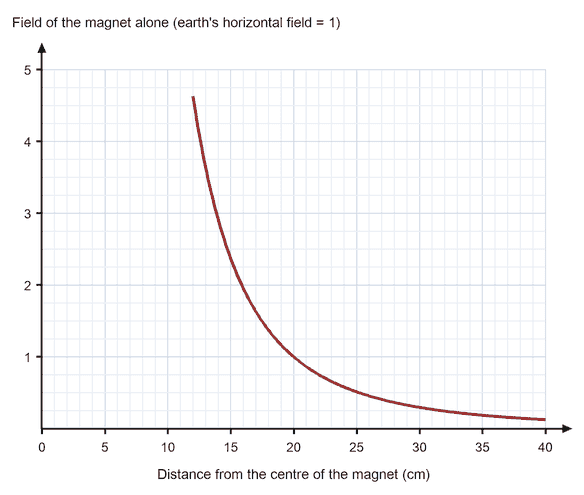
(a) State the direction of the magnet's field and of the earth's horizontal field at points on this east-west line.
(b) Use the graph to find how far from the centre of the magnet the neutral points lie. How many neutral points are there, and where ?
(c) The magnet is replaced by a stronger one that gives twice the field of the first magnet at every distance. Priya's friend says, "The field is doubled, so the neutral points will now be twice as far away, at 40 cm." Use the graph to find the new distance of the neutral points and judge the friend's statement.
- 144 marks
Question 14
Competency: Analysis & Application
Case study: For a science fair, Kabir winds insulated copper wire on a soft iron bolt and joins it to a battery through a rheostat and an ammeter. He counts how many identical iron pins one end of the bolt can hold. He does this for four values of the current, first with 50 turns of wire and then with 100 turns on the same bolt. His results are given in the table.
Current in the coil (A) 0.5 1.0 1.5 2.0 Pins held with 50 turns 6 12 18 24 Pins held with 100 turns 12 24 36 48 (a) How does the number of pins held by the 50-turn coil change when the current is doubled from 0.5 A to 1.0 A, and from 1.0 A to 2.0 A ? What does this show ?
(b) Compare the two coils at the same current. Which two ways of making an electromagnet stronger do Kabir's results confirm ?
(c) Kabir wants his electromagnet to hold 30 pins. Estimate the current needed with the 100-turn coil. His battery cannot give more than 1.0 A. Suggest what he should change, and find from the table the least number of turns that will do.
- 154 marks
Question 15
Competency: Creation & Application
Case study: The corridor doors of a school are fitted with springs that swing them shut. During the day the doors must be held wide open, but if the fire alarm goes off, every door must close by itself at once. The fire alarm is wired so that it switches off the current in a low-voltage d.c. circuit that runs along the corridor. A student suggests holding each door open with a strong permanent magnet fixed to the wall.
(a) Why is a permanent magnet not suitable for this job ?
(b) Design a door holder that uses an electromagnet. Describe its parts and the materials you would use, where each part is fixed, how it is connected, and how it holds the door and lets it go.
(c) In a trial, a strong wind pulls the door away from the holder. Suggest two changes to the electromagnet that will make it hold the door more firmly.
- 161 mark
Question 16
Competency: Understanding
Sana wants to explain to her younger brother why an iron pin jumps towards a magnet. She writes four events on cards, but the cards get mixed up.
P. The pin moves towards the magnet and clings to its pole.
Q. The north pole of a bar magnet is brought near an iron pin.
R. The end of the pin near the magnet becomes a south pole and its far end becomes a north pole.
S. The north pole of the magnet and the south pole of the pin attract each other.
In which order should the cards be placed so that they show how a piece of iron is attracted by a magnet?
- 171 mark
Question 17
Competency: Analysis
A student draws four magnetic field lines, numbered 1 to 4, outside a bar magnet. The arrow heads show the direction that she has marked on each line.
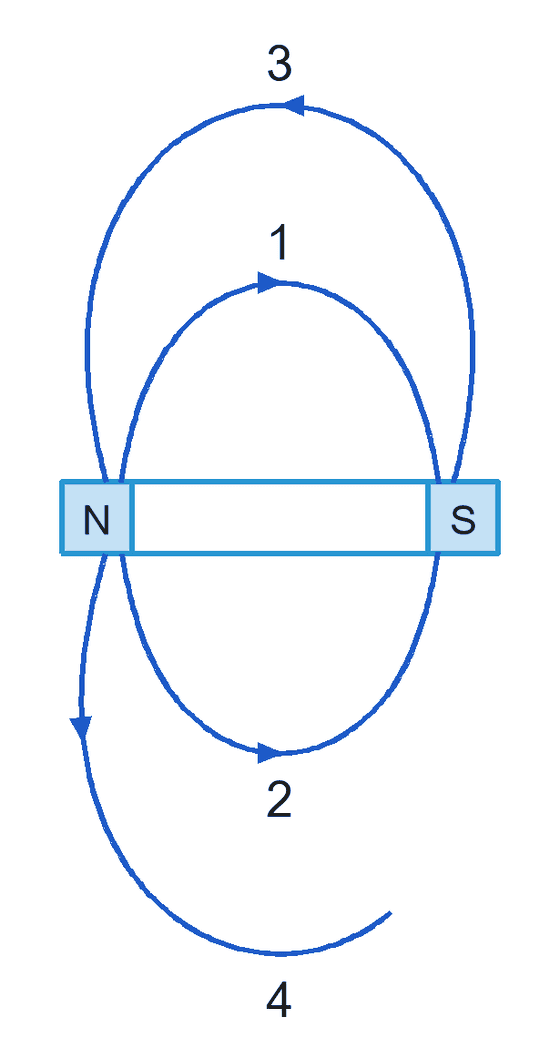
Which of the lines are drawn correctly?
- 181 mark
Question 18
Competency: Understanding
In a class test, Kabir wrote four observations to show that the earth itself behaves like a huge magnet. His teacher found that one of them is not an evidence for the earth's magnetic field. Which one is it?
- 191 mark
Question 19
Competency: Evaluation
Four students plan how to plot the magnetic field lines of a bar magnet with a small compass needle on a sheet of paper. Their plans are given below. Which plan will give the most reliable plot?
- 201 mark
Question 20
Competency: Analysis
Assertion (A): The magnetic field of a bar magnet is stronger near its poles than near the middle of its side.
Reason (R): Outside a magnet, the magnetic field lines are directed from its north pole towards its south pole.
- 211 mark
Question 21
Competency: Analysis
Assertion (A): The north pole of a freely suspended bar magnet points towards the geographic north.
Reason (R): The magnetic north pole of the earth is situated near the geographic north.
- 221 mark
Question 22
Competency: Application
Pooja pushes a magnetised steel needle through a small piece of cork and floats it in a bowl of still water, away from other magnets and iron objects. The end of the needle that comes to rest pointing towards the geographic north is painted red. She then brings one pole of a bar magnet slowly near the red end, without touching it. The red end swings away from the bar magnet.
Which conclusion is correct?
- 231 mark
Question 23
Competency: Application
A school's electric bell rings steadily as long as its bell-push is held pressed. A student counts that the hammer strikes the gong 8 times every second. (Hypothetical data.)
Each stroke needs the electromagnet to pull the armature once, and then the circuit is broken at the contact between the spring strip and the adjusting screw. How many times is the circuit broken at this contact while the bell-push is held pressed for 15 seconds?
- 241 mark
Question 24
Competency: Analysis
Two identical soft iron bars AB and CD, each wound with the same number of turns of insulated wire, lie on a table in a straight line, with the ends B and C close together but not touching. Both coils are joined to the same battery in such a way that each coil, seen from its left end, carries a clockwise current when the key is closed. (Hypothetical set-up.)
What happens between B and C when the key is closed, and what happens if the bar CD (with its coil) is then turned end for end and put back in the same place?
- 251 mark
Question 25
Competency: Analysis
Arjun finds an old electromagnet whose coil is covered with tape, so he cannot see which way the wire is wound. He joins the coil to a battery through a key, closes the key and holds a small compass close to the end P of the electromagnet, far from any other magnet. The north pole of the compass needle swings round and points towards P.
Seen face-on from the end P, which way does the current flow in the coil, and what will the needle do if Arjun interchanges the battery connections?
- 262 marks
Question 26
Competency: Application
A long soft iron rod AB is held horizontally, with its end A a short distance from the north pole of a strong bar magnet, without touching it. A small compass is held close to the far end B of the rod, and its needle is free to turn. Take it that near B the field of the rod is much stronger than all other fields.
(a) State the polarity induced at A and at B.
(b) Which pole of the compass needle will swing towards B? Give a reason.
- 272 marks
Question 27
Competency: Analysis
A student plots the magnetic field lines of the earth on a sheet of paper fixed to a wooden drawing board. At every position she puts the compass so that the south end of the needle is on the last dot and marks a new dot in front of the north end. She measures the dots from the bottom-left corner of the sheet, across the sheet and up the sheet, in cm. Her first line has the dots A (1.0, 1.0), B (1.7, 4.5) and C (2.4, 8.0). Her second line, begun 6 cm to the right, has the dots D (7.0, 1.0), E (7.7, 4.5) and F (8.4, 8.0). (Hypothetical data.)
(a) Show that A, B and C lie on a straight line.
(b) She begins a third line at the dot G (4.0, 1.0). Without plotting it, predict the positions of its next two dots H and J. Name the property of the earth's magnetic field over the sheet that makes this prediction possible.
- 282 marks
Question 28
Competency: Analysis
At a point X near a bar magnet lying on a table, the field of the magnet is directed towards the geographic east and has a strength of 3 units. The horizontal component of the earth's magnetic field at the table has a strength of 4 units. (Hypothetical units.) For two fields at right angles, the strength of the resultant is the square root of the sum of the squares of the two strengths.
(a) Find the strength of the resultant magnetic field at X.
(b) The magnet is moved so that X becomes a neutral point. State the direction and the strength of the magnet's field at X.
- 292 marks
Question 29
Competency: Application
A doctor in a small clinic has to remove a tiny iron splinter that has gone into a labourer's hand. She uses a slim electromagnet joined to a battery through a switch. When the switch is closed, the tip of the electromagnet is a north pole.
(a) By mistake, the battery connections are interchanged, so the tip becomes a south pole. Will the electromagnet still pull out the unmagnetised iron splinter? Give a reason.
(b) A week later, another patient has a tiny splinter of brass in his finger. Can the same electromagnet be used to pull it out? Give a reason.
- 302 marks
Question 30
Competency: Evaluation
Neha completes a table that compares a permanent magnet with an electromagnet. Two of her four rows are wrong.
Row Feature Permanent magnet Electromagnet 1 Material of the core steel soft iron 2 Strength of the magnetic field can be changed easily cannot be changed 3 Polarity cannot be reversed can be reversed by reversing the current 4 Magnetism is lost as soon as the current is switched off is kept for a long time Identify the two wrong rows and correct each of them.
- 312 marks
Question 31
Competency: Understanding & Evaluation
Two students plot the field lines of a horse-shoe magnet with a small compass needle. Gaurav plots in the narrow gap between the two pole ends and finds that his lines there are nearly straight, parallel and equally spaced. Hema plots just outside one arm, near its pole, where she finds that her lines are curved, crowded close to the pole and spread out farther away.
(a) What type of magnetic field does each plot show?
(b) Gaurav says, 'My lines are parallel and equally spaced, so the magnetic field of a horse-shoe magnet is uniform everywhere.' Use Hema's plot to judge his claim.
- 323 marks
Question 32
Competency: Evaluation
Three students make statements about the earth as a magnet.
(i) Ravi: 'The magnetic axis of the earth lies exactly along its axis of rotation, so a compass needle points to the geographic north at every place.'
(ii) Sima: 'When the magnetic field lines of a single bar magnet are plotted on a table, neutral points are found. This shows that the earth itself has a magnetic field.'
(iii) Tarun: 'Once the positions of the earth's magnetic poles have been measured, they never change.'
Judge each statement as correct or incorrect. Give a reason for each, and correct the statements that are wrong.
- 333 marks
Question 33
Competency: Analysis
Dev winds 40 turns of insulated copper wire on a long soft iron bar PQ and joins the ends of the wire to a battery through a key. Half way along the bar he reverses the sense of winding. The same current flows through all 40 turns, one after the other. When the key is closed, the current in the first 20 turns (from P to the middle) flows clockwise as seen from P, and the current in the last 20 turns (from the middle to Q) flows anticlockwise as seen from P. (Hypothetical set-up.)
(a) State the polarity produced at P, at the middle of the bar and at Q when the key is closed.
(b) Where along the bar will iron pins cling?
(c) What happens to these polarities when the battery connections are interchanged?
- 343 marks
Question 34
Competency: Analysis
The figure shows the magnetic field lines between two pairs of identical bar magnets that lie in a line. In (A) the facing poles are unlike. In (B) the facing poles are like. The point Y is midway between the magnets of pair (A) and the point X is midway between the magnets of pair (B). Ignore the earth's magnetic field.

(a) In which pair do the magnets attract each other? How do the field lines show it?
(b) What is the magnetic field at X? What will a small compass needle do at X?
(c) Describe the magnetic field near Y, and state its direction.
- 353 marks
Question 35
Competency: Application & Evaluation
The door of a refrigerator is kept tightly shut by a flexible strip of permanent magnet fitted along its edge. During a power cut at night the door stays shut. Maya says, 'An electromagnet would have been a better choice, because it can be made much stronger.'
(a) Why does the door stay shut during a power cut?
(b) What would happen to the door in a power cut if an electromagnet were used instead? Give a reason.
(c) Is Maya's reason, 'it can be made much stronger', a good reason for choosing the magnet of a refrigerator door? Give a reason, and state the property that the door magnet really needs.
- 363 marks
Question 36
Competency: Application & Evaluation
Rohit finds a dark, rough stone of irregular shape near an old iron mine. He suspects that it may be a piece of lodestone. He has a thread, some small iron pins, a stand and a small magnetic compass.
(a) Describe a test for each of the two properties by which lodestone was recognised in ancient times.
(b) How can he find out which end of the stone, if it is a magnet, is a north pole, using the compass?
(c) In the test of (a), Rohit marks the end of the hanging stone that comes to rest towards the geographic north. His sister says, 'You need not do the test of (b) separately. The end you have marked must be the end that repels the north pole of the compass needle.' Is she right? Give a reason.
- 374 marks
Question 37
Competency: Evaluation
Case study: A workshop manager must decide whether to use a permanent magnet or an electromagnet for each of four jobs. The table shows what each job needs.
Job Must the pull be switched off to release the load? Must the strength be adjustable? Must it work without a battery or mains supply? 1. Lifting iron girders from a lorry onto a platform Yes Yes No 2. Needle of a hand-held compass No No Yes 3. Separating iron pieces from crushed copper ore on a belt Yes No No 4. Toy fishing game for small children No No Yes (a) Which jobs need an electromagnet and which need a permanent magnet?
(b) Give a reason for your choice in job 2 and in job 3, using the table.
(c) In job 1, the magnet sometimes lifts a stack of four thin iron sheets at once, each sheet clinging below the one above it, but the sheets must be put down on the platform one at a time. Using the column "Must the strength be adjustable?", suggest how the operator can put down the lower sheets first while keeping the top sheet held, and say why a permanent magnet could not do this.
- 384 marks
Question 38
Competency: Analysis
Case study: Students plot the earth's magnetic field lines with a compass needle on a sheet of paper on a wooden board, at four stations in a school playground. A large steel water tank stands at the east end of the playground. For each station, they measure the angle between the line that they plot and the true north-south line marked on the ground. (Hypothetical data.)
Station Distance from the steel tank Angle between plotted line and north-south line 1 12 m 0° 2 8 m 0° 3 4 m 9° 4 2 m 21° (a) At which stations do the plotted lines show the field of the earth alone? Give a reason.
(b) What do the readings show about how the effect of the tank changes with the distance from it?
(c) Explain why a steel tank can disturb the plot, and say how the students can get a better plot at station 4.
- 395 marks
Question 39
Competency: Creation
Case study: A teacher gives a student three bars X, Y and Z of the same size and the same iron-grey colour. One is a steel bar that has been magnetised, one is an unmagnetised steel bar and one is an unmagnetised bar of soft iron. The student also has a thread, a stand, a small magnetic compass, a box of small iron pins, a coil of insulated copper wire, a battery and a switch. She may not use any other magnet.
(a) Plan a test that identifies the magnetised bar. Describe what she does and what she should see.
(b) Plan a second test that tells the other two bars apart, using the coil, the battery, the switch and the pins. Say what she should do with each bar to keep the test fair, and what she should see.
(c) State two precautions that she must take to make sure the results are reliable.
- 404 marks
Question 40
Competency: Analysis
Case study: A dip needle is a small magnetic needle that is free to turn in a vertical plane. A geography club uses a model of the earth to show how such needles rest at different places along one route round the earth. The figure shows the earth, its axis of rotation (dashed line) and its magnetic axis (solid line), and five needles at the places P, Q, R, T and U. The arrow head on each needle is its north pole.
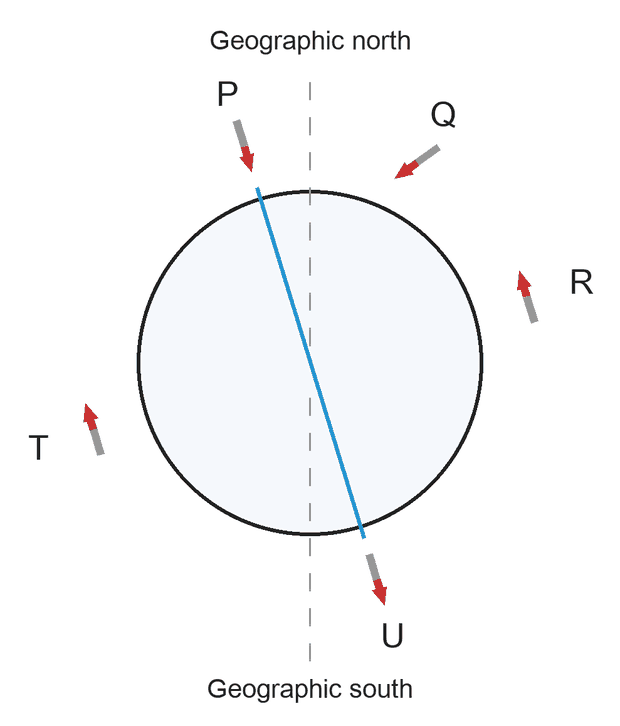
(a) At which two places is the needle vertical? Which of these two places is the earth's magnetic north pole? Give a reason from the way the north pole of the needle points there.
(b) At which places is the needle parallel to the earth's surface? Name the line joining such places.
(c) The figure shows that the two axes do not coincide. A club member says that a dip needle kept exactly at the geographic north pole will be exactly vertical. Is she right? Give a reason.