
Opening your dashboard
Class 7 Maths Chapter 17: Triangles Solutions
42 textbook questions with step-by-step answers, free to read, for ICSE 2026-27.
Get talked through Ch 17, not just shown the answer
Reading a finished solution is not the same as being able to do it. The AI tutor takes one question at a time and works it with you, in your own words, until you can.
- Ask it out loud, in your own words
- It gives you the next step, not the answer
- Stuck on part (ii)? Start there
42 questions with solutions
1–3 marks · Mixed difficulty
The first 41 solutions are on this page. This chapter is a long one, so the rest open on their own page to keep this one quick to load.
- 13 marks
Question 1
State, if the triangles are possible with the following angles :
(i) 20°, 70° and 90° (ii) 40°, 130° and 20°
(iii) 60°, 60° and 50° (iv) 125°, 40° and 15°
Solve with AIWritten solution
Solution:
Concept: The three angles of every triangle add up to 180° (the angle sum property of a triangle).
Step 1 — Part (i).
We add the three angles and compare the sum with 180°.
The sum is exactly 180°, so a triangle with these angles is possible.
Step 2 — Part (ii).
We add the three angles and compare the sum with 180°.
The sum is 190°, not 180°, so no triangle has these angles.
Step 3 — Part (iii).
We add the three angles and compare the sum with 180°.
The sum is 170°, not 180°, so no triangle has these angles.
Step 4 — Part (iv).
We add the three angles and compare the sum with 180°.
The sum is exactly 180°, so a triangle with these angles is possible.
Watch out: The sum must be exactly 180°; a sum of 170° or 190° is not close enough.
Therefore, (i) possible; (ii) not possible; (iii) not possible; (iv) possible.
- 23 marks
Question 2
If the angles of a triangle are equal, find its angles.
Solve with AIWritten solution
Solution:
Concept: The three angles of every triangle add up to 180° (the angle sum property of a triangle).
Step 1 — Name the angles.
All three angles are equal, so we call each of them .
Step 2 — Use the angle sum.
The three angles add up to 180°.
Watch out: Divide 180° by 3, not by 2; there are three equal angles.
Therefore, each angle of the triangle is 60° (it is an equilateral triangle).
- 33 marks
Question 3
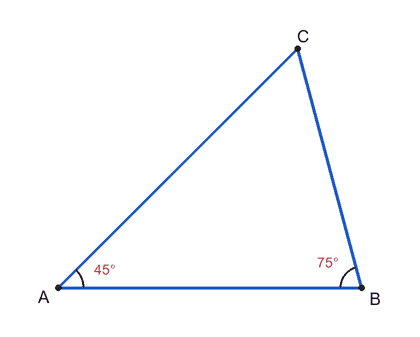
In a triangle ABC, ∠A = 45° and ∠B = 75°, find ∠C.
 Solve with AI
Written solution
Solution:
Concept: The three angles of every triangle add up to 180° (the angle sum property of a triangle).
Given: In triangle ABC, ∠A = 45° and ∠B = 75°.
Step 1 — Use the angle sum.
The angle C is what is left of 180° after ∠A and ∠B.
Watch out: Subtract BOTH given angles from 180°.
Therefore, ∠C = 60°.
- 43 marks
Question 4
In a triangle PQR, ∠P = 60° and ∠Q = ∠R, find ∠R.
 Solve with AI
Written solution
Solution:
Concept: The three angles of every triangle add up to 180° (the angle sum property of a triangle).
Given: In triangle PQR, ∠P = 60° and ∠Q equals ∠R.
Step 1 — Name the equal angles.
The angles Q and R are equal, so we call each of them .
Step 2 — Use the angle sum.
The three angles of triangle PQR add up to 180°.
Watch out: After subtracting ∠P, the remaining 120° is shared equally between ∠Q and ∠R.
Therefore, ∠R = 60°.
- 53 marks
Question 5
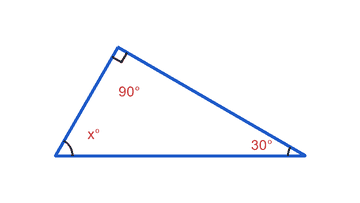
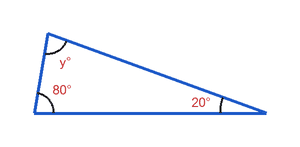
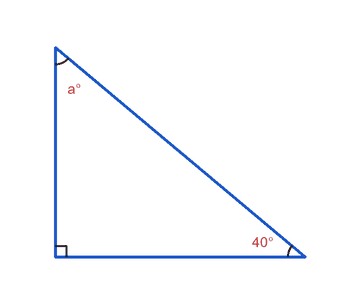
Calculate the unknown marked angles in each figure :
(i)
(ii)
(iii)
 Solve with AI
Written solution
Solution:
Concept: The three angles of every triangle add up to 180° (the angle sum property of a triangle).
Step 1 — Part (i).
The triangle has a right angle (90°), an angle of 30° and the unknown angle . We subtract the two known angles from 180°.
Step 2 — Part (ii).
The angles are at the top, 80° at the bottom left and 20° at the right.
Step 3 — Part (iii).
The triangle has a right angle at the bottom left, 40° at the right and the unknown at the top.
Watch out: The small square in a figure means 90°, even when the number is not printed.
Therefore, (i) x is 60°; (ii) y is 80°; (iii) a is 50°.
- 63 marks
Question 6
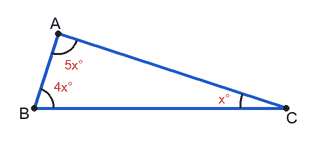
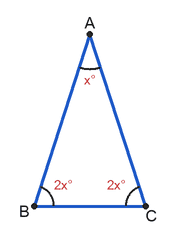
Find the value of each angle in the given figures :
(i)
(ii)
 Solve with AI
Written solution
Solution:
Concept: The three angles of every triangle add up to 180° (the angle sum property of a triangle).
Step 1 — Part (i): find x.
In triangle ABC the angles are , and ; they add up to 180°.
Step 2 — Part (i): find the angles.
Now we put into each angle.
And ∠C is itself, 18°. Check: 90° + 72° + 18° is 180°.
Step 3 — Part (ii): find x.
Here ∠A is , and ∠B and ∠C are each .
Step 4 — Part (ii): find the angles.
We put into each angle.
So ∠A is 36°, and ∠B and ∠C are each 72°.
Watch out: After finding , go on to find every angle: the question asks for each angle, not only .
Therefore, (i) x is 18°, so ∠A is 90°, ∠B is 72° and ∠C is 18°; (ii) x is 36°, so ∠A is 36°, and ∠B and ∠C are 72° each.
- 73 marks
Question 7
Find the unknown marked angles in the given figures :
(i)

(ii)

(iii)
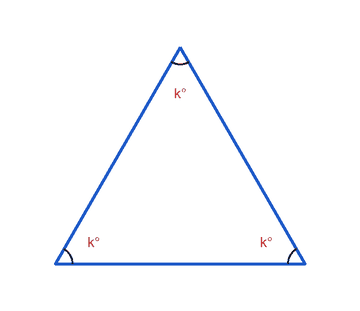
(iv)
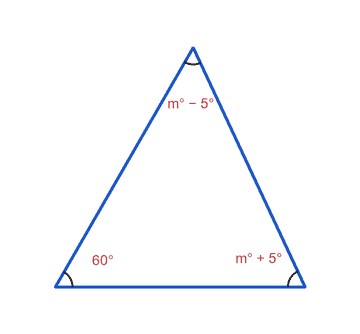 Solve with AI
Written solution
Solution:
Concept: The three angles of every triangle add up to 180° (the angle sum property of a triangle).
Step 1 — Part (i).
The angles are 50° and two angles marked .
Step 2 — Part (ii).
The angles are a right angle (90°) and two angles marked .
Step 3 — Part (iii).
All three angles are marked .
Step 4 — Part (iv).
The angles are 60°, and ; the and cancel when we add.
So the two angles are and .
Watch out: Angles marked with the same letter are equal, so count each letter as many times as it appears.
Therefore, (i) b is 65°; (ii) x is 45°; (iii) k is 60°; (iv) m is 60.
- 83 marks
Question 8
In the given figure, show that : ∠a = ∠b + ∠c.
(i) If ∠b = 60° and ∠c = 50°, find ∠a.
(ii) If ∠a = 100° and ∠b = 55°, find ∠c.
(iii) If ∠a = 108° and ∠c = 48°, find ∠b.
 Solve with AI
Written solution
Solution:
Concept: When a line crosses two parallel lines (marked with arrows), alternate angles are equal and corresponding angles are equal. An exterior angle of a triangle (made by producing one side) equals the sum of the two interior opposite angles. An exterior angle and the interior angle next to it lie on a straight line, so they add up to 180° (a linear pair).
Step 1 — Name the angles.
AB and DC carry arrows, so AB ∥ DC. Let AD and BC cross at O. In the figure, ∠b is ∠ABO (at B), ∠c is ∠ADC (at D) and ∠a is ∠AOC (at O, below the crossing).
Step 2 — Use alternate angles.
AD is a transversal of the parallel lines AB and DC, so the alternate angles ∠BAO and ∠ODC are equal. So ∠BAO = ∠c.
Step 3 — Use the exterior angle of triangle ABO.
BO is produced to C, so ∠AOC is an exterior angle of triangle ABO. It equals the sum of the two interior opposite angles, ∠ABO and ∠BAO.
This proves ∠a = ∠b + ∠c.
Step 4 — Part (i).
We add ∠b and ∠c.
Step 5 — Part (ii).
We subtract ∠b from ∠a.
Step 6 — Part (iii).
We subtract ∠c from ∠a.
Watch out: ∠a is the exterior angle of triangle ABO, so it is a sum, not 180° minus the sum.
Therefore, ∠a = ∠b + ∠c is proved; (i) ∠a is 110°; (ii) ∠c is 45°; (iii) ∠b is 60°.
- 93 marks
Question 9
Calculate the angles of a triangle, if they are in the ratio 4 : 5 : 6.
Solve with AIWritten solution
Solution:
Concept: The three angles of every triangle add up to 180° (the angle sum property of a triangle). If angles are in a given ratio, we write them as the ratio's numbers times a common multiplier and use the fact that they add up to the known total.
Step 1 — Write the angles.
In the ratio 4 : 5 : 6 the angles are , and .
Step 2 — Find x.
The three angles add up to 180°.
Step 3 — Find the angles.
We multiply 12° by 4, 5 and 6.
Check: 48° + 60° + 72° is 180°.
Watch out: The letter is only the multiplier; the angles are , and .
Therefore, the angles are 48°, 60° and 72°.
- 103 marks
Question 10
One angle of a triangle is 60°. The other two angles are in the ratio of 5 : 7. Find the two angles.
Solve with AIWritten solution
Solution:
Concept: The three angles of every triangle add up to 180° (the angle sum property of a triangle). If angles are in a given ratio, we write them as the ratio's numbers times a common multiplier and use the fact that they add up to the known total.
Step 1 — Find the sum of the other two angles.
The three angles add up to 180°, so the other two share what is left.
Step 2 — Share 120° in the ratio 5 : 7.
We write the angles as and .
Watch out: Share 120°, not 180°: the 60° angle is not part of the ratio.
Therefore, the two angles are 50° and 70°.
- 113 marks
Question 11
One angle of a triangle is 61° and the other two angles are in the ratio . Find these angles.
Solve with AIWritten solution
Solution:
Concept: The three angles of every triangle add up to 180° (the angle sum property of a triangle). If angles are in a given ratio, we write them as the ratio's numbers times a common multiplier and use the fact that they add up to the known total.
Step 1 — Write the ratio in whole numbers.
We turn the mixed numbers into fractions and multiply both terms by 6, the L.C.M. of 2 and 3.
Step 2 — Find the sum of the two angles.
The three angles add up to 180°.
Step 3 — Share 119° in the ratio 9 : 8.
We write the angles as and .
Watch out: Convert to (not ) before clearing the fractions.
Therefore, the two angles are 63° and 56°.
- 123 marks
Question 12
Find the unknown marked angles in the given figures.
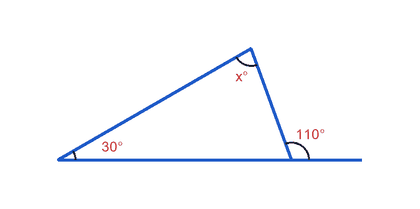
(i)
(ii)

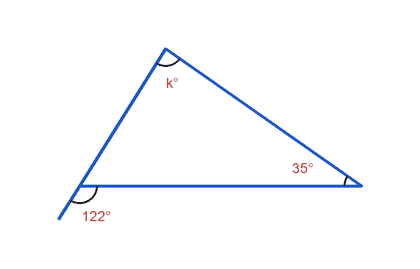
(iii)
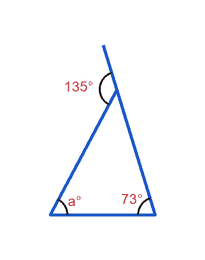
(iv)
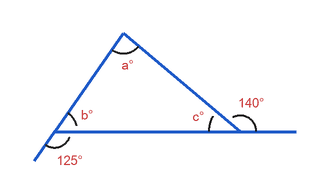
(v)
(vi)

(vii)
(viii)
(ix)
 Solve with AI
Written solution
Solution:
Concept: The three angles of every triangle add up to 180° (the angle sum property of a triangle). An exterior angle of a triangle (made by producing one side) equals the sum of the two interior opposite angles. An exterior angle and the interior angle next to it lie on a straight line, so they add up to 180° (a linear pair).
Step 1 — Part (i).
The base is produced at the right, making an exterior angle of 110°. The interior opposite angles are 30° and .
Step 2 — Part (ii).
The top side is produced at the right, making an exterior angle of 120°. Its interior opposite angles are 60° (top left) and (bottom).
Step 3 — Part (iii).
The left side is produced below the base, making an exterior angle of 122°. Its interior opposite angles are (top) and 35° (right).
Step 4 — Part (iv).
The right side is produced above the top, making an exterior angle of 135° there. Its interior opposite angles are and 73° at the base.
Step 5 — Part (v).
At the left, and 125° form a linear pair; at the right, and 140° form a linear pair. Then comes from the angle sum.
Step 6 — Part (vi).
At the right, and 112° form a linear pair. The 112° is also an exterior angle, equal to 63° + .
Step 7 — Part (vii).
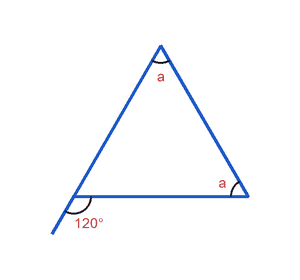
The left side is produced below the base, making an exterior angle of 120°. Its interior opposite angles are both .
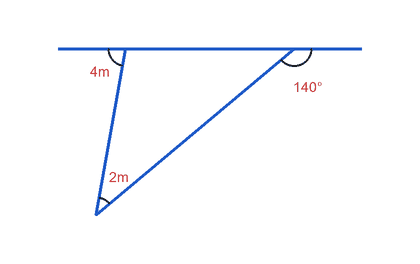
Step 8 — Part (viii).
The interior angle at the top left forms a linear pair with .
So that angle is .
The 140° at the top right is the exterior angle there.
It equals the sum of the two interior opposite angles: and .
Step 9 — Part (ix).
At the right, and 105° form a linear pair. The 105° is also the exterior angle, equal to .
Since 0.5° is 30 minutes, is 52° 30′.
Watch out: An exterior angle equals the sum of the two interior angles FAR from it, not the angle next to it.
Therefore, (i) x is 80°; (ii) y is 60°; (iii) k is 87°; (iv) a is 62°; (v) a is 85°, b is 55° and c is 40°; (vi) x is 68° and y is 49°; (vii) a is 60°; (viii) m is 20; (ix) a is 75° and b is 52.5° (52° 30′).
- 133 marks
Question 13
Find the unknown angles in the given figures :
(i)

(ii)
(iii)
(iv)
(v)
(vi)

(vii)
 Solve with AI
Written solution
Solution:
Concept: In an isosceles triangle the angles opposite the equal sides are equal. Sides with the same tick marks in a figure are equal. In an equilateral triangle all three sides are equal, so each angle is 60°. The three angles of every triangle add up to 180° (the angle sum property of a triangle).
Step 1 — Part (i).
The two marked sides meet at the 80° angle, so the angles opposite them, and , are equal. They share what is left of 180°.
So and are each 50°.
Step 2 — Part (ii).
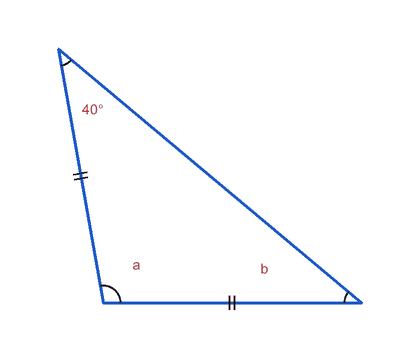
The left side and the base are marked equal. The angle opposite the left side is (bottom right), and the angle opposite the base is 40° (top). So .
Step 3 — Part (iii).
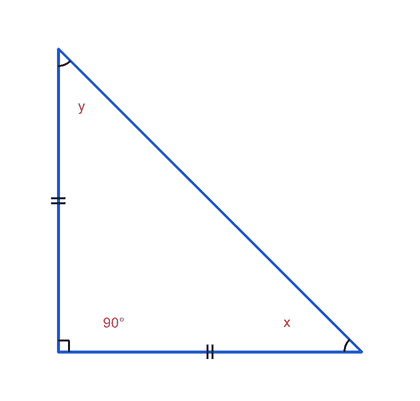
The two arms of the right angle are marked equal, so the angles opposite them, and , are equal. They share 90°.
So and are each 45°.
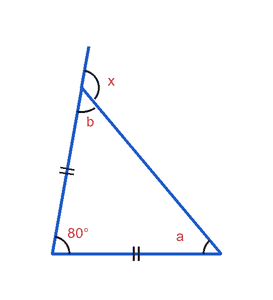
Step 4 — Part (iv).
The left side and the base are marked equal, so the angles opposite them are equal: (bottom right) and (inside the triangle at the top). They share what is left after 80°.
The left side is produced past the top, so and form a linear pair.
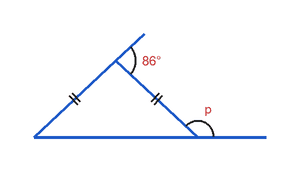
Step 5 — Part (v).
The left side is produced past the top, so the interior angle at the top forms a linear pair with 86°. The two marked sides meet at the top, so the two base angles are equal.
The base is produced at the right, so and the base angle there form a linear pair.
Step 6 — Part (vi).
A line from the top meets the base. In the right-hand triangle, this line and the right part of the base are marked equal. The angle opposite the line is (at the right corner) and the angle opposite the right part of the base is the 35° at the top. So is 35°.
In the whole triangle the top angle is made of 60° and 35°.
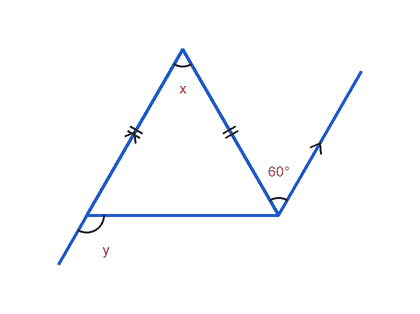
Step 7 — Part (vii).
The line through the bottom right corner is parallel to the left side (arrows), and the right side crosses both. So and the 60° are alternate angles, and . The two marked sides meet at , so each base angle is (180° − 60°) ÷ 2 = 60°. The left side is produced below the base, so and the base angle at the left form a linear pair.
Watch out: The equal angles are the ones OPPOSITE the equal sides; find which vertex faces each marked side.
Therefore, (i) x and y are 50° each; (ii) a is 100° and b is 40°; (iii) x and y are 45° each; (iv) x is 130°, and a and b are 50° each; (v) p is 137°; (vi) m is 35° and n is 50°; (vii) x is 60° and y is 120°.
- 143 marks
Question 14
Apply the properties of isosceles and equilateral triangles to find the unknown angles in the given figures :
(i)

(ii)
(iii)

(iv)

(v)
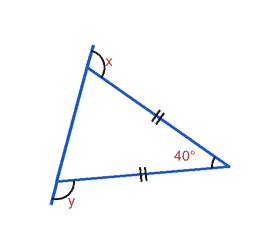
(vi)
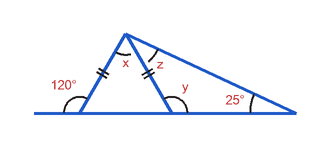 Solve with AI
Written solution
Solution:
Concept: In an isosceles triangle the angles opposite the equal sides are equal. Sides with the same tick marks in a figure are equal. In an equilateral triangle all three sides are equal, so each angle is 60°. The three angles of every triangle add up to 180° (the angle sum property of a triangle). When a line crosses two parallel lines (marked with arrows), alternate angles are equal and corresponding angles are equal.
Step 1 — Part (i).
A line from the top meets the base at D. In the right-hand triangle the right side and the right part of the base carry two ticks, so the angles opposite them are equal: the angle at D (inside this triangle) equals the 70° at the top. Then comes from the angle sum.
The angle at D in the left-hand triangle forms a linear pair with 70°, so it is 110°. Its two single-tick sides are equal, so its other two angles (one of them ) are equal.
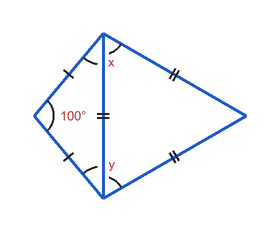
Step 2 — Part (ii).
In the left triangle the two single-tick sides meet at 100°, so each of its other angles is (180° − 100°) ÷ 2 = 40°. The right triangle has all three sides equal, so each of its angles is 60°. Each of and is made of one angle from each triangle.
In the same way, is 40° + 60° = 100°.
Step 3 — Part (iii).
The two horizontal lines are parallel. At the bottom left, and the 50° at the top are alternate angles, so . At the bottom right, the interior angle forms a linear pair with 130°, so it is 50°; and this angle are alternate angles, so . The angles , and lie on the straight top line.
Step 4 — Part (iv).
In the upper triangle the two single-tick sides meet at 30°, so each base angle is (180° − 30°) ÷ 2 = 75°. The lower triangle has a right angle with equal arms (two ticks), so each of its other angles is 45°; one of them is . The angle is made of a 75° angle and a 45° angle.
Step 5 — Part (v).
The two marked sides meet at 40°, so each of the other two angles is (180° − 40°) ÷ 2 = 70°. The left side is produced at both ends, so and each form a linear pair with a 70° angle.
In the same way, is 180° − 70° = 110°.
Step 6 — Part (vi).
The base is produced at the left, so the interior angle there forms a linear pair with 120°, giving 60°. The two marked sides of the left triangle are equal, so the angle at their foot on the base is also 60°, and then is 180° − 60° − 60° = 60°. Next, forms a linear pair with that 60°, and comes from the angle sum of the right-hand triangle.
Watch out: An angle split by a line is the SUM of its two parts; find each part in its own triangle.
Therefore, (i) x is 40° and y is 35°; (ii) x and y are 100° each; (iii) p is 50°, x is 80° and y is 50°; (iv) x is 120° and y is 45°; (v) x and y are 110° each; (vi) x is 60°, y is 120° and z is 35°.
- 153 marks
Question 15
The angle of vertex of an isosceles triangle is 100°. Find its base angles.
Solve with AIWritten solution
Solution:
Concept: In an isosceles triangle the angles opposite the equal sides are equal. Sides with the same tick marks in a figure are equal. In an equilateral triangle all three sides are equal, so each angle is 60°. The three angles of every triangle add up to 180° (the angle sum property of a triangle).
Given: The vertex angle of an isosceles triangle is 100°.
Step 1 — Use the equal base angles.
The two base angles are equal and share what is left of 180° after the vertex angle.
Watch out: Subtract the vertex angle first, then halve.
Therefore, each base angle is 40°.
- 163 marks
Question 16
One of the base angles of an isosceles triangle is 52°. Find its angle of vertex.
Solve with AIWritten solution
Solution:
Concept: In an isosceles triangle the angles opposite the equal sides are equal. Sides with the same tick marks in a figure are equal. In an equilateral triangle all three sides are equal, so each angle is 60°. The three angles of every triangle add up to 180° (the angle sum property of a triangle).
Given: One base angle of an isosceles triangle is 52°.
Step 1 — Use the equal base angles.
Both base angles are 52°, so the vertex angle is what is left of 180°.
Watch out: Both base angles are 52°, so subtract 52° twice.
Therefore, the angle of vertex is 76°.
- 173 marks
Question 17
In an isosceles triangle, each base angle is four times of its vertical angle. Find all the angles of the triangle.
Solve with AIWritten solution
Solution:
Concept: In an isosceles triangle the angles opposite the equal sides are equal. Sides with the same tick marks in a figure are equal. In an equilateral triangle all three sides are equal, so each angle is 60°. The three angles of every triangle add up to 180° (the angle sum property of a triangle).
Step 1 — Name the angles.
Let the vertical angle be ; then each base angle is .
Step 2 — Use the angle sum.
The three angles add up to 180°.
Watch out: There are TWO base angles, so appears twice in the sum.
Therefore, the angles are 80°, 80° and 20°.
- 183 marks
Question 18
The vertical angle of an isosceles triangle is 15° more than each of its base angles. Find each angle of the triangle.
Solve with AIWritten solution
Solution:
Concept: In an isosceles triangle the angles opposite the equal sides are equal. Sides with the same tick marks in a figure are equal. In an equilateral triangle all three sides are equal, so each angle is 60°. The three angles of every triangle add up to 180° (the angle sum property of a triangle).
Step 1 — Name the angles.
Let each base angle be ; then the vertical angle is .
Step 2 — Use the angle sum.
The three angles add up to 180°.
Watch out: Here the VERTICAL angle is the larger one: it is 15° more than each base angle.
Therefore, the angles are 55°, 55° and 70°.
- 193 marks
Question 19
The base angle of an isosceles triangle is 15° more than its vertical angle. Find its each angle.
Solve with AIWritten solution
Solution:
Concept: In an isosceles triangle the angles opposite the equal sides are equal. Sides with the same tick marks in a figure are equal. In an equilateral triangle all three sides are equal, so each angle is 60°. The three angles of every triangle add up to 180° (the angle sum property of a triangle).
Step 1 — Name the angles.
Let the vertical angle be ; then each base angle is .
Step 2 — Use the angle sum.
The three angles add up to 180°.
Watch out: Both base angles carry the extra 15°, so the sum has 30°, not 15°.
Therefore, the angles are 65°, 65° and 50°.
- 203 marks
Question 20
The vertical angle of an isosceles triangle is three times the sum of its base angles. Find each angle.
Solve with AIWritten solution
Solution:
Concept: In an isosceles triangle the angles opposite the equal sides are equal. Sides with the same tick marks in a figure are equal. In an equilateral triangle all three sides are equal, so each angle is 60°. The three angles of every triangle add up to 180° (the angle sum property of a triangle).
Step 1 — Name the angles.
Let each base angle be .
The two base angles add up to .
The vertical angle is three times this sum, so we multiply by 3.
Step 2 — Use the angle sum.
The three angles add up to 180°.
Since 0.5° is 30 minutes, 22.5° is 22° 30′.
Watch out: The vertical angle is three times the SUM of the base angles, , not .
Therefore, the angles are 22° 30′, 22° 30′ and 135°.
- 213 marks
Question 21
The ratio between a base angle and the vertical angle of an isosceles triangle is 1 : 4. Find each angle of the triangle.
Solve with AIWritten solution
Solution:
Concept: In an isosceles triangle the angles opposite the equal sides are equal. Sides with the same tick marks in a figure are equal. In an equilateral triangle all three sides are equal, so each angle is 60°. The three angles of every triangle add up to 180° (the angle sum property of a triangle).
Step 1 — Name the angles.
In the ratio 1 : 4, let each base angle be and the vertical angle .
Step 2 — Use the angle sum.
The three angles add up to 180°.
Watch out: Both base angles are ; there are two of them in the sum.
Therefore, the angles are 30°, 30° and 120°.
- 223 marks
Question 22
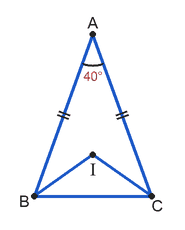
In the given figure, BI is the bisector of ∠ABC and CI is the bisector of ∠ACB. Find ∠BIC.
 Solve with AI
Written solution
Solution:
Concept: In an isosceles triangle the angles opposite the equal sides are equal. Sides with the same tick marks in a figure are equal. In an equilateral triangle all three sides are equal, so each angle is 60°. The three angles of every triangle add up to 180° (the angle sum property of a triangle). A bisector cuts an angle into two equal halves.
Step 1 — Find ∠B and ∠C.
AB and AC are marked equal, so ∠B and ∠C are equal; they share what is left after ∠A = 40°.
Step 2 — Halve them.
BI and CI bisect ∠B and ∠C, so ∠IBC and ∠ICB are each half of 70°.
Step 3 — Use the angle sum in triangle BIC.
The angles of triangle BIC add up to 180°.
Watch out: Use the HALF angles, 35° each, in triangle BIC, not the full 70°.
Therefore, ∠BIC = 110°.
- 233 marks
Question 23
In the given figure, express a in terms of b.
 Solve with AI
Written solution
Solution:
Concept: In an isosceles triangle the angles opposite the equal sides are equal. Sides with the same tick marks in a figure are equal. In an equilateral triangle all three sides are equal, so each angle is 60°. The three angles of every triangle add up to 180° (the angle sum property of a triangle). An exterior angle of a triangle (made by producing one side) equals the sum of the two interior opposite angles. An exterior angle and the interior angle next to it lie on a straight line, so they add up to 180° (a linear pair).
Step 1 — Find the angle at the right corner.
The base is produced at the right, so the interior angle there forms a linear pair with : it is .
Step 2 — Find the angle at the top.
The left side and the base are marked equal. The angle opposite the left side is at the right corner and the angle opposite the base is at the top, so the top angle is also .
Step 3 — Find the angle at the left corner.
The three angles add up to 180°.
Step 4 — Find a.
The left side is produced below the base, so and the left angle form a linear pair.
Watch out: The equal angles face the equal sides: the top angle faces the base, and the right angle faces the left side.
Therefore, a = 360° − 2b.
- 243 marks
Question 24
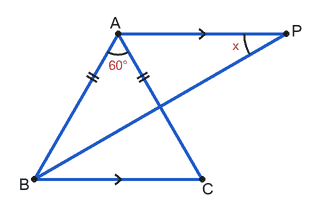
In Figure (i) BP bisects ∠ABC and AB = AC. Find x.
 Solve with AI
Written solution
Solution:
Concept: In an isosceles triangle the angles opposite the equal sides are equal. Sides with the same tick marks in a figure are equal. In an equilateral triangle all three sides are equal, so each angle is 60°. The three angles of every triangle add up to 180° (the angle sum property of a triangle). When a line crosses two parallel lines (marked with arrows), alternate angles are equal and corresponding angles are equal.
Given: BP bisects ∠ABC and AB = AC.
Step 1 — Find ∠B.
AB = AC, so ∠B and ∠C are equal and share what is left after ∠A = 60°.
Step 2 — Halve ∠B.
BP bisects ∠ABC, so ∠PBC is half of 60°.
Step 3 — Use the parallel lines.
AP ∥ BC (arrows), and BP crosses both, so ∠APB and ∠PBC are alternate angles. So .
Watch out: X is equal to HALF of ∠B, because BP is the bisector.
Therefore, x = 30°.
- 253 marks
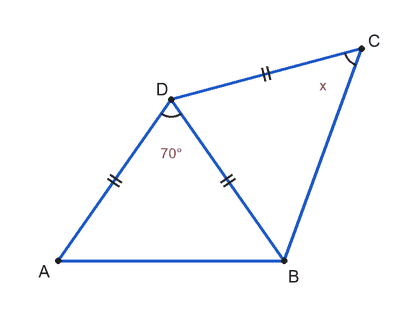
Question 25
Find x in Figure (ii).
Given : DA = DB = DC, BD bisects ∠ABC and ∠ADB = 70°.
 Solve with AI
Written solution
Solution:
Concept: In an isosceles triangle the angles opposite the equal sides are equal. Sides with the same tick marks in a figure are equal. In an equilateral triangle all three sides are equal, so each angle is 60°. The three angles of every triangle add up to 180° (the angle sum property of a triangle). A bisector cuts an angle into two equal halves.
Given: DA, DB and DC are equal, BD bisects ∠ABC and ∠ADB = 70°.
Step 1 — Use triangle ADB.
DA = DB, so ∠DAB and ∠DBA are equal and share what is left after ∠ADB = 70°.
Step 2 — Use the bisector.
BD bisects ∠ABC, so ∠DBC equals ∠DBA. Both are 55°.
Step 3 — Use triangle DBC.
DB = DC, so the angles opposite these sides are equal: ∠DCB equals ∠DBC. So .
Watch out: In triangle DBC the equal sides are DB and DC, so the equal angles are at C and B.
Therefore, x = 55°.
- 263 marks
Question 26
In each figure, given below, ABCD is a square and △BEC is an equilateral triangle.
(i)

(ii)
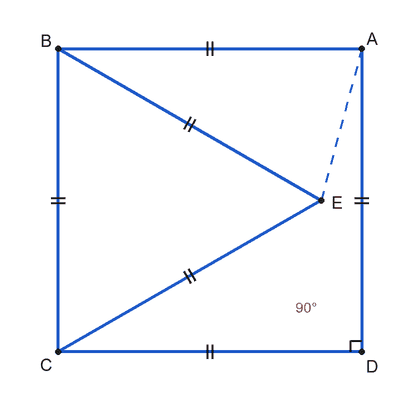
Find, in each case : (i) ∠ABE (ii) ∠BAE
Solve with AIWritten solution
Solution:
Concept: Every angle of a square is 90° and its sides are equal. In an isosceles triangle the angles opposite the equal sides are equal. Sides with the same tick marks in a figure are equal. In an equilateral triangle all three sides are equal, so each angle is 60°. The three angles of every triangle add up to 180° (the angle sum property of a triangle).
Given: ABCD is a square and triangle BEC is equilateral.
Step 1 — Equal sides.
BA = BC (sides of the square) and BC = BE (sides of the equilateral triangle), so BA = BE. Triangle ABE is isosceles, and its base angles ∠BAE and ∠BEA are equal.
Step 2 — Figure (i): ∠ABE.
E is outside the square, so ∠ABE is the square's 90° angle plus the triangle's 60° angle.
Step 3 — Figure (i): ∠BAE.
The two base angles of triangle ABE share what is left of 180°.
Step 4 — Figure (ii): ∠ABE.
E is inside the square, so ∠ABE is the square's 90° angle minus the triangle's 60° angle.
Step 5 — Figure (ii): ∠BAE.
Again the two base angles of triangle ABE share what is left of 180°.
Watch out: Check where E lies: outside the square we ADD 60° to 90°, inside we SUBTRACT it.
Therefore, in figure (i), ∠ABE is 150° and ∠BAE is 15°; in figure (ii), ∠ABE is 30° and ∠BAE is 75°.
- 273 marks
Question 27
In △ABC, BA and BC are produced. Find the angles a and b, if AB = BC.
 Solve with AI
Written solution
Solution:
Concept: In an isosceles triangle the angles opposite the equal sides are equal. Sides with the same tick marks in a figure are equal. In an equilateral triangle all three sides are equal, so each angle is 60°. The three angles of every triangle add up to 180° (the angle sum property of a triangle). An exterior angle of a triangle (made by producing one side) equals the sum of the two interior opposite angles. An exterior angle and the interior angle next to it lie on a straight line, so they add up to 180° (a linear pair).
Given: AB equals BC, ∠B is 54°, and BA and BC are produced.
Step 1 — Find the base angles.
AB = BC, so the angles opposite them, ∠BCA and ∠BAC, are equal. They share what is left after ∠B = 54°.
Step 2 — Use the linear pairs.
BA is produced beyond A, so and ∠BAC form a linear pair; BC is produced beyond C, so and ∠BCA form a linear pair.
In the same way, is 180° − 63° = 117°.
Watch out: AB = BC, so the equal angles are at A and C (opposite those sides), not at B.
Therefore, a and b are 117° each.
- 281 mark
Question 28
The value of angle x is :
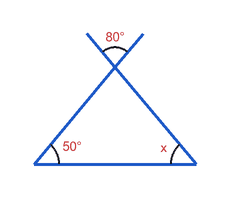 Solve with AI
Answer
(A) 30°
- Correct
(B) 50°
(C) 40°
(D) 80°
Answer: (B) 50°
Concept: Where two straight lines cross, the vertically opposite angles are equal. The three angles of every triangle add up to 180° (the angle sum property of a triangle).
Step 1 — Use vertically opposite angles.
The two slanting lines cross above the base. The angle of the triangle at the crossing is vertically opposite the marked 80°, so it is also 80°.
Step 2 — Use the angle sum.
The triangle's angles are 80°, 50° and .
Watch out: The 80° is outside the triangle, but it equals the angle inside.
Why the other options are wrong:
- (A) 30°: If were 30°, the angles would add up to only 160° (80° + 50° + 30°), not 180°.
- (C) 40°: If were 40°, the angles would add up to only 170°, not 180°.
- (D) 80°: 80° is the angle at the crossing, not .
Therefore, x = 50°, option (B).
- 291 mark
Question 29
The value of angle x is :
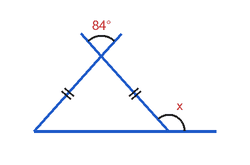 Solve with AI
Answer
(A) 84°
(B) 96°
- Correct
(C) 132°
(D) 48°
Answer: (C) 132°
Concept: Where two straight lines cross, the vertically opposite angles are equal. In an isosceles triangle the angles opposite the equal sides are equal. Sides with the same tick marks in a figure are equal. In an equilateral triangle all three sides are equal, so each angle is 60°. The three angles of every triangle add up to 180° (the angle sum property of a triangle). An exterior angle of a triangle (made by producing one side) equals the sum of the two interior opposite angles. An exterior angle and the interior angle next to it lie on a straight line, so they add up to 180° (a linear pair).
Step 1 — Use vertically opposite angles.
The top angle of the triangle is vertically opposite the marked 84°, so it is 84°.
Step 2 — Find the base angles.
The two marked sides are equal, so the base angles are equal.
Step 3 — Use the linear pair.
The base is produced at the right, so and the base angle there form a linear pair.
Watch out: X is OUTSIDE the triangle, so it is 180° minus the base angle.
Why the other options are wrong:
- (A) 84°: 84° is the top angle of the triangle, not .
- (B) 96°: 96° is 180° − 84°, the sum of the two base angles, not .
- (D) 48°: 48° is the interior base angle; is the angle outside it.
Therefore, x = 132°, option (C).
- 301 mark
Question 30
One angle of a triangle is 60° and the other two angles are in the ratio 1 : 2; the bigger of these two angles is :
Solve with AIAnswer
(A) 60°
(B) 90°
(C) 40°
- Correct
(D) 80°
Answer: (D) 80°
Concept: The three angles of every triangle add up to 180° (the angle sum property of a triangle). If angles are in a given ratio, we write them as the ratio's numbers times a common multiplier and use the fact that they add up to the known total.
Step 1 — Find the sum of the other two angles.
The three angles add up to 180°.
Step 2 — Share 120° in the ratio 1 : 2.
We write the two angles as and .
Watch out: The 60° is not part of the ratio; share only 120°.
Why the other options are wrong:
- (A) 60°: 60° is the given angle, not one of the two in the ratio.
- (B) 90°: If the bigger angle were 90°, the smaller would be 45°, and 60° + 45° + 90° = 195°, not 180°.
- (C) 40°: 40° is the smaller of the two angles.
Therefore, the bigger angle is 80°, option (D).
- 311 mark
Question 31
The angles of a triangle are in the ratio 2 : 3 : 1; the smallest angle is :
Solve with AIAnswer
- Correct
(A) 30°
(B) 45°
(C) 60°
(D) none of these
Answer: (A) 30°
Concept: The three angles of every triangle add up to 180° (the angle sum property of a triangle). If angles are in a given ratio, we write them as the ratio's numbers times a common multiplier and use the fact that they add up to the known total.
Step 1 — Write the angles.
In the ratio 2 : 3 : 1 the angles are , and .
Step 2 — Use the angle sum.
The angles add up to 180°.
So the angles are 60°, 90° and 30°. The smallest is itself: 30°.
Watch out: The smallest angle goes with the smallest ratio number, 1.
Why the other options are wrong:
- (B) 45°: If the smallest angle were 45°, the angles would be 90°, 135° and 45°, which add up to 270°.
- (C) 60°: 60° is the angle, not the smallest.
- (D) none of these: The correct value, 30°, is one of the options.
Therefore, the smallest angle is 30°, option (A).
- 321 mark
Question 32
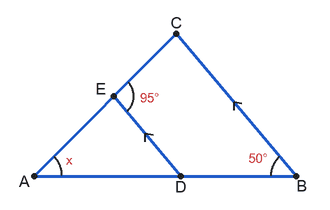
In the given figure, DE is parallel to BC. The value of x is :
 Solve with AI
Answer
(A) 50°
- Correct
(B) 45°
(C) 40°
(D) 35°
Answer: (B) 45°
Concept: When a line crosses two parallel lines (marked with arrows), alternate angles are equal and corresponding angles are equal. The three angles of every triangle add up to 180° (the angle sum property of a triangle). Angles on a straight line add up to 180°.
Step 1 — Use corresponding angles.
DE ∥ BC and AB crosses both, so ∠ADE and ∠ABC are corresponding angles: ∠ADE is 50°.
Step 2 — Use the linear pair at E.
A, E and C lie on one line, so ∠AED forms a linear pair with the 95° angle CED.
Step 3 — Use the angle sum in triangle ADE.
The angles of triangle ADE add up to 180°.
Watch out: 95° is outside triangle ADE; use 85°, the angle inside it.
Why the other options are wrong:
- (A) 50°: 50° is ∠ADE (equal to ∠B), not .
- (C) 40°: 40° would need ∠AED = 90°, but ∠AED is 85°.
- (D) 35°: 35° comes from using 95° inside triangle ADE (180° − 50° − 95°), but 95° is the angle CED outside it.
Therefore, x = 45°, option (B).
- 331 mark
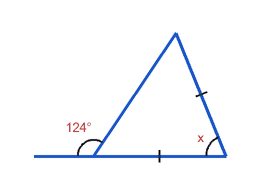
Question 33
The value of angle x is :
 Solve with AI
Answer
(A) 76°
- Correct
(B) 68°
(C) 56°
(D) none of these
Answer: (B) 68°
Concept: In an isosceles triangle the angles opposite the equal sides are equal. Sides with the same tick marks in a figure are equal. In an equilateral triangle all three sides are equal, so each angle is 60°. The three angles of every triangle add up to 180° (the angle sum property of a triangle). Angles on a straight line add up to 180°.
Step 1 — Find the angle at the left.
The base is produced at the left, so the interior angle there forms a linear pair with 124°.
Step 2 — Use the equal sides.
The base and the right side are marked equal. The angle opposite the base is at the top, and the angle opposite the right side is at the left, so the top angle is also 56°.
Step 3 — Use the angle sum.
The angles add up to 180°.
Watch out: X is opposite neither marked side, so it is NOT one of the two equal angles.
Note: The exterior angle at the left is taken as 124°, the value that fits the answer 68° given in the book.
Why the other options are wrong:
- (A) 76°: If were 76°, the angles would add up to 188° (56° + 56° + 76°), not 180°.
- (C) 56°: 56° is the angle at the left (and at the top), not .
- (D) none of these: The correct value, 68°, is one of the options.
Therefore, x = 68°, option (B).
- 341 mark
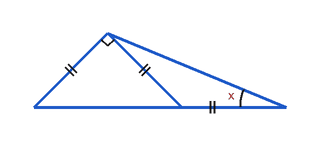
Question 34
The value of angle x is :
 Solve with AI
Answer
(A) 45°
(B) 25°
(C) 30°
- Correct
(D) none of these
Answer: (D) none of these
Concept: In an isosceles triangle the angles opposite the equal sides are equal. Sides with the same tick marks in a figure are equal. In an equilateral triangle all three sides are equal, so each angle is 60°. The three angles of every triangle add up to 180° (the angle sum property of a triangle). Angles on a straight line add up to 180°.
Step 1 — Use the left triangle.
The left triangle has a right angle at the top, and its two arms are marked equal, so its other two angles are 45° each. One of them is at the foot of the inner line, on the base.
Step 2 — Use the linear pair.
On the straight base, the angle on the other side of the inner line is what is left of 180°.
Step 3 — Use the right triangle.
In the right triangle, the inner line and the next part of the base are marked equal, so the angles opposite them are equal: and the angle at the top of this triangle. They share what is left after 135°.
So is 22.5° (that is, 22° 30′). This is not among (A), (B) and (C).
Watch out: The 135° angle is the one inside the right triangle; halve what is left of 180°, not 135°.
Why the other options are wrong:
- (A) 45°: 45° is an angle of the left triangle, not .
- (B) 25°: If were 25°, the angle at the foot of the inner line would be 130° (180° − 50°), but it is 135°.
- (C) 30°: If were 30°, that angle would be 120°, but it is 135°.
Therefore, x = 22.5°, which is none of (A)–(C), so the answer is option (D).
- 351 mark
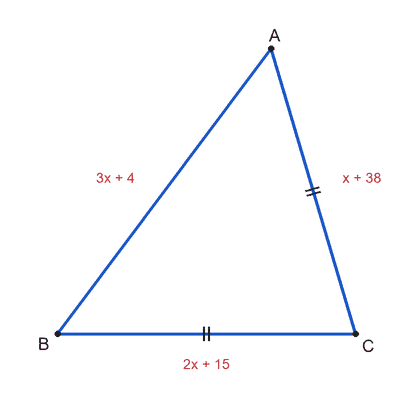
Question 35
The length of AB is :
 Solve with AI
Answer
(A) 23 unit
(B) 46 unit
(C) 61 unit
- Correct
(D) 73 unit
Answer: (D) 73 unit
Concept: Sides with the same tick marks in a figure are equal; we put the equal lengths equal to each other and solve for .
Step 1 — Use the equal sides.
AC and BC carry the same marks, so they are equal.
Step 2 — Find AB.
We put into AB.
Watch out: After finding , put it into AB; itself is not the length.
Why the other options are wrong:
- (A) 23 unit: 23 is the value of , not the length of AB.
- (B) 46 unit: 46 is , not .
- (C) 61 unit: 61 is the length of AC and of BC (), not of AB.
Therefore, AB = 73 units, option (D).
- 361 mark
Question 36
The value of angle x is :
 Solve with AI
Answer
(A) 35°
(B) 45°
- Correct
(C) 55°
(D) 65°
Answer: (C) 55°
Concept: The three angles of every triangle add up to 180° (the angle sum property of a triangle). Where two straight lines cross, the vertically opposite angles are equal. Angles on a straight line add up to 180°.
Step 1 — Name the points.
Let T be the top of the vertical line and F its foot on the base. Let P be the point where the slanting line from the bottom left corner meets the long side, and Q the point where it crosses the vertical line. The 50° is ∠QTP at T and the 85° is the angle at P below the slanting line.
Step 2 — Use the linear pair at P.
T, P and the right end of the base lie on one straight side, so ∠TPQ forms a linear pair with 85°.
Step 3 — Use the angle sum in triangle TPQ.
The angles of triangle TPQ add up to 180°.
Step 4 — Use vertically opposite angles.
At Q, the angle inside the lower left triangle is vertically opposite ∠TQP, so it is also 35°. That triangle has a right angle at F.
Watch out: 85° is the angle below the slanting line; inside triangle TPQ the angle at P is 95°.
Why the other options are wrong:
- (A) 35°: 35° is the angle at the crossing Q, not .
- (B) 45°: 45° would need the angle at Q to be 45°, but it is 35°.
- (D) 65°: 65° would need the angle at Q to be 25°, but it is 35°.
Therefore, x = 55°, option (C).
- 371 mark
Question 37
The value of angle x is :
 Solve with AI
Answer
(A) 54°
(B) 126°
(C) 108°
- Correct
(D) 306°
Answer: (D) 306°
Concept: In an isosceles triangle the angles opposite the equal sides are equal. Sides with the same tick marks in a figure are equal. In an equilateral triangle all three sides are equal, so each angle is 60°. When a line crosses two parallel lines (marked with arrows), alternate angles are equal and corresponding angles are equal. A reflex angle is the angle the long way round: 360° minus the ordinary angle.
Step 1 — Use the small triangle at the top.
The two marked sides of the small triangle are its left side and its base on the upper line; they meet at the 72° angle. So the angles opposite them are equal.
So the right side meets the upper line at 54°.
Step 2 — Use the parallel lines.
The two lines carry arrows, so they are parallel. The right side crosses both, so it meets the lower line at 54° too (corresponding angles).
Step 3 — Find the reflex angle.
The marked goes the long way round that corner, so it is the reflex angle.
Watch out: The arc of goes almost all the way round, so is more than 180°.
Why the other options are wrong:
- (A) 54°: 54° is the ordinary angle at that corner, not the reflex angle marked.
- (B) 126°: 126° is 180° − 54°, the angle on a straight line, not the reflex angle.
- (C) 108°: 108° is , which is not an angle at that corner.
Therefore, x = 306°, option (D).
- 381 mark
Question 38
Statement 1 : In an obtuse angled triangle, two angles of the triangle are always acute.
Statement 2 : A triangle with one or more obtuse angle (more than 90°) is called an obtuse-angled triangle.
Which of the following options is correct?
Solve with AIAnswer
(A) Both the statements are true.
(B) Both the statements are false.
- Correct
(C) Statement 1 is true, and statement 2 is false.
(D) Statement 1 is false, and statement 2 is true.
Answer: (C) Statement 1 is true, and statement 2 is false.
Concept: The three angles of every triangle add up to 180° (the angle sum property of a triangle). An obtuse angle is more than 90° and less than 180°; an acute angle is less than 90°.
Step 1 — Judge statement 1.
An obtuse angle is more than 90°, so the other two angles share less than 90°. Each of them is therefore less than 90°, that is, acute. Statement 1 is true.
Step 2 — Judge statement 2.
Two obtuse angles would already add up to more than 180°, so a triangle has at most ONE obtuse angle. “One or more” is therefore wrong, and statement 2 is false as written.
Watch out: An obtuse-angled triangle has exactly one obtuse angle.
Why the other options are wrong:
- (A): Statement 2 is false, so both cannot be true.
- (B): Statement 1 is true: the other two angles are always acute.
- (D): This reverses the verdicts: statement 1 is true and statement 2 is false.
Therefore, statement 1 is true and statement 2 is false, option (C).
- 391 mark
Question 39
Assertion (A) : A triangle be formed with two interior angles 60°, 50° and with opposite exterior angle 120°.
Reason (R) : Exterior angle of a triangle is equal to the sum of interior opposite angles.
Solve with AIAnswer
(A) (1) A is true, R is false.
- Correct
(B) (2) A is false, R is true.
(C) (3) Both A and R are true.
(D) (4) Both A and R are false.
Answer: (B) (2) A is false, R is true.
Concept: In an Assertion–Reason item we judge A and R separately and then choose the code that matches both verdicts. An exterior angle of a triangle (made by producing one side) equals the sum of the two interior opposite angles. An exterior angle and the interior angle next to it lie on a straight line, so they add up to 180° (a linear pair).
Step 1 — Judge the Reason.
R is the exterior angle property of a triangle, so R is true.
Step 2 — Judge the Assertion.
By R, the exterior angle opposite the interior angles 60° and 50° must be their sum.
It cannot be 120°, so no such triangle can be formed, and A is false.
Step 3 — Choose the code.
A is false and R is true. This matches code (2).
Why the other options are wrong:
- (A): Code (1) says A is true and R is false; the verdicts are the other way round.
- (C): Code (3) says A is true, but the exterior angle must be 110°.
- (D): Code (4) says R is false, but R is the exterior angle property.
Therefore, A is false and R is true, option (B).
- 401 mark
Question 40
Assertion (A) : In the given figure . BI and CI are the bisectors of ∠ABC and ∠ACB respectively. Then △BIC is an obtuse angled triangle.
Reason (R) : If any two sides of a given triangle are equal, the angles opposite to these sides are also equal.
Solve with AIAnswer
(A) (1) A is true, R is false.
(B) (2) A is false, R is true.
- Correct
(C) (3) Both A and R are true.
(D) (4) Both A and R are false.
Answer: (C) (3) Both A and R are true.
Concept: In an Assertion–Reason item we judge A and R separately and then choose the code that matches both verdicts. In an isosceles triangle the angles opposite the equal sides are equal. Sides with the same tick marks in a figure are equal. In an equilateral triangle all three sides are equal, so each angle is 60°. The three angles of every triangle add up to 180° (the angle sum property of a triangle).
Step 1 — Find ∠B and ∠C.
AB = AC, so ∠B and ∠C are equal and share what is left after ∠A = 40°.
Step 2 — Judge the Assertion.
BI and CI bisect ∠B and ∠C, so ∠IBC and ∠ICB are 35° each.
110° is obtuse, so triangle BIC is obtuse-angled, and A is true.
Step 3 — Judge the Reason.
R is the property of an isosceles triangle (angles opposite equal sides are equal), so R is true.
Step 4 — Choose the code.
A is true and R is true. This matches code (3).
Watch out: Use the half angles, 35° each, in triangle BIC.
Why the other options are wrong:
- (A): Code (1) says R is false, but R is the isosceles triangle property.
- (B): Code (2) says A is false, but ∠BIC is 110°, which is obtuse.
- (D): Code (4) says both are false, but both are true.
Therefore, both A and R are true, option (C).
- 411 mark
Question 41
Assertion (A) : In the following figure, it is not possible to express a in terms of b.
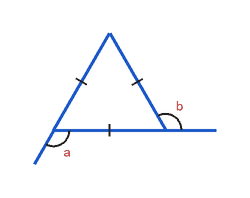
Reason (R) : An equilateral triangle is always an isosceles triangle but the converse is not always true.
Solve with AIAnswer
(A) (1) A is true, R is false.
- Correct
(B) (2) A is false, R is true.
(C) (3) Both A and R are true.
(D) (4) Both A and R are false.
Answer: (B) (2) A is false, R is true.
Concept: In an Assertion–Reason item we judge A and R separately and then choose the code that matches both verdicts. In an isosceles triangle the angles opposite the equal sides are equal. Sides with the same tick marks in a figure are equal. In an equilateral triangle all three sides are equal, so each angle is 60°.
Step 1 — Judge the Assertion.
All three sides carry the same mark, so the triangle is equilateral and each angle is 60°. Both and form a linear pair with a 60° angle.
In the same way is 120°, so . We CAN express in terms of , so A is false.
Step 2 — Judge the Reason.
An equilateral triangle has all three sides equal, so it certainly has two equal sides and is isosceles. An isosceles triangle need not have the third side equal too. So R is true.
Step 3 — Choose the code.
A is false and R is true. This matches code (2).
Why the other options are wrong:
- (A): Code (1) says A is true and R is false; the verdicts are the other way round.
- (C): Code (3) says A is true, but does express in terms of .
- (D): Code (4) says R is false, but every equilateral triangle is isosceles.
Therefore, A is false and R is true, option (B).
- 421 mark
Question 42
Assertion (A) : In △ABC, ∠ABC is 145°. AC is the longest side of the triangle.
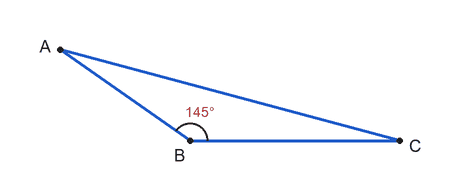
Reason (R) : The greater angle of a triangle has a greater side opposite to it.
What Class 7 Maths Ch 17 covers
The sections of the chapter, in the order the book takes them. Every question above comes from one of these.
- 01Review
- 02Classification of Triangles
- 03Important Properties of an Isosceles Triangle
More ways to study this chapter
The same chapter asked three other ways. Practise it, revise it, and see what the board has set on Ch 17 before.
Class 7 Maths Ch 17 questions students ask
How many questions are there in Class 7 Maths Ch 17?
42 questions. Every one is solved step by step on this page.
Are these Class 7 Maths solutions free?
Yes. Every question and its full working is free to read, with no account needed.
Can I download the Class 7 Maths Ch 17 solutions as a PDF?
There is no PDF to download. Every solution is on this page instead, which means it is searchable, always the current syllabus, and readable on a phone. Use your browser's print option if you want it on paper.