
Question 263 marksMedium
In each figure, given below, ABCD is a square and △BEC is an equilateral triangle.
(i)

(ii)
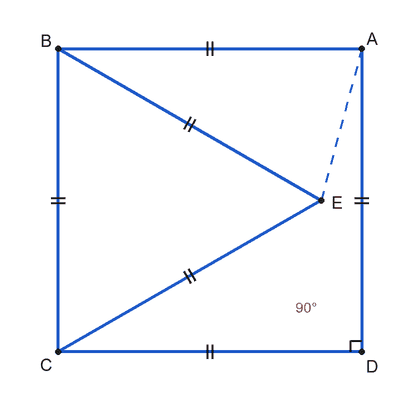
Find, in each case : (i) ∠ABE (ii) ∠BAE
Confirming your payment
Sign up now and get 250 free tokens.
Triangles · Question 26 of 42
In each figure, given below, ABCD is a square and △BEC is an equilateral triangle.
(i)
(ii)
Find, in each case : (i) ∠ABE (ii) ∠BAE
Solution:
Concept: Every angle of a square is 90° and its sides are equal. In an isosceles triangle the angles opposite the equal sides are equal. Sides with the same tick marks in a figure are equal. In an equilateral triangle all three sides are equal, so each angle is 60°. The three angles of every triangle add up to 180° (the angle sum property of a triangle).
Given: ABCD is a square and triangle BEC is equilateral.
Step 1 — Equal sides.
BA = BC (sides of the square) and BC = BE (sides of the equilateral triangle), so BA = BE. Triangle ABE is isosceles, and its base angles ∠BAE and ∠BEA are equal.
Step 2 — Figure (i): ∠ABE.
E is outside the square, so ∠ABE is the square's 90° angle plus the triangle's 60° angle.
Step 3 — Figure (i): ∠BAE.
The two base angles of triangle ABE share what is left of 180°.
Step 4 — Figure (ii): ∠ABE.
E is inside the square, so ∠ABE is the square's 90° angle minus the triangle's 60° angle.
Step 5 — Figure (ii): ∠BAE.
Again the two base angles of triangle ABE share what is left of 180°.
Watch out: Check where E lies: outside the square we ADD 60° to 90°, inside we SUBTRACT it.
Therefore, in figure (i), ∠ABE is 150° and ∠BAE is 15°; in figure (ii), ∠ABE is 30° and ∠BAE is 75°.