
Question 411 markMCQEasy
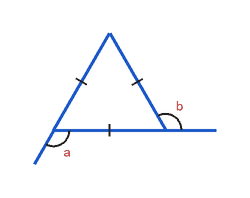
Assertion (A) : In the following figure, it is not possible to express a in terms of b.
Reason (R) : An equilateral triangle is always an isosceles triangle but the converse is not always true.
Confirming your payment
Sign up now and get 250 free tokens.
Triangles · Question 41 of 42
Assertion (A) : In the following figure, it is not possible to express a in terms of b.
Reason (R) : An equilateral triangle is always an isosceles triangle but the converse is not always true.
(A) (1) A is true, R is false.
(B) (2) A is false, R is true.
(C) (3) Both A and R are true.
(D) (4) Both A and R are false.
Answer: (B) (2) A is false, R is true.
Concept: In an Assertion–Reason item we judge A and R separately and then choose the code that matches both verdicts. In an isosceles triangle the angles opposite the equal sides are equal. Sides with the same tick marks in a figure are equal. In an equilateral triangle all three sides are equal, so each angle is 60°.
Step 1 — Judge the Assertion.
All three sides carry the same mark, so the triangle is equilateral and each angle is 60°. Both and form a linear pair with a 60° angle.
In the same way is 120°, so . We CAN express in terms of , so A is false.
Step 2 — Judge the Reason.
An equilateral triangle has all three sides equal, so it certainly has two equal sides and is isosceles. An isosceles triangle need not have the third side equal too. So R is true.
Step 3 — Choose the code.
A is false and R is true. This matches code (2).
Why the other options are wrong:
Therefore, A is false and R is true, option (B).