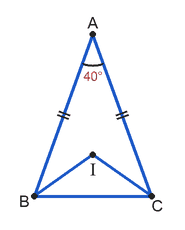
Answer: (C) (3) Both A and R are true.
Concept: In an Assertion–Reason item we judge A and R separately and then choose the code that matches both verdicts. In an isosceles triangle the angles opposite the equal sides are equal. Sides with the same tick marks in a figure are equal. In an equilateral triangle all three sides are equal, so each angle is 60°. The three angles of every triangle add up to 180° (the angle sum property of a triangle).
Step 1 — Find ∠B and ∠C.
AB = AC, so ∠B and ∠C are equal and share what is left after ∠A = 40°.
∠B=2180∘−40∘=2140∘=70∘
Step 2 — Judge the Assertion.
BI and CI bisect ∠B and ∠C, so ∠IBC and ∠ICB are 35° each.
∠BIC=180∘−(35∘+35∘)=180∘−70∘=110∘
110° is obtuse, so triangle BIC is obtuse-angled, and A is true.
Step 3 — Judge the Reason.
R is the property of an isosceles triangle (angles opposite equal sides are equal), so R is true.
Step 4 — Choose the code.
A is true and R is true. This matches code (3).
Watch out: Use the half angles, 35° each, in triangle BIC.
Why the other options are wrong:
- (A): Code (1) says R is false, but R is the isosceles triangle property.
- (B): Code (2) says A is false, but ∠BIC is 110°, which is obtuse.
- (D): Code (4) says both are false, but both are true.
Therefore, both A and R are true, option (C).