
Question 133 marksMedium
Find the unknown angles in the given figures :
(i)

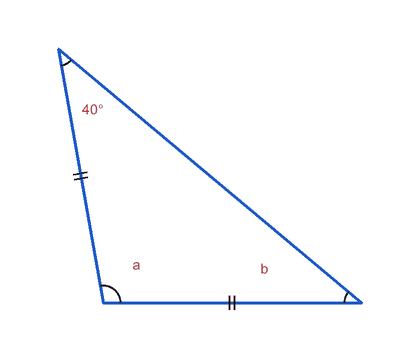
(ii)
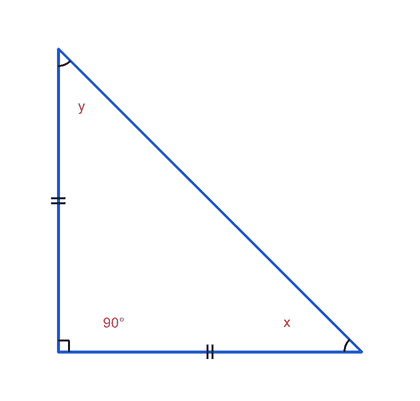
(iii)
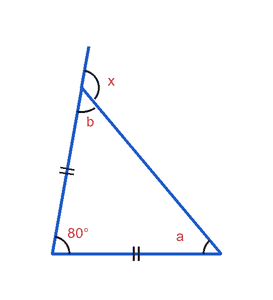
(iv)
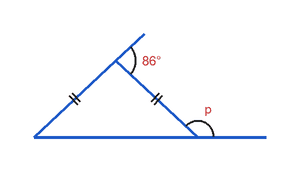
(v)
(vi)

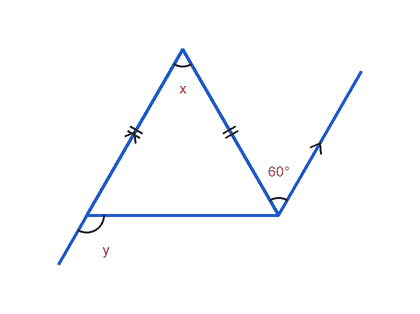
(vii)
Confirming your payment
Sign up now and get 250 free tokens.
Triangles · Question 13 of 42
Find the unknown angles in the given figures :
(i)
(ii)
(iii)
(iv)
(v)
(vi)
(vii)
Solution:
Concept: In an isosceles triangle the angles opposite the equal sides are equal. Sides with the same tick marks in a figure are equal. In an equilateral triangle all three sides are equal, so each angle is 60°. The three angles of every triangle add up to 180° (the angle sum property of a triangle).
Step 1 — Part (i).
The two marked sides meet at the 80° angle, so the angles opposite them, and , are equal. They share what is left of 180°.
So and are each 50°.
Step 2 — Part (ii).
The left side and the base are marked equal. The angle opposite the left side is (bottom right), and the angle opposite the base is 40° (top). So .
Step 3 — Part (iii).
The two arms of the right angle are marked equal, so the angles opposite them, and , are equal. They share 90°.
So and are each 45°.
Step 4 — Part (iv).
The left side and the base are marked equal, so the angles opposite them are equal: (bottom right) and (inside the triangle at the top). They share what is left after 80°.
The left side is produced past the top, so and form a linear pair.
Step 5 — Part (v).
The left side is produced past the top, so the interior angle at the top forms a linear pair with 86°. The two marked sides meet at the top, so the two base angles are equal.
The base is produced at the right, so and the base angle there form a linear pair.
Step 6 — Part (vi).
A line from the top meets the base. In the right-hand triangle, this line and the right part of the base are marked equal. The angle opposite the line is (at the right corner) and the angle opposite the right part of the base is the 35° at the top. So is 35°.
In the whole triangle the top angle is made of 60° and 35°.
Step 7 — Part (vii).
The line through the bottom right corner is parallel to the left side (arrows), and the right side crosses both. So and the 60° are alternate angles, and . The two marked sides meet at , so each base angle is (180° − 60°) ÷ 2 = 60°. The left side is produced below the base, so and the base angle at the left form a linear pair.
Watch out: The equal angles are the ones OPPOSITE the equal sides; find which vertex faces each marked side.
Therefore, (i) x and y are 50° each; (ii) a is 100° and b is 40°; (iii) x and y are 45° each; (iv) x is 130°, and a and b are 50° each; (v) p is 137°; (vi) m is 35° and n is 50°; (vii) x is 60° and y is 120°.