
Question 143 marksMedium
Apply the properties of isosceles and equilateral triangles to find the unknown angles in the given figures :
(i)

(ii)
(iii)

(iv)

(v)
(vi)
Confirming your payment
Sign up now and get 250 free tokens.
Triangles · Question 14 of 42
Apply the properties of isosceles and equilateral triangles to find the unknown angles in the given figures :
(i)
(ii)
(iii)
(iv)
(v)
(vi)
Solution:
Concept: In an isosceles triangle the angles opposite the equal sides are equal. Sides with the same tick marks in a figure are equal. In an equilateral triangle all three sides are equal, so each angle is 60°. The three angles of every triangle add up to 180° (the angle sum property of a triangle). When a line crosses two parallel lines (marked with arrows), alternate angles are equal and corresponding angles are equal.
Step 1 — Part (i).
A line from the top meets the base at D. In the right-hand triangle the right side and the right part of the base carry two ticks, so the angles opposite them are equal: the angle at D (inside this triangle) equals the 70° at the top. Then comes from the angle sum.
The angle at D in the left-hand triangle forms a linear pair with 70°, so it is 110°. Its two single-tick sides are equal, so its other two angles (one of them ) are equal.
Step 2 — Part (ii).
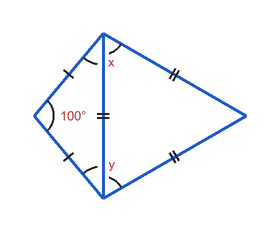
In the left triangle the two single-tick sides meet at 100°, so each of its other angles is (180° − 100°) ÷ 2 = 40°. The right triangle has all three sides equal, so each of its angles is 60°. Each of and is made of one angle from each triangle.
In the same way, is 40° + 60° = 100°.
Step 3 — Part (iii).
The two horizontal lines are parallel. At the bottom left, and the 50° at the top are alternate angles, so . At the bottom right, the interior angle forms a linear pair with 130°, so it is 50°; and this angle are alternate angles, so . The angles , and lie on the straight top line.
Step 4 — Part (iv).
In the upper triangle the two single-tick sides meet at 30°, so each base angle is (180° − 30°) ÷ 2 = 75°. The lower triangle has a right angle with equal arms (two ticks), so each of its other angles is 45°; one of them is . The angle is made of a 75° angle and a 45° angle.
Step 5 — Part (v).
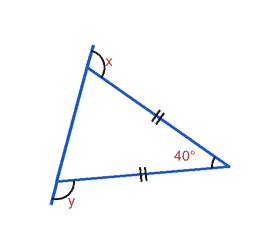
The two marked sides meet at 40°, so each of the other two angles is (180° − 40°) ÷ 2 = 70°. The left side is produced at both ends, so and each form a linear pair with a 70° angle.
In the same way, is 180° − 70° = 110°.
Step 6 — Part (vi).
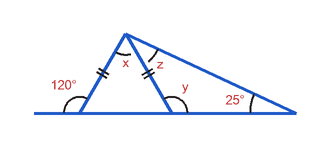
The base is produced at the left, so the interior angle there forms a linear pair with 120°, giving 60°. The two marked sides of the left triangle are equal, so the angle at their foot on the base is also 60°, and then is 180° − 60° − 60° = 60°. Next, forms a linear pair with that 60°, and comes from the angle sum of the right-hand triangle.
Watch out: An angle split by a line is the SUM of its two parts; find each part in its own triangle.
Therefore, (i) x is 40° and y is 35°; (ii) x and y are 100° each; (iii) p is 50°, x is 80° and y is 50°; (iv) x is 120° and y is 45°; (v) x and y are 110° each; (vi) x is 60°, y is 120° and z is 35°.