
Opening your dashboard
Class 7 Maths Chapter 17 Triangles: Practice Questions
47 questions on Chapter 17, each worked through on its own page with the AI tutor. Class 7 Maths, ICSE 2026-27.
47 questions
1–5 marks · Mixed difficulty
- 11 mark
Question 1
Bloom's level: Remember
The three sides and the three angles of a triangle are together called its :
- 21 mark
Question 2
Bloom's level: Remember
Three points P, Q and R can be joined to form a triangle only when the points are :
- 31 mark
Question 3
Bloom's level: Remember
In a right-angled triangle, the side opposite to the right angle is called the :
- 41 mark
Question 4
Bloom's level: Understand
Which of the following statements about an exterior angle of a triangle is always true?
- 51 mark
Question 5
Bloom's level: Understand
A triangle has angles , and . It is :
- 61 mark
Question 6
Bloom's level: Understand
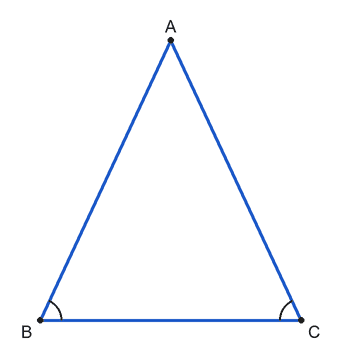
In , . Which two sides of the triangle must be equal?
- 71 mark
Question 7
Bloom's level: Apply
The angles of a triangle are , and . The largest angle of the triangle is :
- 81 mark
Question 8
Bloom's level: Apply
In , and . Then is :

- 91 mark
Question 9
Bloom's level: Analyse
The angles of a triangle are in the ratio . With regard to its angles, the triangle is :
- 101 mark
Question 10
Bloom's level: Understand
Assertion (A) : A triangle cannot have two right angles.
Reason (R) : The sum of the three interior angles of a triangle is .
- 111 mark
Question 11
Bloom's level: Analyse
Assertion (A) : Every equilateral triangle is also an isosceles triangle.
Reason (R) : In every isosceles triangle, each angle is .
- 121 mark
Question 12
Bloom's level: Evaluate
Assertion (A) : A triangle with angles , and is an acute-angled triangle.
Reason (R) : In an obtuse-angled triangle, the other two angles are always acute.
- 131 mark
Question 13
Bloom's level: Remember
What is an exterior angle of a triangle? State how it is related to its interior opposite angles.
- 141 mark
Question 14
Bloom's level: Understand
Can a right-angled triangle be equilateral? Give a reason.
- 152 marks
Question 15
Bloom's level: Understand
Explain why each base angle of an isosceles right-angled triangle is .
- 162 marks
Question 16
Bloom's level: Apply
In , side is produced to and .
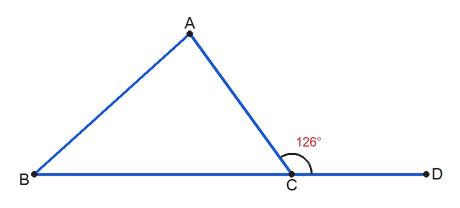
If , find , and .
- 172 marks
Question 17
Bloom's level: Apply
Each base angle of an isosceles triangle is less than twice its vertical angle. Find all the angles of the triangle.
- 182 marks
Question 18
Bloom's level: Apply
In , and . Find all three angles.

- 192 marks
Question 19
Bloom's level: Analyse
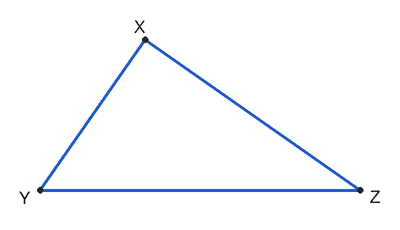
In , . What kind of triangle is with regard to its angles? Justify your answer.
- 202 marks
Question 20
Bloom's level: Apply
Side of is produced on both sides. The exterior angle formed at is and the exterior angle formed at is .
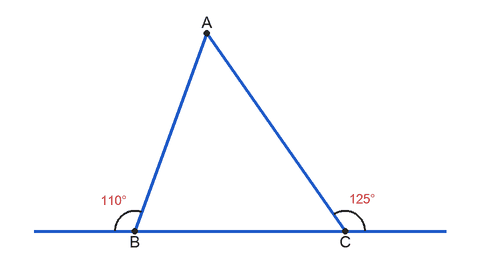
Find the three angles of the triangle and name the triangle with regard to its sides.
- 212 marks
Question 21
Bloom's level: Evaluate
Aman says, "If one angle of an isosceles triangle is , then its angles must be , and ." Is Aman fully correct? Justify your answer.
- 221 mark
Question 22
Bloom's level: Understand
Riya marks three points P, Q and R on a straight line and joins PQ, QR and RP. Explain why she does not get a triangle.
- 233 marks
Question 23
Bloom's level: Apply
In the given figure, side of is produced to . , and .
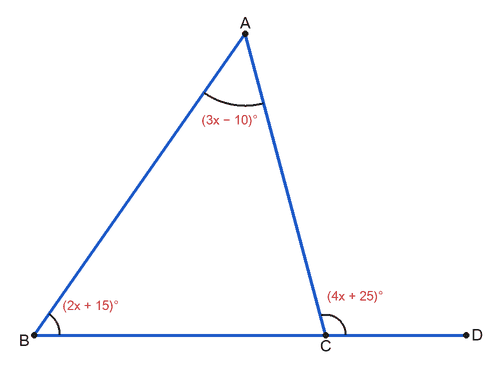
Find :
(i) the value of
(ii) and
(iii)
- 244 marks
Question 24
Bloom's level: Apply
In the given figure, and side is produced to so that . is the bisector of and meets at .

Find :
(i) and
(ii)
(iii) and
- 254 marks
Question 25
Bloom's level: Analyse
In the given figure, is a point on side of . , and .
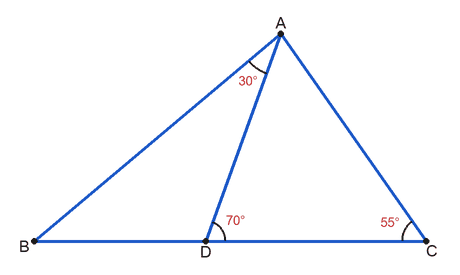
(i) Find .
(ii) Find and .
(iii) Which two sides of are equal? Give a reason.
- 265 marks
Question 26
Bloom's level: Analyse
Case study: The front of a hut has an A-shaped roof. The two slanting rafters are of equal length and meet at the top (the ridge); the floor beam joins their lower ends, so the rafters and the beam form an isosceles triangle. In the first design, the angle at the ridge is .
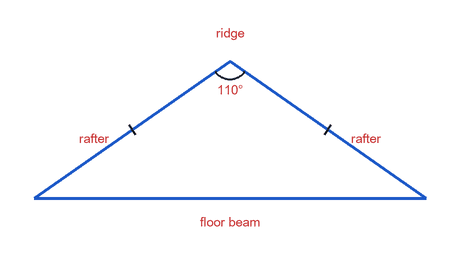
(a) Name the triangle formed with regard to its sides and with regard to its angles.
(b) Find the angle each rafter makes with the floor beam.
(c) For a steeper roof, the carpenter wants each rafter to make with the beam. Find the new ridge angle. In general, if each base angle is increased by , how does the ridge angle change? Explain.
- 274 marks
Question 27
Bloom's level: Apply
Case study: A ladder leans against a vertical wall. The wall, the level ground and the ladder form a right-angled triangle with the right angle where the wall meets the ground.
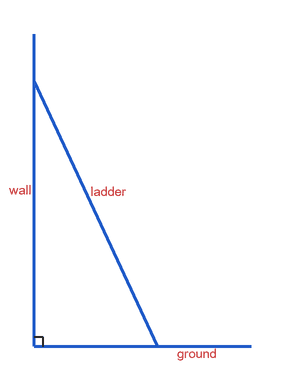
(a) If the ladder makes an angle of with the ground, find the angle it makes with the wall.
(b) Which side of this triangle is the hypotenuse? Give a reason.
(c) The ladder is now moved so that its angle with the ground becomes 4 times its angle with the wall. Find both angles.
- 284 marks
Question 28
Bloom's level: Evaluate
An exterior angle of a triangle is and its two interior opposite angles are in the ratio . Mohan solved it like this :
Interior angle next to the exterior angle .
So the two interior opposite angles add up to : , , ...
(i) Find the mistake in Mohan's working.
(ii) Solve the problem correctly and find all three angles of the triangle.
(iii) Check your answer in two different ways.
- 294 marks
Question 29
Bloom's level: Create
Write down the three angles of a triangle of each kind below. Show that your angles are possible and match the description.
(i) a scalene obtuse-angled triangle
(ii) an isosceles acute-angled triangle
(iii) an isosceles right-angled triangle
(iv) Explain why you cannot write the angles of a triangle that is both equilateral and obtuse-angled.
- 305 marks
Question 30
Bloom's level: Create
Using what you have learnt in this chapter :
(i) Frame a word problem about an isosceles triangle, using a relation between its vertical angle and a base angle, whose answer is , , . Solve your problem.
(ii) Frame a second problem about a triangle whose angles are in a given ratio, with the same answer , , . Solve it.
(iii) State one more property from this chapter that the triangle , , shows.
- 313 marks
Question 31
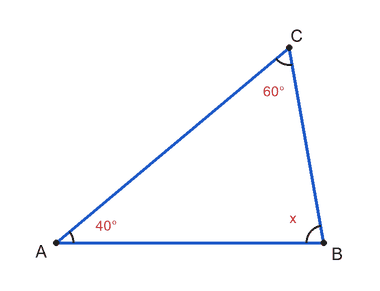
In the given figure, ∠A = 40° and ∠C = 60°. Find the value of .
- 323 marks
Question 32
The three angles of a triangle are , and . Find all the angles of the triangle.
- 333 marks
Question 33
Define the following :
(i) Acute-angled triangle
(ii) Right-angled triangle
(iii) Obtuse-angled triangle
- 343 marks
Question 34
Fill in the blanks :
(i) A triangle whose all sides are unequal is called ______ triangle.
(ii) A triangle whose two sides are equal is called ______ triangle.
(iii) A triangle whose all sides are equal is called ______ triangle.
- 353 marks
Question 35
Is it possible to have a triangle with the following angles ? Give a reason in each case.
(i) 40°, 50°, 60°
(ii) 120°, 30°, 90°
(iii) 60°, 50°, 70°
- 363 marks
Question 36
The angles of a triangle are in the ratio 5 : 4 : 1. Find all the angles.
- 373 marks
Question 37
Two angles of a quadrilateral are 80° and 160°. The other two angles are in the ratio 7 : 5. Find the remaining angles.
(Hint : A diagonal divides a quadrilateral into two triangles.)
- 381 mark
Question 38
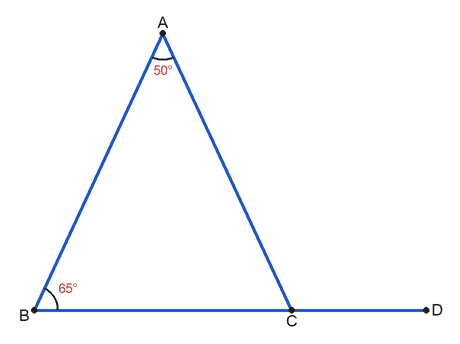
In , the side is produced to . If and , then the exterior angle is :
- 391 mark
Question 39
Which of the following can be the three angles of an isosceles triangle ?
- 401 mark
Question 40
In , . When is produced to a point , the exterior angle is .
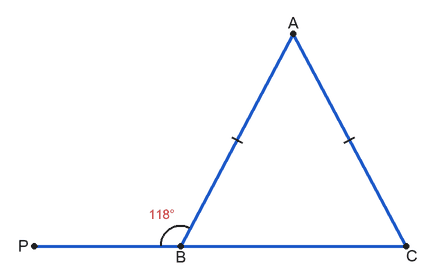
The angle is :
- 412 marks
Question 41
The angles of a triangle are in the ratio . Find the angles and say, with a reason, whether the triangle is acute-angled, right-angled or obtuse-angled.
- 422 marks
Question 42
In , the side is produced to . The exterior angle and .
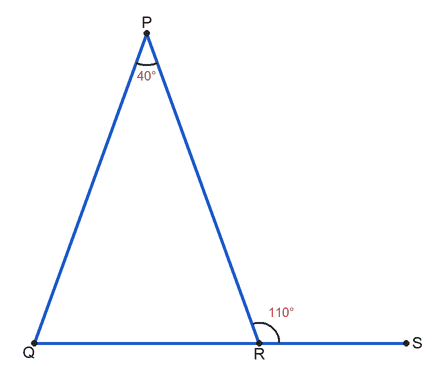
Find and . What kind of triangle (with regard to its sides) is ?
- 432 marks
Question 43
In an isosceles triangle, each of the equal angles is and the third angle is . Find the value of and the three angles of the triangle.
- 442 marks
Question 44
Can a triangle have (a) two right angles, (b) two obtuse angles, (c) exactly two acute angles ? Give a reason in each case, and an example for (c).
- 453 marks
Question 45
In the figure, and the side is produced to . and the exterior angle .

(a) Write in terms of .
(b) Use the angle sum property to form an equation in and solve it.
(c) Find the three angles of .
- 463 marks
Question 46
In the figure, is perpendicular to , and .

(a) Find .
(b) Find .
(c) Find , and show that .
- 474 marks
Question 47
In the figure, is equilateral. The side is produced to so that , and is joined to .
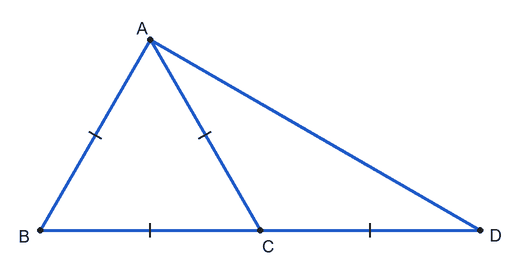
(a) Find .
(b) Name the kind of triangle is, and find and .
(c) Find , and say what kind of triangle is with regard to its angles.