
Opening your dashboard
Class 6 Physics Chapter 5: Light Solutions
79 textbook questions with step-by-step answers, free to read, for ICSE 2026-27.
Get talked through Ch 5, not just shown the answer
Reading a finished solution is not the same as being able to do it. The AI tutor takes one question at a time and works it with you, in your own words, until you can.
- Ask it out loud, in your own words
- It gives you the next step, not the answer
- Stuck on part (ii)? Start there
79 questions with solutions
1–4 marks · Mixed difficulty
- 11 mark
Question 1
The natural source of light is :
Solve with AIAnswer
(A) candle flame
(B) electric lamp
- Correct
(C) sun
(D) kerosene lamp
Answer: (C) sun
Concept: A source of light is a body that gives out light of its own. Natural sources (the sun, the stars, a firefly) are not made by man. Artificial sources (a candle, an electric bulb, a tube light) are made by man.
Step 1 — See what makes a source natural.
A natural source gives out light of its own and is not made by man.
Step 2 — Check the four options.
A candle flame, an electric lamp and a kerosene lamp are all made and lit by people, so they are artificial sources. The sun gives out its own light without anything made by man, so it is the natural source.
Watch out: A flame lit by people, such as a candle flame, is an artificial source even though it gives out real light.
Why the other options are wrong:
- (A) candle flame: A candle is made and lit by people, so its flame is an artificial source of light.
- (B) electric lamp: An electric lamp is a man-made device, so it is an artificial source of light.
- (D) kerosene lamp: A kerosene lamp is made and lit by people, so it is an artificial source of light.
Therefore, the natural source of light is the sun, option (C).
- 21 mark
Question 2
The formation of inverted image in a pin hole camera shows that :
Solve with AIAnswer
(A) light enables us to see
- Correct
(B) light travels in a straight line path
(C) light can pass through the pin hole
(D) light does not pass through the pin hole
Answer: (B) light travels in a straight line path
Concept: A pin hole camera is a closed box with a small pin hole in one face and a translucent screen (tracing paper) on the opposite face. Light from each point of the object travels in a straight line through the pin hole, so the rays from the top and the bottom of the object cross at the hole. The image on the screen is therefore real (it is formed on the screen) and inverted (upside down).
Step 1 — Follow a ray from the top of the object.
Light from the top of the object goes in a straight line through the pin hole. Because it keeps going straight, it lands on the lower part of the screen.
Step 2 — Follow a ray from the bottom.
In the same way, light from the bottom of the object goes straight through the hole and lands on the upper part of the screen.
Step 3 — Draw the conclusion.
The top and the bottom change places only because the rays cross at the hole in straight lines. So the inverted image shows that light travels in a straight line path.
Watch out: The question asks what the inverted image shows, not why an image is formed at all.
Why the other options are wrong:
- (A) light enables us to see: Light does enable us to see, but that fact does not explain why the image is upside down.
- (C) light can pass through the pin hole: Light passing through the hole explains only why an image forms; it does not explain why the image is inverted.
- (D) light does not pass through the pin hole: This is false: light must pass through the pin hole to form any image on the screen.
Therefore, the inverted image shows that light travels in a straight line path, option (B).
- 31 mark
Question 3
The luminous body is :
Solve with AIAnswer
- Correct
(A) a lighted bulb
(B) earth
(C) moon
(D) table
Answer: (A) a lighted bulb
Concept: A luminous body gives out (emits) its own light, for example the sun, the stars, a burning candle and a glowing bulb. A non-luminous body has no light of its own. It is seen only when light from a luminous body falls on it and is sent back to our eyes, for example the moon, the earth, a book and a table.
Step 1 — Recall the meaning of luminous.
A luminous body gives out light of its own.
Step 2 — Check the four bodies.
A lighted bulb glows and gives out its own light, so it is luminous. The earth, the moon and a table have no light of their own; we see them only by the light they send back.
Watch out: The moon looks bright at night, but it only sends back sunlight; it is not luminous.
Why the other options are wrong:
- (B) earth: The earth has no light of its own, so it is a non-luminous body.
- (C) moon: The moon only sends back the sunlight falling on it, so it is a non-luminous body.
- (D) table: A table is seen only when light falls on it, so it is a non-luminous body.
Therefore, the luminous body is a lighted bulb, option (A).
- 41 mark
Question 4
Umbra is a region of :
Solve with AIAnswer
- Correct
(A) complete darkness
(B) partial darkness
(C) complete brightness
(D) partial brightness
Answer: (A) complete darkness
Concept: The umbra is the part of a shadow that receives no light from any part of the source, so it is completely dark. The penumbra is the part that receives light from only a part of the source, so it is partly dark (partly bright). A point source gives only an umbra. An extended source gives an umbra surrounded by a penumbra.
Step 1 — Recall what reaches the umbra.
No light from any part of the source reaches the umbra.
Step 2 — Describe the region.
A region that gets no light at all is completely dark. So the umbra is a region of complete darkness.
Why the other options are wrong:
- (B) partial darkness: Partial darkness describes the penumbra, which gets light from a part of the source.
- (C) complete brightness: No light reaches the umbra, so it cannot be completely bright.
- (D) partial brightness: Partial brightness also describes the penumbra, not the umbra.
Therefore, umbra is a region of complete darkness, option (A).
- 51 mark
Question 5
Penumbra is a region of :
Solve with AIAnswer
(A) complete darkness
(B) complete brightness
- Correct
(C) partial brightness
(D) none of the above
Answer: (C) partial brightness
Concept: The umbra is the part of a shadow that receives no light from any part of the source, so it is completely dark. The penumbra is the part that receives light from only a part of the source, so it is partly dark (partly bright). A point source gives only an umbra. An extended source gives an umbra surrounded by a penumbra.
Step 1 — Recall what reaches the penumbra.
The penumbra receives light from only a part of the source.
Step 2 — Describe the region.
Some light reaches it, so it is not completely dark. Not all the light reaches it, so it is not completely bright. It is a region of partial brightness.
Why the other options are wrong:
- (A) complete darkness: Complete darkness describes the umbra, which gets no light at all.
- (B) complete brightness: The penumbra gets light from only a part of the source, so it is not completely bright.
- (D) none of the above: Option (C) correctly describes the penumbra, so “none of the above” is wrong.
Therefore, penumbra is a region of partial brightness, option (C).
- 61 mark
Question 6
Solar eclipse occurs on :
Solve with AIAnswer
(A) every new moon's day
- Correct
(B) certain new moon's day
(C) every full moon's day
(D) certain full moon's day
Answer: (B) certain new moon's day
Concept: An eclipse is a shadow formed in nature when the sun, the earth and the moon come in one straight line. In a solar eclipse the moon comes in between the sun and the earth, so the moon's shadow falls on the earth; this can happen only on a new moon's day. In a lunar eclipse the earth comes in between the sun and the moon, so the earth's shadow falls on the moon; this can happen only on a full moon's night.
Step 1 — Find the day of the month.
In a solar eclipse the moon is between the sun and the earth. The moon is in this position only on a new moon's day.
Step 2 — Decide whether it happens every month.
The moon's path round the earth is tilted by about 5° to the path of the earth round the sun. So on most new moon days and full moon nights the three bodies are not exactly in one straight line, and there is no eclipse.
Step 3 — Choose the option.
So a solar eclipse occurs only on certain new moon's days.
Watch out: The moon is between the sun and the earth every new moon's day, but it is exactly in line with them only on certain days.
Why the other options are wrong:
- (A) every new moon's day: On most new moon days the moon's shadow passes above or below the earth, so there is no eclipse every new moon's day.
- (C) every full moon's day: On a full moon's day the earth, not the moon, is in between; that can give only a lunar eclipse.
- (D) certain full moon's day: A full moon's day can give only a lunar eclipse, never a solar eclipse.
Therefore, a solar eclipse occurs on certain new moon's days, option (B).
- 71 mark
Question 7
Lunar eclipse occurs on :
Solve with AIAnswer
(A) every full moon's night
- Correct
(B) certain full moon's night
(C) every new moon's day
(D) certain new moon's day
Answer: (B) certain full moon's night
Concept: An eclipse is a shadow formed in nature when the sun, the earth and the moon come in one straight line. In a solar eclipse the moon comes in between the sun and the earth, so the moon's shadow falls on the earth; this can happen only on a new moon's day. In a lunar eclipse the earth comes in between the sun and the moon, so the earth's shadow falls on the moon; this can happen only on a full moon's night.
Step 1 — Find the night of the month.
In a lunar eclipse the earth is between the sun and the moon. The moon is on the far side of the earth from the sun only on a full moon's night.
Step 2 — Decide whether it happens every month.
The moon's path round the earth is tilted by about 5° to the path of the earth round the sun. So on most new moon days and full moon nights the three bodies are not exactly in one straight line, and there is no eclipse.
Step 3 — Choose the option.
So a lunar eclipse occurs only on certain full moon's nights.
Watch out: A full moon's night is needed for a lunar eclipse, but it is not enough; the three bodies must also be in one straight line.
Why the other options are wrong:
- (A) every full moon's night: On most full moon nights the moon passes a little above or below the earth's shadow, so there is no eclipse every full moon's night.
- (C) every new moon's day: On a new moon's day the moon is between the sun and the earth; that can give only a solar eclipse.
- (D) certain new moon's day: A new moon's day can give only a solar eclipse, never a lunar eclipse.
Therefore, a lunar eclipse occurs on certain full moon's nights, option (B).
- 81 mark
Question 8
Grease paper is an example of ..... object.
Solve with AIAnswer
- Correct
(A) translucent
(B) transparent
(C) opaque
(D) all of these
Answer: (A) translucent
Concept: Substances are grouped by how much light passes through them. A transparent medium lets light pass through it easily, so objects behind it are seen clearly (glass, water, air). A translucent medium lets only a part of the light pass, so objects behind it are seen only faintly (tracing paper, grease paper, ground glass). An opaque medium lets no light pass through it (wood, metal, cardboard).
Step 1 — See how much light grease paper lets through.
When grease paper is held up to a lamp, some light passes through it, but objects behind it are seen only faintly.
Step 2 — Name the kind of object.
An object that lets only a part of the light pass through it is translucent.
Why the other options are wrong:
- (B) transparent: Objects cannot be seen clearly through grease paper, so it is not transparent.
- (C) opaque: Some light does pass through grease paper, so it is not opaque.
- (D) all of these: A material belongs to only one of these three groups, so grease paper cannot be all of them.
Therefore, grease paper is an example of a translucent object, option (A).
- 91 mark
Question 9
The shadow of an object does not show :
Solve with AIAnswer
(A) the outline of the object
- Correct
(B) the colour of the object
(C) the shape of the object
(D) none of these
Answer: (B) the colour of the object
Concept: A shadow is the dark patch formed on a screen behind an opaque object placed in the path of light. It is formed because light travels in straight lines and cannot bend round the object to reach the region behind it.
Step 1 — See what a shadow is made of.
A shadow is only a region that the light cannot reach. It is formed by the absence of light, so it is dark.
Step 2 — Compare it with the object.
The edges of the shadow are set by straight rays touching the edges of the object. So the shadow has the outline and shape of the object, but it is dark whatever the colour of the object.
Watch out: A red ball and a blue ball of the same size give the same dark shadow; the colour does not show.
Why the other options are wrong:
- (A) the outline of the object: The shadow does show the outline of the object, because rays touching its edges mark the shadow's edges.
- (C) the shape of the object: The shadow is similar in shape to the object, for the same reason.
- (D) none of these: Option (B) is something the shadow does not show, so “none of these” is wrong.
Therefore, the shadow of an object does not show the colour of the object, option (B).
- 101 mark
Question 10
We do not get a shadow when :
Solve with AIAnswer
(A) there is an opaque object
- Correct
(B) there is no light
(C) there is a light source
(D) there is a translucent object
Answer: (B) there is no light
Concept: A shadow is the dark patch formed on a screen behind an opaque object placed in the path of light. It is formed because light travels in straight lines and cannot bend round the object to reach the region behind it.
Step 1 — List what a shadow needs.
A shadow needs a source of light and an opaque (or translucent) object that blocks some of that light.
Step 2 — Remove the light.
If there is no light at all, nothing is blocked and every place is equally dark. There is no lit region around a dark patch, so no shadow is formed.
Watch out: A light source is needed for a shadow; it is the absence of light that stops a shadow from forming.
Why the other options are wrong:
- (A) there is an opaque object: An opaque object is exactly what blocks the light and forms a shadow.
- (C) there is a light source: A light source is needed to form a shadow; its presence does not stop a shadow.
- (D) there is a translucent object: A translucent object blocks a part of the light, so it can still give a faint shadow.
Therefore, we do not get a shadow when there is no light, option (B).
- 111 mark
Question 11
The following question is Assertion-Reason based. Choose the answer based on the codes given below.
Assertion (A) : Umbra is the darkest part of the shadow.
Reason (R) : Umbra is formed where the light is partially blocked.
Solve with AIAnswer
(A) Both A and R are true and R is the correct explanation of A
(B) Both A and R are true and R is not the correct explanation of A
- Correct
(C) A is true but R is false
(D) A is false but R is true
Answer: (C)
Concept: In an assertion-reason item we judge the Assertion (A) on its own, then the Reason (R) on its own, and then decide whether R correctly explains A. The umbra is the part of a shadow that receives no light from any part of the source, so it is completely dark. The penumbra is the part that receives light from only a part of the source, so it is partly dark (partly bright). A point source gives only an umbra. An extended source gives an umbra surrounded by a penumbra.
Step 1 — Judge the Assertion.
No light reaches the umbra, so it is the darkest part of the shadow. The Assertion is true.
Step 2 — Judge the Reason.
In the umbra the light is completely blocked, not partially. The region where the light is partially blocked is the penumbra. So the Reason is false.
Step 3 — Choose the code.
The Assertion is true and the Reason is false.
Watch out: The words “partially blocked” describe the penumbra; the umbra gets no light at all.
Why the other options are wrong:
- (A): This code needs the Reason to be true, but the Reason is false.
- (B): This code also needs the Reason to be true, but the Reason is false.
- (D): The Assertion is true, so this code is wrong.
Therefore, the Assertion is true but the Reason is false, option (C).
- 121 mark
Question 12
The following question is Assertion-Reason based. Choose the answer based on the codes given below.
Assertion (A) : Image formed by a pinhole camera is inverted.
Reason (R) : The light rays from the top of the object travel in straight line to form the bottom of the image and from the bottom of the object to from the top of the image.
Solve with AIAnswer
- Correct
(A) Both A and R are true and R is the correct explanation of A
(B) Both A and R are true and R is not the correct explanation of A
(C) A is true but R is false
(D) A is false but R is true
Answer: (A)
Concept: In an assertion-reason item we judge the Assertion (A) on its own, then the Reason (R) on its own, and then decide whether R correctly explains A. A pin hole camera is a closed box with a small pin hole in one face and a translucent screen (tracing paper) on the opposite face. Light from each point of the object travels in a straight line through the pin hole, so the rays from the top and the bottom of the object cross at the hole. The image on the screen is therefore real (it is formed on the screen) and inverted (upside down).
Step 1 — Judge the Assertion.
The image on the screen of a pin hole camera is upside down. The Assertion is true.
Step 2 — Judge the Reason.
Light travels in straight lines, so a ray from the top of the object passes through the hole and reaches the bottom of the screen, and a ray from the bottom reaches the top. The Reason is true.
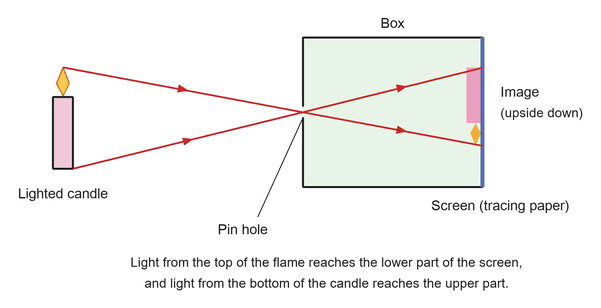
Step 3 — Decide whether R explains A.
This crossing of straight rays at the hole is exactly what turns the image upside down. So the Reason correctly explains the Assertion.
Why the other options are wrong:
- (B): The Reason is the very cause of the inversion, so it does explain the Assertion.
- (C): The Reason is true, so this code is wrong.
- (D): The Assertion is true, so this code is wrong.
Therefore, both are true and the Reason correctly explains the Assertion, option (A).
- 131 mark
Question 13
Fill in the blanks :
Light gives us the sensation of ................
Solve with AIWritten solution
Solution:
Concept: Light is a form of energy that produces the sensation of vision in our eyes. We see an object only when light coming from it enters our eyes.
Step 1 — Recall what light does.
Light is the energy that makes things visible when it enters our eyes.
Step 2 — Fill the blank.
So light gives us the sensation of vision (sight).
Therefore, light gives us the sensation of vision.
- 141 mark
Question 14
Fill in the blanks :
The sun is a ................ source of light.
Solve with AIWritten solution
Solution:
Concept: A source of light is a body that gives out light of its own. Natural sources (the sun, the stars, a firefly) are not made by man. Artificial sources (a candle, an electric bulb, a tube light) are made by man.
Step 1 — See where the sun's light comes from.
The sun gives out light of its own, and it is not made by man.
Step 2 — Fill the blank.
So the sun is a natural source of light.
Therefore, the sun is a natural source of light.
- 151 mark
Question 15
Fill in the blanks :
A medium through which light cannot pass is called the ................
Solve with AIWritten solution
Solution:
Concept: Substances are grouped by how much light passes through them. A transparent medium lets light pass through it easily, so objects behind it are seen clearly (glass, water, air). A translucent medium lets only a part of the light pass, so objects behind it are seen only faintly (tracing paper, grease paper, ground glass). An opaque medium lets no light pass through it (wood, metal, cardboard).
Step 1 — Recall the three kinds of media.
A medium may let all, a part or none of the light pass through it.
Step 2 — Fill the blank.
A medium that lets no light pass through it is called an opaque medium, for example a wooden board.
Therefore, a medium through which light cannot pass is called the opaque medium.
- 161 mark
Question 16
Fill in the blanks :
A medium which allows light to pass through it easily is called the ................
Solve with AIWritten solution
Solution:
Concept: Substances are grouped by how much light passes through them. A transparent medium lets light pass through it easily, so objects behind it are seen clearly (glass, water, air). A translucent medium lets only a part of the light pass, so objects behind it are seen only faintly (tracing paper, grease paper, ground glass). An opaque medium lets no light pass through it (wood, metal, cardboard).
Step 1 — Recall the three kinds of media.
A medium may let all, a part or none of the light pass through it.
Step 2 — Fill the blank.
A medium that lets light pass through it easily is called a transparent medium, for example glass or water.
Therefore, a medium which allows light to pass through it easily is called the transparent medium.
- 171 mark
Question 17
Fill in the blanks :
Moon is a ................ body.
Solve with AIWritten solution
Solution:
Concept: A luminous body gives out (emits) its own light, for example the sun, the stars, a burning candle and a glowing bulb. A non-luminous body has no light of its own. It is seen only when light from a luminous body falls on it and is sent back to our eyes, for example the moon, the earth, a book and a table.
Step 1 — See where the moon's light comes from.
The moon has no light of its own. It shines because sunlight falls on it and is sent back to the earth.
Step 2 — Fill the blank.
So the moon is a non-luminous body.
Watch out: The moon looks bright at night, but brightness from sent-back sunlight does not make it luminous.
Therefore, the moon is a non-luminous body.
- 181 mark
Question 18
Fill in the blanks :
Light travels in a ................ path.
Solve with AIWritten solution
Solution:
Concept: Rectilinear propagation of light means that light travels in a straight line path in a medium. "Rectilinear" means "in a straight line" and "propagation" means "travelling". Shadows, eclipses and the pin hole camera all depend on it.
Step 1 — Recall how light travels.
Light in a medium does not bend round corners; it goes straight on.
Step 2 — Fill the blank.
So light travels in a straight line path.
Therefore, light travels in a straight line path.
- 191 mark
Question 19
Fill in the blanks :
In a pin hole camera, the image formed is ............
Solve with AIWritten solution
Solution:
Concept: A pin hole camera is a closed box with a small pin hole in one face and a translucent screen (tracing paper) on the opposite face. Light from each point of the object travels in a straight line through the pin hole, so the rays from the top and the bottom of the object cross at the hole. The image on the screen is therefore real (it is formed on the screen) and inverted (upside down).
Step 1 — Follow the rays through the hole.
Rays from the top and the bottom of the object cross at the pin hole, so the top of the object appears at the bottom of the image.
Step 2 — See where the image is formed.
The image is actually formed on the tracing-paper screen.
Step 3 — Fill the blank.
So the image is inverted and real.
Therefore, in a pin hole camera, the image formed is inverted and real.
- 201 mark
Question 20
Fill in the blanks :
The darkest portion of a shadow is called the ................
Solve with AIWritten solution
Solution:
Concept: The umbra is the part of a shadow that receives no light from any part of the source, so it is completely dark. The penumbra is the part that receives light from only a part of the source, so it is partly dark (partly bright). A point source gives only an umbra. An extended source gives an umbra surrounded by a penumbra.
Step 1 — Find the darkest part.
No light from any part of the source reaches the central part of a shadow, so it is completely dark.
Step 2 — Fill the blank.
This darkest portion is called the umbra.
Therefore, the darkest portion of a shadow is called the umbra.
- 211 mark
Question 21
Fill in the blanks :
The less dark portion of a shadow is called the ................
Solve with AIWritten solution
Solution:
Concept: The umbra is the part of a shadow that receives no light from any part of the source, so it is completely dark. The penumbra is the part that receives light from only a part of the source, so it is partly dark (partly bright). A point source gives only an umbra. An extended source gives an umbra surrounded by a penumbra.
Step 1 — Find the less dark part.
The outer part of a shadow receives light from a part of the source, so it is only partly dark.
Step 2 — Fill the blank.
This less dark portion is called the penumbra.
Therefore, the less dark portion of a shadow is called the penumbra.
- 221 mark
Question 22
Fill in the blanks :
Lunar eclipse occurs when the ................ comes in between the ............ and the sun.
Solve with AIWritten solution
Solution:
Concept: An eclipse is a shadow formed in nature when the sun, the earth and the moon come in one straight line. In a solar eclipse the moon comes in between the sun and the earth, so the moon's shadow falls on the earth; this can happen only on a new moon's day. In a lunar eclipse the earth comes in between the sun and the moon, so the earth's shadow falls on the moon; this can happen only on a full moon's night.
Step 1 — Recall whose shadow falls in a lunar eclipse.
In a lunar eclipse the moon is darkened by the shadow of the earth.
Step 2 — Place the three bodies.
For the earth's shadow to fall on the moon, the earth must come in between the moon and the sun.
Therefore, lunar eclipse occurs when the earth comes in between the moon and the sun.
- 231 mark
Question 23
Write true or false for each statement :
The moon is a natural source of light.
Solve with AIWritten solution
Solution:
Concept: A source of light is a body that gives out light of its own. Natural sources (the sun, the stars, a firefly) are not made by man. Artificial sources (a candle, an electric bulb, a tube light) are made by man.
Step 1 — Recall what a source of light is.
A source of light must give out light of its own.
Step 2 — Judge the statement.
The moon only sends back the sunlight falling on it, so it is not a source of light at all. The statement is false. Correct statement: the sun is a natural source of light.
Therefore, the statement is false.
- 241 mark
Question 24
Write true or false for each statement :
The moon is self luminous.
Solve with AIWritten solution
Solution:
Concept: A luminous body gives out (emits) its own light, for example the sun, the stars, a burning candle and a glowing bulb. A non-luminous body has no light of its own. It is seen only when light from a luminous body falls on it and is sent back to our eyes, for example the moon, the earth, a book and a table.
Step 1 — Recall what self luminous means.
A self luminous body gives out its own light.
Step 2 — Judge the statement.
The moon has no light of its own and shines by the sunlight falling on it. The statement is false. Correct statement: the moon is non-luminous.
Therefore, the statement is false.
- 251 mark
Question 25
Write true or false for each statement :
We can see an object through an opaque medium.
Solve with AIWritten solution
Solution:
Concept: Substances are grouped by how much light passes through them. A transparent medium lets light pass through it easily, so objects behind it are seen clearly (glass, water, air). A translucent medium lets only a part of the light pass, so objects behind it are seen only faintly (tracing paper, grease paper, ground glass). An opaque medium lets no light pass through it (wood, metal, cardboard).
Step 1 — Recall what an opaque medium does.
An opaque medium lets no light pass through it.
Step 2 — Judge the statement.
We see an object only when light from it reaches our eyes. No light from the object can come through an opaque medium, so the statement is false. Correct statement: we cannot see an object through an opaque medium.
Therefore, the statement is false.
- 261 mark
Question 26
Write true or false for each statement :
Light passes through glass.
Solve with AIWritten solution
Solution:
Concept: Substances are grouped by how much light passes through them. A transparent medium lets light pass through it easily, so objects behind it are seen clearly (glass, water, air). A translucent medium lets only a part of the light pass, so objects behind it are seen only faintly (tracing paper, grease paper, ground glass). An opaque medium lets no light pass through it (wood, metal, cardboard).
Step 1 — Recall what kind of medium glass is.
Clear glass is a transparent medium.
Step 2 — Judge the statement.
A transparent medium lets light pass through it easily, which is why we see clearly through a glass window. The statement is true.
Therefore, the statement is true.
- 271 mark
Question 27
Write true or false for each statement :
Light travels in a straight line path.
Solve with AIWritten solution
Solution:
Concept: Rectilinear propagation of light means that light travels in a straight line path in a medium. "Rectilinear" means "in a straight line" and "propagation" means "travelling". Shadows, eclipses and the pin hole camera all depend on it.
Step 1 — Recall how light travels.
Light travels in a straight line path in a medium.
Step 2 — Judge the statement.
This is the rectilinear propagation of light, so the statement is true.
Therefore, the statement is true.
- 281 mark
Question 28
Write true or false for each statement :
Image formed in a pin hole camera is real.
Solve with AIWritten solution
Solution:
Concept: A pin hole camera is a closed box with a small pin hole in one face and a translucent screen (tracing paper) on the opposite face. Light from each point of the object travels in a straight line through the pin hole, so the rays from the top and the bottom of the object cross at the hole. The image on the screen is therefore real (it is formed on the screen) and inverted (upside down).
Step 1 — Recall what a real image is.
A real image is one that can be obtained on a screen.
Step 2 — Judge the statement.
In a pin hole camera the image is actually formed on the tracing-paper screen, so it is real. The statement is true.
Therefore, the statement is true.
- 291 mark
Question 29
Write true or false for each statement :
The image in a pin hole camera gets blurred if the hole is made bigger.
Solve with AIWritten solution
Solution:
Concept: A pin hole camera is a closed box with a small pin hole in one face and a translucent screen (tracing paper) on the opposite face. Light from each point of the object travels in a straight line through the pin hole, so the rays from the top and the bottom of the object cross at the hole. The image on the screen is therefore real (it is formed on the screen) and inverted (upside down).
Step 1 — Think of a big hole as many small holes.
A big hole is like many pin holes side by side, and each of them forms its own image.
Step 2 — See what the images do.
These images are slightly shifted from one another and overlap, so the edges are no longer sharp. The image becomes blurred (though brighter), so the statement is true.
Therefore, the statement is true.
- 301 mark
Question 30
Write true or false for each statement :
A shadow is formed because light travels in a straight line path.
Solve with AIWritten solution
Solution:
Concept: A shadow is the dark patch formed on a screen behind an opaque object placed in the path of light. It is formed because light travels in straight lines and cannot bend round the object to reach the region behind it.
Step 1 — Follow the rays near the object.
Rays that fall on an opaque object are stopped. Light travels in straight lines, so it cannot bend round the object into the region behind it.
Step 2 — Judge the statement.
That region stays dark and forms the shadow, so the statement is true.
Therefore, the statement is true.
- 311 mark
Question 31
Write true or false for each statement :
Solar eclipse occurs when the sun comes in between the earth and the moon.
Solve with AIWritten solution
Solution:
Concept: An eclipse is a shadow formed in nature when the sun, the earth and the moon come in one straight line. In a solar eclipse the moon comes in between the sun and the earth, so the moon's shadow falls on the earth; this can happen only on a new moon's day. In a lunar eclipse the earth comes in between the sun and the moon, so the earth's shadow falls on the moon; this can happen only on a full moon's night.
Step 1 — Place the three bodies.
In a solar eclipse the moon's shadow falls on the earth, so the moon must be in between the sun and the earth.
Step 2 — Judge the statement.
The statement puts the sun in between, so it is false. Correct statement: a solar eclipse occurs when the moon comes in between the sun and the earth.
Watch out: The sun can never come in between the earth and the moon; it is always at one end of the line.
Therefore, the statement is false.
- 321 mark
Question 32
Write true or false for each statement :
If the shadow of earth falls on the moon, the eclipse is called lunar eclipse.
Solve with AIWritten solution
Solution:
Concept: An eclipse is a shadow formed in nature when the sun, the earth and the moon come in one straight line. In a solar eclipse the moon comes in between the sun and the earth, so the moon's shadow falls on the earth; this can happen only on a new moon's day. In a lunar eclipse the earth comes in between the sun and the moon, so the earth's shadow falls on the moon; this can happen only on a full moon's night.
Step 1 — See which body is darkened.
When the earth's shadow falls on the moon, the moon is darkened.
Step 2 — Judge the statement.
The eclipse of the moon is the lunar eclipse, so the statement is true.
Therefore, the statement is true.
- 331 mark
Question 33
Match the following columns :
Column A : Wooden block
Column B : (i) new moon's day, (ii) rectilinear propagation of light, (iii) opaque body, (iv) luminous body, (v) complete dark part
Solve with AIWritten solution
Solution:
Concept: Substances are grouped by how much light passes through them. A transparent medium lets light pass through it easily, so objects behind it are seen clearly (glass, water, air). A translucent medium lets only a part of the light pass, so objects behind it are seen only faintly (tracing paper, grease paper, ground glass). An opaque medium lets no light pass through it (wood, metal, cardboard).
Step 1 — See how a wooden block treats light.
A wooden block lets no light pass through it.
Step 2 — Match.
So the wooden block goes with opaque body, item iii.
Therefore, wooden block matches (iii) opaque body.
- 341 mark
Question 34
Match the following columns :
Column A : Sun
Column B : (i) new moon's day, (ii) rectilinear propagation of light, (iii) opaque body, (iv) luminous body, (v) complete dark part
Solve with AIWritten solution
Solution:
Concept: A luminous body gives out (emits) its own light, for example the sun, the stars, a burning candle and a glowing bulb. A non-luminous body has no light of its own. It is seen only when light from a luminous body falls on it and is sent back to our eyes, for example the moon, the earth, a book and a table.
Step 1 — See where the sun's light comes from.
The sun gives out light of its own.
Step 2 — Match.
So the sun goes with luminous body, item iv.
Therefore, sun matches (iv) luminous body.
- 351 mark
Question 35
Match the following columns :
Column A : Umbra
Column B : (i) new moon's day, (ii) rectilinear propagation of light, (iii) opaque body, (iv) luminous body, (v) complete dark part
Solve with AIWritten solution
Solution:
Concept: The umbra is the part of a shadow that receives no light from any part of the source, so it is completely dark. The penumbra is the part that receives light from only a part of the source, so it is partly dark (partly bright). A point source gives only an umbra. An extended source gives an umbra surrounded by a penumbra.
Step 1 — Recall what reaches the umbra.
No light from any part of the source reaches the umbra.
Step 2 — Match.
So the umbra goes with complete dark part, item v.
Therefore, umbra matches (v) complete dark part.
- 361 mark
Question 36
Match the following columns :
Column A : Eclipse
Column B : (i) new moon's day, (ii) rectilinear propagation of light, (iii) opaque body, (iv) luminous body, (v) complete dark part
Solve with AIWritten solution
Solution:
Concept: An eclipse is a shadow formed in nature when the sun, the earth and the moon come in one straight line. In a solar eclipse the moon comes in between the sun and the earth, so the moon's shadow falls on the earth; this can happen only on a new moon's day. In a lunar eclipse the earth comes in between the sun and the moon, so the earth's shadow falls on the moon; this can happen only on a full moon's night.
Step 1 — See what an eclipse is.
An eclipse is the shadow of the earth or of the moon formed in nature.
Step 2 — Find the idea behind it.
Shadows are formed because light travels in straight lines, so an eclipse is an example of the rectilinear propagation of light.
Step 3 — Match.
So the eclipse goes with rectilinear propagation of light, item ii. (Item i, new moon's day, is kept for the solar eclipse in the next part.)
Therefore, eclipse matches (ii) rectilinear propagation of light.
- 371 mark
Question 37
Match the following columns :
Column A : Solar eclipse
Column B : (i) new moon's day, (ii) rectilinear propagation of light, (iii) opaque body, (iv) luminous body, (v) complete dark part
Solve with AIWritten solution
Solution:
Concept: An eclipse is a shadow formed in nature when the sun, the earth and the moon come in one straight line. In a solar eclipse the moon comes in between the sun and the earth, so the moon's shadow falls on the earth; this can happen only on a new moon's day. In a lunar eclipse the earth comes in between the sun and the moon, so the earth's shadow falls on the moon; this can happen only on a full moon's night.
Step 1 — Place the three bodies.
In a solar eclipse the moon comes in between the sun and the earth.
Step 2 — Find the day.
The moon is between the sun and the earth only on a new moon's day.
Step 3 — Match.
So the solar eclipse goes with new moon's day, item i. It happens only on certain new moon's days, when the three bodies are exactly in line.
Therefore, solar eclipse matches (i) new moon's day.
- 382 marks
Question 38
What is light ? Define it.
Solve with AIWritten solution
Solution:
Concept: Light is a form of energy that produces the sensation of vision in our eyes. We see an object only when light coming from it enters our eyes.
Step 1 — Say what kind of thing light is.
Light is a form of energy. It is given out by sources such as the sun and a lighted bulb.
Step 2 — Say what it does.
When light enters our eyes it produces the sensation of vision, so we see.
Step 3 — Give an everyday check.
In a completely dark room we cannot see anything. As soon as a torch is switched on, light from it reaches the objects and then our eyes, and we see them.
Therefore, light is a form of energy that produces in our eyes the sensation of vision.
- 392 marks
Question 39
How does light make an object visible ?
Solve with AIWritten solution
Solution:
Concept: Light is a form of energy that produces the sensation of vision in our eyes. We see an object only when light coming from it enters our eyes.
Step 1 — Seeing a luminous object.
A luminous object, such as a lighted bulb or a candle flame, gives out its own light. This light travels straight to our eyes, so we see the object directly.
Step 2 — Seeing a non-luminous object.
A non-luminous object, such as a book, has no light of its own. Light from a luminous body (the sun, a bulb) falls on it, and the object sends a part of this light back in all directions. When some of this light reaches our eyes, we see the book.
Step 3 — See what happens without light.
If no light comes from an object to our eyes, we cannot see it. That is why nothing is visible in a completely dark room.
Watch out: Our eyes do not send out anything to see; the light must travel from the object to the eye.
Therefore, light makes an object visible when light given out or sent back by the object enters our eyes.
- 402 marks
Question 40
Name two natural sources of light.
Solve with AIWritten solution
Solution:
Concept: A source of light is a body that gives out light of its own. Natural sources (the sun, the stars, a firefly) are not made by man. Artificial sources (a candle, an electric bulb, a tube light) are made by man.
Step 1 — Recall what a natural source is.
A natural source gives out light of its own and is not made by man.
Step 2 — Name two of them.
The sun is the main natural source of light. The stars are also natural sources. (A firefly also gives out a faint light of its own.)
Therefore, two natural sources of light are the sun and the stars.
- 412 marks
Question 41
List two artificial sources of light.
Solve with AIWritten solution
Solution:
Concept: A source of light is a body that gives out light of its own. Natural sources (the sun, the stars, a firefly) are not made by man. Artificial sources (a candle, an electric bulb, a tube light) are made by man.
Step 1 — Recall what an artificial source is.
An artificial source of light is made by man.
Step 2 — Name two of them.
A glowing electric bulb and a burning candle are artificial sources. A tube light, a torch and a kerosene lamp are other examples.
Therefore, two artificial sources of light are an electric bulb and a candle.
- 423 marks
Question 42
Differentiate between luminous and non-luminous bodies. Give two examples of each.
Solve with AIWritten solution
Solution:
Concept: A luminous body gives out (emits) its own light, for example the sun, the stars, a burning candle and a glowing bulb. A non-luminous body has no light of its own. It is seen only when light from a luminous body falls on it and is sent back to our eyes, for example the moon, the earth, a book and a table.
Step 1 — Compare the two kinds of bodies.
The table compares them point by point.
Luminous bodies Non-luminous bodies They give out their own light. They have no light of their own. They are seen by their own light. They are seen only when light from a luminous body falls on them and is sent back to our eyes. They can be seen in a dark room. They cannot be seen in a completely dark room. Step 2 — Give two examples of each.
Luminous bodies: the sun and a burning candle (also the stars and a glowing bulb). Non-luminous bodies: the moon and a book (also the earth and a table).
Therefore, a luminous body gives out its own light (sun, candle), while a non-luminous body has no light of its own and is seen by the light it sends back (moon, book).
- 432 marks
Question 43
Is the moon a luminous object ?
Solve with AIWritten solution
Solution:
Concept: A luminous body gives out (emits) its own light, for example the sun, the stars, a burning candle and a glowing bulb. A non-luminous body has no light of its own. It is seen only when light from a luminous body falls on it and is sent back to our eyes, for example the moon, the earth, a book and a table.
Step 1 — See where the moon's light comes from.
The moon has no light of its own. Sunlight falls on it and is sent back towards the earth.
Step 2 — Decide.
A body that shines only by sent-back light is non-luminous. So the moon is not a luminous object.
Watch out: The moon looks bright at night only because it sends back sunlight.
Therefore, no, the moon is not a luminous object; it is non-luminous.
- 442 marks
Question 44
What do we call a body that shines on its own ?
Solve with AIWritten solution
Solution:
Concept: A luminous body gives out (emits) its own light, for example the sun, the stars, a burning candle and a glowing bulb. A non-luminous body has no light of its own. It is seen only when light from a luminous body falls on it and is sent back to our eyes, for example the moon, the earth, a book and a table.
Step 1 — Recall the term.
A body that gives out light of its own is called a luminous body.
Step 2 — Give examples.
The sun, the stars and a burning candle shine on their own.
Therefore, a body that shines on its own is called a luminous body.
- 452 marks
Question 45
What do we call an electric bulb producing light ?
Solve with AIWritten solution
Solution:
Concept: A luminous body gives out (emits) its own light, for example the sun, the stars, a burning candle and a glowing bulb. A non-luminous body has no light of its own. It is seen only when light from a luminous body falls on it and is sent back to our eyes, for example the moon, the earth, a book and a table.
Step 1 — See what the glowing bulb does.
A glowing electric bulb gives out light of its own, so it is a luminous body.
Step 2 — See who made it.
The bulb is made by man, so it is also an artificial source of light.
Therefore, an electric bulb producing light is a luminous body, and an artificial source of light.
- 462 marks
Question 46
What is a transparent medium ? Give two examples.
Solve with AIWritten solution
Solution:
Concept: Substances are grouped by how much light passes through them. A transparent medium lets light pass through it easily, so objects behind it are seen clearly (glass, water, air). A translucent medium lets only a part of the light pass, so objects behind it are seen only faintly (tracing paper, grease paper, ground glass). An opaque medium lets no light pass through it (wood, metal, cardboard).
Step 1 — Define the term.
A transparent medium is a substance through which light passes easily, so an object behind it is seen clearly.
Step 2 — Give two examples.
Clear glass and water are transparent (air is another).
Therefore, a transparent medium lets light pass through it easily; examples are glass and water.
- 472 marks
Question 47
What do we call a substance through which we cannot see light ? Give an example of such a substance.
Solve with AIWritten solution
Solution:
Concept: Substances are grouped by how much light passes through them. A transparent medium lets light pass through it easily, so objects behind it are seen clearly (glass, water, air). A translucent medium lets only a part of the light pass, so objects behind it are seen only faintly (tracing paper, grease paper, ground glass). An opaque medium lets no light pass through it (wood, metal, cardboard).
Step 1 — Name the substance.
A substance through which no light can pass, so that we cannot see through it, is called an opaque substance.
Step 2 — Give an example.
A wooden board is opaque (a metal sheet and a brick wall are other examples).
Therefore, such a substance is called an opaque substance, for example wood.
- 482 marks
Question 48
What do we call a substance through which light passes ? Give an example of such a substance.
Solve with AIWritten solution
Solution:
Concept: Substances are grouped by how much light passes through them. A transparent medium lets light pass through it easily, so objects behind it are seen clearly (glass, water, air). A translucent medium lets only a part of the light pass, so objects behind it are seen only faintly (tracing paper, grease paper, ground glass). An opaque medium lets no light pass through it (wood, metal, cardboard).
Step 1 — Name the substance.
A substance through which light passes easily is called a transparent substance.
Step 2 — Give an example.
Clear glass is transparent (water and air are other examples).
Step 3 — Compare with a translucent substance.
A substance that lets only a part of the light pass, such as tracing paper, is called translucent.
Therefore, such a substance is called a transparent substance, for example glass.
- 492 marks
Question 49
Can a transparent medium form an image? Explain your answer.
Solve with AIWritten solution
Solution:
Concept: Substances are grouped by how much light passes through them. A transparent medium lets light pass through it easily, so objects behind it are seen clearly (glass, water, air). A translucent medium lets only a part of the light pass, so objects behind it are seen only faintly (tracing paper, grease paper, ground glass). An opaque medium lets no light pass through it (wood, metal, cardboard).
Step 1 — Recall how an image is seen on a screen.
In a pin hole camera the image is seen on the tracing paper. The paper stops a part of the light from each point of the object and scatters it, so a picture of the object shows on the paper.
Step 2 — See what a transparent sheet does.
A clear transparent sheet, such as plain glass, lets almost all the light pass straight through it. The light is not held on the sheet, so no picture of the object shows on it.
Step 3 — Draw the conclusion.
So a transparent medium cannot act as a screen on which an image is formed. That is why the screen of a pin hole camera is made of tracing paper and not of clear glass.
Note: This answer is about a transparent sheet used as a screen. A transparent lens can form an image by bending light, which you will study in higher classes.
Therefore, no, a transparent medium cannot form (show) an image on itself, because the light passes straight through it.
- 502 marks
Question 50
How can you obtain a point source of light ?
Solve with AIWritten solution
Solution:
Concept: A ray of light is the straight path along which light travels in one direction, drawn as a straight line with an arrow. A beam of light is a group of rays.
Step 1 — Use a fine hole.
Place a cardboard with a very fine hole in front of a luminous body, such as a burning candle or a lamp. (Or put the lamp inside a box with a fine hole in one side.)
Step 2 — See why it works.
Light can come out only through the tiny hole. It spreads out from there as if it starts from a single point, so the fine hole acts as a point source of light.
Therefore, a point source of light is obtained by letting the light of a lamp or candle come out through a very fine hole.
- 512 marks
Question 51
Define the terms: a ray of light and a beam of light.
Solve with AIWritten solution
Solution:
Concept: A ray of light is the straight path along which light travels in one direction, drawn as a straight line with an arrow. A beam of light is a group of rays.
Step 1 — Define a ray.
A ray of light is the straight path along which light travels in one direction. It is drawn as a straight line with an arrow pointing the way the light moves.
Step 2 — Define a beam.
A beam of light is a group of rays of light given out by a source. A beam may be parallel, diverging (spreading out) or converging (coming together).
Therefore, a ray is the straight path of light in one direction, and a beam is a group of rays.
- 522 marks
Question 52
What do you mean by 'rectilinear propagation of light' ?
Solve with AIWritten solution
Solution:
Concept: Rectilinear propagation of light means that light travels in a straight line path in a medium. "Rectilinear" means "in a straight line" and "propagation" means "travelling". Shadows, eclipses and the pin hole camera all depend on it.
Step 1 — Explain the words.
“Rectilinear” means in a straight line, and “propagation” means travelling.
Step 2 — State the meaning.
So rectilinear propagation of light means that light travels in a straight line path.
Step 3 — Give an example.
Sunlight entering a dark room through a small hole shows up as a straight path lit up by dust particles.
Therefore, rectilinear propagation of light means that light travels in a straight line path.
- 533 marks
Question 53
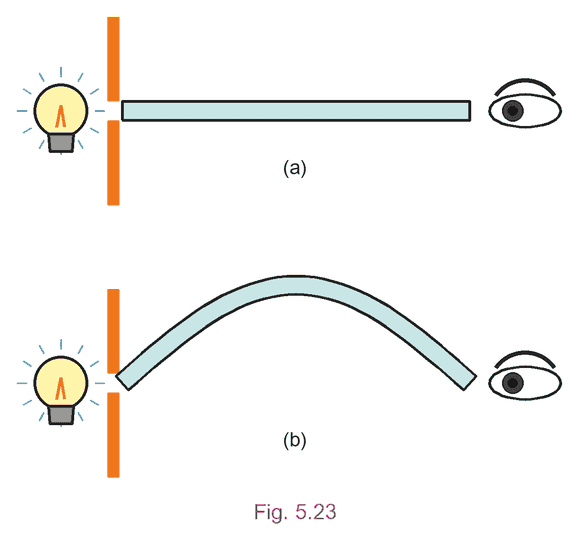
In which of the following two arrangements (a) and (b) shown in Fig. 5.23, you can see the light of the bulb ? Explain your answer.
 Solve with AI
Written solution
Solution:
Concept: Rectilinear propagation of light means that light travels in a straight line path in a medium. "Rectilinear" means "in a straight line" and "propagation" means "travelling". Shadows, eclipses and the pin hole camera all depend on it.
Step 1 — Look at arrangement (a).
In (a) the hole in the board, the straight tube and the eye are all in one straight line. Light from the bulb goes straight through the hole and along the tube into the eye. So the light of the bulb is seen.
Step 2 — Look at arrangement (b).
In (b) the tube is bent. Light entering the tube goes straight on and strikes the curved wall of the tube. It cannot bend along the tube, so it does not reach the eye and the light of the bulb is not seen.
Therefore, the light of the bulb can be seen in arrangement (a) but not in (b), because light travels only in straight lines.
- 542 marks
Question 54
Name a simple application of the rectilinear propagation of light.
Solve with AIWritten solution
Solution:
Concept: Rectilinear propagation of light means that light travels in a straight line path in a medium. "Rectilinear" means "in a straight line" and "propagation" means "travelling". Shadows, eclipses and the pin hole camera all depend on it.
Step 1 — Recall the uses of straight-line travel.
The pin hole camera, shadows and eclipses all depend on light travelling in straight lines.
Step 2 — Name one.
A simple application is the pin hole camera.
Therefore, a simple application of the rectilinear propagation of light is the pin hole camera.
- 552 marks
Question 55
State two factors which affect the size of image formed in a pin hole camera.
Solve with AIWritten solution
Solution:
Concept: In a pin hole camera, the size of the image depends on the distances from the pin hole. Size of image ÷ size of object = (distance of the screen from the hole) ÷ (distance of the object from the hole).
Step 1 — First factor.
The first factor is the distance of the screen from the pin hole. When the screen is moved away from the hole, the image becomes bigger.
Step 2 — Second factor.
The second factor is the distance of the object from the pin hole. When the object is moved away from the hole, the image becomes smaller.
Step 3 — See both in one rule.
The two factors are joined in one rule.
Step 4 — Try an example.
A candle 10 cm high is 50 cm from the hole, and the screen is 20 cm from the hole. We multiply the size of the object by the ratio of the distances.
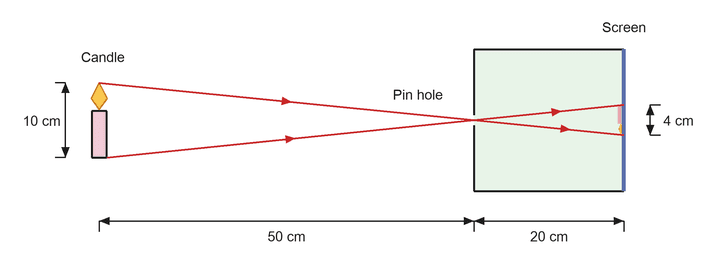
Therefore, the two factors are the distance of the screen from the pin hole and the distance of the object from the pin hole.
- 562 marks
Question 56
Is the image obtained in a pin hole camera erect or inverted ? Give reason for your answer.
Solve with AIWritten solution
Solution:
Concept: A pin hole camera is a closed box with a small pin hole in one face and a translucent screen (tracing paper) on the opposite face. Light from each point of the object travels in a straight line through the pin hole, so the rays from the top and the bottom of the object cross at the hole. The image on the screen is therefore real (it is formed on the screen) and inverted (upside down).
Step 1 — Give the answer.
The image in a pin hole camera is inverted (upside down).
Step 2 — Follow a ray from the top.
Light travels in a straight line, so light from the top of the object passes through the hole and strikes the lower part of the screen.
Step 3 — Follow a ray from the bottom.
Light from the bottom of the object passes through the hole and strikes the upper part of the screen. So the top and the bottom change places, and the image is upside down.
Therefore, the image is inverted, because rays from the top and the bottom of the object cross at the pin hole while travelling in straight lines.
- 572 marks
Question 57
How is the image affected in a pin hole camera when another fine hole is made near the first pin hole ?
Solve with AIWritten solution
Solution:
Concept: A pin hole camera is a closed box with a small pin hole in one face and a translucent screen (tracing paper) on the opposite face. Light from each point of the object travels in a straight line through the pin hole, so the rays from the top and the bottom of the object cross at the hole. The image on the screen is therefore real (it is formed on the screen) and inverted (upside down).
Step 1 — See what each hole does.
Each fine hole forms its own inverted image of the object on the screen.
Step 2 — See what the two images do.
With a second hole close to the first, two images are formed side by side, slightly shifted from each other. They overlap, so the picture on the screen looks blurred (doubled), though it is a little brighter.
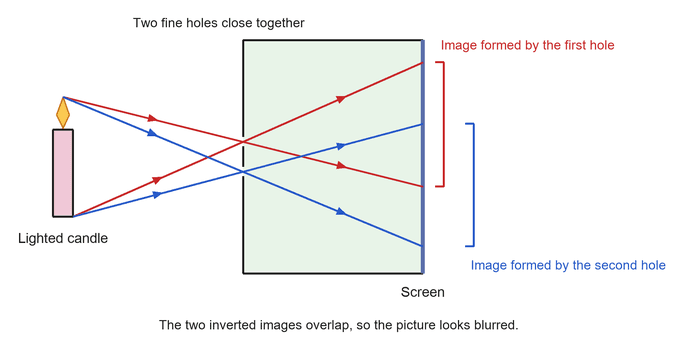
Therefore, two overlapping images are formed, so the image becomes blurred.
- 583 marks
Question 58
State the effect on the image in a pin hole camera if :
(a) the hole is made bigger.
(b) the luminous object is moved towards the pin hole.
(c) the length of the pin hole camera is increased (i.e. the screen is moved away from the pin hole).
Solve with AIWritten solution
Solution:
Concept: A pin hole camera is a closed box with a small pin hole in one face and a translucent screen (tracing paper) on the opposite face. Light from each point of the object travels in a straight line through the pin hole, so the rays from the top and the bottom of the object cross at the hole. The image on the screen is therefore real (it is formed on the screen) and inverted (upside down).
In a pin hole camera, the size of the image depends on the distances from the pin hole. Size of image ÷ size of object = (distance of the screen from the hole) ÷ (distance of the object from the hole).
Step 1 — (a) The hole is made bigger.
A big hole acts like many pin holes side by side. Each forms its own image, and these images overlap. So the image becomes blurred, though brighter.
Step 2 — (b) The object is moved towards the pin hole.
The distance of the object from the hole decreases. By the rule above, the image becomes bigger (and brighter).
Step 3 — (c) The screen is moved away from the pin hole.
The distance of the screen from the hole increases. The image becomes bigger, but less bright, because the same light is spread over a larger area.
Therefore, (a) the image becomes blurred; (b) the image becomes bigger; (c) the image becomes bigger but less bright.
- 592 marks
Question 59
What is a shadow? Give a reason for its formation.
Solve with AIWritten solution
Solution:
Concept: A shadow is the dark patch formed on a screen behind an opaque object placed in the path of light. It is formed because light travels in straight lines and cannot bend round the object to reach the region behind it.
Step 1 — Define a shadow.
When an opaque object is placed in the path of light, a dark patch is formed on a screen behind it. This dark patch is the shadow of the object.
Step 2 — Give the reason.
Light travels in straight lines. The rays that fall on the opaque object are stopped, and they cannot bend round the object. So the part of the screen behind the object gets no light and stays dark.
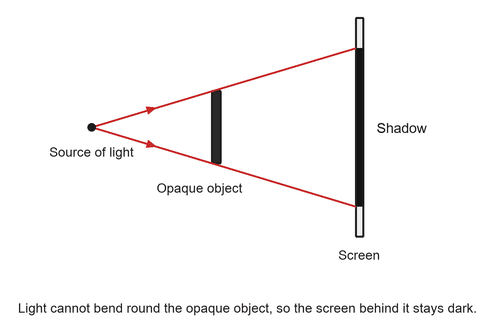
Therefore, a shadow is the dark patch behind an opaque object, formed because light travels in straight lines and cannot bend round the object.
- 602 marks
Question 60
State two differences between an umbra and a penumbra.
Solve with AIWritten solution
Solution:
Concept: The umbra is the part of a shadow that receives no light from any part of the source, so it is completely dark. The penumbra is the part that receives light from only a part of the source, so it is partly dark (partly bright). A point source gives only an umbra. An extended source gives an umbra surrounded by a penumbra.
Step 1 — Compare the two parts.
The table compares the umbra and the penumbra.
Umbra Penumbra No light reaches it from any part of the source. Light reaches it from a part of the source. It is completely dark. It is only partly dark. It is the central part of the shadow. It surrounds the umbra. Therefore, the umbra gets no light and is completely dark, while the penumbra gets light from a part of the source and is partly dark.
- 612 marks
Question 61
Why is it that the birds flying in the sky do not cast their shadows on the earth ?
Solve with AIWritten solution
Solution:
Concept: The umbra is the part of a shadow that receives no light from any part of the source, so it is completely dark. The penumbra is the part that receives light from only a part of the source, so it is partly dark (partly bright). A point source gives only an umbra. An extended source gives an umbra surrounded by a penumbra.
Step 1 — Compare the source and the bird.
The sun is a huge extended source, much bigger than a bird.
Step 2 — Follow the umbra.
When the source is bigger than the object, the umbra narrows behind the object and ends at a short distance behind it. A bird flying high is far from the ground, so its umbra ends long before it reaches the earth.
Step 3 — Follow the penumbra.
Only the penumbra reaches the ground. It spreads out over a large area and is so faint that we do not notice it.
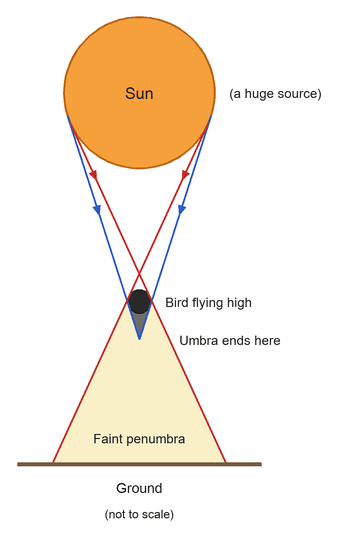
Watch out: A bird or a kite flying low, close to the ground, does cast a clear shadow.
Therefore, birds flying high do not cast a visible shadow, because their umbra ends before the ground and the penumbra on the ground is too large and faint to notice.
- 622 marks
Question 62
Why are shadows at noon shorter than in the morning or in the evening ?
Solve with AIWritten solution
Solution:
Concept: A shadow is the dark patch formed on a screen behind an opaque object placed in the path of light. It is formed because light travels in straight lines and cannot bend round the object to reach the region behind it.
Step 1 — Use straight-line rays.
The ray that just passes over the top of an object marks the end of its shadow.
Step 2 — At noon.
At noon the sun is high in the sky. Its rays come down steeply, so the ray passing over the top of the object meets the ground close to the object. The shadow is short.
Step 3 — In the morning and the evening.
The sun is low in the sky. Its rays come in slantingly, so the ray passing over the top of the object meets the ground far from it. The shadow is long.
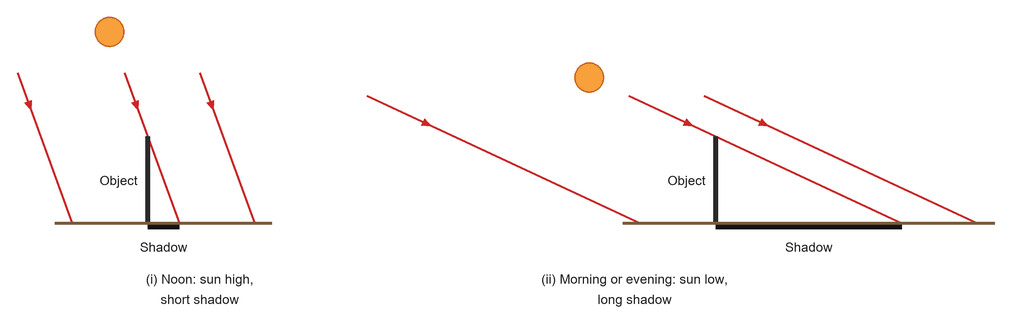
Therefore, shadows at noon are shorter because the sun is high and its rays fall steeply, while in the morning and the evening the low sun's slanting rays make long shadows.
- 632 marks
Question 63
What is an eclipse? Name the two types of eclipses.
Solve with AIWritten solution
Solution:
Concept: An eclipse is a shadow formed in nature when the sun, the earth and the moon come in one straight line. In a solar eclipse the moon comes in between the sun and the earth, so the moon's shadow falls on the earth; this can happen only on a new moon's day. In a lunar eclipse the earth comes in between the sun and the moon, so the earth's shadow falls on the moon; this can happen only on a full moon's night.
Step 1 — Define an eclipse.
When the sun, the earth and the moon come in one straight line, the earth or the moon (whichever is in between) casts its shadow on the other. This is an eclipse, a shadow formed in nature.
Step 2 — Name the two types.
The two types are the lunar eclipse (eclipse of the moon), in which the earth's shadow falls on the moon, and the solar eclipse (eclipse of the sun), in which the moon's shadow falls on the earth.
Therefore, an eclipse is a shadow formed when the sun, the earth and the moon are in a straight line; the two types are lunar and solar eclipses.
- 642 marks
Question 64
When does a lunar eclipse take place ? Does it occur on every full moon's night ?
Solve with AIWritten solution
Solution:
Concept: An eclipse is a shadow formed in nature when the sun, the earth and the moon come in one straight line. In a solar eclipse the moon comes in between the sun and the earth, so the moon's shadow falls on the earth; this can happen only on a new moon's day. In a lunar eclipse the earth comes in between the sun and the moon, so the earth's shadow falls on the moon; this can happen only on a full moon's night.
Step 1 — When it happens.
A lunar eclipse takes place when the earth comes in between the sun and the moon and all three are in one straight line. The earth's shadow falls on the moon, and the part of the moon in the earth's umbra is not seen. This is possible only on a full moon's night.
Step 2 — Check whether it happens every full moon's night.
The moon's path round the earth is tilted by about 5° to the path of the earth round the sun. So on most new moon days and full moon nights the three bodies are not exactly in one straight line, and there is no eclipse. On those nights the moon passes a little above or below the earth's shadow.
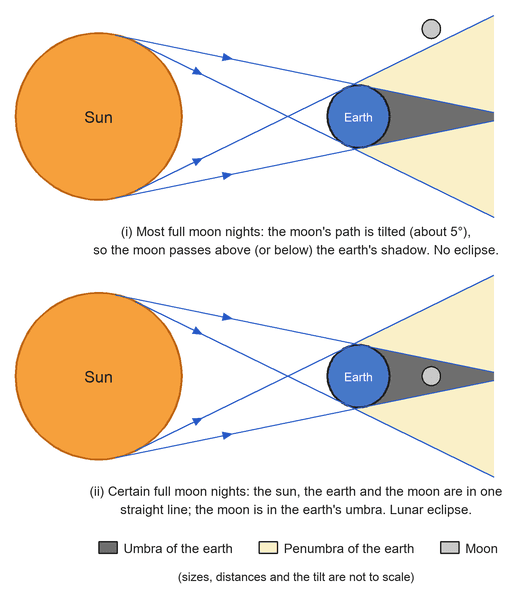
Therefore, a lunar eclipse takes place when the earth comes in between the sun and the moon; it does not occur on every full moon's night, only on certain ones.
- 652 marks
Question 65
When does a solar eclipse take place ? Does it occur on every new moon's day ?
Solve with AIWritten solution
Solution:
Concept: An eclipse is a shadow formed in nature when the sun, the earth and the moon come in one straight line. In a solar eclipse the moon comes in between the sun and the earth, so the moon's shadow falls on the earth; this can happen only on a new moon's day. In a lunar eclipse the earth comes in between the sun and the moon, so the earth's shadow falls on the moon; this can happen only on a full moon's night.
Step 1 — When it happens.
A solar eclipse takes place when the moon comes in between the sun and the earth and all three are in one straight line. The moon's shadow falls on the earth, and from that part of the earth the sun is hidden fully or partly. This is possible only on a new moon's day.
Step 2 — Check whether it happens every new moon's day.
The moon's path round the earth is tilted by about 5° to the path of the earth round the sun. So on most new moon days and full moon nights the three bodies are not exactly in one straight line, and there is no eclipse. On those days the moon's shadow passes above or below the earth.

Therefore, a solar eclipse takes place when the moon comes in between the sun and the earth; it does not occur on every new moon's day, only on certain ones.
- 664 marks
Question 66
Explain the difference between a transparent, a translucent and an opaque medium. Give two examples of each.
Solve with AIWritten solution
Solution:
Concept: Substances are grouped by how much light passes through them. A transparent medium lets light pass through it easily, so objects behind it are seen clearly (glass, water, air). A translucent medium lets only a part of the light pass, so objects behind it are seen only faintly (tracing paper, grease paper, ground glass). An opaque medium lets no light pass through it (wood, metal, cardboard).
Step 1 — Transparent medium.
A substance is transparent if light passes through it easily. An object behind it is seen clearly. Examples: glass and water (also air).
Step 2 — Translucent medium.
A substance is translucent if it lets only a part of the light pass through it. An object behind it is seen only faintly, without clear details. Examples: tracing paper and ground glass (also grease paper).
Step 3 — Opaque medium.
A substance is opaque if it lets no light pass through it. We cannot see an object through it. Examples: a wooden board and a metal sheet (also cardboard).
Step 4 — Compare them together.
The table puts the three side by side.
Medium Light passing through Object behind it Transparent almost all, easily seen clearly Translucent only a part seen faintly Opaque none not seen Therefore, a transparent medium lets light through easily (glass, water), a translucent one lets a part through (tracing paper, ground glass) and an opaque one lets none through (wood, metal).
- 674 marks
Question 67
Describe an experiment to show that light travels in a straight line path.
Solve with AIWritten solution
Solution:
Concept: Rectilinear propagation of light means that light travels in a straight line path in a medium. "Rectilinear" means "in a straight line" and "propagation" means "travelling". Shadows, eclipses and the pin hole camera all depend on it.
Step 1 — Collect the apparatus.
Take three square cardboards A, B and C (each of side about 5 cm), a pin, some thread, a support and a lighted candle.
Step 2 — Set up the cardboards.
Make a small hole with the pin at the centre of each cardboard. Hang the cardboards in a row from the support by threads. Pass a string through the three holes and pull it tight, so that the holes come in one straight line, and then take out the string.
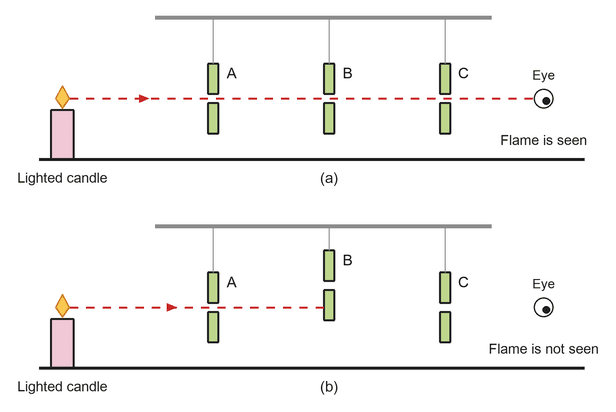
Step 3 — Look at the flame.
Place the lighted candle near cardboard A and look through the hole of cardboard C. The flame is seen, as in figure (a).
Step 4 — Disturb one cardboard.
Now move cardboard B slightly up or sideways, so that the three holes are no longer in a straight line, and look again. The flame is not seen, as in figure (b): the light is stopped by cardboard B.
Step 5 — Draw the conclusion.
Light from the flame reaches the eye only when the holes are in one straight line. This shows that light travels in a straight line path.
Watch out: Move only one cardboard, and keep the eye and the candle where they were; otherwise the test is not fair.
Therefore, the flame is seen only when the three holes are in a straight line, which shows that light travels in a straight line path.
- 684 marks
Question 68
What is a pin hole camera? Draw a neat and labelled diagram to show the formation of image of a lighted candle by it.
Solve with AIWritten solution
Solution:
Concept: A pin hole camera is a closed box with a small pin hole in one face and a translucent screen (tracing paper) on the opposite face. Light from each point of the object travels in a straight line through the pin hole, so the rays from the top and the bottom of the object cross at the hole. The image on the screen is therefore real (it is formed on the screen) and inverted (upside down).
Step 1 — Describe the camera.
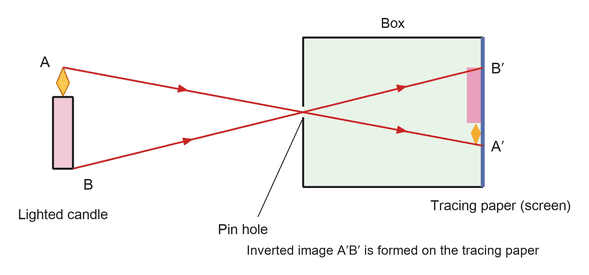
A pin hole camera is a simple device, based on the rectilinear propagation of light, that forms an inverted image of an object on a screen. It is a closed cardboard box with a small pin hole at the centre of one face. The opposite face is replaced by tracing paper, which acts as the screen.
Step 2 — Draw the diagram.
The diagram shows a lighted candle AB in front of the pin hole.
Step 3 — Explain the image.
Light from the top A of the flame travels straight through the pin hole and strikes the tracing paper at A′, low down. Light from the bottom B of the candle strikes it at B′, high up. Rays from all the points between A and B fall between A′ and B′. So an inverted image A′B′ of the candle is seen on the tracing paper.
Therefore, a pin hole camera is a closed box with a pin hole in one face and tracing paper on the opposite face; it forms a real, inverted image A′B′ of the lighted candle.
- 694 marks
Question 69
Explain the formation of image of a luminous object in a pin hole camera with the aid of a neat diagram.
Solve with AIWritten solution
Solution:
Concept: A pin hole camera is a closed box with a small pin hole in one face and a translucent screen (tracing paper) on the opposite face. Light from each point of the object travels in a straight line through the pin hole, so the rays from the top and the bottom of the object cross at the hole. The image on the screen is therefore real (it is formed on the screen) and inverted (upside down).
Step 1 — Draw the diagram.
Let a luminous object AB, such as a lighted candle, be placed in front of the pin hole.
Step 2 — Follow the ray from the top.
Light travels in a straight line. Light from the upper point A passes through the pin hole and strikes the screen at the lower point A′.
Step 3 — Follow the ray from the bottom.
Light from the lower point B passes through the pin hole and strikes the screen at the upper point B′.
Step 4 — Fill in the rest.
Rays from all the other points between A and B pass through the hole and strike the screen between A′ and B′. So a picture A′B′ of the candle is formed on the tracing paper.
Step 5 — Describe the image.
The image is real, because it is formed on the screen, and inverted, because the rays cross at the hole. It is usually smaller than the object, because the object is usually farther from the hole than the screen is.
Therefore, a luminous object forms a real and inverted image in a pin hole camera, because straight rays from every point of it cross at the pin hole.
- 704 marks
Question 70
Draw a ray diagram to show the formation of shadow of an opaque object by a point source of light. How is the size of shadow affected if the screen is moved away from the object ?
Solve with AIWritten solution
Solution:
Concept: A shadow is the dark patch formed on a screen behind an opaque object placed in the path of light. It is formed because light travels in straight lines and cannot bend round the object to reach the region behind it.
Step 1 — Draw the rays.
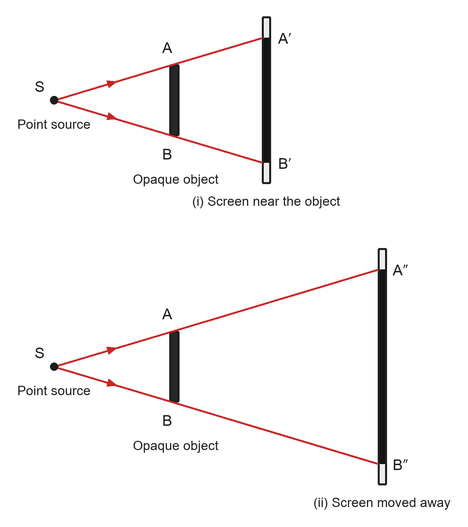
S is a point source and AB is an opaque object. Straight lines drawn from S, just touching the edges A and B of the object, are continued to the screen. The part of the screen between them gets no light. With a point source the whole shadow is completely dark (umbra) with sharp edges.
Step 2 — Move the screen away.
The rays from S keep spreading out as they travel. So on a screen farther away they are farther apart, and the shadow A″B″ is bigger than the shadow A′B′ on the near screen.
Watch out: With a point source the shadow is always bigger than the object, and it grows as the screen moves away.
Therefore, the shadow becomes bigger when the screen is moved away from the object.
- 713 marks
Question 71
Draw a ray diagram to show the formation of umbra alone.
Solve with AIWritten solution
Solution:
Concept: The umbra is the part of a shadow that receives no light from any part of the source, so it is completely dark. The penumbra is the part that receives light from only a part of the source, so it is partly dark (partly bright). A point source gives only an umbra. An extended source gives an umbra surrounded by a penumbra.
Step 1 — Use a point source.
Umbra alone is obtained when the opaque object is lit by a point source of light. A point source can be made by placing a lighted candle behind a cardboard with a small hole.
Step 2 — Draw the rays.
S is the point source and AB is the opaque object. Rays from S that just touch the edges A and B reach the screen at A′ and B′.

Step 3 — Name the shadow.
All the light comes from the single point S, so the part A′B′ of the screen gets no light at all. It is a sharp-edged, completely dark patch: the umbra. No penumbra is formed.
Therefore, a point source S and an opaque object AB give only an umbra A′B′ on the screen.
- 724 marks
Question 72
In each of the following diagrams, draw rays to form umbra and penumbra on the screen.
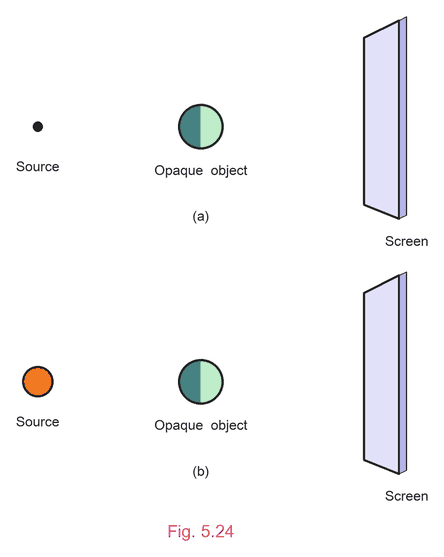 Solve with AI
Written solution
Solution:
Concept: The umbra is the part of a shadow that receives no light from any part of the source, so it is completely dark. The penumbra is the part that receives light from only a part of the source, so it is partly dark (partly bright). A point source gives only an umbra. An extended source gives an umbra surrounded by a penumbra.
Step 1 — Draw the rays.
From the edges of the source we draw straight rays that just touch the edges of the object, and continue them to the screen.
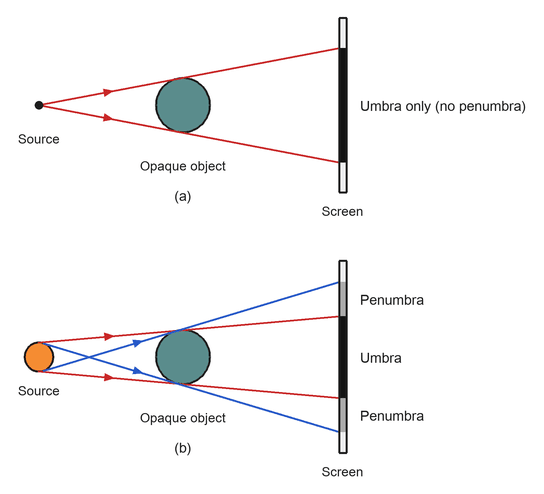
Step 2 — (a) Point source.
Only two rays can be drawn, from the source to the top and the bottom of the object. The screen between them gets no light, so a sharp umbra is formed. All the light comes from one point, so there is no penumbra.
Step 3 — (b) Extended source: the umbra.
Draw a ray from the top of the source past the top of the object, and a ray from the bottom of the source past the bottom of the object (red). The part of the screen between them gets no light from any part of the source. This is the umbra.
Step 4 — (b) Extended source: the penumbra.
Now draw the crossing rays, from the bottom of the source past the top of the object and from the top of the source past the bottom of the object (blue). The part of the screen between a blue ray and the red ray next to it gets light from only a part of the source. This is the penumbra.
Therefore, in (a) the point source gives only an umbra, and in (b) the extended source gives an umbra surrounded by a penumbra.
- 734 marks
Question 73
Draw a ray diagram to show the formation of umbra and penumbra both. Label the parts umbra and penumbra in your diagram.
Solve with AIWritten solution
Solution:
Concept: The umbra is the part of a shadow that receives no light from any part of the source, so it is completely dark. The penumbra is the part that receives light from only a part of the source, so it is partly dark (partly bright). A point source gives only an umbra. An extended source gives an umbra surrounded by a penumbra.
Step 1 — Set up the diagram.
PQ is an extended source (the flame of a burning candle) and AB is an opaque object bigger than the flame. The rays from P and from Q that just touch A and B are drawn to the screen.
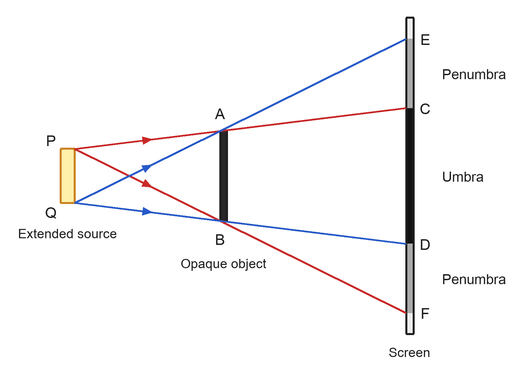
Step 2 — Shadow for the top P.
The rays PA and PB reach the screen at C and F. So the part CF of the screen gets no light from P.
Step 3 — Shadow for the bottom Q.
The rays QA and QB reach the screen at E and D. So the part ED gets no light from Q.
Step 4 — Find the umbra.
The part CD lies in both these parts, so it gets no light from any point of the flame. It is completely dark: the umbra.
Step 5 — Find the penumbra.
The part EC gets light from P but not from Q, and the part DF gets light from Q but not from P. These parts are partly dark: the penumbra. Because of the penumbra, the edges of this shadow are not sharp.
Therefore, the diagram shows the umbra CD in the middle and the penumbra EC and DF on either side of it.
- 743 marks
Question 74
State the conditions when only the penumbra of an opaque object is obtained on the screen.
Solve with AIWritten solution
Solution:
Concept: The umbra is the part of a shadow that receives no light from any part of the source, so it is completely dark. The penumbra is the part that receives light from only a part of the source, so it is partly dark (partly bright). A point source gives only an umbra. An extended source gives an umbra surrounded by a penumbra.
Step 1 — State the first condition.
The source of light must be an extended source bigger than the opaque object.
Step 2 — State the second condition.
The screen must be placed far from the object, beyond the point where the umbra ends.
Step 3 — Explain with the diagram.
When the source PQ is bigger than the object AB, the rays that mark the edges of the umbra come closer together behind the object and meet at a point O. So the umbra ends at O. On a screen placed beyond O there is no umbra, and only the penumbra is seen.
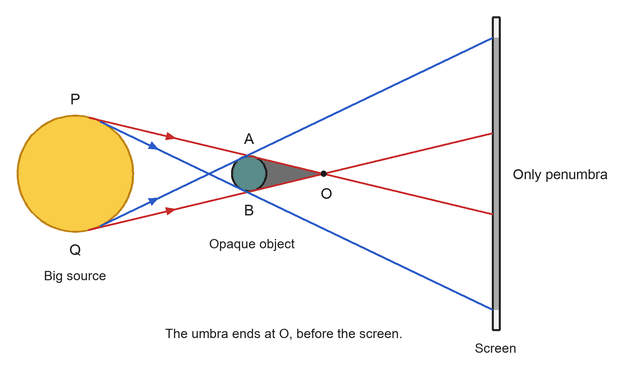
Step 4 — Give an example.
A bird or a kite flying high up gives only a large, faint penumbra on the ground.
Therefore, only the penumbra is obtained when the source is bigger than the object and the screen is placed beyond the point where the umbra ends.
- 753 marks
Question 75
Draw a diagram to show the formation of lunar eclipse.
Solve with AIWritten solution
Solution:
Concept: An eclipse is a shadow formed in nature when the sun, the earth and the moon come in one straight line. In a solar eclipse the moon comes in between the sun and the earth, so the moon's shadow falls on the earth; this can happen only on a new moon's day. In a lunar eclipse the earth comes in between the sun and the moon, so the earth's shadow falls on the moon; this can happen only on a full moon's night.
Step 1 — Place the three bodies.
On a certain full moon's night the sun, the earth and the moon come in one straight line, with the earth in between.
Step 2 — Draw the earth's shadow.
Straight rays from the edges of the sun that just touch the edges of the earth mark out the earth's shadow: a dark umbra that narrows behind the earth, with the penumbra on either side.
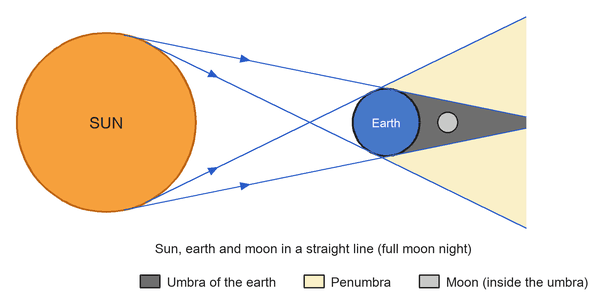
Step 3 — Explain the eclipse.
The part of the moon inside the earth's umbra gets no direct sunlight, so it is not seen from the earth. If the whole moon is in the umbra, it is a total lunar eclipse; if only a part of it is, it is a partial lunar eclipse.
Therefore, a lunar eclipse is formed when the earth comes in between the sun and the moon and the moon passes into the earth's umbra.
- 763 marks
Question 76
Draw a diagram to show the formation of solar eclipse.
Solve with AIWritten solution
Solution:
Concept: An eclipse is a shadow formed in nature when the sun, the earth and the moon come in one straight line. In a solar eclipse the moon comes in between the sun and the earth, so the moon's shadow falls on the earth; this can happen only on a new moon's day. In a lunar eclipse the earth comes in between the sun and the moon, so the earth's shadow falls on the moon; this can happen only on a full moon's night.
Step 1 — Place the three bodies.
On a certain new moon's day the sun, the moon and the earth come in one straight line, with the moon in between.
Step 2 — Draw the moon's shadow.
Straight rays from the edges of the sun that just touch the edges of the moon mark out the moon's umbra and penumbra, which fall on the earth.

Step 3 — Explain the eclipse.
From the small part of the earth in the moon's umbra, the sun is completely hidden, and a total solar eclipse is seen. From the parts of the earth in the moon's penumbra, only a part of the sun is hidden, and a partial solar eclipse is seen.
Therefore, a solar eclipse is formed when the moon comes in between the sun and the earth and its shadow falls on the earth.
- 774 marks
Question 77
What is annular solar eclipse ? Draw a labelled diagram to show its formation.
Solve with AIWritten solution
Solution:
Concept: An eclipse is a shadow formed in nature when the sun, the earth and the moon come in one straight line. In a solar eclipse the moon comes in between the sun and the earth, so the moon's shadow falls on the earth; this can happen only on a new moon's day. In a lunar eclipse the earth comes in between the sun and the moon, so the earth's shadow falls on the moon; this can happen only on a full moon's night.
Step 1 — Define the annular eclipse.
An annular solar eclipse is a solar eclipse in which the sun is seen as a bright ring around the dark moon. “Annular” means ring-shaped.
Step 2 — Explain when it happens.
The moon's path round the earth is not a perfect circle. When the moon is exactly between the sun and the earth but a little farther from the earth than usual, its umbra is too short and ends just before reaching the earth.
Step 3 — Draw the diagram.
The diagram shows the moon's umbra ending short of the earth. D is a point on the earth in line with the sun and the moon, beyond the tip of the umbra.
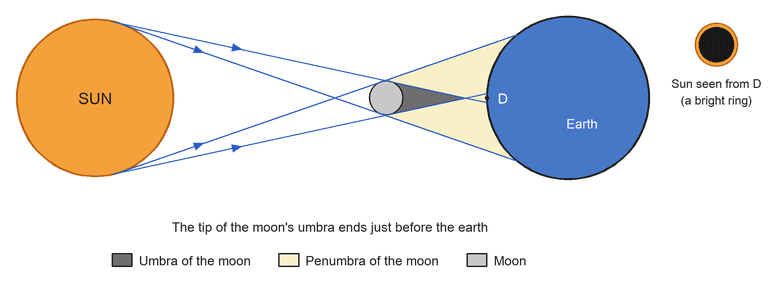
Step 4 — Explain what is seen from D.
From D the moon looks slightly smaller than the sun. So the moon hides the middle of the sun, but the outer edge of the sun still shines round it as a bright ring.
Note: The bright ring is the sun's own bright edge. The sun's faint outer glow (the corona) and the “diamond ring” are seen only during a total solar eclipse.
Therefore, an annular solar eclipse is one in which the sun is seen as a bright ring round the moon, because the moon's umbra ends just short of the earth.
- 782 marks
Question 78
In the diagram below empty boxes show the different phases of moon as viwed from the earth. Which of the box represents the new moon ?
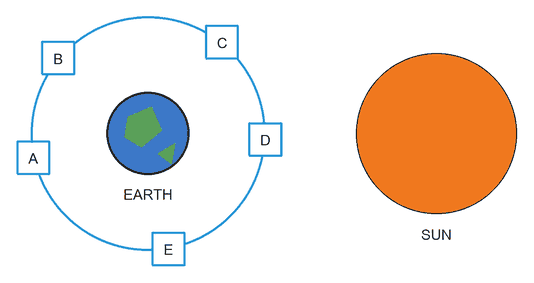 Solve with AI
Written solution
Solution:
Concept: An eclipse is a shadow formed in nature when the sun, the earth and the moon come in one straight line. In a solar eclipse the moon comes in between the sun and the earth, so the moon's shadow falls on the earth; this can happen only on a new moon's day. In a lunar eclipse the earth comes in between the sun and the moon, so the earth's shadow falls on the moon; this can happen only on a full moon's night.
Step 1 — Recall where the moon is at new moon.
At new moon the moon is between the earth and the sun, on the line joining them.
Step 2 — Find that box.
In the diagram the sun is on the right. Box D lies on the moon's path on the side facing the sun, between the earth and the sun.
Step 3 — Check what we see.
In this position sunlight falls only on the far side of the moon, the side turned away from the earth. The side facing us is dark, and the moon has no light of its own, so the moon is not seen. That is the new moon. (Box A, on the far side of the earth from the sun, shows the full moon.)
Therefore, box D represents the new moon.
- 793 marks
Question 79
Can an object have more than one shadow ? If yes, write down the possible reasons.
Solve with AIWritten solution
Solution:
Concept: A shadow is the dark patch formed on a screen behind an opaque object placed in the path of light. It is formed because light travels in straight lines and cannot bend round the object to reach the region behind it.
Step 1 — Give the answer.
Yes, an object can have more than one shadow.
Step 2 — First reason: more than one source.
Each source sends straight rays that the object blocks, so each source forms its own shadow. A player in a stadium lit by several floodlights has several shadows, and a pen held between two lighted bulbs casts two shadows.

Step 3 — Second reason: light from different directions.
Light can reach the object from different directions, for example sunlight and the light of a lamp, or light sent back by a mirror. Each direction gives a separate shadow.
Step 4 — Compare the shadows.
The shadows are usually of different darkness and length, depending on how bright and how far each source is.
Therefore, yes, an object can have more than one shadow when light reaches it from more than one source or from different directions.
What Class 6 Physics Ch 5 covers
The sections of the chapter, in the order the book takes them. Every question above comes from one of these.
- 01Sources of Light
- 02Luminous and Non-Luminous Bodies
- 03Some Important Terms
- 04Rectilinear Propagation of Light
- 05Applications of Rectilinear Propagation of Light
- 06Pin Hole Camera
More ways to study this chapter
The same chapter asked three other ways. Practise it, revise it, and see what the board has set on Ch 5 before.
Class 6 Physics Ch 5 questions students ask
How many questions are there in Class 6 Physics Ch 5?
79 questions. Every one is solved step by step on this page.
Are these Class 6 Physics solutions free?
Yes. Every question and its full working is free to read, with no account needed.
Can I download the Class 6 Physics Ch 5 solutions as a PDF?
There is no PDF to download. Every solution is on this page instead, which means it is searchable, always the current syllabus, and readable on a phone. Use your browser's print option if you want it on paper.