
Opening your dashboard
Class 6 Physics Chapter 5 Light: Practice Questions
40 questions on Chapter 5, each worked through on its own page with the AI tutor. Class 6 Physics, ICSE 2026-27.
40 questions
1–5 marks · Mixed difficulty
- 11 mark
Question 1
Bloom's level: Remember
Light is best described as :
- 21 mark
Question 2
Bloom's level: Remember
On a camping trip at night, Tanya notices four things giving light. Which one of them is a source of light not made by people ?
- 31 mark
Question 3
Bloom's level: Understand
Bathroom windows are often fitted with ground (frosted) glass instead of clear glass. This is because ground glass :
- 41 mark
Question 4
Bloom's level: Understand
In a dark room, a table lamp is switched on and you can now see a red book lying on the table. Which statement correctly explains this ?
- 51 mark
Question 5
Bloom's level: Apply
A candle flame 10 cm tall is placed 40 cm in front of the pin hole of a pin hole camera. The screen (tracing paper) is 20 cm behind the pin hole.
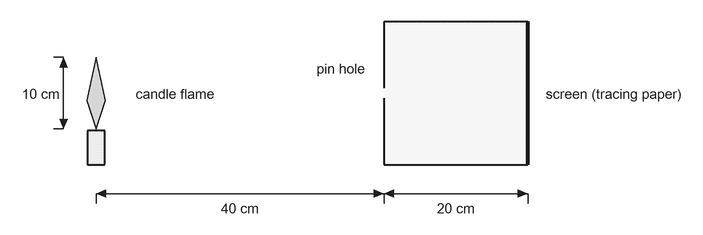
The height of the image of the flame is :
- 61 mark
Question 6
Bloom's level: Apply
A coin is held between a point source of light and a screen. Which change will make the shadow of the coin on the screen larger ?
- 71 mark
Question 7
Bloom's level: Analyse
Three cardboards A, B and C, each with a small hole, are hung one behind the other between a candle and a student's eye. The flame and the eye are both 12 cm above the table. The heights of the holes above the table in four set-ups are :
Set-up Hole in A Hole in B Hole in C P 12 cm 12 cm 10 cm Q 10 cm 12 cm 12 cm R 12 cm 12 cm 12 cm S 12 cm 14 cm 12 cm In which set-up will the student see the candle flame ?
- 81 mark
Question 8
Bloom's level: Evaluate
Sameer says, "Since a lunar eclipse happens when the earth comes between the sun and the moon, we get a lunar eclipse on every full moon night." Which is the best judgement of his statement ?
- 91 mark
Question 9
Bloom's level: Understand
Which one of the following statements about this chapter is correct ?
- 101 mark
Question 10
Bloom's level: Understand
Read the Assertion (A) and the Reason (R) and choose the correct option.
Assertion (A): We cannot see a bulb kept behind a wooden board even when the bulb is switched on.
Reason (R): Wood is an opaque substance; it does not allow any light to pass through it.
- 111 mark
Question 11
Bloom's level: Understand
Read the Assertion (A) and the Reason (R) and choose the correct option.
Assertion (A): The moon is a luminous body.
Reason (R): We can see the moon shining in the sky at night.
- 121 mark
Question 12
Bloom's level: Understand
Read the Assertion (A) and the Reason (R) and choose the correct option.
Assertion (A): The shadow of an object is formed on the side of the object away from the source of light.
Reason (R): The shadow of an object shows the colour of the object.
- 132 marks
Question 13
Bloom's level: Remember
Name the two types of sources of light. Give two examples of each type, other than the sun and an electric bulb.
- 142 marks
Question 14
Bloom's level: Apply
Light travels a distance of metre in one second through air (and vacuum). Light from the sun takes about 500 seconds (8 minutes 20 seconds) to reach the earth. Find the distance of the sun from the earth.
- 152 marks
Question 15
Bloom's level: Understand
Sort the following into transparent, translucent and opaque substances : clear plastic sheet, butter paper, aluminium foil, clean water, oiled paper, a brick.
- 162 marks
Question 16
Bloom's level: Apply
Name the kind of beam of light (parallel, divergent or convergent) in each case and give a reason :
(a) Sunlight reaching a playground.
(b) Light spreading out from a small LED bulb hanging in a room.
- 172 marks
Question 17
Bloom's level: Apply
A carpenter checks whether the edge of a long wooden plank is straight by closing one eye and looking along the edge from one end. Explain how this check works.
- 182 marks
Question 18
Bloom's level: Apply
A pin hole camera is 15 cm long. It is used to look at a building 30 m tall standing 90 m away from the pin hole. Find the height of the image of the building on the screen.
- 192 marks
Question 19
Bloom's level: Analyse
A candle is kept 50 cm in front of a pin hole. Riya moves the screen of her pin hole camera and measures the height of the image :
Distance of screen from pin hole (in cm) 10 15 20 Height of image (in cm) 2 3 4 (a) What pattern do you see ? Predict the height of the image when the screen is 25 cm from the pin hole.
(b) Find the height of the candle.
- 202 marks
Question 20
Bloom's level: Analyse
Three square sheets of the same size - one of wood, one of tracing paper and one of clear glass - are held one at a time in front of a torch. On the wall, sheet 1 gives a very dark shadow, sheet 2 gives a faint, light-grey shadow and sheet 3 gives almost no shadow. Identify each sheet and give a reason.
- 211 mark
Question 21
Bloom's level: Remember
During an annular solar eclipse, what is the bright outer rim of the sun that remains visible for a short time called ?
- 222 marks
Question 22
Bloom's level: Evaluate
Kabir says, "A polished steel plate looks very bright in sunlight, so it is a luminous body." Is Kabir right ? Justify your answer.
- 234 marks
Question 23
Bloom's level: Analyse
The figure shows a long glowing tube light PQ, an opaque card AB (seen edge-on) and a screen. Three regions X, Y and Z are formed on the screen.
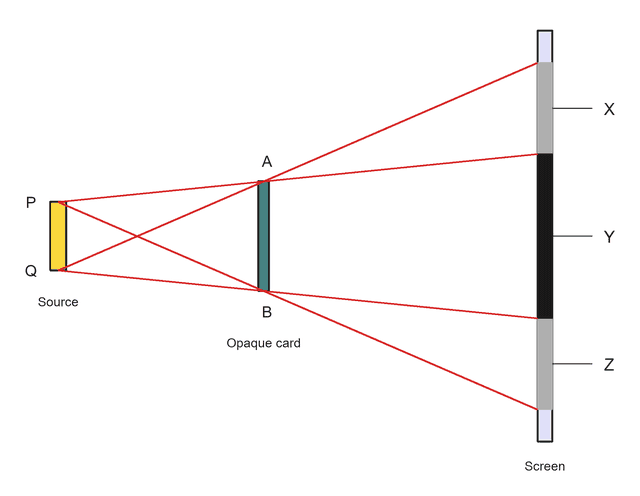
(a) Name the regions X, Y and Z.
(b) Region X receives light from only one end of the tube light. Which end, P or Q ? Explain using the lines in the figure.
(c) Why is region Y completely dark ?
(d) What will happen to the sizes of Y and of the whole shadow if the screen is moved farther from the card ?
- 244 marks
Question 24
Bloom's level: Apply
Case study: A news channel announces, "A total lunar eclipse will be seen tonight. The moon will slowly turn dark." It is a full moon night. Meena wonders why this happens tonight and not every night.
(a) Write the order of the sun, the earth and the moon in space during this eclipse. Whose shadow falls on whom ?
(b) Why does a lunar eclipse take place only on a full moon night ?
(c) Meena's brother says, "Let's also watch a solar eclipse tomorrow night." Explain why this is impossible.
- 254 marks
Question 25
Bloom's level: Apply
Case study: Students make a pin hole camera from a shoe box 24 cm long, with tracing paper at one end and a pin hole at the other. They point it at their friend Arjun, who is 180 cm tall and stands 6 m from the pin hole.
(a) Will Arjun's image be upright or upside down ? Why ?
(b) Find the height of Arjun's image.
(c) Arjun now walks closer and stands 4 m from the pin hole. Find the new height of the image. Then state what will happen to the image if a student makes the pin hole bigger.
- 263 marks
Question 26
Bloom's level: Apply
Use the rectilinear propagation of light to explain each of the following :
(a) The image of a lighted candle in a pin hole camera is upside down.
(b) Your hand held in front of a torch makes a dark patch on the wall behind it.
(c) On a certain new moon day, people in some places on earth cannot see the sun at mid-day.
- 274 marks
Question 27
Bloom's level: Evaluate
Arnav wrote these revision notes for the chapter. Check each statement. Say whether it is correct or wrong, and rewrite each wrong statement correctly.
-
Light is a form of energy which produces the sensation of vision.
-
Tracing paper is an opaque substance.
-
The image in a pin hole camera is real and inverted.
-
A point source of light gives a shadow with umbra and penumbra both.
-
A solar eclipse occurs when the earth comes in between the sun and the moon.
-
The shadow of an object is similar in shape to the object.
-
- 285 marks
Question 28
Bloom's level: Create
Your class is putting up a shadow-puppet show. The puppets are cut out of thick cardboard and the audience sits on the other side of a screen. Plan the show :
(a) What material will you use for the screen, and why ?
(b) Which kind of light source will you choose to get shadows with sharp edges ? Why ?
(c) How will you make a puppet's shadow look bigger (for a giant) and smaller (for a child) during the show ?
(d) Why must the puppets be of cardboard and not of clear plastic ?
- 295 marks
Question 29
Bloom's level: Create
Looking straight at the sun, even during an eclipse, can harm the eyes. Design a pin hole viewer to watch a partial solar eclipse safely. Include :
(a) the materials you need,
(b) how you will make it,
(c) how you will use it,
(d) what you expect to see on the screen and why it looks that way, and how you could make the picture of the sun larger.
- 304 marks
Question 30
Bloom's level: Analyse
A ball 6 cm across is placed 20 cm from a source of light. The diameters of the umbra and the penumbra (outer edge) on a screen are measured for three different sources I, II and III, with the screen first at 30 cm and then at 40 cm from the source.
Source Umbra at 30 cm Umbra at 40 cm Penumbra at 30 cm Penumbra at 40 cm I 9 cm 12 cm none none II 8 cm 10 cm 10 cm 14 cm III 4 cm 2 cm 14 cm 22 cm (a) Which source is a point source ? Give a reason from the table.
(b) One of sources II and III is smaller than the ball and the other is bigger. Which one is bigger than the ball ? Give two reasons from the table.
(c) Predict what will happen to the umbra of source III if the screen is moved still farther away.
- 311 mark
Question 31
Which of the following is an artificial source of light ?
- 321 mark
Question 32
A group of light rays which spread out in different directions from a point source of light is called :
- 331 mark
Question 33
A pin hole camera is pointed at a tree and an image of the tree is seen on its screen. Which statement about this image is not correct ?
- 341 mark
Question 34
Fill in the blank :
The working of a pin hole camera and the formation of shadows and eclipses are applications of the .............. propagation of light.
- 351 mark
Question 35
Write true or false :
The shadow of an opaque object formed on a screen by a point source of light has both an umbra and a penumbra.
- 362 marks
Question 36
On a foggy night, the light from the headlight of a motor cycle is seen as a bright beam on the road ahead.
(a) How does the edge of this beam look - straight or curved ? Which property of light does this show ?
(b) A man is standing just behind a thick tree trunk by the side of the road. The headlight does not light him up. Explain why, using the same property of light.
- 372 marks
Question 37
(a) What is a non-luminous body ?
(b) The moon is a non-luminous body, yet it shines brightly on a full moon night. Explain how.
- 385 marks
Question 38
A lighted candle AB, 12 cm tall up to the tip of its flame, is placed in front of a pin hole camera at a distance of 30 cm from the pin hole. The screen of the camera is 15 cm behind the pin hole.
(a) Draw a labelled ray diagram to show how the image of the candle is formed on the screen.
(b) Calculate the height of the image.
(c) The candle is now moved towards the camera, so that it is 20 cm from the pin hole. Calculate the new height of the image. Does the image become bigger or smaller ?
- 394 marks
Question 39
A ball is held between a large glowing bulb and a white wall. The bulb acts as an extended source of light. A shadow of the ball is seen on the wall.
(a) Name the two parts of this shadow. Which of them is darker, and why ?
(b) Draw a labelled ray diagram to show how the two parts of the shadow are formed.
(c) The glowing bulb is now replaced by a point source of light. State two changes that will be seen in the shadow on the wall.
- 404 marks
Question 40
(a) State three differences between a solar eclipse and a lunar eclipse. Write your answer in the form of a table.
(b) On the day of a solar eclipse, people in one city see a total solar eclipse, while people in another city see a partial solar eclipse. In which part of the shadow of the moon does each city lie ?