
Question 642 marksEasy
When does a lunar eclipse take place ? Does it occur on every full moon's night ?
Confirming your payment
Sign up now and get 250 free tokens.
Light · Question 64 of 79
When does a lunar eclipse take place ? Does it occur on every full moon's night ?
Solution:
Concept: An eclipse is a shadow formed in nature when the sun, the earth and the moon come in one straight line. In a solar eclipse the moon comes in between the sun and the earth, so the moon's shadow falls on the earth; this can happen only on a new moon's day. In a lunar eclipse the earth comes in between the sun and the moon, so the earth's shadow falls on the moon; this can happen only on a full moon's night.
Step 1 — When it happens.
A lunar eclipse takes place when the earth comes in between the sun and the moon and all three are in one straight line. The earth's shadow falls on the moon, and the part of the moon in the earth's umbra is not seen. This is possible only on a full moon's night.
Step 2 — Check whether it happens every full moon's night.
The moon's path round the earth is tilted by about 5° to the path of the earth round the sun. So on most new moon days and full moon nights the three bodies are not exactly in one straight line, and there is no eclipse. On those nights the moon passes a little above or below the earth's shadow.
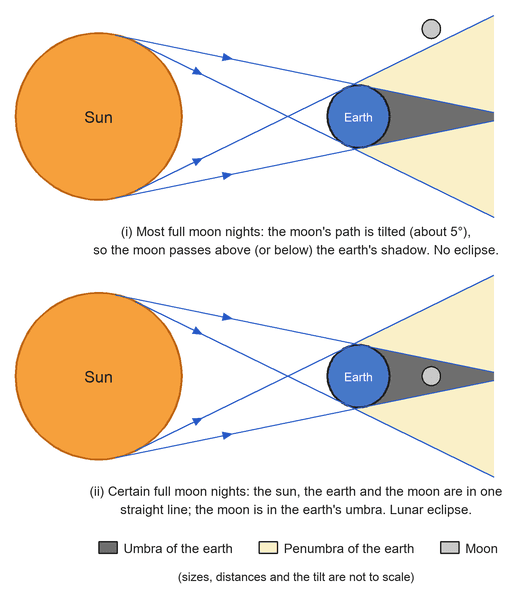
Therefore, a lunar eclipse takes place when the earth comes in between the sun and the moon; it does not occur on every full moon's night, only on certain ones.