
Question 694 marksEasy
Explain the formation of image of a luminous object in a pin hole camera with the aid of a neat diagram.
Confirming your payment
Sign up now and get 250 free tokens.
Light · Question 69 of 79
Explain the formation of image of a luminous object in a pin hole camera with the aid of a neat diagram.
Solution:
Concept: A pin hole camera is a closed box with a small pin hole in one face and a translucent screen (tracing paper) on the opposite face. Light from each point of the object travels in a straight line through the pin hole, so the rays from the top and the bottom of the object cross at the hole. The image on the screen is therefore real (it is formed on the screen) and inverted (upside down).
Step 1 — Draw the diagram.
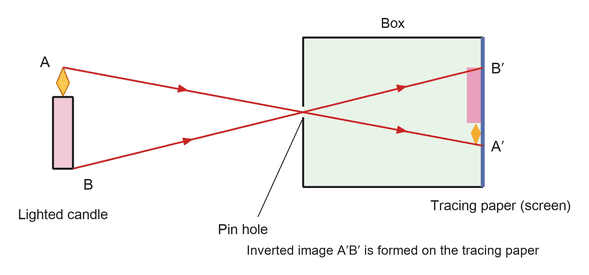
Let a luminous object AB, such as a lighted candle, be placed in front of the pin hole.
Step 2 — Follow the ray from the top.
Light travels in a straight line. Light from the upper point A passes through the pin hole and strikes the screen at the lower point A′.
Step 3 — Follow the ray from the bottom.
Light from the lower point B passes through the pin hole and strikes the screen at the upper point B′.
Step 4 — Fill in the rest.
Rays from all the other points between A and B pass through the hole and strike the screen between A′ and B′. So a picture A′B′ of the candle is formed on the tracing paper.
Step 5 — Describe the image.
The image is real, because it is formed on the screen, and inverted, because the rays cross at the hole. It is usually smaller than the object, because the object is usually farther from the hole than the screen is.
Therefore, a luminous object forms a real and inverted image in a pin hole camera, because straight rays from every point of it cross at the pin hole.