
Question 753 marksEasy
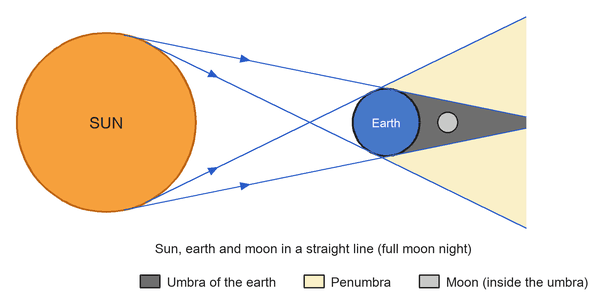
Draw a diagram to show the formation of lunar eclipse.
Confirming your payment
Sign up now and get 250 free tokens.
Light · Question 75 of 79
Draw a diagram to show the formation of lunar eclipse.
Solution:
Concept: An eclipse is a shadow formed in nature when the sun, the earth and the moon come in one straight line. In a solar eclipse the moon comes in between the sun and the earth, so the moon's shadow falls on the earth; this can happen only on a new moon's day. In a lunar eclipse the earth comes in between the sun and the moon, so the earth's shadow falls on the moon; this can happen only on a full moon's night.
Step 1 — Place the three bodies.
On a certain full moon's night the sun, the earth and the moon come in one straight line, with the earth in between.
Step 2 — Draw the earth's shadow.
Straight rays from the edges of the sun that just touch the edges of the earth mark out the earth's shadow: a dark umbra that narrows behind the earth, with the penumbra on either side.
Step 3 — Explain the eclipse.
The part of the moon inside the earth's umbra gets no direct sunlight, so it is not seen from the earth. If the whole moon is in the umbra, it is a total lunar eclipse; if only a part of it is, it is a partial lunar eclipse.
Therefore, a lunar eclipse is formed when the earth comes in between the sun and the moon and the moon passes into the earth's umbra.