Answer: (A)
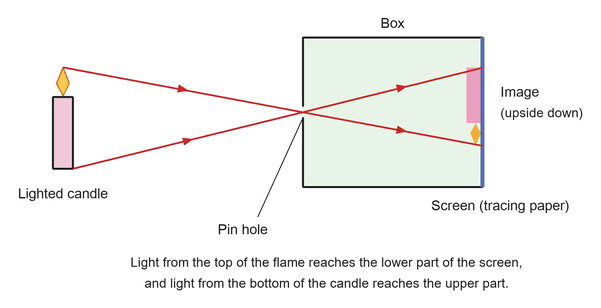
Concept: In an assertion-reason item we judge the Assertion (A) on its own, then the Reason (R) on its own, and then decide whether R correctly explains A. A pin hole camera is a closed box with a small pin hole in one face and a translucent screen (tracing paper) on the opposite face. Light from each point of the object travels in a straight line through the pin hole, so the rays from the top and the bottom of the object cross at the hole. The image on the screen is therefore real (it is formed on the screen) and inverted (upside down).
Step 1 — Judge the Assertion.
The image on the screen of a pin hole camera is upside down. The Assertion is true.
Step 2 — Judge the Reason.
Light travels in straight lines, so a ray from the top of the object passes through the hole and reaches the bottom of the screen, and a ray from the bottom reaches the top. The Reason is true.
Step 3 — Decide whether R explains A.
This crossing of straight rays at the hole is exactly what turns the image upside down. So the Reason correctly explains the Assertion.
Why the other options are wrong:
- (B): The Reason is the very cause of the inversion, so it does explain the Assertion.
- (C): The Reason is true, so this code is wrong.
- (D): The Assertion is true, so this code is wrong.
Therefore, both are true and the Reason correctly explains the Assertion, option (A).
