
Opening your dashboard
Class 6 Physics Chapter 5 Light: Competency-Based Questions (CBQ)
40 questions on Chapter 5, each worked through on its own page with the AI tutor. Class 6 Physics, ICSE 2026-27.
40 questions
1–4 marks · Mixed difficulty
- 11 mark
Question 1
Competency: Understanding & Application
On an evening walk in her village, Asha notes five things that seem to give light: the stars, a firefly, the moon, a street lamp and a kerosene lamp in a shop. She wants to sort them for her science notebook.
Which sorting is correct?
- 21 mark
Question 2
Competency: Analysis
Imran cuts a small window in one side of a shoe box. He puts things inside the box, covers the box and his head with a thick black cloth, and looks in through the window. His record is given below.
Things inside the box What he sees through the window A white sheet of paper and a polished steel spoon Nothing The paper, the spoon and a torch that is switched off Nothing The paper, the spoon and the same torch switched on The torch, the paper and the spoon Which conclusion do these observations support?
- 31 mark
Question 3
Competency: Application
Neel points a pin hole camera at a tree standing in bright sunlight. The tracing paper screen of the camera is 20 cm behind the pin hole. The tree is 6 m tall and its image on the screen is 4 cm tall.
How far is the tree from the pin hole?
- 41 mark
Question 4
Competency: Application & Analysis
The lamp above an operation table is a wide panel of many bulbs. The panel is much wider than a surgeon's hand. When the surgeon's hand comes between the lamp and the patient, no dark shadow of the hand is seen on the patient, only a slight dimness.
Which explanation is correct?
- 51 mark
Question 5
Competency: Understanding
Assertion (A): In a dark, dusty store room, the sunlight coming in through a small hole in the window is seen as a straight bright band.
Reason (R): Light travels in a straight line path, and the dust particles lit up by it show this path.
- 61 mark
Question 6
Competency: Understanding & Analysis
Assertion (A): During a total solar eclipse, the sun is completely hidden for people at all the places on the earth where it is day.
Reason (R): The umbra of the moon falls on only a small part of the earth; from the places that lie in the penumbra of the moon, a part of the sun can still be seen.
- 72 marks
Question 7
Competency: Application & Evaluation
A shopkeeper is fitting out a sweet shop. He has sheets of three materials: clear glass, ground glass and plywood. He needs a sheet for each of these jobs:
- the front of the display counter, through which customers must see the sweets clearly;
- the cover of the tube light above the counter, which must let light come out but must not show the tube clearly;
- the door of a cupboard for a box of photographic film, which must be kept away from light.
(a) Choose the material for each job. Give the reason in terms of how light passes through it.
(b) His helper says, "Use ground glass for the front of the counter as well. It lets light through, so the customers will see the sweets just as well." Judge this statement.
- 82 marks
Question 8
Competency: Application & Evaluation
On a full moon night Riya reads that the moon is about m away from the earth, and that light travels m in one second.
(a) How long does light leaving the moon take to reach Riya?
(b) Riya says, "So the moonlight I see now was made by the moon a little more than a second ago." Judge her statement, and describe the complete path of this light.
- 92 marks
Question 9
Competency: Application & Analysis
A small bright bulb L is fixed on top of a pole in a garden. A wall stands 4 m from the pole. Four flower pots P, Q, R and S are kept on the ground on the other side of the wall. The side view below is drawn on a grid in which each square is 1 m wide and 1 m high. Take each pot as a point on the ground.
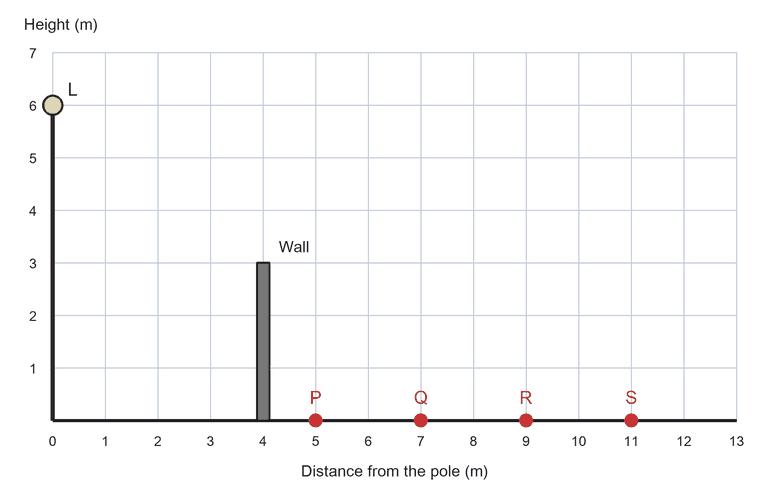
(a) Which of the four pots receive light directly from the bulb L? Explain how you find this out from the figure.
(b) The owner wants all four pots to be in the shadow of the wall, so he makes the wall 1 m higher. Will this be enough? Use the grid to justify your answer.
- 102 marks
Question 10
Competency: Analysis & Evaluation
Kavya and Dev make pin hole cameras from two boxes of the same size. They point them at the same lighted candle from the same distance. On Kavya's screen the image is sharp but faint. On Dev's screen the image is brighter but blurred.
(a) What is the difference between the holes of the two cameras? Explain why Dev's image is blurred.
(b) To make Kavya's image brighter, Dev suggests, "Make three more pin holes very close to the first one, so that more light gets in." Will Kavya get a brighter and still sharp image? Judge his suggestion.
- 114 marks
Question 11
Competency: Application & Analysis
Case study: For a science exhibition, a group makes a pin hole camera from a box 20 cm long: the pin hole is at one end and the tracing paper screen is at the other end. They point it at a brightly lit lamp stand in the school hall. They measure the height of the image with the lamp stand at four different distances from the pin hole. Their results are the four marked points on the graph.
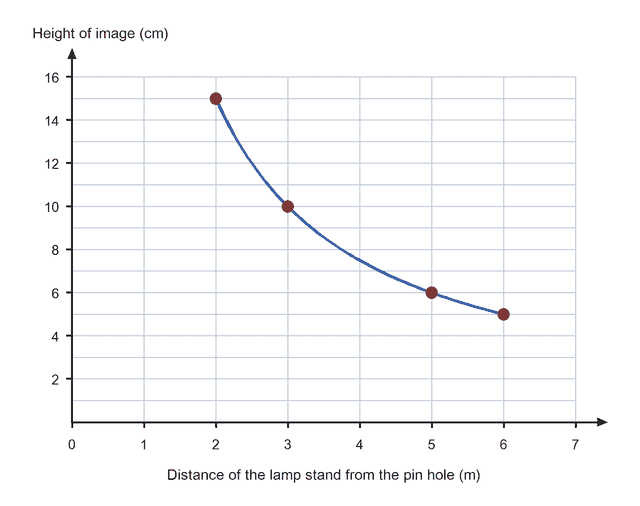
(a) Read from the graph the height of the image when the lamp stand is 3 m and 6 m from the pin hole. How does the size of the image change as the lamp stand is moved away?
(b) Use the reading for 5 m and the length of the camera to find the height of the lamp stand.
(c) The screen is only 12 cm high. What is the least distance of the lamp stand from the pin hole at which its whole image fits on the screen? If the lamp stand has to stay 2 m away, what change in the camera will make the whole image fit?
- 123 marks
Question 12
Competency: Understanding & Analysis
Case study: Arif plays cricket at night in a lane. One end of the lane is lit by a single small bulb on a distant pole. The other end is lit by a long tube light fixed low on a wall. He holds his bat a little above the ground at each end and looks at its shadow on the ground.
Where the bat is held Shadow of the bat on the ground Near the small distant bulb Equally dark all over, with sharp edges Near the long tube light Dark in the middle, with a lighter border that has no sharp edge (a) Name the dark middle part and the lighter border of the second shadow. Which of the two lamps acts as a point source of light and which as an extended source?
(b) Think of the light coming from the two ends of the tube light. Explain why the border is neither as bright as the open ground nor as dark as the middle part.
(c) Near the tube light, Arif slowly raises the bat higher above the ground. The dark middle part becomes smaller and at last disappears; only a faint patch is left. Explain this observation.
- 134 marks
Question 13
Competency: Analysis & Evaluation
Case study: The members of an astronomy club copy the following record for one year from an almanac.
Event Number in the year Full moon nights 12 New moon days 12 Lunar eclipses (each on a full moon night) 2 Solar eclipses (each on a new moon day) 2 (a) For each kind of eclipse, state which of the three bodies (the sun, the earth, the moon) is in the middle, and whose shadow falls on which body.
(b) On how many full moon nights of that year was there no lunar eclipse? What does this tell you about the positions of the sun, the earth and the moon on those nights?
(c) One of the solar eclipses was total in the club's town but only partial in a city a few hundred kilometres away. A member says, "This must be a printing mistake. An eclipse looks the same from everywhere." Judge his statement.
- 144 marks
Question 14
Competency: Creation
Your school wants a "shadow clock" in the playground, so that students can tell the time on sunny days without a watch. You are given a straight stick 1 m long, some pebbles, a piece of chalk and a watch (to be used only while you are making the clock).
(a) Write the steps to make the shadow clock and mark it.
(b) Describe how the shadow of the stick will change from morning to evening, in length and in direction. Give the reason.
(c) State two limitations of your shadow clock and one care you will take so that it keeps showing the right time.
- 153 marks
Question 15
Competency: Analysis & Evaluation
One morning, sunlight comes in through the only window of a classroom. Meera notes three observations.
- Observation 1: The sunlight makes a bright patch on the floor, and the patch has four straight sides like the window.
- Observation 2: When a student stands in the sunlight, a dark patch with the outline of the student appears inside the bright patch.
- Observation 3: The desks at the back of the room, where no direct sunlight falls, can still be seen clearly.
(a) Explain how observations 1 and 2 show that light travels in a straight line path.
(b) Meera says, "Observation 3 shows that light can bend round corners, so light does not always travel in straight lines." Judge her statement, and explain observation 3 correctly.
(c) A cardboard with a triangular hole is now fixed over the window so that sunlight enters only through the hole. Predict the shape of the bright patch on the floor, and give the reason.
- 161 mark
Question 16
Competency: Analysis
In a dark room, Gita keeps a lighted lamp behind a tall glass of clear water and looks at the lamp through the glass. She then adds drops of milk to the water, stirring after each addition, and notes what she sees. (Hypothetical data.)
Drops of milk added What Gita sees of the lamp 0 The lamp, with a sharp outline 5 The lamp, with a blurred outline 20 Only a glow, with no shape 100 Nothing at all Which conclusion do these observations support?
- 171 mark
Question 17
Competency: Application
Naveen has made a pin hole camera from a closed box with a tracing paper screen at the back. He stands behind the camera, facing the same way as the camera, and looks at the screen from behind. A boy in bright sunshine walks across in front of the camera, from Naveen's left to Naveen's right.
What does Naveen see on the screen?
- 181 mark
Question 18
Competency: Analysis
Mohan switches on a torch in a dark room and points it at a book on a table. He can see both the torch and the book. The figure shows four arrows. Each arrow is a possible path of light, and its arrow head shows the direction in which the light travels.
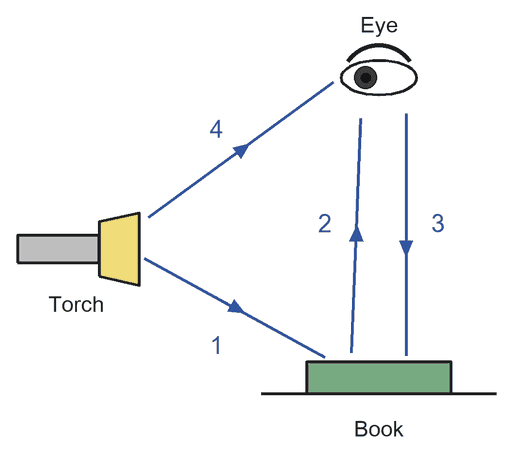
Which arrow shows the light by which Mohan sees the torch, and which arrow shows the light that enters his eye from the book?
- 191 mark
Question 19
Competency: Understanding
The figure shows three beams of light P, Q and R. Light in all three beams travels from left to right.

Rima holds a card at right angles to each beam, near the place where the beam starts, and then slides it slowly to the right along the beam. For beam Q she stops before the place where its rays meet.
How does the size of the bright patch of light on the card change in the three beams?
- 201 mark
Question 20
Competency: Understanding
Assertion (A): A pin hole camera forms a sharp image only when its hole is very small.
Reason (R): A very small hole lets only a thin pencil of light from each point of the object reach the screen, so each point of the object makes only a tiny spot on the screen.
- 211 mark
Question 21
Competency: Analysis
Assertion (A): A solar eclipse can take place only on a new moon day.
Reason (R): On a new moon day, the side of the moon that faces the earth does not get any light from the sun.
- 221 mark
Question 22
Competency: Analysis
Two small bulbs L and R are fixed close together in a dark room, with L on the left and R on the right, as seen by a student standing behind them. A wide opaque card is held in front of the bulbs, and a white wall is behind the card. Both bulbs are lighted. On the wall the student sees a dark middle part and a narrow lighter strip on each side of it. The strips are lighter because some light reaches them.
Which statement is correct?
- 231 mark
Question 23
Competency: Evaluation
On a sunny afternoon, Pooja sits under a tall mango tree. On the ground she sees many small round bright spots of sunlight. Looking up, she finds that the tiny gaps between the leaves, high above her, have jagged shapes of many kinds, and not one of them is round. Her teacher adds that during a partial solar eclipse, the same kind of spots take the shape of a crescent. Her friends give four explanations of the round spots.
Which explanation is correct?
- 241 mark
Question 24
Competency: Evaluation
Four groups make a pin hole camera each, to look at a lighted candle in a dim room. All the cameras use the same kind of box and the same tiny pin hole in front, except for the changes given below.
Which camera will show the sharpest and clearest image of the candle on its screen?
- 251 mark
Question 25
Competency: Application
A newspaper reports: "On Thursday an annular solar eclipse will be seen from some places in the south. For a few minutes, the dark moon will be seen at the centre of the sun, with a bright ring of the sun all around it. At that time the moon will be at the farthest point of its path from the earth."
What does the bright ring tell us?
- 262 marks
Question 26
Competency: Understanding
A red reflector is fixed at the back of a bicycle. On a dark road at night, the reflector glows brightly when the headlight of a vehicle coming from behind falls on it. When no vehicle is near, the reflector is hardly seen at all.
(a) Is the reflector a luminous body or a non-luminous body? Give a reason.
(b) Why does the reflector look bright only when the headlight falls on it?
- 272 marks
Question 27
Competency: Evaluation
Ravi says, "Every luminous body is a natural source of light, and everything made by people is non-luminous."
(a) Judge his statement. Support your answer with one example of a luminous body made by people and one example of a non-luminous natural body.
(b) Write the correct statement about luminous and non-luminous bodies.
- 282 marks
Question 28
Competency: Application
In a dark room, Anil keeps a candle, a card with a small hole and a white screen in a line on a long table. The card is 30 cm from the candle and the screen is 60 cm from the candle. The tip of the flame is 10 cm above the table and the hole in the card is also 10 cm above the table. A small bright spot, made by the light of the tip of the flame, falls on the screen.
(a) At what height above the table does this spot fall on the screen? Give the reason.
(b) Anil now fixes the card in a new way, so that its hole is 14 cm above the table, and the card stays 30 cm from the candle. Find the new height of the spot above the table.
- 292 marks
Question 29
Competency: Analysis
In bright sunshine, Sneha holds a pencil 2 cm above her notebook and sees a dark shadow of the pencil with sharp edges. She raises the pencil slowly to 40 cm above the notebook. Now the shadow is wider. Its middle is dark, but it has a lighter border with soft edges all round.
(a) Name the dark middle part and the lighter border of the shadow.
(b) Explain why the lighter border becomes wide when the pencil is high, but is hardly seen when the pencil is close to the notebook.
- 302 marks
Question 30
Competency: Application
Rahul makes a pin hole camera from a box with a tracing paper screen at the back. In a bright classroom, he sees only a faint image of the window on the screen. He then pulls a black cloth over his head and over the back of the camera, as old photographers did, and the image looks much clearer.
(a) Why does the image look clearer under the black cloth?
(b) Why is the inside of the box painted black?
- 312 marks
Question 31
Competency: Analysis
Asha looks through the keyhole of a closed door at a lighted room. When her eye is 30 cm from the keyhole, she sees only a small part of the room. When she brings her eye very close to the keyhole, she sees a much larger part of the room.
(a) Why does she see only a small part of the room when her eye is far from the keyhole?
(b) Why does she see a larger part when her eye is close to the keyhole?
- 323 marks
Question 32
Competency: Evaluation
A trainee reporter writes three headlines for a science page. The editor asks you to check whether each headline could be true.
Headline Statement 1 A lunar eclipse will be seen from Delhi on the coming new moon day. 2 In tonight's lunar eclipse, the edge of the dark shadow moving across the moon will look curved, because the earth is round. 3 The lunar eclipse tonight will be seen from every place where the moon is above the horizon. (a) Can headline 1 be true? Give a reason.
(b) Can headline 2 be true? Give a reason.
(c) Can headline 3 be true? Give a reason.
- 333 marks
Question 33
Competency: Application
Tara wants to find the height of a tall tree without climbing it. At 10 a.m. on a sunny day she stands a 1.2 m long stick upright on level ground near the tree and measures the shadows on the ground at the same moment. (Hypothetical data.)
Object Height Length of its shadow Stick 1.2 m 0.9 m Tree not known 7.5 m At a given time, the length of the shadow of an upright object is proportional to its height.
(a) Find the height of the tree.
(b) Later in the day, the shadow of the stick is 1.5 m long. How long is the shadow of the tree at that time?
(c) Why must the shadows of the stick and of the tree be measured at the same time?
- 343 marks
Question 34
Competency: Analysis
On a full moon night, Imran watches a total lunar eclipse. His notebook gives the following times, in the order in which the events took place. (Hypothetical data.)
Event Time The moon begins to enter the dark shadow (umbra) of the earth 9:30 p.m. The whole moon is inside the umbra 10:40 p.m. The moon begins to leave the umbra 11:25 p.m. The whole moon is out of the umbra 12:35 a.m. (a) For how long was the whole moon inside the umbra? For how long was part of the moon inside the umbra?
(b) Imran's friend lives in a village 500 km away on the same side of the earth, and watches the same eclipse. Will the friend see the moon begin to enter the umbra at the same time as Imran? Give a reason.
(c) At 10:00 p.m. one edge of the moon was dark and the rest of the moon looked only a little dim. Name the part of the shadow of the earth that fell on the dark edge, and the part that fell on the rest of the moon.
- 353 marks
Question 35
Competency: Analysis
A point source of light is placed at the zero mark of a table, in a dark room. An opaque object 4 cm tall stands 10 cm from the source, with its middle on the central line. Two screens, S1 and S2, stand 20 cm and 30 cm from the source. The figure shows this side view on a grid of 1 cm squares. (Hypothetical data.)

(a) Draw straight lines on the grid from the source past the top and the bottom of the object. Find the height of the shadow on S1 and on S2.
(b) Predict the height of the shadow on a screen 50 cm from the source.
(c) The object is now moved to 5 cm from the source, and S2 stays at 30 cm. Find the height of the shadow on S2.
- 363 marks
Question 36
Competency: Application
The sun is about 400 times as wide as the moon. The distance of the sun from the earth is about km. The distance of the moon from the earth changes during a month. At its nearest it is about 363 000 km, and at its farthest it is about 406 000 km. (Values are rounded.)
A body looks bigger when it is wide compared with its distance. So if the sun is more than 400 times as far from the earth as the moon is, the moon looks bigger than the sun, and if it is less than 400 times as far, the moon looks smaller than the sun.
(a) How many times as far from the earth as the moon is the sun when the moon is nearest, and when it is farthest? Give your answers to the nearest whole number.
(b) When can the moon cover the whole sun in a solar eclipse, and when does it leave a bright ring?
- 374 marks
Question 37
Competency: Analysis
Case study: Workers are laying a straight irrigation pipe across a level field. To keep the pipe in a straight line, the supervisor fixes four thin opaque rods A, B, C and D in the ground, one behind the other, along the planned line. He stands at the start of the line with his eye 1.5 m above the ground and looks along the top of rod A. If the tops of all the rods lie on one straight line from his eye, the tops of the other rods are hidden behind the top of rod A. The table gives the distance of each rod from his eye and the height of its top above the ground. (Hypothetical data.)
Rod Distance from the eye Height of the top above the ground A 10 m 1.7 m B 20 m 1.9 m C 30 m 2.1 m D 40 m 2.4 m (a) Show that the tops of rods A, B and C lie on one straight line from his eye.
(b) At what height should the top of rod D be, to lie on the same straight line? By how much is it wrong?
(c) When the supervisor looks along the top of rod A, which tops are hidden and which top is seen? Explain this using the way light travels.
- 384 marks
Question 38
Competency: Analysis
Case study: A class studies the shadow of a 1 m long stick that stands upright on level ground in an open playground in northern India, on a clear sunny day in March. Every hour, from 8 a.m. to 4 p.m., the students measure the length of the shadow of the stick on the ground. They plot their readings on the graph given below. Their teacher tells them that the position of the sun in the sky changes during the day, and that the shadow changes with it. (Hypothetical data.)

(a) Read from the graph the time at which the shadow is the shortest and its length. By how much is the shadow at 8 a.m. longer than this?
(b) Compare the shadows at 10 a.m. and 2 p.m., and at 9 a.m. and 3 p.m. What pattern do you see, and what does it tell you about the sun?
(c) The class repeats the readings on a clear day in June. At noon in June, the sun stands higher in the sky than at noon in March. Will the shortest shadow in June be longer or shorter than the shortest shadow in March? Give the reason.
- 394 marks
Question 39
Competency: Evaluation
Case study: Aman prepares a chart for a school exhibition on sources of light. He lists six things and gives each one a label. His sister Neha, who looks at the chart, thinks that two of the labels are wrong. (Hypothetical project sheet.)
Item Aman's label The sun Luminous, natural source A lightning flash Luminous, artificial source The planet Venus, seen as a bright "evening star" Luminous, natural source A burning diya Luminous, artificial source A mobile phone screen that is switched on Luminous, artificial source A polished steel spoon Non-luminous (Venus is a planet, and not a star. Like the moon, it is seen because the light of the sun falls on it.)
(a) Find the two labels that are wrong.
(b) Correct each wrong label and give the reason.
(c) Neha wants a simple test to decide whether a body is luminous. Describe one test in a dark room.
- 404 marks
Question 40
Competency: Creativity
Case study: Your class wants to show a working model of eclipses at the school exhibition. You may use a bright torch to stand for the sun, a large ball to stand for the earth, a small ball to stand for the moon, a white card as a screen, a stand or clay to hold the balls, and a dark room. The torch is only a model, and nobody should look at the real sun.
(a) Describe how you will arrange the torch and the balls to show a solar eclipse, and where the shadow will be seen.
(b) Describe how you will arrange them to show a lunar eclipse.
(c) State one way in which your model is different from the real sun, earth and moon, and say how a visitor could still learn the main idea.