
Opening your dashboard
Class 6 Physics Chapter 4: Simple Machines Solutions
64 textbook questions with step-by-step answers, free to read, for ICSE 2026-27.
Get talked through Ch 4, not just shown the answer
Reading a finished solution is not the same as being able to do it. The AI tutor takes one question at a time and works it with you, in your own words, until you can.
- Ask it out loud, in your own words
- It gives you the next step, not the answer
- Stuck on part (ii)? Start there
64 questions with solutions
1–4 marks · Mixed difficulty
- 11 mark
Question 1
Choose the correct answer from the multiple choices given below.
Mechanical advantage of a machine is defined as :
Solve with AIAnswer
(A) Load × Effort
- Correct
(B)
(C) Load + Effort
(D)
Answer: (B)
Concept: The mechanical advantage (M.A.) of a machine is the ratio of the load to the effort, . It has no unit, because it is a ratio of two forces. When M.A. is more than 1, the machine is a force multiplier.
Step 1 — Recall what mechanical advantage measures.
Mechanical advantage tells us how many times the machine multiplies the effort we apply. So it compares the load with the effort by dividing one by the other.
Step 2 — Write the ratio.
The load is divided by the effort, so the ratio is load over effort.
Watch out: The ratio is load ÷ effort, not effort ÷ load; a force multiplier has M.A. greater than 1.
Why the other options are wrong:
- (A) Load × Effort: Mechanical advantage is a ratio of two forces, not their product.
- (C) Load + Effort: Adding the load and the effort does not tell how many times the effort is multiplied.
- (D) : This is the upside-down ratio; mechanical advantage is the load divided by the effort.
Therefore, mechanical advantage is defined as load ÷ effort, option (B).
- 21 mark
Question 2
Choose the correct answer from the multiple choices given below.
For an ideal machine, the efficiency is:
Solve with AIAnswer
(A) greater than unity
(B) less than unity
- Correct
(C) equal to unity
(D) depends on the value of load
Answer: (C) equal to unity
Concept: The work input is the work done on the machine by the effort, and the work output is the useful work done by the machine on the load. Efficiency is the ratio of the work output to the work input. An ideal machine wastes no work, so its efficiency is 1 (100%). In an actual machine some work is wasted against friction, so its efficiency is less than 1.
Step 1 — See what is special about an ideal machine.
In an ideal machine no part of the work done on it is wasted against friction. So the work output is equal to the work input.
Step 2 — Find the efficiency.
Efficiency is work output divided by work input, and these two are equal here.
Why the other options are wrong:
- (A) greater than unity: No machine can give out more work than is put into it, so the efficiency is never greater than 1.
- (B) less than unity: An efficiency less than 1 is true of an actual machine, where some work is wasted against friction.
- (D) depends on the value of load: The efficiency of an ideal machine is 1 whatever the load, because no work is ever wasted in it.
Therefore, the efficiency of an ideal machine is equal to unity, option (C).
- 31 mark
Question 3
Choose the correct answer from the multiple choices given below.
The mechanical advantage of a lever is equal to :
Solve with AIAnswer
(A)
- Correct
(B)
(C) Load arm + Effort arm
(D) Load arm – Effort arm
Answer: (B)
Concept: A lever is a rigid rod that can turn about a fixed point called the fulcrum (F). The distance of the load from the fulcrum is the load arm, and the distance of the effort from the fulcrum is the effort arm. For a balanced lever, . This is the principle of a lever.
Step 1 — Write the principle of a lever.
When a lever is balanced, the load times its arm equals the effort times its arm.
Step 2 — Rearrange to get load over effort.
Dividing both sides by the effort and by the load arm gives the ratio of the load to the effort, which is the mechanical advantage.
Step 3 — Name the result.
So the mechanical advantage of a lever is the effort arm divided by the load arm.
Watch out: The longer the effort arm, the larger the mechanical advantage; do not turn the ratio upside down.
Why the other options are wrong:
- (A) : This is the reciprocal of the correct ratio; it would make a long effort arm give a small M.A.
- (C) Load arm + Effort arm: Mechanical advantage is a ratio of the two arms, not their sum.
- (D) Load arm – Effort arm: Mechanical advantage is a ratio of the two arms, not their difference.
Therefore, the mechanical advantage of a lever is effort arm ÷ load arm, option (B).
- 41 mark
Question 4
Choose the correct answer from the multiple choices given below.
A pulley is used because it :
Solve with AIAnswer
(A) has the mechanical advantage greater than one
(B) has 100% efficiency
- Correct
(C) helps to apply the force in a convenient direction
(D) requires more effort to raise a less load.
Answer: (C) helps to apply the force in a convenient direction
Concept: A pulley is a grooved wheel that turns about an axle held in a frame called the block, which hangs from a fixed support. A string passes over the groove: the load hangs from one end and the effort is applied at the other end. A single fixed pulley changes the direction of the effort, so we pull down to raise the load up. In an ideal pulley the effort equals the load, so its M.A. is 1.
Step 1 — Recall what a single pulley does.
In a single fixed pulley the effort is about equal to the load, so it does not reduce the force needed.
Step 2 — Find its real use.
It lets us pull the string downwards to raise the load upwards. Pulling down is easier, and we can even use our own weight as part of the effort.
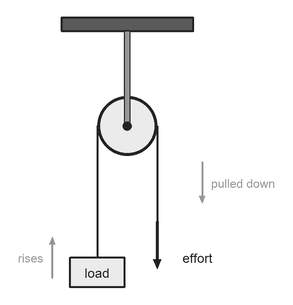
Watch out: A single fixed pulley does not reduce the effort; its use is the convenient direction of the effort.
Why the other options are wrong:
- (A) has the mechanical advantage greater than one: The M.A. of an ideal single pulley is 1, and of an actual pulley a little less than 1, never greater.
- (B) has 100% efficiency: An actual pulley has friction and a string to lift, so its efficiency is less than 100%.
- (D) requires more effort to raise a less load: Needing a little more effort than the load is a drawback of an actual pulley, not the reason for using it.
Therefore, a pulley is used because it helps to apply the force in a convenient direction, option (C).
- 51 mark
Question 5
Choose the correct answer from the multiple choices given below.
Wheel is used with axle because :
Solve with AIAnswer
(A) sliding friction is less than the rolling friction
- Correct
(B) rolling friction is less than the sliding friction
(C) they work as the inclined plane
(D) they help us to change the direction of force.
Answer: (B) rolling friction is less than the sliding friction
Concept: A wheel and axle is a large wheel fixed to a smaller rod, the axle, so that both turn together. The effort is applied at the rim of the wheel and the load acts on the axle.
Step 1 — Compare rolling with sliding.
A body that rolls on a wheel meets much less friction than the same body dragged along the ground, because rolling friction is less than sliding friction.
Step 2 — Apply it to the wheel and axle.
Fixing wheels on an axle lets a cart or trolley roll instead of slide, so a smaller force moves it.
Why the other options are wrong:
- (A) sliding friction is less than the rolling friction: This is the wrong way round; rolling friction is the smaller of the two.
- (C) they work as the inclined plane: The screw and the wedge are forms of the inclined plane; the wheel and axle is not.
- (D) they help us to change the direction of force: Changing the direction of the force is the main use of a pulley, not of a wheel and axle.
Therefore, a wheel is used with an axle because rolling friction is less than sliding friction, option (B).
- 61 mark
Question 6
The following question is Assertion-Reason based. Choose the answer based on the codes given below.
Assertion (A) : Mechanical advantage of a lever can be less than 1.
Reason (R) : If the effort arm is shorter than the load arm, more effort is required than the load.
Solve with AIAnswer
- Correct
(A) Both A and R are true and R is the correct explanation of A
(B) Both A and R are true and R is not the correct explanation of A
(C) A is true but R is false
(D) A is false but R is true
Answer: (A) Both A and R are true and R is the correct explanation of A
Concept: For a balanced lever the mechanical advantage equals the ratio of its arms, . So M.A. is more than 1 when the effort arm is longer than the load arm, and less than 1 when it is shorter.
Step 1 — Judge the Assertion.
In a class III lever, and in a class I lever whose effort arm is shorter than its load arm, the effort needed is more than the load. Then load ÷ effort is less than 1. So the Assertion is true.
Step 2 — Judge the Reason.
By the principle of a lever, . If the effort arm is the shorter one, the effort must be the larger force. So the Reason is true.
Step 3 — Decide whether R explains A.
A larger effort than load is exactly what makes load ÷ effort less than 1, so the Reason correctly explains the Assertion.
Why the other options are wrong:
- (B): The Reason does explain the Assertion, so this code is wrong.
- (C): The Reason is true, so this code is wrong.
- (D): The Assertion is true, so this code is wrong.
Therefore, both are true and the Reason correctly explains the Assertion, option (A).
- 71 mark
Question 7
The following question is Assertion-Reason based. Choose the answer based on the codes given below.
Assertion (A) : A forearm holding a load is an example of class II lever
Reason (R) : The levers in which the load is in between the fulcrum and the effort belong to class II.
Solve with AIAnswer
(A) Both A and R are true and R is the correct explanation of A
(B) Both A and R are true and R is not the correct explanation of A
(C) A is true but R is false
- Correct
(D) A is false but R is true
Answer: (D) A is false but R is true
Concept: Levers are put into three classes by what lies in the middle. In class I the fulcrum is between the load and the effort. In class II the load is between the fulcrum and the effort. In class III the effort is between the fulcrum and the load.
Step 1 — Find the three points in the forearm.
In the forearm the elbow joint is the fulcrum. The biceps muscle pulls on the forearm a little in front of the elbow (effort), and the load is held in the palm.
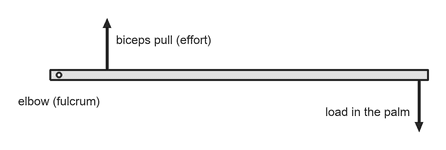
Step 2 — Judge the Assertion.
The effort lies between the fulcrum and the load, so the forearm is a class III lever, not class II. So the Assertion is false.
Step 3 — Judge the Reason.
A lever with the load between the fulcrum and the effort is a class II lever, such as a nut cracker. So the Reason is true.
Why the other options are wrong:
- (A): This needs both statements to be true, but the Assertion is false.
- (B): This needs both statements to be true, but the Assertion is false.
- (C): It is the other way round: the Assertion is false and the Reason is true.
Therefore, the Assertion is false but the Reason is true, option (D).
- 81 mark
Question 8
Fill in the blanks :
The useful work done by an actual machine is always .................. than the work done on the machine.
Solve with AIWritten solution
Solution:
Concept: The work input is the work done on the machine by the effort, and the work output is the useful work done by the machine on the load. Efficiency is the ratio of the work output to the work input. An ideal machine wastes no work, so its efficiency is 1 (100%). In an actual machine some work is wasted against friction, so its efficiency is less than 1.
Step 1 — Recall where the work goes.
In an actual machine part of the work input is used up against friction between the moving parts, so it is wasted.
Step 2 — Fill the blank.
So the useful work done by the machine is always less than the work done on it.
Therefore, the useful work done by an actual machine is always less than the work done on the machine.
- 91 mark
Question 9
Fill in the blanks :
In class II levers, the .................. is in between fulcrum and ..................
Solve with AIWritten solution
Solution:
Concept: Levers are put into three classes by what lies in the middle. In class I the fulcrum is between the load and the effort. In class II the load is between the fulcrum and the effort. In class III the effort is between the fulcrum and the load.
Step 1 — Recall the class II arrangement.
In a class II lever the fulcrum is at one end, the effort at the other end, and the load lies between them, as in a nut cracker.
Step 2 — Fill the blanks.
So the load is in between the fulcrum and the effort.
Therefore, in class II levers, the load is in between fulcrum and effort.
- 101 mark
Question 10
Fill in the blanks :
The mechanical advantage of class .................. lever is always less than 1.
Solve with AIWritten solution
Solution:
Concept: For a balanced lever the mechanical advantage equals the ratio of its arms, . So M.A. is more than 1 when the effort arm is longer than the load arm, and less than 1 when it is shorter.
Step 1 — See which arm is shorter.
In a class III lever the effort lies between the fulcrum and the load, so the effort arm is always shorter than the load arm.
Step 2 — Fill the blank.
A shorter effort arm means M.A. less than 1, so the blank is III.
Therefore, the mechanical advantage of class III lever is always less than 1.
- 111 mark
Question 11
Fill in the blanks :
A pulley is used to change ..................
Solve with AIWritten solution
Solution:
Concept: A pulley is a grooved wheel that turns about an axle held in a frame called the block, which hangs from a fixed support. A string passes over the groove: the load hangs from one end and the effort is applied at the other end. A single fixed pulley changes the direction of the effort, so we pull down to raise the load up. In an ideal pulley the effort equals the load, so its M.A. is 1.
Step 1 — Recall how a pulley is used.
With a pulley we pull the string downwards, and the load at the other end moves upwards.
Step 2 — Fill the blank.
So a pulley is used to change the direction of the effort.
Therefore, a pulley is used to change the direction of the effort.
- 121 mark
Question 12
Fill in the blanks :
Mechanical advantage of an inclined plane is always ..................
Solve with AIWritten solution
Solution:
Concept: An inclined plane is a sloping surface, such as a plank or a ramp, used to raise a load with less effort than lifting it straight up. The gentler the slope (the longer the slope for the same height), the less effort is needed.
Step 1 — Compare the effort with the load.
Pushing a load up a slope needs less effort than lifting it straight up, so the effort is less than the load.
Step 2 — Fill the blank.
Load ÷ effort is then more than 1, so the blank is greater than 1.
Note: this assumes little friction on the slope, as in the chapter. For a frictionless slope the M.A. equals the length of the slope divided by its height.
Therefore, mechanical advantage of an inclined plane is always greater than 1.
- 131 mark
Question 13
State whether the following statement is true or false :
A boy does work while pushing a wall.
Solve with AIWritten solution
Solution:
Concept: In physics, work is done only when a force applied on a body moves it. The work done is the force multiplied by the distance moved in the direction of the force.
Step 1 — Check for movement.
The boy applies a force on the wall, but the wall does not move at all.
Step 2 — Judge the statement.
Without movement no work is done, however hard the boy pushes. So the statement is false.
Watch out: Feeling tired does not mean work is done in the physics sense; the body must move.
Therefore, the statement is false: a boy pushing a wall does no work.
- 141 mark
Question 14
State whether the following statement is true or false :
A machine performs work by itself.
Solve with AIWritten solution
Solution:
Concept: A machine is a device that helps us to do work more easily. The force we apply to the machine is called the effort (E), and the weight it lifts or the force it overcomes is called the load (L). A machine does not work by itself and never gives out more work than is put into it.
Step 1 — Recall the principle of a machine.
A machine does useful work only when energy is supplied to it, that is, when an effort does work on it.
Step 2 — Judge the statement.
A machine cannot do work on its own, so the statement is false.
Therefore, the statement is false: a machine does not perform work by itself.
- 151 mark
Question 15
State whether the following statement is true or false :
In an ideal machine, work done on load is equal to the work done by effort.
Solve with AIWritten solution
Solution:
Concept: The work input is the work done on the machine by the effort, and the work output is the useful work done by the machine on the load. Efficiency is the ratio of the work output to the work input. An ideal machine wastes no work, so its efficiency is 1 (100%). In an actual machine some work is wasted against friction, so its efficiency is less than 1.
Step 1 — Recall what ideal means.
An ideal machine has no friction, so none of the work done on it is wasted.
Step 2 — Judge the statement.
So the work done on the load (output) equals the work done by the effort (input), and the statement is true.
Therefore, the statement is true.
- 161 mark
Question 16
State whether the following statement is true or false :
All levers are force multipliers.
Solve with AIWritten solution
Solution:
Concept: For a balanced lever the mechanical advantage equals the ratio of its arms, . So M.A. is more than 1 when the effort arm is longer than the load arm, and less than 1 when it is shorter.
Step 1 — Recall what a force multiplier is.
A machine is a force multiplier only when its M.A. is more than 1, so that the effort is less than the load.
Step 2 — Check every class.
Class III levers such as sugar tongs and forceps always have M.A. less than 1. Class I levers with a shorter effort arm, such as scissors with long blades, also have M.A. less than 1.
Step 3 — Judge the statement.
Since some levers are not force multipliers, the statement is false.
Therefore, the statement is false: not all levers are force multipliers.
- 171 mark
Question 17
State whether the following statement is true or false :
A pulley changes the direction of force.
Solve with AIWritten solution
Solution:
Concept: A pulley is a grooved wheel that turns about an axle held in a frame called the block, which hangs from a fixed support. A string passes over the groove: the load hangs from one end and the effort is applied at the other end. A single fixed pulley changes the direction of the effort, so we pull down to raise the load up. In an ideal pulley the effort equals the load, so its M.A. is 1.
Step 1 — Recall how a pulley is used.
We pull the string downwards, and the load rises upwards.
Step 2 — Judge the statement.
The pulley turns the downward effort into an upward pull on the load, so the statement is true.
Therefore, the statement is true: a pulley changes the direction of force.
- 181 mark
Question 18
State whether the following statement is true or false :
An inclined plane always has the mechanical advantage more than 1.
Solve with AIWritten solution
Solution:
Concept: An inclined plane is a sloping surface, such as a plank or a ramp, used to raise a load with less effort than lifting it straight up. The gentler the slope (the longer the slope for the same height), the less effort is needed.
Step 1 — Compare the effort with the load.
On a slope the effort needed to push the load up is less than the load itself.
Step 2 — Judge the statement.
So load ÷ effort is more than 1, and the statement is true. The gentler the slope, the larger the mechanical advantage.
Note: this assumes little friction on the slope, as in the chapter. For a frictionless slope the M.A. equals the length of the slope divided by its height, which is always more than 1.
Therefore, the statement is true.
- 191 mark
Question 19
Match the following columns :
Column A : Needle
Choose from Column B :
Column B (i) class II lever (ii) inclined plane (iii) class I lever (iv) wheel and axle (v) wedge Solve with AIWritten solution
Solution:
Concept: A wedge has a sharp edge formed by two inclined planes placed back to back. It is driven into a material to cut or split it.
Step 1 — Look at the tip of a needle.
The pointed tip of a needle is formed by sloping faces that meet at a sharp point.
Step 2 — Match it.
It pierces cloth by pushing the threads apart, just as a wedge splits wood. So the needle matches (v) wedge.
Therefore, needle matches (v) wedge.
- 201 mark
Question 20
Match the following columns :
Column A : Door knob
Choose from Column B :
Column B (i) class II lever (ii) inclined plane (iii) class I lever (iv) wheel and axle (v) wedge Solve with AIWritten solution
Solution:
Concept: A wheel and axle is a large wheel fixed to a smaller rod, the axle, so that both turn together. The effort is applied at the rim of the wheel and the load acts on the axle.
Step 1 — Look at a door knob.
The knob is a large wheel fixed to a thin rod (the spindle) that works the latch.
Step 2 — Match it.
Turning the large knob turns the thin rod with a small effort, so the door knob matches (iv) wheel and axle.
Therefore, door knob matches (iv) wheel and axle.
- 211 mark
Question 21
Match the following columns :
Column A : Ramp
Choose from Column B :
Column B (i) class II lever (ii) inclined plane (iii) class I lever (iv) wheel and axle (v) wedge Solve with AIWritten solution
Solution:
Concept: An inclined plane is a sloping surface, such as a plank or a ramp, used to raise a load with less effort than lifting it straight up. The gentler the slope (the longer the slope for the same height), the less effort is needed.
Step 1 — Look at a ramp.
A ramp is a sloping surface leading from a lower level to a higher level.
Step 2 — Match it.
Wheelchairs, stretchers and scooters are pushed up a ramp instead of being lifted, so the ramp matches (ii) inclined plane.
Therefore, ramp matches (ii) inclined plane.
- 221 mark
Question 22
Match the following columns :
Column A : Lemon crusher
Choose from Column B :
Column B (i) class II lever (ii) inclined plane (iii) class I lever (iv) wheel and axle (v) wedge Solve with AIWritten solution
Solution:
Concept: Levers are put into three classes by what lies in the middle. In class I the fulcrum is between the load and the effort. In class II the load is between the fulcrum and the effort. In class III the effort is between the fulcrum and the load.
Step 1 — Find the three points.
The hinge of the lemon crusher is the fulcrum, the lemon placed near it is the load, and the hand presses at the far ends of the handles (effort).
Step 2 — Match it.
The load is between the fulcrum and the effort, so the lemon crusher matches (i) class II lever.
Therefore, lemon crusher matches (i) class II lever.
- 231 mark
Question 23
Match the following columns :
Column A : See-saw
Choose from Column B :
Column B (i) class II lever (ii) inclined plane (iii) class I lever (iv) wheel and axle (v) wedge Solve with AIWritten solution
Solution:
Concept: Levers are put into three classes by what lies in the middle. In class I the fulcrum is between the load and the effort. In class II the load is between the fulcrum and the effort. In class III the effort is between the fulcrum and the load.
Step 1 — Find the three points.
The support in the middle of the see-saw is the fulcrum, and a child sits on each side: one is the load and the other gives the effort.
Step 2 — Match it.
The fulcrum is between the load and the effort, so the see-saw matches (iii) class I lever.
Therefore, see-saw matches (iii) class I lever.
- 242 marks
Question 24
When is work said to be done by a force ?
Solve with AIWritten solution
Solution:
Concept: In physics, work is done only when a force applied on a body moves it. The work done is the force multiplied by the distance moved in the direction of the force.
Step 1 — State the condition.
Work is said to be done by a force only when the force applied on a body moves it, that is, when the body changes its position.
Step 2 — Give examples.
A coolie lifting a box, a horse pulling a cart and a boy climbing stairs all do work. A boy pushing a heavy stone that does not move, or a coolie just standing with a box on his head, does no work, because nothing moves.
Step 3 — Write how work is measured.
The work done equals the force multiplied by the distance moved in the direction of the force.
Watch out: A force alone is not enough; if the body does not move, the work done is zero.
Therefore, work is said to be done when the force applied on a body moves it.
- 252 marks
Question 25
What is energy ?
Solve with AIWritten solution
Solution:
Concept: Energy is the capacity (ability) of a body to do work. Energy and work have the same S.I. unit, the joule (J).
Step 1 — Define energy.
The energy of a body is its capacity (ability) to do work. A body that can do work is said to possess energy.
Step 2 — Link it with work.
When a body does work, it uses up some of its energy, so energy is measured in the same unit as work, the joule (J).
Therefore, energy is the capacity of a body to do work, measured in joules.
- 262 marks
Question 26
What do you understand by a machine ?
Solve with AIWritten solution
Solution:
Concept: A machine is a device that helps us to do work more easily. The force we apply to the machine is called the effort (E), and the weight it lifts or the force it overcomes is called the load (L). A machine does not work by itself and never gives out more work than is put into it.
Step 1 — Define a machine.
A machine is a device which helps us to do work more easily, for example by letting a small effort overcome a large load.
Step 2 — List what a machine lets us do.
A machine enables us to do one or more of these:
- to overcome a large load with a smaller effort (a jack lifting a car);
- to apply the effort at a convenient point (a spanner on a nut);
- to apply the effort in a convenient direction (a pulley over a well);
- to make the load move farther or faster than the effort (a pair of scissors with long blades).
Step 3 — Say what it cannot do.
A machine does not save work or energy. In an actual machine the work put in is even a little more than the useful work got out, because some is wasted against friction.
Watch out: A machine makes a job easier; it never reduces the total work needed.
Therefore, a machine is a device that helps us to do work more easily.
- 272 marks
Question 27
What is the principle on which a machine works?
Solve with AIWritten solution
Solution:
Concept: A machine is a device that helps us to do work more easily. The force we apply to the machine is called the effort (E), and the weight it lifts or the force it overcomes is called the load (L). A machine does not work by itself and never gives out more work than is put into it.
Step 1 — State the principle.
A machine does not work by itself. When energy is supplied to it, that is, when work is done on it by an effort, it does useful work on the load.
Step 2 — Name the two forces.
The force applied on the machine is the effort (E), and the weight it lifts or the resistance it overcomes is the load (L).
Step 3 — Compare work in and work out.
In an ideal machine the work done by the effort equals the work done on the load. In an actual machine the work done on the load is a little less, because of friction.
Therefore, a machine works on the principle that it does useful work only when work is done on it by an effort.
- 282 marks
Question 28
State two functions of a machine.
Solve with AIWritten solution
Solution:
Concept: A machine is a device that helps us to do work more easily. The force we apply to the machine is called the effort (E), and the weight it lifts or the force it overcomes is called the load (L). A machine does not work by itself and never gives out more work than is put into it.
Step 1 — First function.
A machine can reduce the effort needed, so that the effort is less than the load. Example: a jack lets us lift a car with a small effort.
Step 2 — Second function.
A machine can change the direction of the effort to a convenient one. Example: a pulley lets us pull downwards to raise a bucket of water from a well.
Note: a machine can also apply the effort at a convenient point, or make the load move farther than the effort.
Therefore, a machine reduces the effort needed and changes its direction to a convenient one.
- 292 marks
Question 29
Define the term 'work input' and 'work output' in relation to a machine.
Solve with AIWritten solution
Solution:
Concept: The work input is the work done on the machine by the effort, and the work output is the useful work done by the machine on the load. Efficiency is the ratio of the work output to the work input. An ideal machine wastes no work, so its efficiency is 1 (100%). In an actual machine some work is wasted against friction, so its efficiency is less than 1.
Step 1 — Define work input.
Work input is the work done on the machine by the effort.
Step 2 — Define work output.
Work output is the useful work done by the machine on the load.
Step 3 — Compare them.
In an actual machine the work output is always less than the work input, because some work is wasted against friction.
Therefore, work input is the work done on the machine by the effort, and work output is the useful work done by the machine on the load.
- 302 marks
Question 30
Explain the term mechanical advantage of a machine.
Solve with AIWritten solution
Solution:
Concept: The mechanical advantage (M.A.) of a machine is the ratio of the load to the effort, . It has no unit, because it is a ratio of two forces. When M.A. is more than 1, the machine is a force multiplier.
Step 1 — Define mechanical advantage.
The mechanical advantage of a machine is the factor by which it multiplies the effort. It is the ratio of the load to the effort.
Step 2 — Say what its value means.
The smaller the effort needed for a given load, the greater the mechanical advantage. It can be more than 1, equal to 1 or less than 1. A machine with M.A. more than 1 is a force multiplier.
Step 3 — Work an example.
Suppose an effort of 10 kgf lifts a load of 50 kgf. We divide the load by the effort.
Watch out: M.A. has no unit; the kgf cancels because both forces are in the same unit.
Therefore, mechanical advantage is the ratio of the load to the effort, the factor by which a machine multiplies the effort.
- 312 marks
Question 31
Define the term efficiency of a machine.
Solve with AIWritten solution
Solution:
Concept: The work input is the work done on the machine by the effort, and the work output is the useful work done by the machine on the load. Efficiency is the ratio of the work output to the work input. An ideal machine wastes no work, so its efficiency is 1 (100%). In an actual machine some work is wasted against friction, so its efficiency is less than 1.
Step 1 — Define efficiency.
The efficiency of a machine is the ratio of the useful work done by the machine on the load to the work done on the machine by the effort.
Step 2 — Say what values it takes.
It is often written as a percentage. It is 1 (100%) for an ideal machine and less than 1 for an actual machine.
Therefore, efficiency is the ratio of the work output of a machine to its work input.
- 322 marks
Question 32
What is an ideal machine ?
Solve with AIWritten solution
Solution:
Concept: The work input is the work done on the machine by the effort, and the work output is the useful work done by the machine on the load. Efficiency is the ratio of the work output to the work input. An ideal machine wastes no work, so its efficiency is 1 (100%). In an actual machine some work is wasted against friction, so its efficiency is less than 1.
Step 1 — Define an ideal machine.
A machine in which no part of the work done on it is wasted is called an ideal (perfect) machine.
Step 2 — Give its efficiency.
Its work output equals its work input, so its efficiency is 1, or 100%.
Step 3 — Compare with real machines.
Every real machine has some friction, so an ideal machine does not exist in practice.
Therefore, an ideal machine is one in which no work is wasted, so its efficiency is 100%.
- 332 marks
Question 33
Can a machine have an efficiency of 100 % ? Give a reason to support your answer.
Solve with AIWritten solution
Solution:
Concept: The work input is the work done on the machine by the effort, and the work output is the useful work done by the machine on the load. Efficiency is the ratio of the work output to the work input. An ideal machine wastes no work, so its efficiency is 1 (100%). In an actual machine some work is wasted against friction, so its efficiency is less than 1.
Step 1 — Answer the question.
No, an actual machine cannot have an efficiency of 100%.
Step 2 — Give the reason.
Some of the work done on a machine is always used up in overcoming the friction between its moving parts. So the work output is always less than the work input.
Step 3 — Note the ideal case.
Only an ideal machine, which has no friction and does not exist in practice, would have an efficiency of 100%.
Therefore, no actual machine can have an efficiency of 100%, because some work is always wasted against friction.
- 342 marks
Question 34
'A machine is 75% efficient'. What do you understand by this statement ?
Solve with AIWritten solution
Solution:
Concept: The work input is the work done on the machine by the effort, and the work output is the useful work done by the machine on the load. Efficiency is the ratio of the work output to the work input. An ideal machine wastes no work, so its efficiency is 1 (100%). In an actual machine some work is wasted against friction, so its efficiency is less than 1.
Step 1 — Read the statement.
An efficiency of 75% means the work output is 75% of the work input.
Step 2 — Find the wasted part.
The rest of the work input is wasted in overcoming friction.
Step 3 — Give an example.
If 100 J of work is done on this machine by the effort, it does 75 J of useful work on the load, and 25 J is wasted against friction.
Therefore, a 75% efficient machine gives out as useful work 75% of the work put into it, and 25% is wasted.
- 352 marks
Question 35
What is a lever ?
Solve with AIWritten solution
Solution:
Concept: A lever is a rigid rod that can turn about a fixed point called the fulcrum (F). The distance of the load from the fulcrum is the load arm, and the distance of the effort from the fulcrum is the effort arm. For a balanced lever, . This is the principle of a lever.
Step 1 — Define a lever.
A lever is a simple machine made of a rigid rod that can turn about a fixed point called the fulcrum.
Step 2 — Name the forces on it.
The effort is applied at one point of the rod, and the load acts at another point.
Step 3 — Give examples.
A see-saw, a pair of scissors, a nut cracker and sugar tongs are levers.
Therefore, a lever is a rigid rod which can turn about a fixed point called the fulcrum.
- 362 marks
Question 36
What do you mean by the mechanical advantage of a lever ?
Solve with AIWritten solution
Solution:
Concept: A lever is a rigid rod that can turn about a fixed point called the fulcrum (F). The distance of the load from the fulcrum is the load arm, and the distance of the effort from the fulcrum is the effort arm. For a balanced lever, . This is the principle of a lever.
Step 1 — Start from the definition.
Like any machine, the mechanical advantage of a lever is the ratio of the load to the effort.
Step 2 — Use the principle of a lever.
For a balanced lever the load times the load arm equals the effort times the effort arm. Rearranging this gives the ratio of the arms.
Step 3 — Name the arms.
The effort arm is the distance of the effort from the fulcrum, and the load arm is the distance of the load from the fulcrum.
Step 4 — Say what it means.
If the effort arm is longer than the load arm, the mechanical advantage is more than 1.
Watch out: Both arms are measured from the fulcrum, not from the ends of the rod.
Therefore, the mechanical advantage of a lever is the ratio of its effort arm to its load arm, which equals load ÷ effort.
- 372 marks
Question 37
Which class of lever has the mechanical advantage always more than 1 ? Give an example.
Solve with AIWritten solution
Solution:
Concept: For a balanced lever the mechanical advantage equals the ratio of its arms, . So M.A. is more than 1 when the effort arm is longer than the load arm, and less than 1 when it is shorter.
Step 1 — Find the class.
In a class II lever the load lies between the fulcrum and the effort, with the effort at the far end.
Step 2 — Compare the arms.
The effort is always farther from the fulcrum than the load, so the effort arm is always longer than the load arm, and M.A. is always more than 1.
Step 3 — Give an example.
A nut cracker is a class II lever. A wheel barrow, a lemon squeezer and a bottle opener are others.
Therefore, class II levers always have M.A. more than 1, for example a nut cracker.
- 382 marks
Question 38
Which class of lever has the mechanical advantage always less than 1 ? Give an example.
Solve with AIWritten solution
Solution:
Concept: For a balanced lever the mechanical advantage equals the ratio of its arms, . So M.A. is more than 1 when the effort arm is longer than the load arm, and less than 1 when it is shorter.
Step 1 — Find the class.
In a class III lever the effort lies between the fulcrum and the load.
Step 2 — Compare the arms.
The effort is always nearer the fulcrum than the load, so the effort arm is always shorter than the load arm, and M.A. is always less than 1.
Step 3 — Give an example.
A pair of sugar tongs is a class III lever. Forceps and the human forearm holding a load are others.
Therefore, class III levers always have M.A. less than 1, for example a pair of sugar tongs.
- 393 marks
Question 39
Give one example of class I lever in each case where the mechanical advantage is
(i) more than 1 (ii) equal to 1 (iii) less than 1.
Solve with AIWritten solution
Solution:
Concept: For a balanced lever the mechanical advantage equals the ratio of its arms, . So M.A. is more than 1 when the effort arm is longer than the load arm, and less than 1 when it is shorter.
Step 1 — Use the arms of a class I lever.
In a class I lever the fulcrum is in the middle, so the effort arm can be longer than, equal to or shorter than the load arm.
Step 2 — M.A. more than 1.
A pair of pliers has short jaws (load arm) and long handles (effort arm), so its M.A. is more than 1. A crow bar is another example.
Step 3 — M.A. equal to 1.
A beam balance has its fulcrum exactly in the middle, so the effort arm equals the load arm and M.A. is 1.
Step 4 — M.A. less than 1.
A pair of scissors with long blades and short handles has a load arm (blades) longer than the effort arm (handles), so its M.A. is less than 1.
Therefore, (i) a pair of pliers, (ii) a beam balance and (iii) a pair of scissors with long blades.
- 403 marks
Question 40
Name the class to which the following levers belong :
(a) A pair of scissors, (b) a lemon squeezer, (c) a nut cracker, (d) a pair of sugar tongs, (e) a beam balance, (f) an oar rowing a boat, (g) a wheel barrow, (h) a see-saw, (i) a pair of pliers, (j) a crowbar.
Solve with AIWritten solution
Solution:
Concept: Levers are put into three classes by what lies in the middle. In class I the fulcrum is between the load and the effort. In class II the load is between the fulcrum and the effort. In class III the effort is between the fulcrum and the load.
Step 1 — Find what is in the middle.
For each lever we find which of the fulcrum, the load and the effort lies between the other two.
Lever In the middle Class (a) A pair of scissors fulcrum (the rivet) Class I (b) A lemon squeezer load (the lemon) Class II (c) A nut cracker load (the nut) Class II (d) A pair of sugar tongs effort (the fingers) Class III (e) A beam balance fulcrum (the knife edge) Class I (f) An oar rowing a boat fulcrum (the rowlock) Class I (g) A wheel barrow load (in the tray) Class II (h) A see-saw fulcrum (the support) Class I (i) A pair of pliers fulcrum (the rivet) Class I (j) A crowbar fulcrum (where it rests) Class I Step 2 — Note the oar.
Here the oar is taken with its fulcrum at the rowlock, the effort at the handle and the load at the blade pushing the water, as the chapter does.
Note: if the blade in the water is taken as the fixed point instead, the oar acts as a class II lever, with the load (the boat) at the rowlock between the blade and the hands.
Therefore, (a), (e), (f), (h), (i) and (j) are class I; (b), (c) and (g) are class II; and (d) is class III.
- 413 marks
Question 41
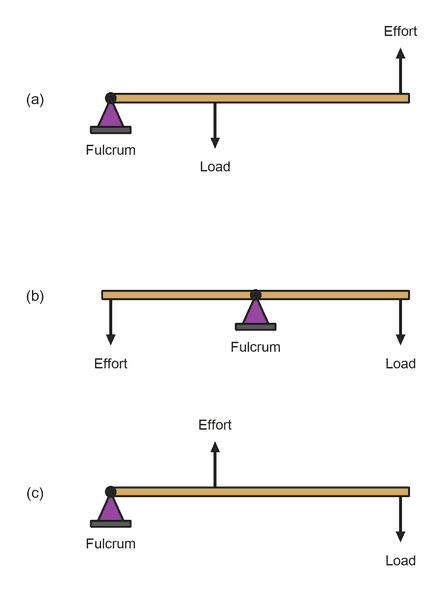
The diagram given below shows the three kinds of levers. Name the class of each lever and give one example of each class.
 Solve with AI
Written solution
Solution:
Concept: Levers are put into three classes by what lies in the middle. In class I the fulcrum is between the load and the effort. In class II the load is between the fulcrum and the effort. In class III the effort is between the fulcrum and the load.
Step 1 — Lever (a).
The fulcrum is at one end, the effort at the other end and the load lies between them. So it is a class II lever, like a nut cracker or a wheel barrow.
Step 2 — Lever (b).
The fulcrum lies between the effort and the load. So it is a class I lever, like a see-saw or a pair of scissors.
Step 3 — Lever (c).
The fulcrum is at one end, the load at the other end and the effort lies between them. So it is a class III lever, like a pair of sugar tongs or forceps.
Watch out: Decide by what is in the middle, not by which way the arrows point.
Therefore, (a) is class II (nut cracker), (b) is class I (see-saw) and (c) is class III (sugar tongs).
- 422 marks
Question 42
How can you increase the mechanical advantage of a lever ?
Solve with AIWritten solution
Solution:
Concept: For a balanced lever the mechanical advantage equals the ratio of its arms, . So M.A. is more than 1 when the effort arm is longer than the load arm, and less than 1 when it is shorter.
Step 1 — Look at the ratio.
M.A. is the effort arm divided by the load arm, so it grows when the effort arm grows or when the load arm shrinks.
Step 2 — Ways to increase it.
There are two ways to do this.
- Increase the effort arm by applying the effort farther from the fulcrum.
- Decrease the load arm by placing the load closer to the fulcrum.
Step 3 — Give an example.
A long-handled spanner opens a tight nut more easily than a short one, because its effort arm is longer.
Therefore, the M.A. of a lever is increased by making the effort arm longer or the load arm shorter.
- 432 marks
Question 43
How does the friction at the fulcrum affect the mechanical advantage of a lever ?
Solve with AIWritten solution
Solution:
Concept: The mechanical advantage (M.A.) of a machine is the ratio of the load to the effort, . It has no unit, because it is a ratio of two forces. When M.A. is more than 1, the machine is a force multiplier.
Step 1 — See what friction does.
Friction at the fulcrum opposes the turning of the lever, so part of the effort is used up just to overcome it.
Step 2 — Find the effect on M.A.
A larger effort is then needed for the same load, so load ÷ effort becomes smaller.
Therefore, friction at the fulcrum reduces the mechanical advantage of a lever.
- 443 marks
Question 44
State three differences between the three classes of levers.
Solve with AIWritten solution
Solution:
Concept: Levers are put into three classes by what lies in the middle. In class I the fulcrum is between the load and the effort. In class II the load is between the fulcrum and the effort. In class III the effort is between the fulcrum and the load.
Step 1 — Compare the three classes.
The classes differ in what lies in the middle, in the lengths of the arms, and so in the mechanical advantage.
Class I Class II Class III 1. In the middle fulcrum load effort 2. Arms effort arm longer, equal or shorter effort arm always longer effort arm always shorter 3. M.A. more than, equal to or less than 1 always more than 1 always less than 1 Step 2 — Note the directions.
In class I the load and the effort act in the same direction. In classes II and III they act in opposite directions.
Therefore, the three classes differ in what lies in the middle, in the relative lengths of the arms and in their mechanical advantage.
- 452 marks
Question 45
What is a pulley ?
Solve with AIWritten solution
Solution:
Concept: A pulley is a grooved wheel that turns about an axle held in a frame called the block, which hangs from a fixed support. A string passes over the groove: the load hangs from one end and the effort is applied at the other end. A single fixed pulley changes the direction of the effort, so we pull down to raise the load up. In an ideal pulley the effort equals the load, so its M.A. is 1.
Step 1 — Define a pulley.
A pulley is a simple machine by which the direction of the effort is changed to raise a load.
Step 2 — Describe its parts.
It is a circular disc of metal or wood with a groove along its rim, free to turn about an axle through its centre. The ends of the axle are held in a frame called the block, which is fixed to a support. A string or rope runs in the groove.
Step 3 — Give uses.
It is used to draw a bucket of water from a well and to lift heavy loads in factories and garages.
Therefore, a pulley is a grooved wheel turning in a block, used to raise a load by changing the direction of the effort.
- 462 marks
Question 46
What is the mechanical advantage of an ideal pulley ?
Solve with AIWritten solution
Solution:
Concept: A pulley is a grooved wheel that turns about an axle held in a frame called the block, which hangs from a fixed support. A string passes over the groove: the load hangs from one end and the effort is applied at the other end. A single fixed pulley changes the direction of the effort, so we pull down to raise the load up. In an ideal pulley the effort equals the load, so its M.A. is 1.
Step 1 — Compare effort and load.
In an ideal (frictionless) single pulley the effort needed equals the load.
Step 2 — Find the M.A.
We divide the load by an equal effort.
Step 3 — Compare with an actual pulley.
In an actual pulley friction makes the effort a little larger, so its M.A. is a little less than 1.
Therefore, the mechanical advantage of an ideal pulley is 1.
- 472 marks
Question 47
What is a screw ? Give two examples.
Solve with AIWritten solution
Solution:
Concept: A screw is an inclined plane wound round a rod. Its spiral ridges are called threads.
Step 1 — Define a screw.
A screw is a simple machine that looks like an inclined plane wound round a rod with a pointed tip. It is made by cutting spiral grooves, called threads, on a metal rod.
Step 2 — Give examples.
A bolt and the lid of a jar are examples. A screw jack and a drill also use the screw.
Therefore, a screw is an inclined plane wound round a rod; examples are a bolt and a jar lid.
- 482 marks
Question 48
What is wheel and axle ? Give two examples.
Solve with AIWritten solution
Solution:
Concept: A wheel and axle is a large wheel fixed to a smaller rod, the axle, so that both turn together. The effort is applied at the rim of the wheel and the load acts on the axle.
Step 1 — Define a wheel and axle.
A wheel and axle is a simple machine made of a wheel fixed to an axle, or of two wheels of different sizes fixed together. The effort is applied on the bigger wheel and the load acts on the smaller one, and both turn together.
Step 2 — Give examples.
The steering wheel of a car and a screwdriver are examples. A door knob and a water tap are others.
Therefore, a wheel and axle is a large wheel fixed to a smaller axle; examples are a steering wheel and a screwdriver.
- 492 marks
Question 49
How does a wheel help in moving the axle ?
Solve with AIWritten solution
Solution:
Concept: A wheel and axle is a large wheel fixed to a smaller rod, the axle, so that both turn together. The effort is applied at the rim of the wheel and the load acts on the axle.
Step 1 — See how they are joined.
The wheel is fixed to the axle, so when the wheel turns, the axle turns with it.
Step 2 — See why it is easier.
The effort acts at the rim of the large wheel, far from the centre, while the load acts on the thin axle, close to the centre. So a small effort on the wheel turns the axle against a larger load, as when a door knob turns its spindle or a screwdriver handle drives a screw.
Step 3 — Note rolling.
When wheels carry a vehicle, they roll instead of sliding, and rolling friction is much less than sliding friction.
Therefore, turning the large wheel turns the axle fixed to it with a smaller effort than turning the axle directly.
- 502 marks
Question 50
What is a wedge? Give two examples.
Solve with AIWritten solution
Solution:
Concept: A wedge has a sharp edge formed by two inclined planes placed back to back. It is driven into a material to cut or split it.
Step 1 — Define a wedge.
A wedge is a simple machine with a sharp edge formed by putting two inclined planes back to back.
Step 2 — Say how it works.
When it is driven into a log, its sloping faces push the wood apart and split it.
Step 3 — Give examples.
A knife and an axe are wedges. A needle, a nail and a plough are others.
Therefore, a wedge is two inclined planes put together to form a sharp edge; examples are a knife and an axe.
- 513 marks
Question 51
Name the machine to which the following belong :
(a) Beam balance (b) Lemon crusher (c) Sugar tongs (d) Ramp (e) Door knob (f) Needle
Solve with AIWritten solution
Solution:
Concept: The six simple machines are the lever, the pulley, the wheel and axle, the inclined plane, the wedge and the screw.
Step 1 — Match each tool.
We decide which simple machine each tool works as.
Tool Machine (a) Beam balance lever (class I) (b) Lemon crusher lever (class II) (c) Sugar tongs lever (class III) (d) Ramp inclined plane (e) Door knob wheel and axle (f) Needle wedge Therefore, (a), (b) and (c) are levers of classes I, II and III; (d) is an inclined plane; (e) is a wheel and axle; and (f) is a wedge.
- 522 marks
Question 52
What care would you take to increase the life span of a machine which you use ?
Solve with AIWritten solution
Solution:
Concept: Dust, rust and friction wear out the moving parts of a machine and shorten its life.
Step 1 — List the care.
Three simple habits protect a machine.
- Keep it clean and free from dust.
- Paint its iron parts so that they do not rust.
- Oil or grease its moving parts from time to time to reduce friction and wear.
Step 2 — Say why it helps.
Less friction and rust mean less wear and tear, so the machine lasts longer and also works more efficiently.
Therefore, a machine lasts longer if it is kept clean, painted against rust and lubricated regularly.
- 532 marks
Question 53
Select the correct statement :
(a) A wheel barrow is a lever of class I.
(b) The efficiency of a machine is always 100%.
(c) Friction in moving parts of a machine reduces its efficiency.
(d) No lever has the mechanical advantage greater than 1.
(e) It is easier to lift a load vertically up than to push it along an inclined plane.
(f) A screw is made by two inclined planes placed together.
Solve with AIWritten solution
Solution:
Concept: Each statement is checked against the facts about levers, efficiency and inclined planes in the chapter.
Step 1 — Pick the correct statement.
Statement (c) is correct. Friction in the moving parts wastes some of the work input, so the work output and the efficiency become smaller.
Step 2 — See why the others are wrong.
Each of the other statements goes against a fact in the chapter.
- (a) A wheel barrow is a class II lever: the load in the tray lies between the wheel (fulcrum) and the handles (effort).
- (b) The efficiency of an actual machine is always less than 100%.
- (d) Class II levers, and many class I levers, have M.A. greater than 1.
- (e) It is easier to push a load up an inclined plane than to lift it straight up.
- (f) Two inclined planes placed together make a wedge; a screw is an inclined plane wound round a rod.
Therefore, the correct statement is (c): friction in the moving parts of a machine reduces its efficiency.
- 543 marks
Question 54
Name six simple machines. Give an example of each machine.
Solve with AIWritten solution
Solution:
Concept: The six simple machines are the lever, the pulley, the wheel and axle, the inclined plane, the wedge and the screw.
Step 1 — List the machines with examples.
Each simple machine is named with an example from daily life.
Simple machine Example 1. Lever a beam balance (also scissors) 2. Pulley a pulley over a water well 3. Wheel and axle a door knob (also a steering wheel) 4. Inclined plane a ramp (also a sloping road on a hill) 5. Wedge an axe (also a needle) 6. Screw a bolt (also a jar lid) Therefore, the six simple machines are the lever, pulley, wheel and axle, inclined plane, wedge and screw.
- 554 marks
Question 55
Describe three orders of levers giving an example of each. Draw neat diagrams showing the positions of fulcrum, load and effort in each kind of lever.
Solve with AIWritten solution
Solution:
Concept: Levers are put into three classes by what lies in the middle. In class I the fulcrum is between the load and the effort. In class II the load is between the fulcrum and the effort. In class III the effort is between the fulcrum and the load.
Step 1 — Class I (first order).
The fulcrum is between the load and the effort. The effort arm can be longer than, equal to or shorter than the load arm, so M.A. can be more than, equal to or less than 1. Examples: a see-saw, a pair of scissors, a pair of pliers, a crow bar and a beam balance.
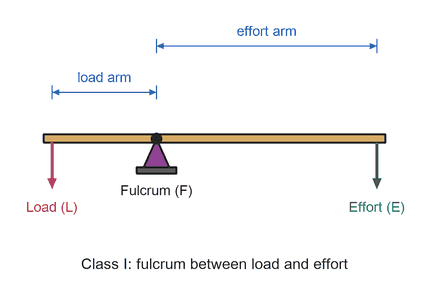
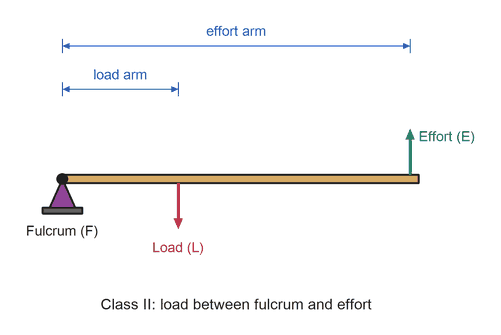
Step 2 — Class II (second order).
The load is between the fulcrum and the effort. The effort is farther from the fulcrum than the load, so the effort arm is always longer and M.A. is always more than 1. Examples: a nut cracker, a wheel barrow, a lemon squeezer and a bottle opener.
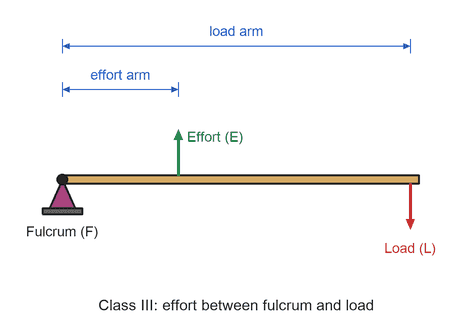
Step 3 — Class III (third order).
The effort is between the fulcrum and the load. The effort is nearer the fulcrum than the load, so the effort arm is always shorter and M.A. is always less than 1. Examples: a pair of sugar tongs, forceps and the forearm holding a load. Its use is that the load moves farther and faster than the effort.
Watch out: The class depends only on what lies in the middle, not on the size of the lever.
Therefore, the three orders are class I (fulcrum in the middle), class II (load in the middle) and class III (effort in the middle).
- 564 marks
Question 56
Draw diagrams to illustrate the positions of fulcrum, load and effort, in each of the following:
(a) a see-saw (b) a beam balance (c) a nut cracker (d) a pair of forceps
Solve with AIWritten solution
Solution:
Concept: Find the fulcrum (the point about which it turns) first, then the load (what is moved or resisted) and the effort (where we push or pull).
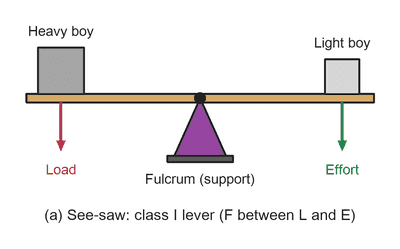
Step 1 — A see-saw.
The support in the middle is the fulcrum. The heavier child is the load and the lighter child pushing down is the effort. The fulcrum is between them, so it is a class I lever.
Step 2 — A beam balance.
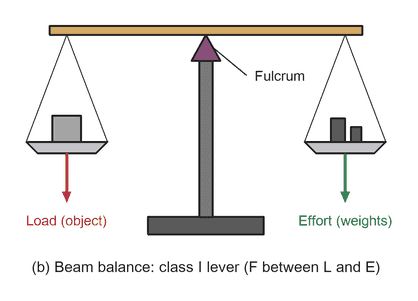
The beam rests on a knife edge at its middle (fulcrum). The object in one pan is the load and the weights in the other pan are the effort. The arms are equal, so it is a class I lever with M.A. 1.
Step 3 — A nut cracker.
The hinge is the fulcrum. The nut placed near the hinge is the load and the hands press at the far ends (effort). The load is between them, so it is a class II lever.
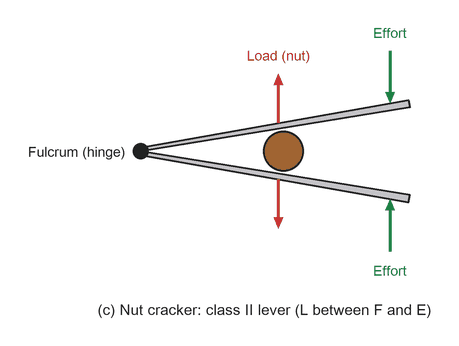
Step 4 — A pair of forceps.
The joined end is the fulcrum. The fingers press in the middle (effort) and the object held at the tips is the load. The effort is between them, so it is a class III lever.

Therefore, the see-saw and the beam balance are class I levers, the nut cracker is class II and the forceps are class III.
- 573 marks
Question 57
The mechanical advantage of an actual pulley is less than 1. Give a reason. What is the justification for using the pulley then ?
Solve with AIWritten solution
Solution:
Concept: A pulley is a grooved wheel that turns about an axle held in a frame called the block, which hangs from a fixed support. A string passes over the groove: the load hangs from one end and the effort is applied at the other end. A single fixed pulley changes the direction of the effort, so we pull down to raise the load up. In an ideal pulley the effort equals the load, so its M.A. is 1.
Step 1 — Give the reason.
In an ideal pulley the effort equals the load. In an actual pulley some effort is used up against friction at the axle and in the groove, and the string itself has to be lifted. So the effort is a little more than the load.
Step 2 — Justify its use.
A pulley lets us apply the effort downwards, which is a convenient direction. Lifting a load straight up is hard, but pulling down is easy, and we can even use our own weight as part of the effort, as when drawing a bucket of water from a well.
Watch out: A single pulley is not used to reduce the effort; it is used for the convenient direction of the effort.
Therefore, an actual pulley has M.A. less than 1 because of friction, but it is used because it lets us apply the effort in a convenient downward direction.
- 584 marks
Question 58
Draw a neat labelled diagram showing a pulley being used to lift a load. How are load and effort related in an ideal situation ?
Solve with AIWritten solution
Solution:
Concept: A pulley is a grooved wheel that turns about an axle held in a frame called the block, which hangs from a fixed support. A string passes over the groove: the load hangs from one end and the effort is applied at the other end. A single fixed pulley changes the direction of the effort, so we pull down to raise the load up. In an ideal pulley the effort equals the load, so its M.A. is 1.
Step 1 — Draw the diagram.
The block of the pulley hangs from a fixed support. A string passes over the groove; the load is tied to one end and the effort pulls the other end downwards.
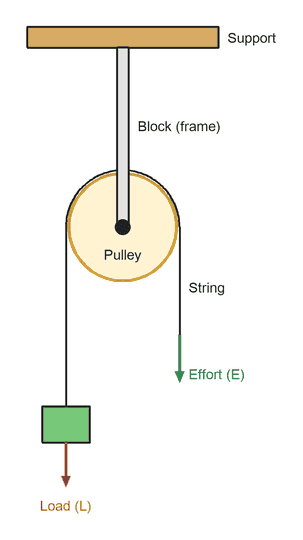
Step 2 — Relate the load and the effort.
In an ideal pulley there is no friction, so the effort equals the load.
Step 3 — Find the M.A.
Dividing the load by an equal effort gives 1.
Therefore, in an ideal pulley the effort is equal to the load, so its mechanical advantage is 1.
- 594 marks
Question 59
What is an inclined plane ? What is its mechanical advantage ? Give two examples where it is used.
Solve with AIWritten solution
Solution:
Concept: An inclined plane is a sloping surface, such as a plank or a ramp, used to raise a load with less effort than lifting it straight up. The gentler the slope (the longer the slope for the same height), the less effort is needed.
Step 1 — Define an inclined plane.
An inclined plane is a slanting plank or sloping surface used to move a load up with less effort than lifting it straight up.
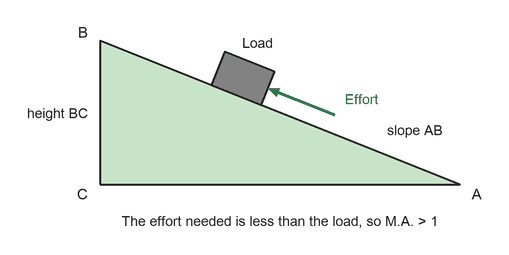
Step 2 — State its mechanical advantage.
The effort needed to push the load up the slope AB is less than the load, so the mechanical advantage of an inclined plane is greater than 1. The longer the slope AB compared with its height BC, the gentler the slope and the smaller the effort. For a slope with little friction the M.A. equals the length AB divided by the height BC.
Step 3 — Give two uses.
Inclined planes are used wherever heavy loads must be raised.
- A coolie pushes a heavy drum up a plank laid from the ground to a truck.
- Ramps in hospitals and buildings let stretchers, wheelchairs and scooters be moved up to a higher level.
Therefore, an inclined plane is a sloping surface with M.A. greater than 1, used in loading trucks and in ramps.
- 603 marks
Question 60
In a machine an effort of 10 kgf is applied to lift a load of 100 kgf. What is its mechanical advantage?
Solve with AIWritten solution
Solution:
Concept: The mechanical advantage (M.A.) of a machine is the ratio of the load to the effort, . It has no unit, because it is a ratio of two forces. When M.A. is more than 1, the machine is a force multiplier.
Given: Load = 100 kgf, effort = 10 kgf.
Step 1 — Write the formula.
Mechanical advantage is the load divided by the effort.
Step 2 — Substitute the values.
We put in the load of 100 kgf and the effort of 10 kgf.
Watch out: M.A. has no unit, because the kgf cancels.
Therefore, the mechanical advantage of the machine is 10.
- 613 marks
Question 61
The mechanical advantage of a machine is 5. How much load it can exert for the effort of 2 kgf ?
Solve with AIWritten solution
Solution:
Concept: The mechanical advantage (M.A.) of a machine is the ratio of the load to the effort, . It has no unit, because it is a ratio of two forces. When M.A. is more than 1, the machine is a force multiplier.
Given: M.A. = 5, effort = 2 kgf.
Step 1 — Rearrange the formula.
Since M.A. is load ÷ effort, the load is the M.A. multiplied by the effort.
Step 2 — Substitute the values.
We put in M.A. = 5 and effort = 2 kgf.
Therefore, the machine can overcome a load of 10 kgf.
- 623 marks
Question 62
The mechanical advantage of a machine is 2. It is used to raise a load of 15 kgf. What effort is needed ?
Solve with AIWritten solution
Solution:
Concept: The mechanical advantage (M.A.) of a machine is the ratio of the load to the effort, . It has no unit, because it is a ratio of two forces. When M.A. is more than 1, the machine is a force multiplier.
Given: M.A. = 2, load = 15 kgf.
Step 1 — Rearrange the formula.
Since M.A. is load ÷ effort, the effort is the load divided by the M.A.
Step 2 — Substitute the values.
We put in load = 15 kgf and M.A. = 2.
Therefore, an effort of 7.5 kgf is needed.
- 633 marks
Question 63
A lever of length 100 cm has effort of 15 kgf at a distance of 40 cm from the fulcrum at one end.
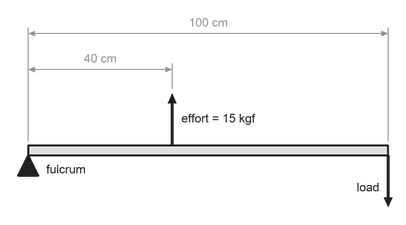
What load can be applied at its other end ?
Solve with AIWritten solution
Solution:
Concept: A lever is a rigid rod that can turn about a fixed point called the fulcrum (F). The distance of the load from the fulcrum is the load arm, and the distance of the effort from the fulcrum is the effort arm. For a balanced lever, . This is the principle of a lever.
Given: Length of lever = 100 cm, effort = 15 kgf, effort arm = 40 cm, fulcrum at one end.
Step 1 — Find the two arms.
The fulcrum is at one end of the 100 cm lever, so the load at the other end is the whole length, 100 cm, from the fulcrum. The effort is 40 cm from the fulcrum. The effort lies between the fulcrum and the load, so this is a class III lever.

Step 2 — Write the principle of a lever.
For a balanced lever the load times the load arm equals the effort times the effort arm.
Step 3 — Substitute and solve.
We put in load arm = 100 cm, effort = 15 kgf and effort arm = 40 cm, then divide by 100 cm.
Step 4 — Check with the M.A.
The M.A. is the effort arm divided by the load arm, which is less than 1, as it must be for a class III lever. So the load is less than the effort.
Watch out: The load at the other end is 100 cm from the fulcrum, not 100 − 40 = 60 cm, because the fulcrum is at one end.
Note: if the words “at one end” are read as describing the effort instead (effort at one end, 40 cm from the fulcrum), the load at the other end is 60 cm from the fulcrum, and the load would be 10 kgf. The first reading, with the fulcrum at one end, is the one used above.
Therefore, a load of 6 kgf can be applied at the other end.
- 644 marks
Question 64
In a lever, fulcrum is at one end at a distance of 30 cm from the load and effort is at the other end at a distance of 90 cm from the load.
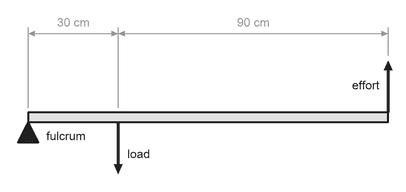
Find :
(a) the length of load arm,
(b) the length of effort arm, and
(c) the mechanical advantage of the lever.
Solve with AIWritten solution
Solution:
Concept: A lever is a rigid rod that can turn about a fixed point called the fulcrum (F). The distance of the load from the fulcrum is the load arm, and the distance of the effort from the fulcrum is the effort arm. For a balanced lever, . This is the principle of a lever.
Given: Fulcrum to load = 30 cm, load to effort = 90 cm.
Step 1 — Place the three points.
The fulcrum is at one end and the load is 30 cm from it. The effort is at the other end, 90 cm beyond the load. So the load lies between the fulcrum and the effort: a class II lever.
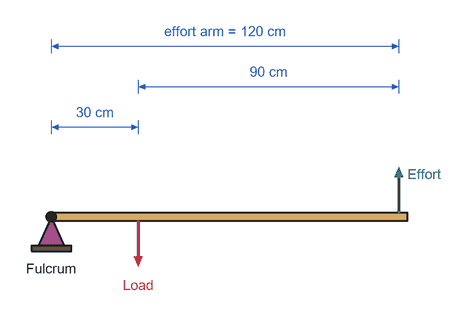
Step 2 — Find the load arm (a).
The load arm is the distance of the load from the fulcrum.
Step 3 — Find the effort arm (b).
The effort is measured from the fulcrum too, so we add the 30 cm up to the load and the 90 cm beyond it.
Step 4 — Find the mechanical advantage (c).
The M.A. of a lever is the effort arm divided by the load arm.
Watch out: The 90 cm is measured from the load, not from the fulcrum; the effort arm is 30 cm + 90 cm.
Therefore, the load arm is 30 cm, the effort arm is 120 cm and the mechanical advantage is 4.
What Class 6 Physics Ch 4 covers
The sections of the chapter, in the order the book takes them. Every question above comes from one of these.
- 01Work and Energy
- 02Machines
- 03Efficiency of a Machine
- 04Mechanical Advantage
- 05Levers
- 06Pulley
More ways to study this chapter
The same chapter asked three other ways. Practise it, revise it, and see what the board has set on Ch 4 before.
Class 6 Physics Ch 4 questions students ask
How many questions are there in Class 6 Physics Ch 4?
64 questions. Every one is solved step by step on this page.
Are these Class 6 Physics solutions free?
Yes. Every question and its full working is free to read, with no account needed.
Can I download the Class 6 Physics Ch 4 solutions as a PDF?
There is no PDF to download. Every solution is on this page instead, which means it is searchable, always the current syllabus, and readable on a phone. Use your browser's print option if you want it on paper.