
Question 573 marksEasy
The mechanical advantage of an actual pulley is less than 1. Give a reason. What is the justification for using the pulley then ?
Confirming your payment
Sign up now and get 250 free tokens.
Simple Machines · Question 57 of 64
The mechanical advantage of an actual pulley is less than 1. Give a reason. What is the justification for using the pulley then ?
Solution:
Concept: A pulley is a grooved wheel that turns about an axle held in a frame called the block, which hangs from a fixed support. A string passes over the groove: the load hangs from one end and the effort is applied at the other end. A single fixed pulley changes the direction of the effort, so we pull down to raise the load up. In an ideal pulley the effort equals the load, so its M.A. is 1.
Step 1 — Give the reason.
In an ideal pulley the effort equals the load. In an actual pulley some effort is used up against friction at the axle and in the groove, and the string itself has to be lifted. So the effort is a little more than the load.
Step 2 — Justify its use.
A pulley lets us apply the effort downwards, which is a convenient direction. Lifting a load straight up is hard, but pulling down is easy, and we can even use our own weight as part of the effort, as when drawing a bucket of water from a well.
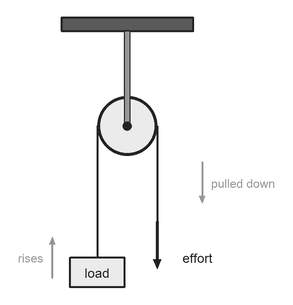
Watch out: A single pulley is not used to reduce the effort; it is used for the convenient direction of the effort.
Therefore, an actual pulley has M.A. less than 1 because of friction, but it is used because it lets us apply the effort in a convenient downward direction.