
Opening your dashboard
Class 6 Physics Chapter 4 Simple Machines: Competency-Based Questions (CBQ)
40 questions on Chapter 4, each worked through on its own page with the AI tutor. Class 6 Physics, ICSE 2026-27.
40 questions
1–5 marks · Mixed difficulty
- 11 mark
Question 1
Competency: Application
A gardener pushes a lawn roller with a steady force of 50 N and moves it 8 m across the lawn. The roller then gets stuck against the edge of a path. He keeps pushing it with the same force of 50 N for 2 minutes, but it does not move at all.
How much work does the gardener do on the roller altogether? (Work done = force × distance moved in the direction of the force)
- 21 mark
Question 2
Competency: Understanding & Evaluation
An advertisement for a hand-operated juicer says:
"Claim 1: It works by itself - you need no effort. Claim 2: It gives out more work than you put into it."
Which is the best judgement of the two claims?
- 31 mark
Question 3
Competency: Application & Analysis
Meena tests two kitchen tools.
- Bottle opener: when she pushes its handle with a force of 2 kgf, it pulls on the cap with a force of 12 kgf.
- Pair of tongs: when she squeezes its arms with a force of 3 kgf, its tips grip a piece of coal with a force of 1 kgf.
Which conclusion is correct?
- 41 mark
Question 4
Competency: Understanding & Application
The main water valve of a school is opened by turning a round hand-wheel of diameter 10 cm, which is fixed on a thin metal rod (the spindle). The valve has become stiff and the gardener cannot turn it.
Which change will let him turn the valve with the least effort?
- 51 mark
Question 5
Competency: Understanding & Analysis
Assertion (A): Using a wheel barrow, a gardener can lift a load of soil that is heavier than the effort he applies on the handles.
Reason (R): In a wheel barrow, the load lies between the fulcrum (the wheel) and the effort, so its effort arm is longer than its load arm.
- 61 mark
Question 6
Competency: Understanding
Assertion (A): A bicycle whose chain and axles are oiled regularly is more efficient than the same bicycle left dry and rusty.
Reason (R): Oiling the moving parts removes friction completely, so that no part of the work input is wasted.
- 72 marks
Question 7
Competency: Application & Analysis
A carpenter drives two iron nails of the same length and thickness into the same wooden plank, using the same hammer and equally hard blows. Nail P has its usual pointed tip. The tip of nail Q has been filed flat. He records the following.
Nail Tip Number of blows needed P pointed 5 Q filed flat 14 (a) Explain the observation, using the idea of a wedge.
(b) The tip of a tailor's needle has broken off. Predict what she will notice when she sews thick cloth with it, and give the reason.
- 82 marks
Question 8
Competency: Understanding & Application
Arjun is fixing a hinge on a wooden door. He first tries to hammer a screw straight into the wood. It hardly goes in. He then turns the same screw with a screw driver, and it goes in easily.
(a) Explain why turning the screw works better than hammering it. Use what you know about the shape of a screw.
(b) While he turns it, the screw driver is itself working as a simple machine. Name this machine and say which part of the screw driver he applies the effort on.
- 92 marks
Question 9
Competency: Application
On a building site, a helper lifts a bucket of bricks using a single pulley fixed at the top of a pole. The bucket of bricks weighs 225 N. To raise it through 4 m, he pulls the rope down through 4 m with a steady force of 250 N.

(a) Find the efficiency of the pulley. (Work done = force × distance)
(b) How much work is wasted, and where does it go?
- 102 marks
Question 10
Competency: Analysis & Evaluation
A customer suspects that a vegetable seller's beam balance is not correct. She measures it and finds that the fulcrum is not at the middle of the beam: the pan for the weights hangs 20 cm from the fulcrum, and the pan for the vegetables hangs 25 cm from it. With both pans empty, the beam stays level.
She asks for 1 kg of potatoes. The seller puts a 1 kg weight in one pan and adds potatoes to the other pan until the beam is level again.
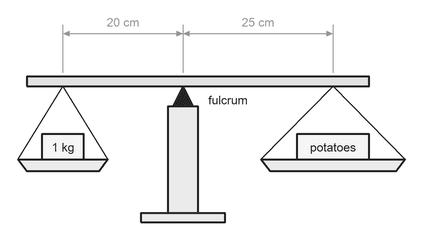
(a) Use the principle of a lever to find the mass of potatoes she gets.
(b) Is the balance fair to the customer? What must be true of the two arms of a correct beam balance?
- 114 marks
Question 11
Competency: Application & Analysis
Case study: Two loaders have to put a refrigerator of weight 120 kgf into a van whose floor is 1 m above the road. They try planks of four different lengths as a ramp. For each plank they measure the effort needed to push the refrigerator steadily up the plank. Their results are shown as the four marked points on the graph.
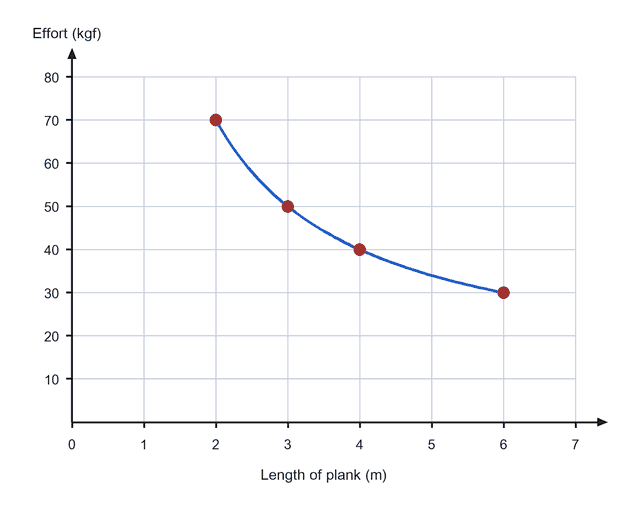
(a) Read from the graph the effort needed with the 2 m plank and with the 6 m plank.
(b) Find the mechanical advantage of the 4 m plank. How does the mechanical advantage change as the plank is made longer?
(c) Together the two loaders can push with a force of 45 kgf at the most. Which is the shortest of the four planks they can use? State one disadvantage of choosing the 6 m plank instead.
- 124 marks
Question 12
Competency: Application & Analysis
Case study: A cook turns chapatis on a hot pan with a pair of flat kitchen tongs. The two arms of the tongs are joined at one end. She presses the arms with her fingers at a point 6 cm from the joined end, and the tips, 24 cm from the joined end, grip the chapati. One arm of the tongs can be drawn as the lever shown below.
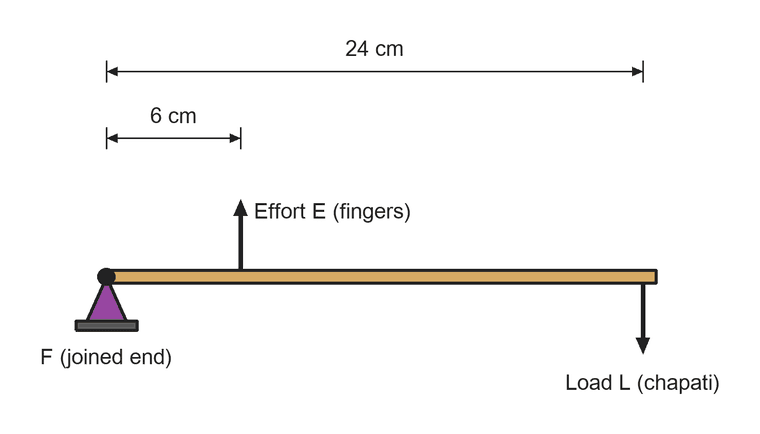
(a) To which class of levers do the tongs belong? Give a reason from the figure.
(b) Find the mechanical advantage of the tongs. What effort must her fingers apply so that the tips press on the chapati with a force of 0.5 kgf?
(c) The effort is greater than the load, yet the tongs are useful to the cook. Give one reason. Then find the effort needed for the same load if she holds the tongs 12 cm from the joined end, and say what this tells her about where to hold them.
- 134 marks
Question 13
Competency: Analysis & Evaluation
Case study: A group of students tests a single pulley fixed to a stand. For each load they pull the string down with a spring balance and note the effort needed to raise the load steadily. Their readings are given in the table.
Load (kgf) 2 4 6 8 Effort (kgf) 2.5 5.0 7.5 10.0 (a) Find the mechanical advantage of the pulley for each load. What do you notice?
(b) Explain why the value you get is less than 1. What would it be for an ideal pulley? Using the pattern in the table, predict the effort for a load of 10 kgf.
(c) Another group using the same kind of pulley reports: "We raised a load of 8 kgf with an effort of only 7 kgf." Should this reading be accepted? Justify your answer.
- 144 marks
Question 14
Competency: Creation
The pulley on your school's flag pole squeaks, and the rope has become hard to pull. Your teacher thinks there is too much friction at the axle of the pulley. She asks your group to design a fair test, in the laboratory, to find out whether oiling the axle of a pulley reduces the effort needed to raise a load.
You are given: a single pulley fixed on a stand, a string, a 2 kgf weight, a spring balance (it shows the pull on it in kgf) and a little machine oil.
(a) Write the steps of your test.
(b) State two things you will keep the same so that the test is fair, and draw the table in which you will record your readings.
(c) What result do you expect? How will you use your readings to show that the pulley has become a better machine?
- 154 marks
Question 15
Competency: Analysis & Evaluation
Case study: A garage tests three car jacks, P, Q and R. Each jack is used to raise the same side of a car, a load of 600 kgf, through the same small height, so the useful work done on the load is 300 J each time. The effort needed on the handle and the total work put in by the effort are given in the table.
Jack Load (kgf) Effort (kgf) Work input (J) Useful work output (J) P 600 20 500 300 Q 600 25 400 300 R 600 30 375 300 (a) Find the mechanical advantage of each jack.
(b) Find the efficiency of each jack.
(c) The mechanic says, "Jack P has the greatest mechanical advantage, so it must also be the most efficient." Use your answers to judge his statement. Which jack would you recommend for a driver who cannot push with a force of more than 22 kgf? Give a reason.
- 161 mark
Question 16
Competency: Application
Neha carries her school bag, of weight 40 N, up a staircase of 12 steps, each 20 cm high. At the top she walks 5 m along a level corridor, holding the bag at the same height. To carry the bag she exerts an upward force equal to its weight.
How much work does this upward force do on the bag during the climb and the walk together? (Work done = force × distance moved in the direction of the force)
- 171 mark
Question 17
Competency: Analysis
A carpenter pulls a nail out of a plank with the claw of a hammer. He pushes the end of the handle with an effort of 100 N and the handle end moves through 30 cm. The nail comes out through 5 cm against a grip of 500 N. (Hypothetical data.)
Which statement describes the working of the hammer?
- 181 mark
Question 18
Competency: Analysis
A labourer wants to raise one edge of a heavy trunk that stands on short legs, using a wooden plank 2 m long. He tries two ways. (Hypothetical data.)
- Way 1: He pushes one end of the plank under the trunk so that this end rests on the ground and does not slip. The edge of the trunk rests on the plank 0.5 m from that end, and he lifts the far end of the plank upwards.
- Way 2: He puts a brick under the plank 0.5 m from one end and slides that end under the edge of the trunk. He pushes the far end of the plank downwards.
Which statement is correct?
- 191 mark
Question 19
Competency: Recall
Which of the following is NOT an example of a wheel and axle?
- 201 mark
Question 20
Competency: Understanding
A boy raises a flag on a school flag pole by pulling the rope down through 6 m. The rope passes over a single fixed pulley at the top of the pole.
Through what distance does the flag rise, and why?
- 211 mark
Question 21
Competency: Evaluation
Four students test four hand-operated machines and record the work they put in and the useful work they get out. (Hypothetical data.)
Machine Work input (J) Work output (J) P 250 200 Q 300 330 R 400 380 S 100 40 Which reading must be wrong?
- 221 mark
Question 22
Competency: Understanding
The box of a lifting device used in a garage says: "Mechanical advantage 4, efficiency 80%". Which statement correctly explains both numbers?
- 231 mark
Question 23
Competency: Understanding
Assertion (A): The mechanical advantage of a machine has no unit.
Reason (R): Mechanical advantage is the ratio of the load to the effort, and both are measured in the same unit.
- 241 mark
Question 24
Competency: Analysis
Assertion (A): A boy of weight 40 kgf cannot raise a load of 45 kgf by pulling down on a rope passing over a single fixed pulley.
Reason (R): With a single fixed pulley the effort needed is always less than the load.
- 251 mark
Question 25
Competency: Analysis
A wheel chair and its passenger together weigh 900 N. They are pushed up a straight ramp 6 m long, which rises 0.5 m. The helper pushes along the ramp with a steady force of 100 N. (Work done = force × distance)
What is the efficiency of the ramp?
- 262 marks
Question 26
Competency: Application
A screw jack, used to raise one side of a lorry, has a long handle. The driver turns the handle round and round and the lorry rises only a little in each turn.
(a) Which two simple machines are combined in a screw jack?
(b) Explain how turning a long handle lets the driver lift a very heavy lorry with a small effort.
- 272 marks
Question 27
Competency: Analysis
Two children play on a see-saw. Asha weighs 30 kgf and sits 1.5 m from the pivot. Bilal weighs 45 kgf. (Hypothetical data.)
(a) How far from the pivot must Bilal sit on the other side to balance the see-saw?
(b) Bilal moves to a point 1.2 m from the pivot. Predict which child goes down, and explain.
- 282 marks
Question 28
Competency: Application
A mason wants to lift a stone block of load 200 kgf with a lever, but he can apply an effort of at most 25 kgf.
(a) What is the least mechanical advantage the lever must have?
(b) He uses a crowbar and places the fulcrum so that the stone is 20 cm from it. How far from the fulcrum must he hold the crowbar, at least?
- 292 marks
Question 29
Competency: Application
A boy lifts a sack of weight 250 N and puts it on a shelf 1.2 m high. Then he drags a similar sack 3 m along the floor by pulling it with a steady force of 90 N along the floor. (Work done = force × distance moved in the direction of the force)
(a) Find the work done on the sack while lifting it on to the shelf.
(b) In which case is more work done, lifting or dragging? Why is the dragging work less although the sack moves farther?
- 302 marks
Question 30
Competency: Analysis
A light rod 100 cm long (its own weight can be neglected) is used as a lever. A load of 60 kgf hangs at one end A and the effort is applied at the other end B, downwards. First the fulcrum is placed 50 cm from A. Then it is moved to a point 20 cm from A.
(a) Find the mechanical advantage in the two cases.
(b) What happens to the effort needed for the 60 kgf load when the fulcrum is moved nearer the load? Give the effort in each case.
- 312 marks
Question 31
Competency: Understanding
On a visit to a flour mill, a group of students sees four machines: (i) a crowbar used to shift a heavy sack of grain, (ii) an electric flour mill with many moving parts, (iii) a single pulley used to raise sacks to the loft, and (iv) a crane run by a diesel engine.
(a) Sort the four into simple machines and complex machines, and give the reason for your sorting.
(b) The mill owner says, "The electric mill does its work by itself." Explain why this is not correct.
- 323 marks
Question 32
Competency: Application
On a building site a hand-operated hoist of efficiency 75% is used to lift 40 bricks, each of weight 30 N, to a height of 5 m. (Work done = force × distance)
(a) Find the useful work the hoist has to do on the bricks.
(b) How much work must the workers put in?
(c) How much work is wasted, and where does it go?
- 333 marks
Question 33
Competency: Analysis
Anand fits handles of different radii on a tap spindle and measures the effort at the rim of the handle needed to turn the tight tap. (Hypothetical data.)
Radius of the handle (cm) 2 3 6 9 Effort needed (kgf) 18 12 6 4 (a) What do you notice about the effort as the handle gets larger? Give one calculation that supports your answer.
(b) Predict the effort needed with a handle of radius 4 cm.
(c) A small child can apply 4.5 kgf at most. What is the smallest handle radius that lets her turn the tap?
- 343 marks
Question 34
Competency: Evaluation
A hill station is 300 m above the town. Two roads are planned to reach it. Road A climbs steeply and is 2 km long. Road B winds gently round the hill and is 6 km long. A loaded truck has to climb to the top.
(a) On which road will the engine of the truck have to push with the smaller force? Give a reason.
(b) State one disadvantage of that road.
(c) An old truck with a weak engine and an ambulance that must reach the town quickly use the roads. Which road would you advise for each? Give a reason for each.
- 353 marks
Question 35
Competency: Analysis
In a nail cutter, one end of the long handle is hooked at the front and does not move. A small bump under the handle, which presses the upper jaw down on the nail, is 1 cm from this end, and the thumb presses the handle at its far end, 5 cm from the hooked end. (Hypothetical data.) The nail is cut by the sharp edges of the two jaws.
(a) To which class of levers does the handle belong? Give a reason.
(b) Find the mechanical advantage of the handle and the effort needed for a load of 6 kgf.
(c) Name the simple machine that the sharp edges of the jaws form and state why a sharp edge helps.
- 363 marks
Question 36
Competency: Analysis
Three levers P, Q and R have the following arms. (Hypothetical data.)
Lever Effort arm (cm) Load arm (cm) P 12 30 Q 40 10 R 25 25 (a) Find the mechanical advantage of each lever.
(b) A class II lever always has an M.A. more than 1 and a class III lever always has an M.A. less than 1, while a class I lever can have any value. Which of P, Q and R can be a class III lever, and which can be a class II lever? Which of them must be class I?
(c) Name one everyday tool that could be lever R.
- 374 marks
Question 37
Competency: Analysis
Case study: In the school laboratory a group tests the principle of a lever. They balance a metre-long wooden plank on a support at its middle (the fulcrum F), hang a load on one side and pull down on the other side with a spring balance, which shows the effort. The plank stays horizontal each time. The arms are measured from F. The arrangement is shown in the figure and their readings in the table. (Hypothetical data.)
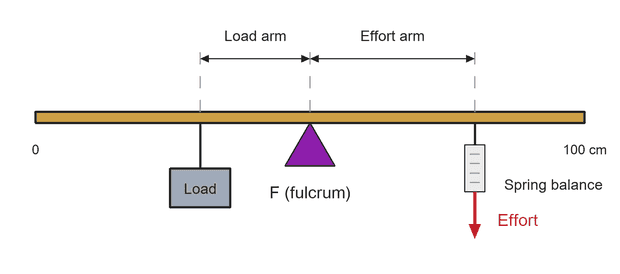
Trial Load (kgf) Load arm (cm) Effort arm (cm) Effort shown (kgf) 1 6 10 30 2.1 2 8 15 30 4.0 3 9 20 40 4.4 4 10 12 40 5.0 (a) For each trial find Load × Load arm and Effort × Effort arm.
(b) One trial does not agree with the principle of a lever. Name it and state the effort that should have been shown. Give one possible mistake.
(c) For trial 2 find the mechanical advantage. Then predict the effort needed for a load of 12 kgf with the load arm 20 cm and the effort arm 50 cm.
- 384 marks
Question 38
Competency: Evaluation
Case study: A carpenter is fixing shelves in a school library. He tests three screws, P, Q and R, of the same length and thickness, in the same kind of wood and with the same screw driver. They differ only in how close their threads are. The distance between two neighbouring threads is the distance the screw moves into the wood in one full turn. He notes the number of turns each screw needs to go 24 mm into the wood, and the effort his hand applies on the handle. (Hypothetical data.)
Screw Distance between threads (mm) Turns to go 24 mm in Effort on the handle (kgf) P 1 24 1.5 Q 2 12 3 R 4 6 6 (a) How do the number of turns and the effort change as the threads get closer together? How many times as much effort does screw R need as screw P?
(b) Use the idea that a screw is an inclined plane wound round a rod to explain why screw P needs the least effort.
(c) Ravi says, "Screw P is the best screw for every job." Judge his statement, giving one advantage and one disadvantage of screw P from the table. When would screw R be the better choice?
- 395 marks
Question 39
Competency: Creativity
Case study: A farmer's grain store has a loft 2 m above the ground. She must put sacks of grain of load 50 kgf in the loft one by one. She can push or pull with an effort of at most 20 kgf. She has a long wooden plank, a strong rope, a single pulley and an iron crowbar. She has no electricity and no helpers. (Hypothetical data.)
(a) What is the least mechanical advantage she needs? A neighbour suggests hanging the pulley from the loft and pulling the rope down to raise the sack. Will this alone solve the problem? Give a reason.
(b) Suggest a better plan using one of the things she has. Describe it in a few lines, say what simple machine it is, and say how it helps her.
(c) State one disadvantage of your plan and one way in which the pulley can still be useful to her.
- 404 marks
Question 40
Competency: Analysis
Case study: A woodcutter has two iron wedges, A and B, both 12 cm high, to split logs of the same dry wood for the village school's kitchen. Wedge A is thin and wedge B is thick, as shown in the figure. He drives each wedge into a log with the same hammer and five equally hard blows, and measures how deep it goes. (Hypothetical data.)
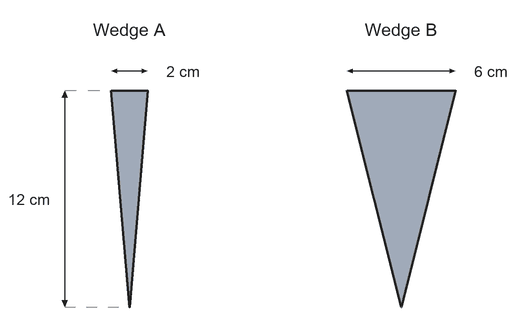
Wedge Width at the broad end (cm) Depth after five blows (cm) A 2 9 B 6 3 (a) Which wedge goes deeper, and how many times as deep as the other?
(b) Explain the result using the idea that a wedge is made of two inclined planes.
(c) The woodcutter makes a third wedge C, 12 cm high and 4 cm wide. Predict whether its depth after five blows will be less than 3 cm, between 3 cm and 9 cm, or more than 9 cm. Give a reason.