
Question 404 marksMedium
Competency: Analysis
Case study: A woodcutter has two iron wedges, A and B, both 12 cm high, to split logs of the same dry wood for the village school's kitchen. Wedge A is thin and wedge B is thick, as shown in the figure. He drives each wedge into a log with the same hammer and five equally hard blows, and measures how deep it goes. (Hypothetical data.)
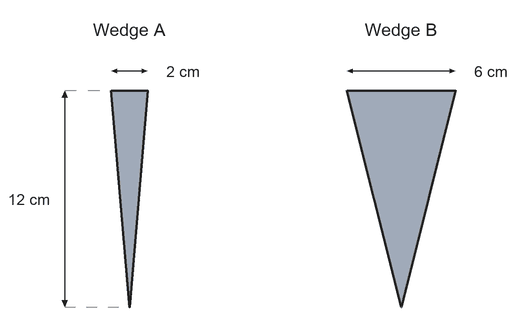
| Wedge | Width at the broad end (cm) | Depth after five blows (cm) |
|---|---|---|
| A | 2 | 9 |
| B | 6 | 3 |
(a) Which wedge goes deeper, and how many times as deep as the other?
(b) Explain the result using the idea that a wedge is made of two inclined planes.
(c) The woodcutter makes a third wedge C, 12 cm high and 4 cm wide. Predict whether its depth after five blows will be less than 3 cm, between 3 cm and 9 cm, or more than 9 cm. Give a reason.