
Competency: Analysis
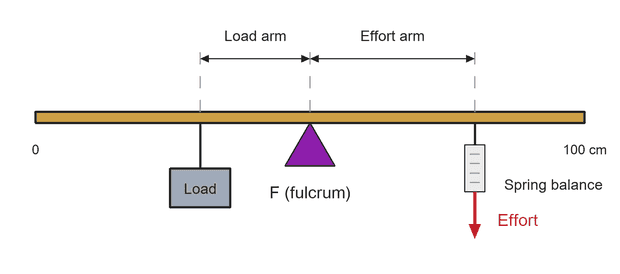
Case study: In the school laboratory a group tests the principle of a lever. They balance a metre-long wooden plank on a support at its middle (the fulcrum F), hang a load on one side and pull down on the other side with a spring balance, which shows the effort. The plank stays horizontal each time. The arms are measured from F. The arrangement is shown in the figure and their readings in the table. (Hypothetical data.)
| Trial | Load (kgf) | Load arm (cm) | Effort arm (cm) | Effort shown (kgf) |
|---|---|---|---|---|
| 1 | 6 | 10 | 30 | 2.1 |
| 2 | 8 | 15 | 30 | 4.0 |
| 3 | 9 | 20 | 40 | 4.4 |
| 4 | 10 | 12 | 40 | 5.0 |
(a) For each trial find Load × Load arm and Effort × Effort arm.
(b) One trial does not agree with the principle of a lever. Name it and state the effort that should have been shown. Give one possible mistake.
(c) For trial 2 find the mechanical advantage. Then predict the effort needed for a load of 12 kgf with the load arm 20 cm and the effort arm 50 cm.