Solution:
Concept: A lever is a rigid rod that can turn about a fixed point called the fulcrum (F). The distance of the load from the fulcrum is the load arm, and the distance of the effort from the fulcrum is the effort arm. For a balanced lever, Load×Load arm=Effort×Effort arm. This is the principle of a lever.
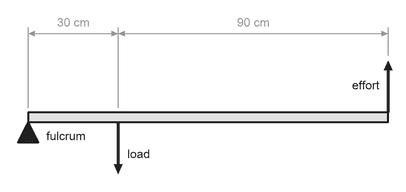
Given: Fulcrum to load = 30 cm, load to effort = 90 cm.
Step 1 — Place the three points.
The fulcrum is at one end and the load is 30 cm from it. The effort is at the other end, 90 cm beyond the load. So the load lies between the fulcrum and the effort: a class II lever.
Step 2 — Find the load arm (a).
The load arm is the distance of the load from the fulcrum.
Load arm=30 cm
Step 3 — Find the effort arm (b).
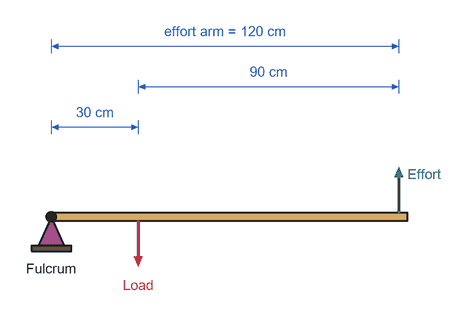
The effort is measured from the fulcrum too, so we add the 30 cm up to the load and the 90 cm beyond it.
Effort arm=30 cm+90 cm
Effort arm=120 cm
Step 4 — Find the mechanical advantage (c).
The M.A. of a lever is the effort arm divided by the load arm.
M.A.=Load armEffort arm
M.A.=30 cm120 cm
M.A.=4
Watch out: The 90 cm is measured from the load, not from the fulcrum; the effort arm is 30 cm + 90 cm.
Therefore, the load arm is 30 cm, the effort arm is 120 cm and the mechanical advantage is 4.