
Question 633 marksMedium
A lever of length 100 cm has effort of 15 kgf at a distance of 40 cm from the fulcrum at one end.
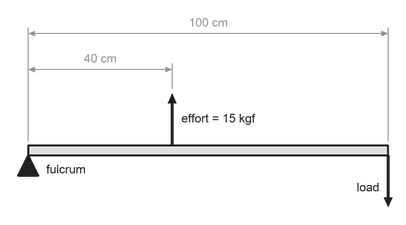
What load can be applied at its other end ?
Confirming your payment
Sign up now and get 250 free tokens.
Simple Machines · Question 63 of 64
A lever of length 100 cm has effort of 15 kgf at a distance of 40 cm from the fulcrum at one end.
What load can be applied at its other end ?
Solution:
Concept: A lever is a rigid rod that can turn about a fixed point called the fulcrum (F). The distance of the load from the fulcrum is the load arm, and the distance of the effort from the fulcrum is the effort arm. For a balanced lever, . This is the principle of a lever.
Given: Length of lever = 100 cm, effort = 15 kgf, effort arm = 40 cm, fulcrum at one end.
Step 1 — Find the two arms.
The fulcrum is at one end of the 100 cm lever, so the load at the other end is the whole length, 100 cm, from the fulcrum. The effort is 40 cm from the fulcrum. The effort lies between the fulcrum and the load, so this is a class III lever.

Step 2 — Write the principle of a lever.
For a balanced lever the load times the load arm equals the effort times the effort arm.
Step 3 — Substitute and solve.
We put in load arm = 100 cm, effort = 15 kgf and effort arm = 40 cm, then divide by 100 cm.
Step 4 — Check with the M.A.
The M.A. is the effort arm divided by the load arm, which is less than 1, as it must be for a class III lever. So the load is less than the effort.
Watch out: The load at the other end is 100 cm from the fulcrum, not 100 − 40 = 60 cm, because the fulcrum is at one end.
Note: if the words “at one end” are read as describing the effort instead (effort at one end, 40 cm from the fulcrum), the load at the other end is 60 cm from the fulcrum, and the load would be 10 kgf. The first reading, with the fulcrum at one end, is the one used above.
Therefore, a load of 6 kgf can be applied at the other end.