
Opening your dashboard
Class 6 Physics Chapter 4 Simple Machines: Practice Questions
47 questions on Chapter 4, each worked through on its own page with the AI tutor. Class 6 Physics, ICSE 2026-27.
47 questions
1–5 marks · Mixed difficulty
- 11 mark
Question 1
Bloom's level: Apply
In which of the following is work being done ?
- 21 mark
Question 2
Bloom's level: Understand
When we cut cloth with a pair of scissors, the blades move a longer distance on the cloth than the handles move in our hand. This shows that a machine can :
- 31 mark
Question 3
Bloom's level: Apply
A machine is given 500 J of work by the effort, and it does 400 J of useful work on the load. Its efficiency is :
- 41 mark
Question 4
Bloom's level: Apply
A car jack lifts one side of a car, which presses down with a load of 900 kgf, when an effort of 30 kgf is applied on its handle. The mechanical advantage of the jack is :
- 51 mark
Question 5
Bloom's level: Remember
Which of the following is a lever of class III ?
- 61 mark
Question 6
Bloom's level: Understand
A bucket of water of load 20 kgf is raised from a well using a single pulley fixed at the top. The effort needed with this actual (not ideal) pulley is :
- 71 mark
Question 7
Bloom's level: Analyse
A drum has to be pushed up on to a platform 1 m high. Three planks of lengths 2 m, 3 m and 5 m are available, each with one end on the platform and the other on the ground.
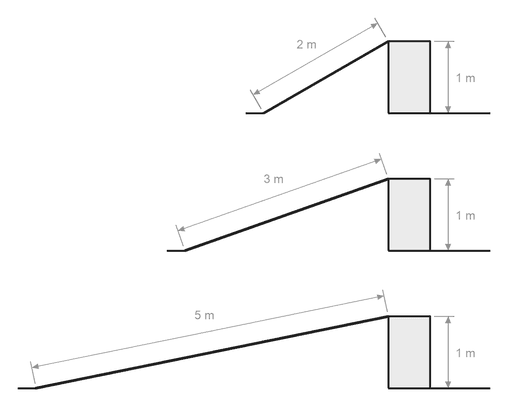
Using which plank will the drum need the least effort ?
- 81 mark
Question 8
Bloom's level: Remember
A wedge is a simple machine which has :
- 91 mark
Question 9
Bloom's level: Evaluate
Anil says, "A screw is a kind of lever, because we turn it with a screw driver." Which is the best judgement of Anil's statement ?
- 101 mark
Question 10
Bloom's level: Understand
Read the Assertion (A) and the Reason (R) and choose the correct option.
Assertion (A): The efficiency of an actual machine is always less than 100%.
Reason (R): In an actual machine, some part of the work input is wasted in overcoming friction between its moving parts.
- 111 mark
Question 11
Bloom's level: Analyse
Read the Assertion (A) and the Reason (R) and choose the correct option.
Assertion (A): A pair of scissors with long blades and short handles has a mechanical advantage less than 1.
Reason (R): In a pair of scissors, the fulcrum lies between the load and the effort.
- 121 mark
Question 12
Bloom's level: Understand
Read the Assertion (A) and the Reason (R) and choose the correct option.
Assertion (A): A screw driver with a thick handle makes it easier to turn a tight screw.
Reason (R): In a wheel and axle, the effort is applied on the smaller wheel, called the axle.
- 132 marks
Question 13
Bloom's level: Remember
Name the simple machine (lever, pulley, wheel and axle, inclined plane, wedge or screw) in each of the following :
(a) a bottle opener (b) the steering wheel of a car (c) a ramp at a hospital entrance (d) an axe (e) a bolt (f) the rope-and-wheel arrangement over a water well
- 142 marks
Question 14
Bloom's level: Understand
A coolie stands on a railway platform holding a heavy suitcase on his head, waiting for the train. When the train arrives, he lifts the suitcase up on to the luggage rack.
(a) Does he do any work while he is standing and waiting ? Does he do work while lifting the suitcase ? Explain.
(b) Name the S.I. unit of work and of energy.
- 152 marks
Question 15
Bloom's level: Apply
State which function of a machine is used in each case :
(a) a car jack lifting a car
(b) a small pulley at the top of a flag pole
(c) the pedal and chain of a bicycle
(d) a pair of sugar tongs picking up a sugar cube
- 162 marks
Question 16
Bloom's level: Apply
In a garage, a mechanic uses a lifting device whose mechanical advantage is 8.
(a) What effort must he apply to raise a car engine of load 240 kgf ?
(b) The largest effort he can comfortably apply is 45 kgf. What is the heaviest load he can raise with the device ?
- 172 marks
Question 17
Bloom's level: Apply
A machine of efficiency 60% is given 1500 J of work by the effort. How much useful work does it do on the load, and how much work is wasted ?
- 182 marks
Question 18
Bloom's level: Apply
In a lever, the effort arm is 80 cm and the load arm is 20 cm. Find (a) its mechanical advantage, and (b) the effort needed to balance a load of 60 kgf.
- 192 marks
Question 19
Bloom's level: Analyse
Raju pulls a 20 kgf bucket straight up from the roof using a rope. Shyam lifts the same bucket using a single fixed pulley and finds that he has to pull down with 22 kgf.
(a) Find the mechanical advantage of Shyam's pulley.
(b) Shyam needs more effort than the load, yet he finds his way easier. Explain why.
- 202 marks
Question 20
Bloom's level: Apply
Give a reason for each :
(a) The steering wheel of a bus is very large.
(b) A water tap whose handle has broken off is very hard to open with the fingers.
- 212 marks
Question 21
Bloom's level: Understand
Why is the blade of an axe made thin and sharp at the edge ? Name two other wedges you use at home.
- 222 marks
Question 22
Bloom's level: Remember
Name the parts of a screw: (a) its pointed end, (b) its flat end, (c) the spiral grooves on it, and (d) the narrow cut made in its flat end. Which simple machine is a screw a modified form of ?
- 234 marks
Question 23
Bloom's level: Apply
Case study: A coolie has to load a heavy drum on to a truck whose floor is 1 m above the road. He cannot lift it, so he places a wooden plank 4 m long with one end on the truck and the other on the road, and rolls the drum up the plank. The drum has a weight of 1000 N.

(a) Which simple machine is the plank ? Why does it help him ?
(b) He also has a 2 m plank. Which plank should he use, and why ?
(c) For an ideal (frictionless) plank, the work done by the effort equals the work done on the load (work = force × distance). Find the effort needed with the 4 m plank, and the mechanical advantage.
- 245 marks
Question 24
Bloom's level: Analyse
The figure shows a lever with its fulcrum F, a load and an effort E.
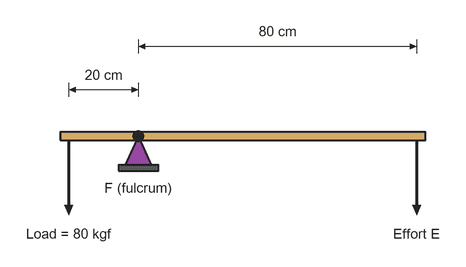
(a) Name the class of this lever. Give a reason.
(b) Write the load arm and the effort arm.
(c) Find the mechanical advantage.
(d) Find the effort needed to balance the load.
(e) How far from the fulcrum should the effort be applied so that an effort of only 16 kgf can balance the same load ?
- 254 marks
Question 25
Bloom's level: Analyse
Three machines P, Q and R are tested :
Machine Load (kgf) Effort (kgf) P 300 50 Q 120 120 R 40 80 (a) Find the mechanical advantage of each.
(b) Which is a force multiplier ? Which could be an ideal single fixed pulley, and which could be a pair of sugar tongs ?
(c) Machine R needs more effort than the load. Why would anyone use such a machine ?
- 264 marks
Question 26
Bloom's level: Evaluate
A student classified some levers as shown. Check each row and correct the mistakes.
Lever Class written Reason written Claw hammer pulling a nail I fulcrum between load and effort Paper cutter III effort between fulcrum and load Forceps III effort between fulcrum and load Mango cutter I fulcrum between load and effort Handle of a hand pump II load between fulcrum and effort Finally, state which of these levers will always have a mechanical advantage more than 1.
- 274 marks
Question 27
Bloom's level: Evaluate
Case study: Grandmother's old sewing machine has become rusty and stiff. When 800 J of work is put in by pedalling, it does only 480 J of useful work. Rohan cleans it, oils its moving parts and paints its iron body. Now 800 J of work input gives 680 J of useful work.
(a) Find the efficiency of the machine before and after Rohan's care.
(b) Rohan says, "If I oil it every day, its efficiency will become 100%." Is he right ? Justify.
(c) Was each of his three steps (cleaning, oiling, painting the body) a good one ? Give a reason for each.
- 284 marks
Question 28
Bloom's level: Create
Using a metre ruler, a pencil (as fulcrum) and some identical coins, design a simple activity to show that for a lever in balance, Load × Load arm = Effort × Effort arm, and that the mechanical advantage = effort arm ÷ load arm.
(a) Describe how you will set it up and what you will do.
(b) Make a table with sample readings for two trials.
(c) Using one trial, show how the mechanical advantage is found in two ways.
- 294 marks
Question 29
Bloom's level: Create
Plan a 'machine hunt' in your home. Prepare a table with one household example for each of the six simple machines, and for each example write (i) what the machine helps you to do and (ii) where the effort is applied. End with one sentence on why machines make work easier.
- 303 marks
Question 30
Bloom's level: Understand
The chapter begins by saying, 'A simple machine changes the direction or the magnitude of force applied.'
(a) Explain how a pulley at a well changes the direction of the force.
(b) Explain how a crow bar changes the magnitude of the force needed to shift a heavy stone.
(c) What name is given to the factor by which a machine multiplies the force applied ?
- 311 mark
Question 31
A nut cracker is a lever in which :
- 321 mark
Question 32
With a crowbar, a workman shifts a stone which offers a load of 150 kgf by applying an effort of 30 kgf. The mechanical advantage of the crowbar is :
- 331 mark
Question 33
A mechanic raises one side of a heavy car by turning the handle of a jack with a small force. In this case the jack is a machine which mainly :
- 341 mark
Question 34
Fill in the blank :
The spiral grooves cut on the surface of the rod of a screw are called its ..............
- 351 mark
Question 35
Write true or false :
A single fixed pulley is used to raise a load because the effort needed is less than the load.
- 362 marks
Question 36
(a) What is meant by the energy of a body ? Name its S.I. unit.
(b) A batsman first holds his bat still above his shoulder while waiting for the ball. He then swings the bat to hit the ball. In which of these two cases does he do work on the bat ? Give a reason.
- 372 marks
Question 37
A screw driver acts as a wheel and axle.
(a) Which part of the screw driver acts as the wheel, and which part acts as the axle ?
(b) On which of these two parts is the effort applied ? How does this help in turning a screw ?
- 384 marks
Question 38
The figure shows a wheel barrow drawn as a lever. F is the fulcrum (the axle of the wheel). The load of 90 kgf acts at a distance of 40 cm from F, and the effort E is applied by the hands at a distance of 120 cm from F.
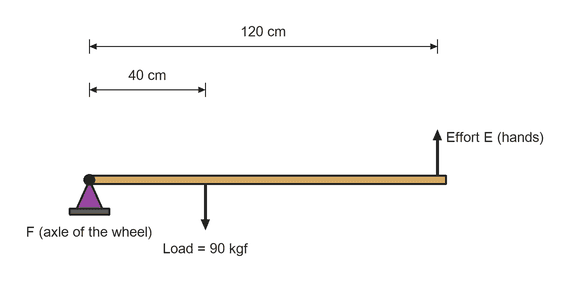
(a) To which class of levers does the wheel barrow belong ? Give a reason for your answer.
(b) Calculate the mechanical advantage of the wheel barrow.
(c) Calculate the effort E needed to lift the load.
- 394 marks
Question 39
(a) What is an inclined plane ?
(b) Draw a labelled diagram to show a load being pushed up an inclined plane. Mark on it the load, the effort, the length of the slope and the vertical height.
(c) Give a reason : The ramp for wheel chairs at the entrance of a hospital is made long and gently sloping, and not short and steep.
- 404 marks
Question 40
(a) Define the efficiency of a machine.
(b) The work done on a machine by the effort is 1200 J. Out of this, 300 J of work is wasted in overcoming friction between its moving parts. Calculate (i) the useful work done by the machine on the load, (ii) the efficiency of the machine as a percentage.
(c) State one way in which the efficiency of this machine can be increased.
- 411 mark
Question 41
Find the work done in lifting a body of mass 5 kg through a height of 10 m. (The weight of a body of mass 1 kg is 1 kgf. Take 1 kgf = 10 N.)
- 421 mark
Question 42
In a wheel barrow, which of the following lies in the middle, between the other two ?
- 431 mark
Question 43
State the factors on which the work done by a force depends.
- 441 mark
Question 44
Write the names of the two quantities by which the ability of a machine to do work is measured.
- 451 mark
Question 45
Find the odd one out. Give a reason for your answer.
Nut cracker, sugar tongs, wheel barrow, bottle opener
- 461 mark
Question 46
A man pushes a box with a force of 15 N. The work done by him in moving the box is 100 J. Find the distance through which the box is moved in the direction of the force, correct to one decimal place.
- 471 mark
Question 47
Define 1 joule of work.