
Opening your dashboard
Class 12 Physics Chapter 27: Nuclei Solutions
89 textbook questions with step-by-step answers, free to read, for ISC 2026-27.
Get talked through Ch 27, not just shown the answer
Reading a finished solution is not the same as being able to do it. The AI tutor takes one question at a time and works it with you, in your own words, until you can.
- Ask it out loud, in your own words
- It gives you the next step, not the answer
- Stuck on part (ii)? Start there
89 questions with solutions
1–5 marks · Mixed difficulty
The first 43 solutions are on this page. This chapter is a long one, so the rest open on their own page to keep this one quick to load.
- 11 mark
Question 1
Mark the correct statement.
Solve with AIAnswer
- Correct
(A) Nuclei of different elements can have the same number of neutrons
(B) Every element has only two stable isotopes
(C) Only one isotope of each element is stable
(D) All isotopes of every element are radioactive
Answer: (A) Nuclei of different elements can have the same number of neutrons
Concept: An element is fixed by its atomic number (number of protons). The number of neutrons can be the same for nuclei of different elements; such nuclei are called isotones.
Step 1 — Test statement (A) with an example. We count the neutrons, , in two nuclei of different elements:
- Carbon-14 has 6 protons and neutrons.
- Oxygen-16 has 8 protons and neutrons.
They are different elements with the same number of neutrons, so (A) is true.
Step 2 — Check the other options. Each of the other statements is false:
- (B) This is false: elements have different numbers of stable isotopes; fluorine has one, and tin has ten.
- (C) This is false: oxygen, for example, has three stable isotopes, ¹⁶O, ¹⁷O and ¹⁸O.
- (D) This is false: most elements have stable isotopes, such as carbon-12 and carbon-13.
Therefore, the correct statement is (A).
- 21 mark
Question 2
The mass number of a nucleus is
Solve with AIAnswer
(A) always less than its atomic number
(B) always more than its atomic number
(C) always equal to its atomic number
- Correct
(D) sometimes more than and sometimes equal to its atomic number
Answer: (D) sometimes more than and sometimes equal to its atomic number
Concept: The mass number is , the number of protons plus the number of neutrons, so .
Step 1 — Find when they are equal. The ordinary hydrogen nucleus is a single proton with no neutron, so its mass number and atomic number are both 1.
Step 2 — Find when is larger. Every other nucleus contains at least one neutron, so and (for example, helium-4 has and ).
Step 3 — Check the other options. Each of the other options fails for a definite reason:
- (A) This is impossible, because can never be smaller than .
- (B) This fails for hydrogen-1, where .
- (C) This holds only for hydrogen-1; all other nuclei have neutrons.
Therefore, the answer is (D).
- 31 mark
Question 3
As compared to atom, atom has
Solve with AIAnswer
(A) two extra protons and two extra electrons
(B) two extra protons but no extra electrons
- Correct
(C) two extra neutrons and no extra electrons
(D) two extra neutrons and two extra electrons
Answer: (C) two extra neutrons and no extra electrons
Concept: Isotopes of an element have the same atomic number (same number of protons and, in a neutral atom, of electrons) but different numbers of neutrons.
Step 1 — Count the particles. Both atoms are carbon, so : 6 protons and 6 electrons each. The neutrons are :
- Carbon-12 has neutrons.
- Carbon-14 has neutrons.
Step 2 — Compare. Carbon-14 has more neutrons and the same number of electrons.
Step 3 — Check the other options. Each of the other options fails for a definite reason:
- (A) Extra protons would make a different element, not carbon.
- (B) This again adds protons, which would change the element.
- (D) A neutral carbon atom always has 6 electrons, whatever its mass number.
Therefore, the answer is (C).
- 41 mark
Question 4
The radius of a nucleus of mass number is directly proportional to
Solve with AIAnswer
(A)
(B)
(C)
- Correct
(D)
Answer: (D) , the cube root of the mass number
Concept: The radius of a nucleus of mass number is , where m (1.2 fm). So the volume of a nucleus, , is proportional to .
Step 1 — Explain the cube root. Nuclear matter has nearly the same density in every nucleus, so the volume of a nucleus is proportional to the number of nucleons . Volume is proportional to , so and .
Step 2 — Check the other options. Each of the other options fails for a definite reason:
- (A) This would make the volume grow as , far faster than the mass.
- (B) This is how the volume (and the mass) grows, not the radius.
- (C) This is how the surface area of the nucleus grows.
Therefore, the answer is (D).
- 51 mark
Question 5
The atoms of the same element having different masses but same chemical properties are called
Solve with AIAnswer
(A) isotones
- Correct
(B) isotopes
(C) isobars
(D) isomers
Answer: (B) isotopes
Concept: Chemical properties depend on the number of electrons, which equals the atomic number . Atoms with the same but different numbers of neutrons are isotopes.
Step 1 — Apply the definition. Atoms of the same element have the same , so they behave alike chemically; different masses mean different numbers of neutrons. These are isotopes, such as ¹H, ²H and ³H.
Step 2 — Check the other options. Each of the other options names a different group:
- (A) Isotones have the same number of neutrons but different , so they are different elements.
- (C) Isobars have the same mass number but different , so again different elements.
- (D) Isomers have the same and the same (same mass number), differing only in nuclear energy state.
Therefore, the answer is (B).
- 61 mark
Question 6
Which of the following is most unstable?
Solve with AIAnswer
(A) Electrons
(B) Protons
- Correct
(C) Neutrons
(D) α-particle
Answer: (C) Neutrons
Concept: A particle is unstable if it decays by itself. A free neutron decays into a proton, an electron and an antineutrino.
Step 1 — Decay of a free neutron. Outside a nucleus a neutron decays with a half-life of about 10 minutes:
Step 2 — Check the other options. Each of the other particles is stable:
- (A) The electron has never been seen to decay; there is no lighter charged particle it could decay into while conserving charge.
- (B) No proton decay has ever been observed; the proton's lifetime is more than about years.
- (D) The α-particle (helium-4 nucleus) is one of the most tightly bound and stable nuclei.
Therefore, the answer is (C).
- 71 mark
Question 7
The mass equivalent of 931 MeV energy is
Solve with AIAnswer
- Correct
(A) kg
(B) kg
(C) kg
(D) kg
Answer: (A) kg, which is one atomic mass unit
Concept: Mass and energy are related by , so , with J.
Step 1 — Convert the energy to joules. We multiply by J per MeV:
Step 2 — Divide by . We divide by , taking as :
Step 3 — Check the other options. Each of the other values is far from this:
- (B) This is about 3600 times too large.
- (C) This has the power of ten wrong; it is times too large.
- (D) This is about 3.6 times too large.
Therefore, the answer is (A).
- 81 mark
Question 8
For the stability of any nucleus
Solve with AIAnswer
- Correct
(A) binding energy per nucleon will be more
(B) binding energy per nucleon will be less
(C) number of electrons will be more
(D) none of the above
Answer: (A) binding energy per nucleon will be more
Concept: The binding energy per nucleon is the average energy needed to pull one nucleon out of the nucleus. The larger it is, the more tightly the nucleons are held.
Step 1 — Link binding energy per nucleon to stability. A nucleus with a high binding energy per nucleon needs more energy to break up, so it is more stable. Nuclei near iron-56 and nickel-62, with about 8.8 MeV per nucleon, are the most stable.
Step 2 — Check the other options. Each of the other options fails for a definite reason:
- (B) This is the reverse: a lower binding energy per nucleon means a less tightly bound nucleus.
- (C) There are no electrons in a nucleus; electrons outside it do not decide nuclear stability.
- (D) This is wrong, because (A) is correct.
Therefore, the answer is (A).
- 91 mark
Question 9
The radius of nucleus in fermi is (given m)
Solve with AIAnswer
- Correct
(A) 4.8
(B) 1.2
(C) 7.7
(D) 9.6
Answer: (A) 4.8
Concept: The radius of a nucleus of mass number is , where m (1.2 fm). So the volume of a nucleus, , is proportional to .
Step 1 — Find the cube root of the mass number. For copper-64, :
Step 2 — Multiply by . We use fm:
Step 3 — Check the other options. Each of the other values comes from a slip:
- (B) This is alone, leaving out the factor .
- (C) This would need , that is, a mass number of about 260, not 64.
- (D) This uses the square root, , instead of the cube root.
Therefore, the answer is (A).
- 101 mark
Question 10
If and are the radii of the atomic nuclei of mass numbers 64 and 125 respectively, then the ratio is
Solve with AIAnswer
(A)
(B)
(C)
- Correct
(D)
Answer: (D)
Concept: The radius of a nucleus of mass number is , where m (1.2 fm). So the volume of a nucleus, , is proportional to .
Step 1 — Write the ratio. The constant is the same for both nuclei, so it cancels and the ratio is:
Step 2 — Take the cube roots. The cube root of 64 is 4 and the cube root of 125 is 5, so:
Step 3 — Check the other options. Each of the other options comes from a slip:
- (A) This is the ratio of the volumes (or masses), not of the radii.
- (B) This uses a square root instead of a cube root.
- (C) This is the ratio turned upside down, .
Therefore, the answer is (D).
- 111 mark
Question 11
Two protons exert a nuclear force on each other, the distance between them is
Solve with AIAnswer
- Correct
(A) m
(B) m
(C) m
(D) m
Answer: (A) m
Concept: The nuclear force is short-ranged: it acts only between nucleons that are within a few femtometres ( m) of each other, that is, within nuclear distances.
Step 1 — Pick the nuclear distance. Of the options, only m (10 fm) is of nuclear size; nuclei have radii from about 1 fm to about 7.5 fm.
Step 2 — Check the other options. Each of the other distances is far too large:
- (B) This is the size of a whole atom; at this distance only the electrostatic force acts between protons.
- (C) This is 1000 times the size of a nucleus; the nuclear force is zero there.
- (D) This is about a hundred atoms across, far outside the range of the nuclear force.
Note: the nuclear force is strongest at separations of about 1 to 2 fm and is already very weak at 10 fm, so “of the order of m” describes it best; m is the option nearest to this nuclear range.
Therefore, the answer is (A).
- 121 mark
Question 12
The mass and energy equivalent to 1 amu are respectively
Solve with AIAnswer
(A) g, 9.30 MeV
- Correct
(B) kg, 930 MeV
(C) kg, 1 MeV
(D) kg, 1 MeV
Answer: (B) kg, 930 MeV
Concept: One atomic mass unit is of the mass of a carbon-12 atom, kg, and by its energy equivalent is about 931.5 MeV.
Step 1 — Find the energy of 1 u. We use and J:
Step 2 — Match the option. Option (B) is the only one with the right unit (kg) and the right size for both quantities. Its values are approximate: 1 u is more exactly kg (the printed 1.67 is closer to the proton's mass) and 931.5 MeV.
Step 3 — Check the other options. Each of the other options has a wrong value:
- (A) This gives grams instead of kilograms (1000 times too small) and an energy 100 times too small.
- (C) The mass is right, but 1 MeV is about 930 times too small for the energy.
- (D) The mass is times too small, and 1 MeV is again about 930 times too small for the energy.
Therefore, the answer is (B).
- 131 mark
Question 13
If , and are the masses of nucleus, neutron and proton respectively, then
Solve with AIAnswer
- Correct
(A)
(B)
(C)
(D)
Answer: (A)
Concept: When nucleons join to form a nucleus, energy (the binding energy) is released, so the nucleus is lighter than its separate nucleons. The difference is the mass defect .
Step 1 — Write the total mass of the separate nucleons. The nucleus has protons and neutrons, so its nucleons together have mass:
Step 2 — Compare with the nucleus. The mass defect is positive for every stable nucleus:
Since , the nuclear mass is less than the total.
Step 3 — Check the other options. Each of the other options fails for a definite reason:
- (B) Equality would mean zero binding energy, so the nucleus would not hold together.
- (C) This swaps the numbers of protons and neutrons.
- (D) A nucleus heavier than its parts would break up by itself, releasing energy.
Therefore, the answer is (A).
- 141 mark
Question 14
The mass defect per nucleon is called
Solve with AIAnswer
(A) binding energy
- Correct
(B) packing fraction
(C) ionising energy
(D) excitation energy
Answer: (B) packing fraction
Concept: Packing fraction is defined in two ways: the chapter (§27.14) defines it as ; many books define it as . Here is the mass defect, the isotopic mass in u and the mass number.
Step 1 — Match the definition. The printed key follows the chapter's definition: the mass defect divided by the number of nucleons, , is exactly what the chapter calls the packing fraction.
Step 2 — Check the other options. Each of the other options is a different quantity:
- (A) Binding energy is an energy for the whole nucleus, , not a mass per nucleon.
- (C) Ionisation energy is the energy needed to remove an electron from an atom; it has nothing to do with nuclear mass.
- (D) Excitation energy is the energy needed to raise an atom or nucleus to a higher energy level.
Note: with the other definition, , the quantity is the mass excess, not the mass defect ; multiplying by gives the binding energy per nucleon.
Therefore, the answer is (B).
- 151 mark
Question 15
Nuclear forces are
Solve with AIAnswer
- Correct
(A) Short ranged attractive and charge independent
(B) Short ranged attractive and charge dependent
(C) Long ranged repulsive and charge independent
(D) Long ranged repulsive and charge dependent
Answer: (A) Short ranged attractive and charge independent
Concept: The nuclear force holds nucleons together. It is strongly attractive at separations of about 1 to 2 fm, becomes repulsive below about 0.8 fm, and is negligible beyond a few femtometres.
Step 1 — Range and nature. The force acts only over nuclear distances, so it is short ranged, and between nucleons at their usual spacing it is attractive.
Step 2 — Charge independence. The force between two protons, two neutrons, or a proton and a neutron is about the same, so it does not depend on charge.
Step 3 — Check the other options. Each of the other options gets a property wrong:
- (B) The force is the same for p–p, n–n and n–p pairs, so it is not charge dependent.
- (C) The force is short ranged and, at usual spacings, attractive.
- (D) This describes the electrostatic force between protons, not the nuclear force.
Therefore, the answer is (A).
- 161 mark
Question 16
The energy equivalent to 1 mg of matter in MeV is
Solve with AIAnswer
- Correct
(A)
(B)
(C)
(D)
Answer: (A)
Concept: By Einstein's relation ; to change joules into MeV we divide by J per MeV.
Step 1 — Write the mass in kilograms. One milligram is a millionth of a kilogram, so kg.
Step 2 — Find the energy in joules. We use :
Step 3 — Change to MeV. We divide by J per MeV:
Step 4 — Check the other options. Each of the other options has the power of ten wrong:
- (B) This is 100 times too large; it is the energy of kg (0.1 g), as if 1 mg were taken as kg.
- (C) This is times too large; it is the energy of kg (10 g).
- (D) This is times too large; it is the energy of a whole kilogram.
Therefore, the answer is (A).
- 171 mark
Question 17
Isotopes are atoms having
Solve with AIAnswer
- Correct
(A) Same number of protons but different number of neutrons
(B) Same number of neutrons but different number of protons
(C) Same number of protons and neutrons
(D) None of the above
Answer: (A) Same number of protons but different number of neutrons
Concept: Isotopes are atoms of the same element: the same atomic number but different mass numbers .
Step 1 — Apply the definition. Same element means the same number of protons; different mass numbers then mean different numbers of neutrons, as in ³⁵Cl and ³⁷Cl.
Step 2 — Check the other options. Each of the other options fails for a definite reason:
- (B) This describes isotones, which are different elements.
- (C) Atoms with the same numbers of protons and neutrons are the same nuclide, not different isotopes.
- (D) This is wrong, because (A) is correct.
Therefore, the answer is (A).
- 181 mark
Question 18
If the radius of a nucleus of mass number 3 is , then the radius of a nucleus of mass number 81 is,
Solve with AIAnswer
- Correct
(A)
(B)
(C)
(D)
Answer: (A)
Concept: The radius of a nucleus of mass number is , where m (1.2 fm). So the volume of a nucleus, , is proportional to .
Step 1 — Write the ratio of the radii. The constant is the same for both nuclei, so it cancels:
Step 2 — Simplify. The ratio of the mass numbers is 27, and the cube root of 27 is 3, so:
Step 3 — Check the other options. Each of the other options comes from a slip:
- (B) This takes the power , which gives the ratio of surface areas.
- (C) This takes a square root instead of a cube root.
- (D) This makes the radius proportional to ; 27 is the ratio of the volumes.
Therefore, the answer is (A).
- 191 mark
Question 19
The mass defect in a particular nuclear reaction is 0.3 g. The amount of energy liberated in kilowatt hour is ( m/s)
Solve with AIAnswer
(A)
(B)
(C)
- Correct
(D)
Answer: (D)
Concept: The energy released is . One kilowatt hour (1000 W for 3600 s) equals J.
Step 1 — Write the mass defect in kilograms. One gram is kg, so the mass defect is kg.
Step 2 — Find the energy in joules. We use :
Step 3 — Change to kWh. We divide by J per kWh:
Step 4 — Check the other options. Each of the other values would need a smaller mass defect:
- (A) This is the energy of a mass defect of only 0.06 g.
- (B) This is the energy of a mass defect of only 0.1 g.
- (C) This is the energy of a mass defect of only 0.12 g.
Therefore, the answer is (D).
- 201 mark
Question 20
The binding energy of a nucleus is a measure of its
Solve with AIAnswer
(A) charge
(B) mass
(C) momentum
- Correct
(D) stability
Answer: (D) stability
Concept: The binding energy is the energy needed to separate a nucleus completely into its free nucleons. The more energy this needs, the harder the nucleus is to break up.
Step 1 — Link binding energy and stability. A large binding energy (strictly, a large binding energy per nucleon, when nuclei of different sizes are compared) means the nucleons are held tightly, so the nucleus is stable.
Step 2 — Check the other options. Each of the other options is fixed by something else:
- (A) The charge of a nucleus is , set by the number of protons alone.
- (B) The mass of a nucleus is set mainly by the number of nucleons; the binding energy is linked only to the small mass defect, not to the mass itself.
- (C) Momentum depends on how the nucleus moves, not on how tightly it is bound.
Therefore, the answer is (D).
- 211 mark
Question 21
The curve of binding per nucleon as a function of atomic mass number has a sharp peak for helium nucleus. This implies that the helium nucleus
Solve with AIAnswer
(A) can easily be broken up
- Correct
(B) is very stable
(C) can be used as a fissionable material
(D) is radioactive
Answer: (B) is very stable
Concept: A high binding energy per nucleon means each nucleon is held tightly, so the nucleus is stable.
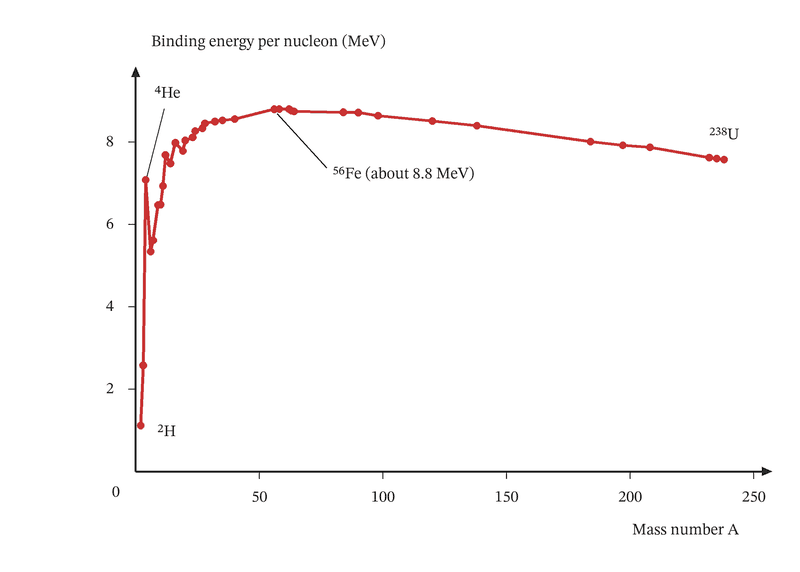
Step 1 — Read the curve. The curve below is plotted from measured atomic masses. Helium-4 (about 7.07 MeV per nucleon) stands well above its neighbours, lithium-6 (5.33 MeV) and lithium-7 (5.61 MeV).

Step 2 — Draw the conclusion. Its nucleons are bound much more tightly than those of the nearby light nuclei, so helium-4 is very stable. This is also why heavy nuclei often give out whole helium nuclei (α-particles).
Step 3 — Check the other options. Each of the other options contradicts the peak:
- (A) A high binding energy per nucleon makes the nucleus hard, not easy, to break up.
- (C) Fission is used with heavy nuclei such as uranium-235; splitting helium would absorb energy.
- (D) Helium-4 is a stable nucleus and does not decay.
Therefore, the answer is (B).
- 221 mark
Question 22
The binding energy per nucleon of deuterium and helium atom is 1.1 MeV and 7.0 MeV. If two deuterium nuclei fuse to form helium atom, the energy released is
Solve with AIAnswer
(A) 19.2 MeV
- Correct
(B) 23.6 MeV
(C) 26.9 MeV
(D) 13.9 MeV
Answer: (B) 23.6 MeV
Concept: In a nuclear reaction the energy released equals the binding energy of the products minus the binding energy of the reacting nuclei. The total binding energy of a nucleus is (binding energy per nucleon) × (number of nucleons).
Step 1 — Binding energy of the two deuterons. Each deuteron has 2 nucleons:
Step 2 — Binding energy of the helium nucleus. Helium-4 has 4 nucleons:
Step 3 — Find the energy released. The reaction is + energy, so:
Step 4 — Check the other options. Each of the other values comes from a slip:
- (A) This takes each deuteron's binding energy as MeV, as if it had four nucleons: .
- (C) This subtracts only 1.1 MeV, one deuteron's binding energy per nucleon: .
- (D) This is too small: the binding energy rises from 4.4 MeV to 28 MeV, an increase of 23.6 MeV, not 13.9 MeV.
Therefore, the answer is (B).
- 231 mark
Question 23
If a proton and antiproton come close to each other and annihilate, how much energy will be released?
Solve with AIAnswer
(A) J
- Correct
(B) J
(C) J
(D) None of the above
Answer: (B) J
Concept: In annihilation the whole rest-mass energy of the particle and its antiparticle, , is released. For a proton and an antiproton it appears mostly as short-lived particles called pions, not directly as gamma rays, but the total energy is the same. An antiproton has the same mass as a proton, about 1 u (938 MeV).
Step 1 — Find the total mass. The two particles together have a mass of about 2 u.
Step 2 — Change it into energy. We multiply by 931.5 MeV per u and by J per MeV:
Using the more precise proton rest energy, 938.3 MeV each, gives J, which also rounds to J.
Step 3 — Check the other options. Each of the other options fails for a definite reason:
- (A) This is the rest energy of only one of the two particles.
- (C) This is three times the rest energy of one particle; only two particles are destroyed.
- (D) The energy released has a definite value, about J, and this value is listed as (B), so 'none of the above' does not apply.
Therefore, the answer is (B).
- 241 mark
Question 24
An alpha particle has a mass of 4.00300 u. A proton has a mass of 1.00783 u and a neutron has a mass of 1.00867 u respectively. The binding energy of alpha particle estimated from these data is closest to
Solve with AIAnswer
- Correct
(A) 27.9 MeV
(B) 22.3 MeV
(C) 35.0 MeV
(D) 20.4 MeV
Answer: (A) 27.9 MeV
Concept: The mass defect of a nucleus is the mass of its separate nucleons minus the mass of the nucleus:
The binding energy is the energy equivalent of this mass, . With in u, we multiply it by 931 MeV (more precisely 931.5 MeV) per u.
Step 1 — Total mass of the nucleons. An α-particle has 2 protons and 2 neutrons:
Step 2 — Mass defect. We subtract the mass of the α-particle:
Step 3 — Binding energy. We multiply by 931.5 MeV per u:
Step 4 — Check the other options. Each of the other values needs a different mass defect from the 0.0300 u the data give:
- (B) 22.3 MeV would need a mass defect of about 0.0240 u.
- (C) 35.0 MeV would need a mass defect of about 0.0376 u.
- (D) 20.4 MeV would need a mass defect of about 0.0219 u.
Note: the value 1.00783 u quoted for the proton is really the mass of a hydrogen atom (a bare proton is 1.00728 u), so the data act as atomic masses and the electron masses cancel. The accepted mass of a helium-4 atom is 4.00260 u, which gives a binding energy of about 28.3 MeV; the printed 4.00300 u gives 27.9 MeV, so (A) is the option closest to the data given.
Therefore, the binding energy of the α-particle is about 27.9 MeV, option (A).
- 251 mark
Question 25
On bombardment of neutron with Boron, α-particle is emitted and product nuclei formed is
Solve with AIAnswer
(A)
(B)
- Correct
(C)
(D)
Answer: (C)
Concept: In every nuclear reaction the total mass number (top numbers) and the total charge number (bottom numbers) are the same on both sides.
Step 1 — Write the reaction. Boron-10, the boron isotope that readily captures neutrons, takes in a neutron and gives out an α-particle:
Step 2 — Balance the mass numbers. The mass numbers give:
Step 3 — Balance the charge numbers. The charge numbers give:
An element with is lithium, so the product is lithium-7.
Step 4 — Check the other options. Each of the other products breaks a balance:
- (A) This has , so the right side would carry charge , not 5.
- (B) This has , so the mass numbers would add to 10, not 11.
- (D) This has , so the charges would add to 6, not 5.
Therefore, the answer is (C).
- 261 mark
Question 26
The subatomic particles proton and neutron fall under the group of
Solve with AIAnswer
(A) mesons
(B) photons
(C) leptons
- Correct
(D) baryons
Answer: (D) baryons
Concept: Baryons are heavy particles made of three quarks. Protons (uud) and neutrons (udd) are the lightest baryons.
Step 1 — Classify the nucleons. Both the proton and the neutron are built from three quarks, so both are baryons.
Step 2 — Check the other options. Each of the other groups contains different particles:
- (A) Mesons, such as pions, are made of a quark and an antiquark.
- (B) Photons are the quanta of electromagnetic radiation and have no rest mass.
- (C) Leptons, such as electrons, muons and neutrinos, are not made of quarks and do not feel the nuclear force.
Therefore, the answer is (D).
- 271 mark
Question 27
How does the binding energy per nucleon vary with the increase in the number of nucleons?
Solve with AIAnswer
(A) Decreases continuously with mass number.
(B) First decreases and then increases with increase in mass number.
- Correct
(C) First increases and then decreases with increases in mass number.
(D) Increases continuously with mass number.
Answer: (C) First increases and then decreases with increases in mass number.
Concept: The binding energy per nucleon curve shows how tightly the nucleons are held, on average, for each mass number.
Step 1 — Read the curve. The curve, plotted from measured masses, rises steeply for light nuclei (1.1 MeV for ²H, 7.07 MeV for ⁴He), reaches a broad maximum of about 8.8 MeV near to 62 (iron and nickel), and then falls slowly to about 7.6 MeV for uranium-238.
Step 2 — Check the other options. Each of the other options misses part of this shape:
- (A) The value does not fall at first; it rises from 1.1 MeV for deuterium to a broad peak of about 8.8 MeV near iron.
- (B) This is the reverse of the shape: rise first, fall later.
- (D) The value falls after ; uranium has less binding energy per nucleon than iron.
Therefore, the answer is (C).
- 281 mark
Question 28
Which of the following particles has similar mass to electron?
Solve with AIAnswer
(A) Proton
(B) Neutron
- Correct
(C) Positron
(D) Neutrino
Answer: (C) Positron
Concept: The positron is the antiparticle of the electron: it has exactly the same mass ( kg, 0.511 MeV) and an equal but positive charge.
Step 1 — Match the mass. Only the positron has the same mass as the electron.
Step 2 — Check the other options. Each of the other particles has a very different mass:
- (A) The proton is about 1836 times as heavy as the electron.
- (B) The neutron is about 1839 times as heavy as the electron.
- (D) A neutrino's mass is tiny: direct measurements (2025) put it below about 0.45 eV, less than one millionth of the electron's mass.
Therefore, the answer is (C).
- 291 mark
Question 29
What is a nucleon?
Solve with AIWritten solution
Solution:
Concept: A nucleus is made of protons and neutrons only.
Step 1 — Name the particles in a nucleus. Every nucleus is built from protons, which carry a charge , and neutrons, which carry no charge; the ordinary hydrogen nucleus is a single proton.
Step 2 — Explain the common name. Protons and neutrons have nearly equal masses (about 1 u each) and are held almost equally strongly by the nuclear force, so they are treated as one family of particles and given the common name nucleon. The number of nucleons in a nucleus is its mass number .
Therefore, a nucleon is the common name for a proton or a neutron in the nucleus.
- 301 mark
Question 30
What is the order of nuclear radius?
Solve with AIWritten solution
Solution:
Concept: Nuclear radii are given by with fm, where (1 fermi) m.
Step 1 — Find the range of the cube root of the mass number. Mass numbers run from 1 for hydrogen to about 240 for the heaviest natural nuclei, so runs from 1 up to:
Step 2 — Multiply by to get the radii. The smallest nucleus has fm, and the largest has:
So every nuclear radius lies between about m and m.
Therefore, the nuclear radius is of the order of m (1 fermi), a few femtometres for most nuclei.
- 311 mark
Question 31
What will be the ratio of the radii of two nuclei of mass numbers and ?
Solve with AIWritten solution
Solution:
Concept: The radius of a nucleus of mass number is , where m (1.2 fm). So the volume of a nucleus, , is proportional to .
Step 1 — Write the ratio of the two radii. Each radius follows the same rule, so we divide one by the other:
Step 2 — Cancel and combine the cube roots. is the same for both nuclei, so it cancels, and a ratio of two cube roots is the cube root of the ratio:
For example, nuclei with mass numbers 27 and 216 have cube roots 3 and 6, so their radii are in the ratio 1 : 2.
Therefore, .
- 321 mark
Question 32
What is the ratio of nuclear densities of two nuclei having mass numbers in the ratio of 1:2?
Solve with AIWritten solution
Solution:
Concept: Since , the volume of a nucleus is proportional to , and so is its mass. Their ratio, the density, does not depend on .
Step 1 — Write the density of a nucleus. We divide the mass by the volume , where is the mass of one nucleon:
Step 2 — Compare the two nuclei. The mass number has cancelled, so both nuclei have the same density even though their mass numbers are in the ratio 1 : 2:
Therefore, the ratio of the nuclear densities is 1 : 1.
- 331 mark
Question 33
What is atomic mass unit?
Solve with AIWritten solution
Solution:
Concept: Atomic and nuclear masses are very small, so they are measured in a special unit based on the carbon-12 atom.
Step 1 — State the definition. One atomic mass unit (1 u) is defined as one-twelfth of the mass of one neutral atom of carbon-12 at rest in its ground state.
Step 2 — Give its value in kilograms. One mole of carbon-12 atoms has a mass of 12 g, so one atom has a mass of kg, and one-twelfth of this is:
Therefore, 1 atomic mass unit is one-twelfth of the mass of a atom, about kg.
- 341 mark
Question 34
How many kg are there in one amu?
Solve with AIWritten solution
Solution:
Concept: One atomic mass unit (1 u) is one-twelfth of the mass of a carbon-12 atom; one mole of carbon-12 (Avogadro's number of atoms) has a mass of 12 g.
Step 1 — Find the mass of one carbon-12 atom. We divide 12 g by Avogadro's number:
Step 2 — Take one-twelfth. One-twelfth of this is:
Therefore, 1 amu kg (more exactly kg).
- 351 mark
Question 35
You are given two nuclides and . Are they the isotopes of the same element?
Solve with AIWritten solution
Solution:
Concept: The atomic number (the lower number) decides the element. Isotopes of one element have the same and different mass numbers.
Step 1 — Compare the atomic numbers as printed. has and has . The atomic numbers differ, so these would be different elements. (A nucleus with and cannot exist anyway, since can never be less than .)
Step 2 — Look at the intended pair. The next question uses and . These have the same atomic number, (lithium), and different mass numbers, so they are isotopes of the same element.
Note: the book's answer (“they are isotopes of the same element”) fits ; the printed lower number 8 on X is most likely a misprint for 3.
Therefore, as printed the two nuclides are not isotopes (their atomic numbers 8 and 3 differ); with , as the book intends, they are isotopes of the same element because the atomic number is the same.
- 361 mark
Question 36
You are given two nuclides and . Which one of the two is likely to be more stable? Give reason.
Solve with AIWritten solution
Solution:
Concept: A light nucleus is stable when its numbers of neutrons and protons are about equal, so that the attractive nuclear force can outweigh the repulsion between the protons.
Step 1 — Count the neutrons. We subtract the atomic number from the mass number:
- has 3 protons and neutrons.
- has 3 protons and only neutron.
Step 2 — Compare. X has more neutrons, so it has more nuclear attraction without extra electrostatic repulsion. is lithium-7, a stable nucleus, while a nucleus with 3 protons and 1 neutron is not bound and breaks up at once.
Therefore, is more stable, because its larger number of neutrons makes the attractive nuclear force stronger than the electrostatic repulsion.
- 371 mark
Question 37
Who discovered neutron?
Solve with AIWritten solution
Solution:
Concept: The neutron is the uncharged nucleon; being neutral, it was hard to detect and was found only in 1932.
Step 1 — Recall the earlier observations. In 1930 Bothe and Becker found that beryllium bombarded with α-particles gives out a very penetrating, uncharged radiation, and in early 1932 Irène Joliot-Curie and Frédéric Joliot showed that this radiation knocks fast protons out of paraffin wax. They took it to be gamma radiation.
Step 2 — Name the discoverer. In 1932 James Chadwick measured the recoil of hydrogen and nitrogen nuclei struck by this radiation and showed that it is made of neutral particles with about the mass of a proton, the neutrons. He received the 1935 Nobel Prize in Physics for this discovery.
Therefore, the neutron was discovered by James Chadwick (1932).
- 381 mark
Question 38
What is the half-life of free neutron?
Solve with AIWritten solution
Solution:
Concept: A free neutron (outside a nucleus) is unstable and decays into a proton, an electron and an antineutrino. Its half-life is related to its mean life by .
Step 1 — Give the measured mean life. Present measurements give a mean life of about 879 s, which is about 14.7 minutes.
Step 2 — Change the mean life into the half-life. We multiply the mean life by :
Step 3 — Change to minutes. We divide by 60 s per minute:
Note: the book's 13 minutes is an old value; the half-life measured today is about 10.2 minutes (the mean life is about 14.7 minutes).
Therefore, the half-life of a free neutron is about 10 minutes (10.2 min).
- 391 mark
Question 39
Name two particles having infinite lifetime.
Solve with AIWritten solution
Solution:
Concept: A particle has an infinite lifetime if it is stable: it does not decay by itself.
Step 1 — Name the first stable particle. The electron is the lightest charged particle, so conservation of charge leaves it nothing lighter to decay into. No electron decay has ever been seen, and experiments put its lifetime above about years.
Step 2 — Name the second stable particle. No proton decay has ever been observed either. Experiments show that the proton's lifetime is more than about years, far longer than the age of the Universe (about years).
Therefore, the electron and the proton have (as far as is known) infinite lifetimes.
- 401 mark
Question 40
What are the numbers of protons and the number of neutrons in a nucleus of ?
Solve with AIWritten solution
Solution:
Concept: In the lower number is the number of protons, and the number of neutrons is .
Step 1 — Read the atomic number. The lower number is the atomic number, , so the nucleus has 92 protons.
Step 2 — Find the neutrons. We subtract from :
Therefore, uranium-238 has 92 protons and 146 neutrons.
- 411 mark
Question 41
What are thermal neutrons?
Solve with AIWritten solution
Solution:
Concept: Fast neutrons lose energy by colliding with the nuclei of a medium until their average kinetic energy matches the thermal energy of the medium, about .
Step 1 — State the definition. Thermal neutrons are slow neutrons that are in thermal equilibrium with the medium through which they pass.
Step 2 — Give their energy. At room temperature (about 20 °C) their typical energy is about 0.025 eV, and their speed is about 2200 m s⁻¹. Such slow neutrons are captured readily by uranium-235 and cause fission.
Note: the book says thermal neutrons have energy around 1 eV; their typical energy is about 0.025 eV, some 40 times smaller (neutrons of about 1 eV are faster than thermal neutrons).
Therefore, thermal neutrons are slow neutrons in thermal equilibrium with their surroundings, with energies of about 0.025 eV.
- 421 mark
Question 42
What is mass defect of nucleus?
Solve with AIWritten solution
Solution:
Concept: When nucleons bind into a nucleus, energy is released, so the nucleus weighs less than its separate nucleons.
Step 1 — State the definition in words. The mass defect of a nucleus is the difference between the sum of the masses of its separate nucleons (protons and neutrons) and the actual mass of the nucleus.
Step 2 — Write the definition as a formula. We write it for a nucleus of mass with protons, each of mass , and neutrons, each of mass :
The mass defect is always positive for a stable nucleus, and its energy equivalent is the binding energy.
Therefore, the mass defect is the difference between the sum of the masses of the nucleons in a nucleus and the rest mass of the nucleus.
- 431 mark
Question 43
Which is bigger, MeV or kWh?
Solve with AIWritten solution
Solution:
Concept: Both are units of energy, so we compare them in joules.
Step 1 — Write both in joules. One MeV is J, while one kWh (1000 W for 3600 s) is J.
Step 2 — Compare. The ratio is:
Therefore, the kWh is bigger; 1 kWh is about MeV.
- 441 mark
Question 44
Give an equation representing the decay of a free neutron.
- 451 mark
Question 45
What holds nucleons together in a nucleus?
- 461 mark
Question 46
Define binding energy of a nucleus.
- 471 mark
Question 47
How many electrons, protons and neutrons are there in a nucleus of atomic number 11 and mass number 24?
- 481 mark
Question 48
Write the number of protons and neutrons in .
- 491 mark
Question 49
What is meant by the term isotope?
- 501 mark
Question 50
Express one atomic mass unit in kilogram.
- 511 mark
Question 51
How many electron volts make up one joule?
- 521 mark
Question 52
How many joule are there in 1 MeV?
- 531 mark
Question 53
Write the relation connecting the radius of nucleus and its mass number 4.
- 541 mark
Question 54
What is the order of magnitude of nuclear mass density?
- 551 mark
Question 55
A nucleus, of mass number has a mass defect . Give the formula for the binding energy per nucleon of this nucleus.
- 561 mark
Question 56
How are protons, which are positively charged, held together inside a nucleus? Draw a graph between potential energy of a pair of nucleons as a function of their separation.
- 572 marks
Question 57
Define mass number and atomic number.
- 582 marks
Question 58
Define amu. How is it related to MeV?
- 592 marks
Question 59
Write down the expression for the nuclear radius.
- 602 marks
Question 60
Obtain an expression for the density of nucleus.
- 612 marks
Question 61
Define mass defect and packing fraction.
- 622 marks
Question 62
Define binding energy. What is its significance?
- 632 marks
Question 63
“Heavy nuclei split into lighter nuclei by a process called fission.” Why?
- 642 marks
Question 64
“Lighter nuclei fuse together under suitable conditions.” Why?
- 652 marks
Question 65
Give an example for conversion of mass into energy.
- 662 marks
Question 66
Give an example for conversion of energy into mass.
- 672 marks
Question 67
Draw a graph to show the variation of binding energy per nucleon with mass number.
- 682 marks
Question 68
Which type of nuclei are most stable?
- 693 marks
Question 69
Define mass defect of a nucleus. How is it related to the binding energy of the nucleus?
- 703 marks
Question 70
Find the minimum energy which a gamma ray photon should possess so that it is capable of producing an electron–positron pair.
- 713 marks
Question 71
Define amu and electron volt. Obtain the relation connecting them.
- 723 marks
Question 72
Define (a) isotopes, (b) isobars and (c) isotones. Give examples.
- 733 marks
Question 73
Write one balanced equation each to show
(a) nuclear fission
(b) nuclear fusion
(c) emission of (i.e., a negative beta particle)
- 745 marks
Question 74
(a) Explain the term nuclear binding energy.
(b) Sketch a graph showing variation of binding energy per nucleon with nucleon number (mass number) and show how both nuclear fission and nuclear fusion can be explained from the shape of this curve.
- 755 marks
Question 75
(a) Write down Einstein's mass–energy relation.
(b) What is mutual annihilation? Give an example.
(c) What is pair production? Give an example.
- 763 marks
Question 76
What is the radius of the nucleus of an iron atom? Given m and mass number of iron is 56.
- 773 marks
Question 77
Calculate the nuclear density of iron nucleus. Given that the mass of iron nucleus is 55.85 u. Mass number of iron is 56 and m.
- 783 marks
Question 78
Calculate the binding energy per nucleon for (given mass of amu, , amu).
- 793 marks
Question 79
Given the following isotope masses amu, amu, amu. Calculate the binding energy of neutron in the nucleus. Express the result in MeV and J.
- 803 marks
Question 80
Calculate (i) the mass defect, (ii) binding energy and (iii) binding energy per nucleon for nucleus. Atomic mass of amu, mass of proton amu and mass of neutron amu.
- 813 marks
Question 81
Find the difference in binding energies of a neutron and a proton in a nucleus.
(Given: amu, amu, mass of amu, mass of amu, mass of amu).
- 823 marks
Question 82
Find the packing fraction of α-particle from the following data. Mass of α-particle amu, u, u.
- 833 marks
Question 83
Calculate the binding energy per nucleon for the Beryllium isotope () of mass 9.012 amu. Given: mass of proton amu; mass of neutron amu; 1 amu MeV.
- 843 marks
Question 84
The binding energy per nucleon of deuteron () and α-particle () are 1.112 and 7.07 MeV respectively. (i) Which nucleus is more stable? (ii) If an α-particle is formed from two deuterons, find the energy liberated during the process.
- 853 marks
Question 85
Calculate the binding energy per nucleon of . Given amu; amu and amu.
- 863 marks
Question 86
Calculate binding energy per nucleon of lithium, given that the mass of nucleus is 0.042 amu less than the sum of mass of its nucleons.
- 873 marks
Question 87
and represent the masses of nucleus and nucleus respectively. State whether or or .
- 883 marks
Question 88
Calculate the energy equivalent of (in MeV) of one twelfth of the mass of one atom of carbon-12.
- 893 marks
Question 89
The value of one unified atomic mass unit is kg. Calculate the mass of one atom of in kg.
What Class 12 Physics Ch 27 covers
The sections of the chapter, in the order the book takes them. Every question above comes from one of these.
- 01Composition and Size of the Nucleus
- 02Isotopes, Isobars and Isotones
- 03Atomic Mass Unit
- 04Nuclear Forces
- 05Mass-Energy Relation
- 06Mass Defect and Binding Energy
More ways to study this chapter
The same chapter asked three other ways. Practise it, revise it, and see what the board has set on Ch 27 before.
- Competency-Based Questions (CBQ)Case study questions: a situation, and the part of the chapter that answers it.40questionsOpen
- Previous Year QuestionsQuestions that have actually appeared in board papers, each tagged with its year.9questionsOpen
- Practice QuestionsExtra questions per chapter, for when one attempt at a method is not enough.98questionsOpen
Ch 27 in past ISC papers
The same chapter as the board has actually asked it. These are worded differently from the textbook exercise, which is the point of reading them.
- 11 mark
Board paper question 1
What is the significance of binding energy per nucleon of a nucleus of a radioactive element?
Solve with AIWritten solution
Solution:
Key idea: The binding energy per nucleon is the total binding energy of a nucleus divided by its number of nucleons, that is, the average energy per nucleon needed to break the nucleus up into separate protons and neutrons. The larger it is, the more tightly the nucleons are held and the more stable the nucleus.
Step 1 — Compare a radioactive heavy nucleus with the most stable nuclei.
The binding energy per nucleon is greatest, about , for nuclei near iron-56. Heavy radioactive nuclei such as uranium-238 have a smaller value, about .
Step 2 — State the significance.
The smaller binding energy per nucleon shows that the nucleons in a heavy nucleus such as uranium-238 are held less tightly than in nuclei of middle mass, so the nucleus is less stable. It can move towards a more tightly bound arrangement by giving out an alpha particle. For example, uranium-238 (about 7.570 MeV per nucleon) decays to thorium-234 (about 7.597 MeV per nucleon), and the energy released appears mainly as the kinetic energy of the alpha particle.
Step 3 — Note the limits of this idea.
The binding energy per nucleon is not the only factor that decides radioactivity. Beta decay happens when a nucleus has too many neutrons or too many protons for its size, and it can even lead to a slightly smaller binding energy per nucleon. For example, carbon-14 (about 7.52 MeV per nucleon) decays to nitrogen-14 (about 7.48 MeV per nucleon); the energy comes from a neutron changing into a proton, because a neutron is heavier than a hydrogen atom (a proton plus an electron).
Therefore, the low binding energy per nucleon of a heavy radioactive nucleus shows that its nucleons are loosely bound and the nucleus is less stable, so it can release energy by decaying (for example by alpha emission) towards more tightly bound nuclei.
- 22 marks
Board paper question 2
With the help of a suitable example and an equation, explain the term pair production.
Solve with AIWritten solution
Solution:
Key idea: By Einstein's relation , energy can turn into mass. A gamma photon with enough energy can create a particle and its antiparticle.
Step 1 — Explain the term.
Pair production is the conversion of a high-energy gamma-ray photon into an electron and a positron (the antiparticle of the electron, with the same mass and a positive charge). It is an example of energy turning into mass, .
It happens only when the photon passes close to a nucleus (most often a heavy one, such as lead), which takes up some momentum so that both energy and momentum are conserved. Charge is conserved too, since , the charge of the photon.
Step 2 — Find the minimum photon energy.
The photon must supply at least the rest-mass energy of the two particles. The rest-mass energy of an electron (or a positron) is .
Step 3 — Give an example.
A gamma photon of energy passing close to a lead nucleus can produce an electron–positron pair. Of its energy, becomes the masses of the two particles, and the remaining energy is shared between them as kinetic energy.
Therefore, pair production is the conversion of a gamma photon of at least 1.02 MeV, near a nucleus, into an electron and a positron: γ → e⁻ + e⁺.
- 32 marks
Board paper question 3
Sketch a graph showing the variation of binding energy per nucleon of a nucleus with its mass number.
Solve with AIWritten solution
Solution:
Key idea: The binding energy per nucleon is the binding energy of a nucleus divided by its mass number . Its variation with shows which nuclei are most stable.
Step 1 — Draw the graph.
The graph is plotted from measured nuclear masses, with the mass number along the -axis and the binding energy per nucleon (in MeV) along the -axis.
Step 2 — Describe its main features.
For light nuclei the curve rises steeply, from about for , with a sharp local peak at (about ). It reaches a broad maximum of about for mass numbers between about 50 and 80, near iron-56; these are the most stable nuclei. For heavier nuclei it falls slowly, to about for . For most nuclei (from of about 30 to 170) the value stays between about and , which shows that nuclear forces are short-range and saturate.
Step 3 — Read the consequences from the graph.
Very light nuclei can increase their binding energy per nucleon by fusing together, and very heavy nuclei by splitting (fission); in both cases energy is released.
Therefore, the binding energy per nucleon rises steeply for light nuclei, has a broad maximum of about 8.8 MeV near A = 56 and falls slowly to about 7.6 MeV for the heaviest nuclei.
- 41 mark
Board paper question 4
What is the minimum energy which a gamma ray photon must possess in order to produce electron-positron pair ?
Solve with AIWritten solution
Solution:
Key idea: In pair production a gamma photon becomes an electron and a positron. Its energy must at least equal their total rest-mass energy, .
Step 1 — Write the condition.
The positron has the same mass as the electron, .
Step 2 — Substitute the values.
We use .
Step 3 — Convert to MeV.
We divide by .
Therefore, the gamma photon must have at least 1.02 MeV (about 1.64 × 10⁻¹³ J) of energy.
- 53 marks
Board paper question 5
Calculate mass defect and binding energy per nucleon of , given
Mass of
Mass of
Mass of
Solve with AIWritten solution
Solution:
Key idea: The mass defect is the total mass of the separate nucleons minus the mass of the nucleus. The binding energy is the mass defect times ; with , it is the mass defect in u times .
Step 1 — Count the nucleons.
Neon-20 has protons, and its number of neutrons is .
We use the mass of the hydrogen atom (rather than a bare proton) because the neon mass given is an atomic mass; the masses of the 10 electrons then cancel.
Step 2 — Find the total mass of the separate particles.
We add the masses of 10 hydrogen atoms and 10 neutrons.
Step 3 — Find the mass defect.
We subtract the mass of the neon atom from the total mass of its separate particles.
Step 4 — Find the binding energy.
Each atomic mass unit is equivalent to .
Step 5 — Find the binding energy per nucleon.
We share the binding energy among the 20 nucleons.
Therefore, the mass defect of neon-20 is 0.172503 u and its binding energy per nucleon is about 8.03 MeV.
- 62 marks
Board paper question 6
What is meant by pair annihilation? Write a balanced equation for the same.
Solve with AIWritten solution
Solution:
Key idea: When a particle meets its antiparticle, the two can disappear completely, and their rest-mass energy, , becomes the energy of radiation.
Step 1 — Explain the term.
Pair annihilation is the process in which an electron and a positron (its antiparticle) meet and destroy each other. Their whole rest-mass energy (plus any kinetic energy) becomes radiation energy, which appears as gamma-ray photons.
Step 2 — Write the balanced equation.
An electron and a positron go in, and (for a pair nearly at rest) two gamma photons come out.
The equation is balanced: the total charge is on both sides, and the photons carry the energy.
Step 3 — Explain why two photons appear.
If the pair is nearly at rest, its total momentum is almost zero. A single photon always carries momentum, so at least two photons are needed, moving in opposite directions. Two is the usual case (a small fraction of annihilations, from the spin-1 state called ortho-positronium, give three photons). Each of the two photons then has an energy of about , the rest-mass energy of one electron.
Therefore, pair annihilation is the conversion of an electron and a positron into gamma-ray energy: e⁻ + e⁺ → γ + γ.
All 9 board paper questions for this chapter, solved the same way.
Class 12 Physics Ch 27 questions students ask
How many questions are there in Class 12 Physics Ch 27?
89 questions. Every one is solved step by step on this page.
Are these Class 12 Physics solutions free?
Yes. Every question and its full working is free to read, with no account needed.
Can I download the Class 12 Physics Ch 27 solutions as a PDF?
There is no PDF to download. Every solution is on this page instead, which means it is searchable, always the current syllabus, and readable on a phone. Use your browser's print option if you want it on paper.