Solution:
Concept: A nucleus has less mass than its separate nucleons. The missing mass, the mass defect Δm, is equivalent to the binding energy EB=Δmc2: the energy given out when the nucleus forms from free nucleons, and the energy needed to pull it apart again. Energy is released whenever nuclei change into nuclei with a higher binding energy per nucleon.
Step 1 — (a) Explain nuclear binding energy. The binding energy of a nucleus is the energy required to break it up completely into its separate protons and neutrons, placed so far apart that they no longer interact. The same energy is released when the nucleus is formed from free nucleons. For a nucleus ZAX of mass M:
Δm=Zmp+(A−Z)mn−M
EB=Δmc2
With Δm in u, EB=931.5Δm MeV, because 1 u is equivalent to 931.5 MeV. Dividing by A gives the binding energy per nucleon, a measure of the stability of the nucleus.
Step 2 — (b) Sketch the graph. The curve below is plotted from measured nuclear masses. It rises steeply for light nuclei (1.1 MeV for ²H, a peak of 7.07 MeV for ⁴He), reaches a broad maximum of about 8.8 MeV near A=56 to 62, and falls slowly to about 7.6 MeV for uranium-238.
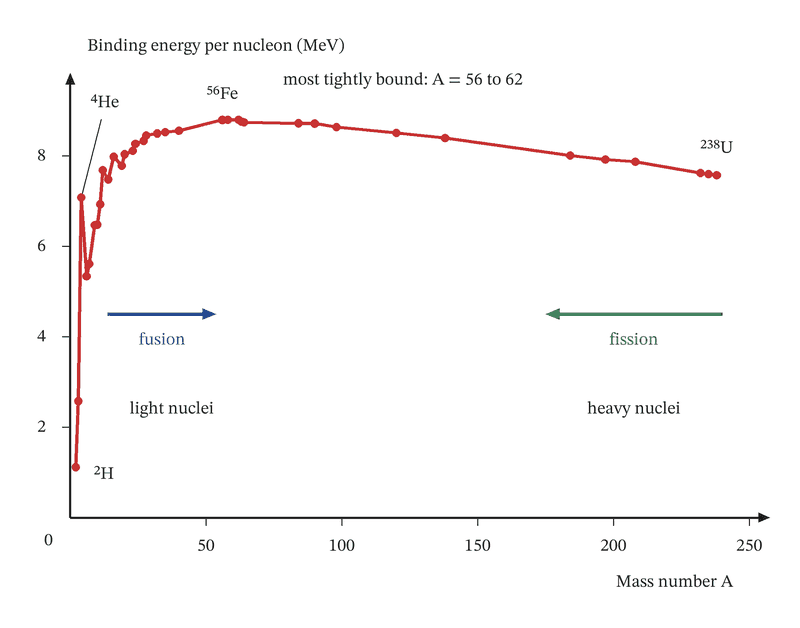
Step 3 — Explain fission from the curve. A heavy nucleus (uranium-235, about 7.6 MeV per nucleon) splits into two medium nuclei (about 8.5 MeV per nucleon). The nucleons move up the curve and become more tightly bound, so energy is released:
Q≈235×(8.5−7.6) MeV
Q≈210 MeV
This rough estimate agrees well with the measured energy of about 200 MeV per fission.
Step 4 — Explain fusion from the curve. Very light nuclei lie on the steep rising part of the curve. When two of them join to form a heavier nucleus, the binding energy per nucleon rises sharply (for example from 1.1 MeV for ²H to 7.07 MeV for ⁴He), so energy is released. Per nucleon this is more than in fission, because the curve rises so steeply for light nuclei.
Step 5 — State the common idea. Both processes move nuclei towards the peak of the curve near iron, where the nucleons are most tightly bound: heavy nuclei by splitting, light nuclei by joining.
Therefore, (a) nuclear binding energy is the energy needed to separate a nucleus into its nucleons, EB=Δmc2; (b) because the binding energy per nucleon is greatest for medium nuclei, heavy nuclei release energy by splitting (fission) and light nuclei release energy by joining (fusion).
