
Opening your dashboard
Class 12 Physics Chapter 27 Nuclei: Competency-Based Questions (CBQ)
40 questions on Chapter 27, each worked through on its own page with the AI tutor. Class 12 Physics, ICSE 2026-27.
40 questions
1–5 marks · Mixed difficulty
- 13 marks
Question 1
Competency: Application
A neutron star is the collapsed core left behind when a very massive star explodes as a supernova. A typical neutron star has a mass of times the Sun's mass packed into a sphere of radius about , and it is made almost entirely of neutrons. (Hypothetical data.) Take the Sun's mass as , the mass of a neutron as , the density of nuclear matter as , and in the nuclear radius formula .
(a) Find the mean density of the neutron star, and compare it with the density of nuclear matter.
(b) Treating the star as made only of neutrons, estimate how many neutrons it contains.
(c) If the star were one giant nucleus with this mass number, what radius would give? Compare it with the star's actual radius and explain the difference.
- 21 mark
Question 2
Competency: Analysis & Evaluation
Electron-scattering experiments measure the root-mean-square (rms) radius of the charge in a nucleus. For lead-208 the measured rms charge radius is . For a uniformly charged sphere of radius , the rms radius is . Treating the lead-208 nucleus as such a sphere with , the value of is about
- 31 mark
Question 3
Competency: Analysis & Evaluation
Cobalt-60, used in hospital radiotherapy units, decays by giving out fast electrons ( particles) and becomes nickel-60. A student notes that the cobalt-60 nucleus contains 27 protons and 33 neutrons, but no electrons.
Assertion (A): Fast electrons come out of the cobalt-60 nucleus even though the nucleus contains no electrons.
Reason (R): In the nucleus a neutron changes into a proton, and the electron is created at that moment and thrown out together with an antineutrino.
- 44 marks
Question 4
Competency: Application
India's pressurised heavy-water reactors run on natural uranium, in which only of the atoms are uranium-235 and the rest are uranium-238. Light-water reactors, such as those at Kudankulam, need uranium enriched to about uranium-235. (Hypothetical data.) To enrich it, the uranium is first turned into the gas uranium hexafluoride, . In gaseous diffusion the gas is pushed through a porous barrier; the lighter molecules get through slightly faster, and at each ideal stage the ratio of the numbers of and atoms is multiplied by the factor , where and are the masses of the two kinds of molecule. Fluorine has only one stable isotope, . Take the atomic masses , and .
(a) State the numbers of protons and neutrons in the nuclei and , and explain why the two isotopes cannot be separated by ordinary chemical reactions.
(b) Find the masses of a molecule and a molecule, and the separation factor of one ideal stage.
(c) How many ideal stages are needed to raise the uranium-235 content from to ?
- 51 mark
Question 5
Competency: Application
The third stage of India's nuclear power programme plans to use thorium, of which India has large reserves. In a reactor, thorium-232 is turned into the fuel uranium-233 in three steps:
The protactinium-233 nucleus formed in the second step is an isotone of
- 61 mark
Question 6
Competency: Analysis & Evaluation
In hospitals, technetium-99m is the most widely used tracer for nuclear-medicine scans; it is obtained from the decay of molybdenum-99 in a small “generator”. A nucleus is in an excited state. It gives out a γ-ray photon of energy and becomes a nucleus in its ground state, with no change in its numbers of protons and neutrons.
Assertion (A): and are isotopes of technetium.
Reason (R): Both nuclei contain 43 protons.
- 71 mark
Question 7
Competency: Analysis & Evaluation
India's pressurised heavy-water reactors use heavy water, , in which both hydrogen atoms are deuterium (). At heavy water has a density of about , while ordinary water has . Take , and .
Assertion (A): Heavy water is about denser than ordinary water.
Reason (R): A molecule has about more mass than an molecule, while the two kinds of molecule are almost the same size and are packed in almost the same way.
- 83 marks
Question 8
Competency: Application
At low resolution, a mass spectrometer in a forensic laboratory shows a single peak at about . The peak could come from singly charged ions of carbon monoxide (), nitrogen () or ethene (), all with a total mass number of 28. (Hypothetical data.) Take the atomic masses , , and , with and . Each ion has lost one electron, which does not change the differences between their masses.
(a) Find the mass of each molecule in u.
(b) Find the difference between the masses of the and molecules in u, in kg and in .
(c) The resolving power needed to separate two peaks is , where is their mass and their difference. Find the resolving power needed to separate the and peaks, and say which pair of the three molecules is the easiest to separate.
- 91 mark
Question 9
Competency: Analysis & Evaluation
The unified atomic mass unit is one-twelfth of the mass of a neutral atom. Mass tables give the mass of a neutral atom as . The binding energy per nucleon is for and for ; both nuclei have equal numbers of protons and neutrons. Take .
Assertion (A): The mass of an atom is slightly less than .
Reason (R): Each nucleon in an nucleus is more tightly bound than each nucleon in a nucleus.
- 101 mark
Question 10
Competency: Analysis & Evaluation
To find the energy released in the fusion reaction , a student takes atomic masses from a table, which include the masses of the electrons in each atom, instead of the masses of the bare nuclei. The electron mass is and . Compared with the value found from the nuclear masses, the student's answer is
- 113 marks
Question 11
Competency: Analysis & Evaluation
ITER, the international fusion experiment being built in France with India as one of its members, will heat a plasma of deuterium and tritium nuclei to about million (). For two of these nuclei, each of charge , to fuse, their centres must come within about of each other, where the attractive nuclear force can act. (Hypothetical data.) Take and Boltzmann's constant . The average kinetic energy of a nucleus in a hot gas is .
(a) Find the electrostatic potential energy of two such nuclei when their centres are apart.
(b) Find the average kinetic energy of a nucleus in the ITER plasma, and how many times smaller it is than your answer to (a).
(c) Explain why the strong nuclear attraction cannot help the nuclei to come together until they are this close, and what this means for the conditions needed in a fusion reactor.
- 121 mark
Question 12
Competency: Analysis & Evaluation
India's pressurised heavy-water reactors use heavy water, , to slow down neutrons. Its deuterium nucleus, the deuteron, is made of one proton and one neutron.
Assertion (A): The deuteron is a bound nucleus even though there is no electrostatic attraction between its two particles.
Reason (R): The neutron carries a small negative charge, which the proton attracts.
- 131 mark
Question 13
Competency: Analysis & Evaluation
In an experiment, α-particles of different energies are fired at a thin aluminium foil, and the number scattered through large angles is counted. Up to an energy of about the counts agree with Rutherford's formula, which assumes that only the electrostatic (Coulomb) force acts between an α-particle and a nucleus. At higher energies the counts fall clearly below the prediction. (Hypothetical data.) Take for aluminium, with for each nucleus, and . The best explanation is that at these higher energies
- 144 marks
Question 14
Competency: Application
In a PET (positron emission tomography) scan, a patient is given glucose labelled with fluorine-18. Most nuclei decay by giving out a positron: . The positron soon meets an electron, and the two annihilate into two γ-ray photons, which are picked up by a ring of detectors across. For one annihilation, the photons reach detectors and , at opposite ends of a line through the centre O of the ring, as shown. (Hypothetical data.)
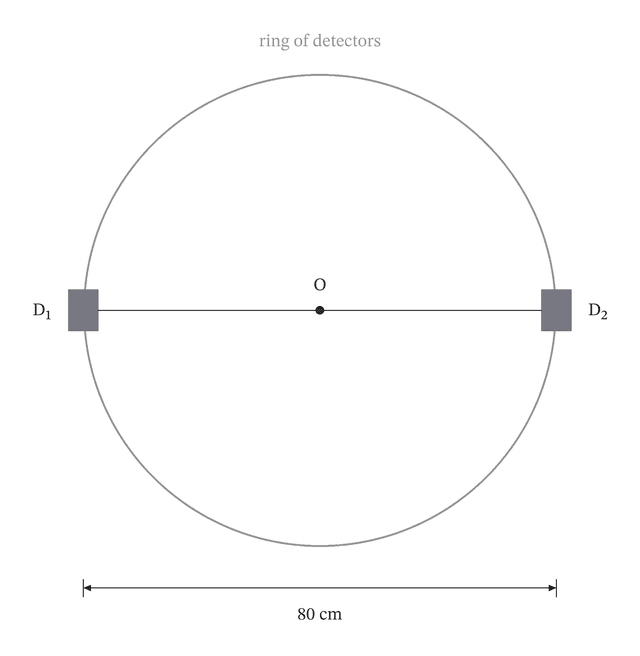
Take , , , , the atomic masses and , and .
(a) The positron and the electron are nearly at rest when they annihilate. Explain why two photons are produced and why they travel in opposite directions. Find the energy and the momentum of each photon.
(b) The photon travelling towards arrives there before the other photon arrives at . Find where on the line the annihilation took place.
(c) For positron emission, the energy released, found from atomic masses, is . Find the greatest kinetic energy a positron from can have.
- 151 mark
Question 15
Competency: Application
Sunlight arrives at the top of the Earth's atmosphere with an intensity of (the solar constant). The Earth intercepts this sunlight over a disc of radius , its cross-section. Taking , the mass equivalent of the solar energy that the Earth receives each second is about
- 163 marks
Question 16
Competency: Analysis & Evaluation
A (electrical) pressurised heavy-water reactor, like units 3 and 4 at Kakrapar in Gujarat, produces heat in its core at about . A coal-fired power station producing heat at the same rate burns coal that gives about of heat per kilogram. (Hypothetical data.) Take and .
(a) How much heat does each station produce in one day? What mass of coal does the coal-fired station burn in a day?
(b) By how much is the total mass of the products of burning (ash, carbon dioxide and water vapour) less than the total mass of the coal and oxygen used in one day?
(c) The total mass of the fuel and fission products in the reactor also decreases each day. Compare this decrease with your answer to (b), and explain why the reactor needs only a few kilograms of nuclei to be split each day, while the coal station burns thousands of tonnes of coal.
- 171 mark
Question 17
Competency: Analysis & Evaluation
In ITER, deuterium and tritium nuclei fuse: . The hot plasma is held away from the walls by strong magnetic fields.
Assertion (A): The helium nucleus and the neutron that come out of each reaction together have more kinetic energy than the deuterium and tritium nuclei had just before they fused.
Reason (R): The neutron has no charge, so the magnetic field that holds the plasma cannot hold the neutron.
- 184 marks
Question 18
Competency: Application
A fusion power plant burning deuterium and tritium must make its own tritium, because tritium is radioactive and very rare in nature. The plan is to surround the plasma with a blanket containing lithium, where neutrons from the fusion reactions react with lithium nuclei:
Natural lithium is about lithium-6 and lithium-7. (Hypothetical data.) Take the atomic masses , , , and , with and . The binding energies of and are and .
(a) Find the energy released or absorbed in each reaction.
(b) Find the binding energy of , and show that the energy released in the lithium-6 reaction equals the gain in total binding energy.
(c) The neutrons from deuterium–tritium fusion have about of kinetic energy. Which reaction can be caused only by fast neutrons? Explain why the lithium-7 reaction is still useful in the blanket.
- 194 marks
Question 19
Competency: Analysis & Evaluation
India's pressurised heavy-water reactors run on natural uranium with slow neutrons. The slow neutrons split the uranium-235 nuclei in the fuel but not the far more plentiful uranium-238 nuclei, although some of these capture the slow neutrons. When a nucleus captures a slow neutron, the energy released by the capture goes into exciting the new nucleus. The least excitation energy that makes a nucleus split, its fission barrier, is about for and about for . (Hypothetical data.) Take the atomic masses , , and , with and .
(a) Find the excitation energy of the nucleus formed when captures a slow neutron.
(b) Find the excitation energy of the nucleus formed when captures a slow neutron.
(c) Use your answers to explain why slow neutrons can split but not , and estimate the least kinetic energy a neutron must bring for to split.
- 201 mark
Question 20
Competency: Analysis & Evaluation
A student reads in a table that the binding energy per nucleon is for carbon-12 and for uranium-238. Take .
Assertion (A): The mass defect of a nucleus is greater than that of a nucleus.
Reason (R): The binding energy per nucleon of is greater than that of .
- 211 mark
Question 21
Competency: Application
A small balloon contains of helium-4 gas. (Hypothetical data.) How much energy would be needed to break every helium-4 nucleus in it into separate protons and neutrons? Take the atomic masses and , , , , and note that of helium-4 contains atoms.
- 224 marks
Question 22
Competency: Analysis & Evaluation
Near the end of the life of a very massive star, silicon in its core is turned into nickel-56 at temperatures of about . The overall change is equivalent to
although it really happens through a chain of steps. The nickel-56 later decays into iron-56, which is one reason why iron is so common in the universe. (Hypothetical data.) Take the atomic masses , and , with and .
(a) Find the energy released by the overall change.
(b) Find the binding energy per nucleon of and of , and use them to check your answer to (a).
(c) Nuclei with mass numbers near 112 have a binding energy per nucleon of about . Use this to explain why the star cannot release more energy by joining two nuclei into one nucleus.
- 234 marks
Question 23
Competency: Analysis & Evaluation
Uranium-238, the main isotope in the fuel of India's pressurised heavy-water reactors, has 92 protons packed into a nucleus only a few femtometres across. Treat the nucleus as a uniformly charged sphere of radius , with . The electrostatic energy of protons spread uniformly through such a sphere is , with . (Hypothetical data.) Take the atomic masses and , with and .
(a) Find the binding energy of the nucleus and its binding energy per nucleon.
(b) Find the radius of the nucleus and the electrostatic energy of its protons.
(c) The nuclear attraction must supply both the binding energy and . Find the energy it supplies per nucleon, and explain why nuclei with more and more protons, beyond the peak of the binding-energy curve, become less tightly bound.
- 241 mark
Question 24
Competency: Analysis & Evaluation
A student studies these values of the binding energy per nucleon: , , , and .
Assertion (A): The nucleus is much more tightly bound than its neighbours and .
Reason (R): The nucleus has the largest binding energy per nucleon of all nuclei.
- 251 mark
Question 25
Competency: Analysis & Evaluation
An astrophysics student uses this table of binding energies per nucleon to decide which nuclear changes give out energy.
Nucleus B.E. per nucleon (MeV) 1.112 7.074 7.680 7.976 8.032 8.551 7.597 7.570 Which one of these changes would need energy to be supplied?
- 264 marks
Question 26
The measured binding energies of and are and . Use these values to test two models of the nuclear force.
(i) Model 1: every nucleon attracts every other nucleon in the nucleus equally, so the binding energy is proportional to the number of pairs of nucleons, . Find the ratio this model predicts.
(ii) Model 2: each nucleon attracts only its nearest neighbours, so the binding energy is proportional to . Find the ratio this model predicts.
(iii) Find the measured ratio and decide which model fits better.
(iv) Name the property of the nuclear force that this shows, and explain it.
- 274 marks
Question 27
Iron-56 is often described as the most stable nucleus. The atomic masses are and ; also , and .
(a) Find the binding energy per nucleon of each nucleus.
(b) Which of the two nuclei is more tightly bound?
(c) Find the mass per nucleon, , of each atom. Which is smaller?
(d) Explain how your answers to (b) and (c) can both be true.
- 284 marks
Question 28
The graph shows the binding energy per nucleon, found from measured masses, plotted against mass number .
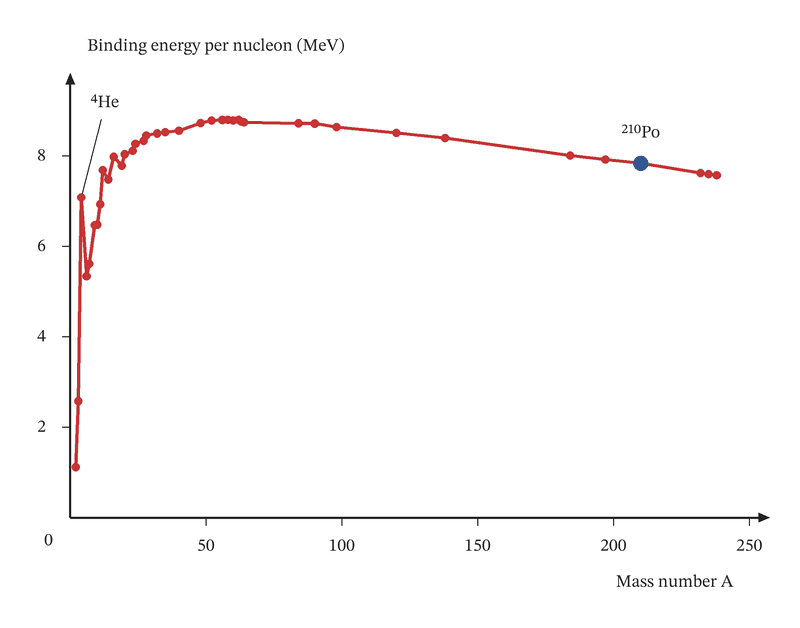
The table gives some values of the binding energy per nucleon. A free proton has no binding energy.
Nucleus B.E. per nucleon (MeV) 7.8344 7.8754 7.8481 7.0739 (a) Polonium-210 decays by giving out an α-particle: . Find the energy released.
(b) Find the energy that would be released if polonium-210 gave out a proton instead: .
(c) Using the graph, explain why heavy nuclei such as polonium-210 can throw out α-particles but not single protons.
- 293 marks
Question 29
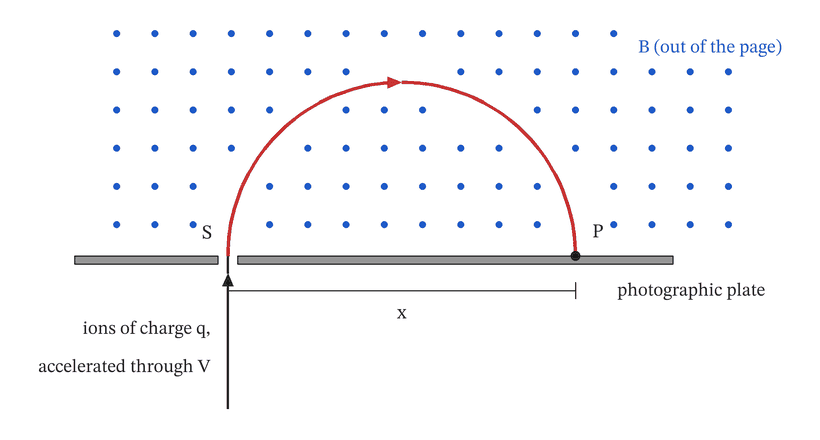
A charge is accelerated by a potential difference volt and allowed to enter a magnetic field . In the field it moves in a semicircle, striking a photographic plate at a distance from the entry slit. Show that the mass is given by .
- 303 marks
Question 30
Two positive ions having the same charge but different masses and are accelerated horizontally from rest through a potential difference . They then enter a region where there is a uniform electric field upward.
(a) Show that if the ion beam enters the field along -axis, the value of -coordinate at any time is given by .
(b) Can this arrangement be used for isotope separation?

- 313 marks
Question 31
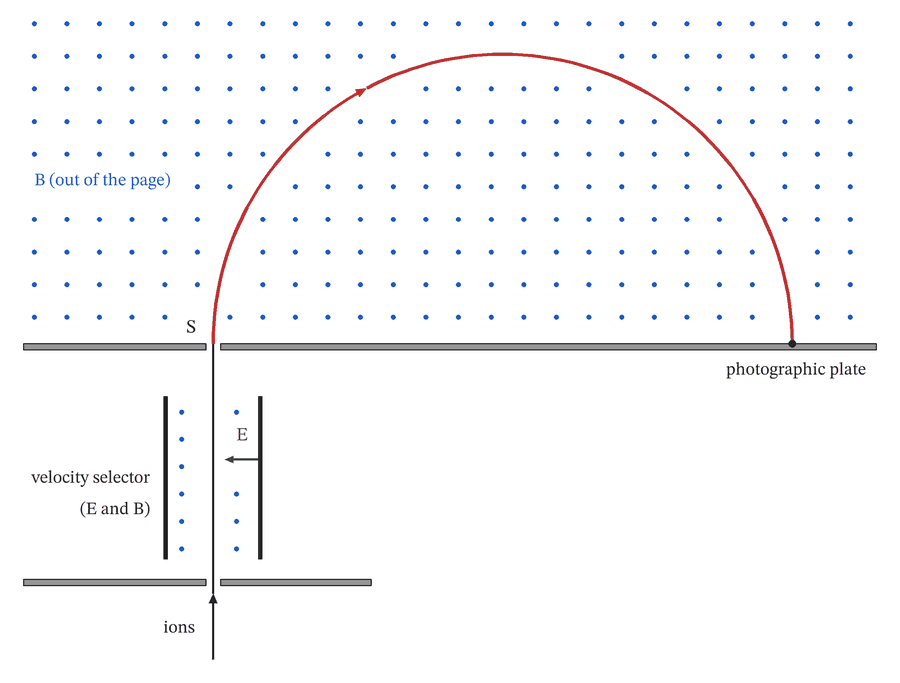
The electric field between the plates of the velocity selector is 800 V/cm. The magnetic field common to both parts is 0.55 Wb/m². If the ion source contains singly charged neon isotopes 20 and 22, calculate the linear separation of the lines formed by the isotopes on the photographic plate.
- 323 marks
Question 32
Two positive ions having the same charge but different masses and are accelerated horizontally from rest through a potential difference . They then enter a region where there is a uniform magnetic field upward. Show that if ion beam enters the field along the -axis, the value of -coordinate is given by .

- 333 marks
Question 33
Assuming that protons and neutrons possess equal masses, calculate how many times nuclear matter is denser than water, if nuclear radius is given by m where is the mass number.
- 343 marks
Question 34
Find the energy in MeV required to split a nucleus of into four alpha particles. The atomic mass of an alpha particle is 4.002603 amu, while that of oxygen is 15.994915 amu. (Given 1 amu = 931 MeV).
- 353 marks
Question 35
The mass of is 34.800 amu. Calculate its binding energy. What is the binding energy per nucleon? (Given amu, amu)
- 363 marks
Question 36
Calculate the binding energy of an α-particle in MeV. The masses of proton, neutron and α-particle are 1.00728, 1.00867 and 4.001510 respectively.
- 373 marks
Question 37
A heavy nucleus of mass number and binding energy per nucleon MeV is split into two nearly equal fragments and of mass numbers and . The binding energy of each one of these nuclei is 8.5 MeV per nucleon. Calculate the total binding energy of each of the nuclei , and and hence the released per fission in MeV.
- 381 mark
Question 38
Competency: Application
In 1935 the Japanese physicist Hideki Yukawa suggested that nucleons attract one another by exchanging a particle, later called a meson. In his theory, a force carried by a particle of rest energy has a range of about , where . Scattering experiments show that the attraction between two nucleons dies away rapidly with distance: it is still felt out to –, but its characteristic range (the distance over which it falls by a large factor) is about . The rest energy of an electron is . The particle that Yukawa's theory predicts should have a mass of about
- 393 marks
Question 39
Competency: Analysis & Evaluation
Measurements that helped fix the constants used in the 2019 redefinition of the kilogram counted the atoms in highly polished spheres of almost pure silicon-28. Take one such sphere to be pure silicon-28, with a mass of and a diameter of . In a silicon crystal, every cube of edge contains exactly atoms. The atomic mass of silicon-28 is . (Hypothetical data.)
(a) Find the number of atoms in the sphere.
(b) Hence find the mass of one silicon-28 atom and the value of in kilograms. Compare it with the accepted value, .
(c) Suppose the diameter had been measured with a micrometer only to . Find the percentage uncertainty this gives in the value of , and decide whether the comparison in (b) can then show a real difference.
- 405 marks
Question 40
Competency: Analysis & Evaluation
In 1932 James Chadwick bombarded beryllium with α-particles of kinetic energy about from polonium. The beryllium gave out a very penetrating radiation that carried no charge. When this radiation struck paraffin wax, protons were knocked out with speeds of up to about ; when it passed through nitrogen gas, nitrogen nuclei recoiled with speeds of up to about . Other scientists thought the radiation was γ-rays from Reaction 2 below. Chadwick proposed instead that it was a stream of neutral particles from Reaction 1.
Take the atomic masses , , , and , with . Take , and . A photon of energy has momentum . In a head-on elastic collision, a particle of mass moving with speed gives a nucleus of mass at rest a speed .
(a) Find the energy released in each reaction. Hence find the greatest energy that a γ-ray from Reaction 2 could carry.
(b) Find the kinetic energy of the fastest protons. A photon gives a proton the most momentum when it bounces straight back. Find the least energy a γ-ray photon would need to give a proton this momentum, and do the same for the nitrogen nuclei (take the mass of a nitrogen nucleus as ). Use your results to judge the γ-ray explanation.
(c) Taking the masses of a proton and a nitrogen nucleus as and , use the two greatest recoil speeds to find the mass of Chadwick's neutral particle. Check whether Reaction 1 can give these particles enough energy, and state your conclusion.