
Competency: Application
In a PET (positron emission tomography) scan, a patient is given glucose labelled with fluorine-18. Most nuclei decay by giving out a positron: . The positron soon meets an electron, and the two annihilate into two γ-ray photons, which are picked up by a ring of detectors across. For one annihilation, the photons reach detectors and , at opposite ends of a line through the centre O of the ring, as shown. (Hypothetical data.)
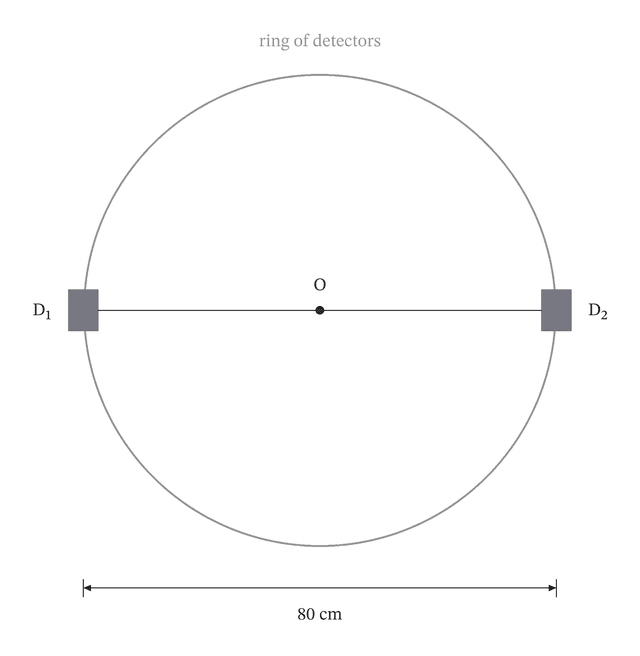
Take , , , , the atomic masses and , and .
(a) The positron and the electron are nearly at rest when they annihilate. Explain why two photons are produced and why they travel in opposite directions. Find the energy and the momentum of each photon.
(b) The photon travelling towards arrives there before the other photon arrives at . Find where on the line the annihilation took place.
(c) For positron emission, the energy released, found from atomic masses, is . Find the greatest kinetic energy a positron from can have.