
Opening your dashboard
Class 12 Physics Chapter 27 Nuclei: Previous Year Questions
9 questions on Chapter 27, each solved step by step. Class 12 Physics, ICSE 2026-27.
9 questions with solutions
1–3 marks · Mixed difficulty
- 11 mark
Question 1
What is the significance of binding energy per nucleon of a nucleus of a radioactive element?
Solve with AIWritten solution
Solution:
Key idea: The binding energy per nucleon is the total binding energy of a nucleus divided by its number of nucleons, that is, the average energy per nucleon needed to break the nucleus up into separate protons and neutrons. The larger it is, the more tightly the nucleons are held and the more stable the nucleus.
Step 1 — Compare a radioactive heavy nucleus with the most stable nuclei.
The binding energy per nucleon is greatest, about , for nuclei near iron-56. Heavy radioactive nuclei such as uranium-238 have a smaller value, about .
Step 2 — State the significance.
The smaller binding energy per nucleon shows that the nucleons in a heavy nucleus such as uranium-238 are held less tightly than in nuclei of middle mass, so the nucleus is less stable. It can move towards a more tightly bound arrangement by giving out an alpha particle. For example, uranium-238 (about 7.570 MeV per nucleon) decays to thorium-234 (about 7.597 MeV per nucleon), and the energy released appears mainly as the kinetic energy of the alpha particle.
Step 3 — Note the limits of this idea.
The binding energy per nucleon is not the only factor that decides radioactivity. Beta decay happens when a nucleus has too many neutrons or too many protons for its size, and it can even lead to a slightly smaller binding energy per nucleon. For example, carbon-14 (about 7.52 MeV per nucleon) decays to nitrogen-14 (about 7.48 MeV per nucleon); the energy comes from a neutron changing into a proton, because a neutron is heavier than a hydrogen atom (a proton plus an electron).
Therefore, the low binding energy per nucleon of a heavy radioactive nucleus shows that its nucleons are loosely bound and the nucleus is less stable, so it can release energy by decaying (for example by alpha emission) towards more tightly bound nuclei.
- 22 marks
Question 2
With the help of a suitable example and an equation, explain the term pair production.
Solve with AIWritten solution
Solution:
Key idea: By Einstein's relation , energy can turn into mass. A gamma photon with enough energy can create a particle and its antiparticle.
Step 1 — Explain the term.
Pair production is the conversion of a high-energy gamma-ray photon into an electron and a positron (the antiparticle of the electron, with the same mass and a positive charge). It is an example of energy turning into mass, .
It happens only when the photon passes close to a nucleus (most often a heavy one, such as lead), which takes up some momentum so that both energy and momentum are conserved. Charge is conserved too, since , the charge of the photon.
Step 2 — Find the minimum photon energy.
The photon must supply at least the rest-mass energy of the two particles. The rest-mass energy of an electron (or a positron) is .
Step 3 — Give an example.
A gamma photon of energy passing close to a lead nucleus can produce an electron–positron pair. Of its energy, becomes the masses of the two particles, and the remaining energy is shared between them as kinetic energy.
Therefore, pair production is the conversion of a gamma photon of at least 1.02 MeV, near a nucleus, into an electron and a positron: γ → e⁻ + e⁺.
- 32 marks
Question 3
Sketch a graph showing the variation of binding energy per nucleon of a nucleus with its mass number.
Solve with AIWritten solution
Solution:
Key idea: The binding energy per nucleon is the binding energy of a nucleus divided by its mass number . Its variation with shows which nuclei are most stable.
Step 1 — Draw the graph.
The graph is plotted from measured nuclear masses, with the mass number along the -axis and the binding energy per nucleon (in MeV) along the -axis.
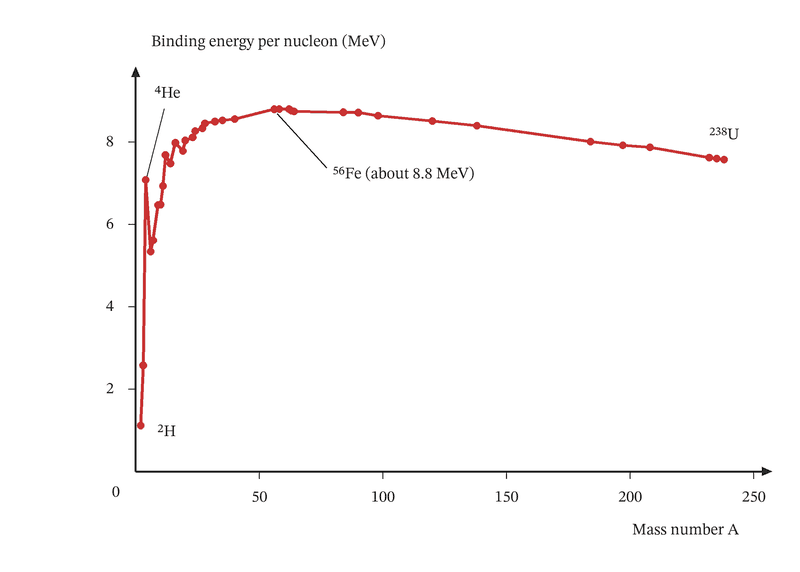
Step 2 — Describe its main features.
For light nuclei the curve rises steeply, from about for , with a sharp local peak at (about ). It reaches a broad maximum of about for mass numbers between about 50 and 80, near iron-56; these are the most stable nuclei. For heavier nuclei it falls slowly, to about for . For most nuclei (from of about 30 to 170) the value stays between about and , which shows that nuclear forces are short-range and saturate.
Step 3 — Read the consequences from the graph.
Very light nuclei can increase their binding energy per nucleon by fusing together, and very heavy nuclei by splitting (fission); in both cases energy is released.
Therefore, the binding energy per nucleon rises steeply for light nuclei, has a broad maximum of about 8.8 MeV near A = 56 and falls slowly to about 7.6 MeV for the heaviest nuclei.
- 41 mark
Question 4
What is the minimum energy which a gamma ray photon must possess in order to produce electron-positron pair ?
Solve with AIWritten solution
Solution:
Key idea: In pair production a gamma photon becomes an electron and a positron. Its energy must at least equal their total rest-mass energy, .
Step 1 — Write the condition.
The positron has the same mass as the electron, .
Step 2 — Substitute the values.
We use .
Step 3 — Convert to MeV.
We divide by .
Therefore, the gamma photon must have at least 1.02 MeV (about 1.64 × 10⁻¹³ J) of energy.
- 53 marks
Question 5
Calculate mass defect and binding energy per nucleon of , given
Mass of
Mass of
Mass of
Solve with AIWritten solution
Solution:
Key idea: The mass defect is the total mass of the separate nucleons minus the mass of the nucleus. The binding energy is the mass defect times ; with , it is the mass defect in u times .
Step 1 — Count the nucleons.
Neon-20 has protons, and its number of neutrons is .
We use the mass of the hydrogen atom (rather than a bare proton) because the neon mass given is an atomic mass; the masses of the 10 electrons then cancel.
Step 2 — Find the total mass of the separate particles.
We add the masses of 10 hydrogen atoms and 10 neutrons.
Step 3 — Find the mass defect.
We subtract the mass of the neon atom from the total mass of its separate particles.
Step 4 — Find the binding energy.
Each atomic mass unit is equivalent to .
Step 5 — Find the binding energy per nucleon.
We share the binding energy among the 20 nucleons.
Therefore, the mass defect of neon-20 is 0.172503 u and its binding energy per nucleon is about 8.03 MeV.
- 62 marks
Question 6
What is meant by pair annihilation? Write a balanced equation for the same.
Solve with AIWritten solution
Solution:
Key idea: When a particle meets its antiparticle, the two can disappear completely, and their rest-mass energy, , becomes the energy of radiation.
Step 1 — Explain the term.
Pair annihilation is the process in which an electron and a positron (its antiparticle) meet and destroy each other. Their whole rest-mass energy (plus any kinetic energy) becomes radiation energy, which appears as gamma-ray photons.
Step 2 — Write the balanced equation.
An electron and a positron go in, and (for a pair nearly at rest) two gamma photons come out.
The equation is balanced: the total charge is on both sides, and the photons carry the energy.
Step 3 — Explain why two photons appear.
If the pair is nearly at rest, its total momentum is almost zero. A single photon always carries momentum, so at least two photons are needed, moving in opposite directions. Two is the usual case (a small fraction of annihilations, from the spin-1 state called ortho-positronium, give three photons). Each of the two photons then has an energy of about , the rest-mass energy of one electron.
Therefore, pair annihilation is the conversion of an electron and a positron into gamma-ray energy: e⁻ + e⁺ → γ + γ.
- 72 marks
Question 7
Calculate binding energy of oxygen nucleus () from the data given below:
Mass of a proton = 1.007825u
Mass of a neutron = 1.008665u
Mass of () = 15.994915u
Solve with AIWritten solution
Solution:
Key idea: The binding energy of a nucleus is the energy equivalent of its mass defect. The mass defect is the total mass of the separate nucleons minus the mass of the nucleus, and of mass is equivalent to .
Step 1 — Count the nucleons.
Oxygen-16 has protons, and its number of neutrons is .
The "proton" mass given, , is really the mass of a hydrogen atom, and is the mass of an oxygen atom. Using atomic masses for both is correct, because the masses of the 8 electrons cancel.
Step 2 — Find the total mass of the separate particles.
We add the masses of 8 protons (hydrogen atoms) and 8 neutrons.
Step 3 — Find the mass defect.
We subtract the mass of the oxygen atom from the total mass of its separate particles.
Step 4 — Convert the mass defect into energy.
We use .
So the binding energy is about , or about per nucleon. With the more precise value the result is also about .
Therefore, the binding energy of the oxygen-16 nucleus is about 127.6 MeV.
- 81 mark
Question 8
What is 'Pair production'?
Solve with AIWritten solution
Solution:
Key idea: By Einstein's relation , the energy of a photon can be converted into the mass of new particles.
Step 1 — Explain the term.
Pair production is the conversion of a high-energy gamma-ray photon into an electron and a positron (the antiparticle of the electron, with the same mass and a positive charge). It is an example of energy turning into mass, .
It happens only when the photon passes close to a nucleus (most often a heavy one, such as lead), which takes up some momentum so that both energy and momentum are conserved. Charge is conserved too, since , the charge of the photon.
Step 2 — State the energy condition.
The photon's energy must be at least the rest-mass energy of the electron and the positron together, . Any extra energy becomes the kinetic energy of the pair.
Therefore, pair production is the conversion of a gamma-ray photon of at least 1.02 MeV, near a nucleus, into an electron–positron pair.
- 91 mark
Question 9
What is the minimum energy a gamma ray () photon should possess to produce an electron - positron pair?
Solve with AIWritten solution
Solution:
Key idea: A gamma photon can create an electron–positron pair only if its energy at least equals the total rest-mass energy of the two particles, .
Step 1 — Find the rest-mass energy of one electron.
The electron has mass , and its rest-mass energy is , about . The positron has the same mass, so the same rest-mass energy.
Step 2 — Add the two rest-mass energies.
The photon must create both particles, so it needs twice the rest-mass energy of one electron.
Therefore, the gamma photon must possess at least 1.02 MeV of energy.