
Question 561 markMedium
How are protons, which are positively charged, held together inside a nucleus? Draw a graph between potential energy of a pair of nucleons as a function of their separation.
Confirming your payment
Sign up now and get 250 free tokens.
Nuclei · Question 56 of 89
How are protons, which are positively charged, held together inside a nucleus? Draw a graph between potential energy of a pair of nucleons as a function of their separation.
Solution:
Concept: Besides the electrostatic repulsion between protons, every pair of nearby nucleons feels the nuclear force: repulsive closer than about 0.8 fm, strongly attractive at about 1 to 2 fm, and negligible beyond a few fm.
Step 1 — Explain the binding. The protons are held together by the strong attractive nuclear force acting between all nucleons (protons and neutrons). At nuclear distances it is much stronger than the electrostatic repulsion between the protons.
Step 2 — Describe the graph. The potential energy of a pair of nucleons is plotted against their separation in the sketch below.
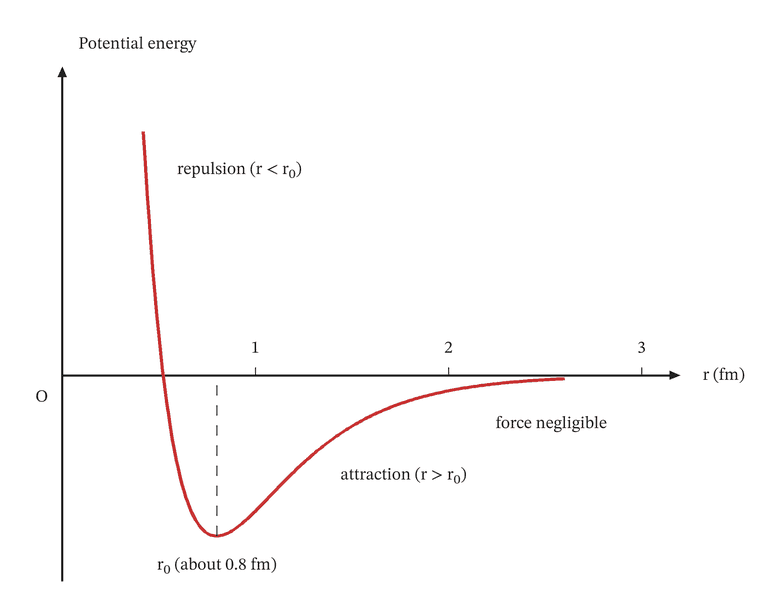
The graph shows three features:
Therefore, protons are held together by the strong, short-range attractive nuclear force, which outweighs their electrostatic repulsion; the potential energy curve has a minimum near 0.8 fm, repulsion closer in and negligible force beyond a few fm.