
Opening your dashboard
Class 12 Physics Chapter 27 Nuclei: Practice Questions
98 questions on Chapter 27, each worked through on its own page with the AI tutor. Class 12 Physics, ICSE 2026-27.
98 questions
1–4 marks · Mixed difficulty
- 11 mark
Question 1
Each carbon-12 atom has 6 protons and 6 neutrons in its nucleus. How many neutrons are there in of pure carbon-12? (Take the molar mass of carbon-12 as and .)
- 22 marks
Question 2
Using with , the radius of a certain nucleus works out to be .
(i) Find the mass number of the nucleus.
(ii) The nucleus contains 84 protons. How many neutrons does it contain?
- 33 marks
Question 3
A gold atom has a nucleus of mass number . Take the radius of the gold atom as (half the distance between neighbouring atoms in gold metal) and .
(i) Find the radius of the gold nucleus.
(ii) How many times larger is the radius of the atom than that of its nucleus?
(iii) What fraction of the volume of the atom does the nucleus fill?
- 43 marks
Question 4
Treat a nucleus of mass number as a sphere of radius , with and mass , where .
(i) Show that the density of nuclear matter does not depend on , and find its value.
(ii) Neutron stars are made of matter of about this density. If the whole Earth (mass ) were squeezed to this density, what would its radius be?
- 51 mark
Question 5
The radii of several nuclei are plotted against their mass numbers in different ways. If , which of these graphs is a straight line through the origin?
- 61 mark
Question 6
Take the volume of a nucleus of mass number as , with . If this volume is shared equally among the nucleons, each nucleon having a small cube, the edge of each cube is about
- 73 marks
Question 7
(Hypothetical data.) Electron-scattering experiments give these radii for five nuclei:
Mass number 8 27 64 125 216 Radius (fm) 2.5 3.5 4.9 6.0 7.1 (i) Explain why a graph of against is a good way to test the relation .
(ii) Plot this graph and use it to find .
(iii) Use your value of to predict the radius of a nucleus with .
- 83 marks
Question 8
The chart shows five nuclides P, Q, R, S and T, plotted by their proton number and neutron number .
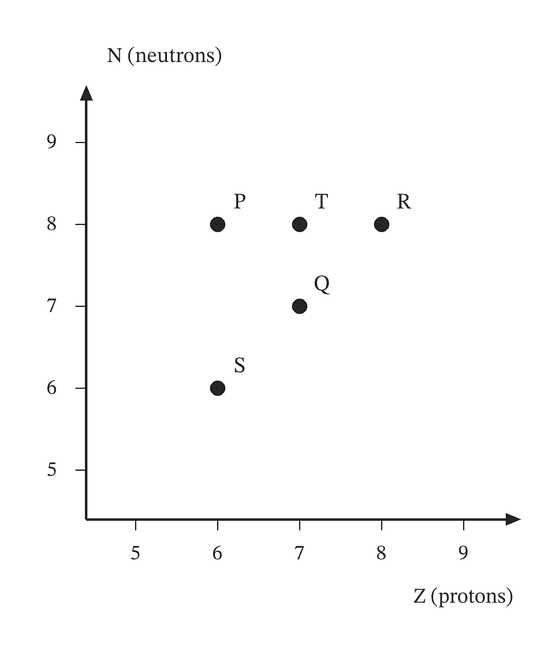
(i) Name every pair of isotopes.
(ii) Name the pair of isobars.
(iii) Name the nuclides that are isotones of one another.
(iv) Along what kind of line do isobars lie on such a chart?
- 91 mark
Question 9
and are isobars. Using , the ratio of their nuclear radii, , is
- 102 marks
Question 10
A nuclide X is an isotope of iron () and an isotone of .
(i) Find the proton number, neutron number and mass number of X, and write its symbol.
(ii) Nickel has . Write the symbol of the nickel nuclide that is an isobar of X, and give its neutron number.
- 113 marks
Question 11
Natural magnesium has three stable isotopes:
Isotope Atomic mass (u) 23.985042 24.985837 25.982593 Abundance (by number of atoms) 78.99 % 10.00 % 11.01 % (i) Find the average atomic mass of natural magnesium.
(ii) Explain why this value is not close to a whole number, although each isotope's mass is close to a whole number.
- 121 mark
Question 12
Natural bromine consists of about atoms and atoms. The two atoms of each molecule are picked at random from this mixture. About what fraction of molecules have a total mass number of ?
- 131 mark
Question 13
In a tritium nucleus, , one neutron slowly turns into a proton, and the nucleus becomes . The two nuclei and are
- 141 mark
Question 14
Before 1961, physicists used a mass scale on which one atom of had a mass of exactly 16 units. On today's unified scale, the atom has a mass of and the atom exactly . On the old scale, the mass of a atom was
- 152 marks
Question 15
The mass of an electron is . Take and .
(i) Express the mass of the electron in atomic mass units.
(ii) Express it in .
(iii) About how many electrons together have a mass of ?
- 163 marks
Question 16
Mass tables give the mass of the neutral atom as . Take the electron mass as and .
(i) Find the mass of the nucleus.
(ii) What percentage of the atom's mass do its electrons carry?
(iii) The eight electrons are bound to the nucleus with a total binding energy of about . Show that leaving this out changes the answer to (i) by only about .
- 171 mark
Question 17
Take , , and the mass of a atom as . Which of these has a mass of exactly ?
- 182 marks
Question 18
Biochemists give the masses of large molecules in daltons (Da), where . A protein molecule has a mass of (about the mass of human serum albumin).
(i) Find the mass of one molecule in kilograms.
(ii) How many such molecules are there in of the pure protein?
- 191 mark
Question 19
Take , and . The difference is closest to how many electron masses?
- 203 marks
Question 20
Two protons in a nucleus are apart. Take , , and .
(i) Find the electrostatic force between them.
(ii) Find the gravitational force between them.
(iii) Compare the two forces, and explain what this tells you about the force that holds the nucleus together.
- 211 mark
Question 21
Which one of the following statements about the nuclear force is NOT correct?
- 223 marks
Question 22
The nuclei (one proton, two neutrons) and (two protons, one neutron) are called mirror nuclei. Their binding energies (the energy needed to pull each nucleus apart into separate nucleons) are and respectively.
(i) Which nucleus has the smaller binding energy? Give the reason you would expect this.
(ii) Assume the nuclear force is the same for every pair of nucleons, so that the whole difference comes from the electrostatic repulsion between the two protons in . Treating the protons as point charges, estimate their separation. Take .
- 231 mark
Question 23
Two protons are held apart, a few times farther than the range of the nuclear force. Take and . The net force between them is
- 243 marks
Question 24
(Hypothetical model curve.) The graph shows how the force between two nucleons varies with the distance between their centres. A positive means repulsion and a negative means attraction. A, B, C and D are points on the curve; B is where the curve meets the -axis.
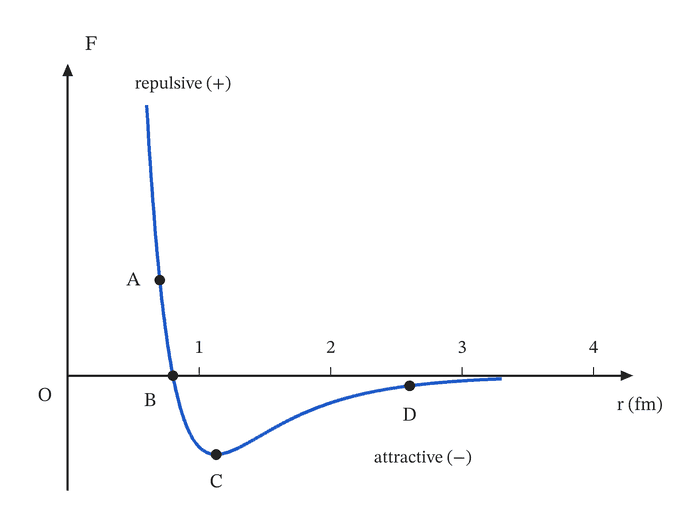
(i) At which of the points A, C and D is the force repulsive, and at which is it attractive? At which of them is the attraction strongest?
(ii) At which point could two nucleons stay at rest in equilibrium? Explain whether this equilibrium is stable.
(iii) What does the shape of the curve near D and beyond show about the nuclear force?
- 251 mark
Question 25
A smartphone battery (a 4000 mAh cell at 3.85 V) stores about of energy when it is fully charged. (Hypothetical data.) Taking , the increase in the mass of the battery when it is charged from empty to full is about
- 264 marks
Question 26
The Sun radiates energy at the rate . In its core, hydrogen is turned into helium; the overall change can be written with atomic masses as (using atomic masses also takes care of the positrons that are formed and annihilated). Take , , , and . Assume that all the energy released ends up in the Sun's radiation.
(a) How much mass does the Sun lose each second because it radiates?
(b) Find the energy released each time one helium nucleus is formed.
(c) How many helium nuclei are formed in the Sun each second?
(d) The Sun is about years old and its mass is . Assuming it has always shone at the present rate, what fraction of its mass has it lost as radiation? Take .
- 272 marks
Question 27
When hydrogen burns in oxygen to form (one mole) of liquid water, about of heat is given out. Take .
(a) By how much is the mass of the water formed less than the total mass of the hydrogen and oxygen used?
(b) What fraction of the mass is this? Could a laboratory balance that reads to detect the change?
- 282 marks
Question 28
In 1932 Cockcroft and Walton fired fast protons at lithium-7 and saw pairs of α-particles fly out: . Suppose the protons have a kinetic energy of and each α-particle is found to have a kinetic energy of about . (Hypothetical data.) The atomic masses are , and ; .
(a) Find the energy released in the reaction from the masses.
(b) Show that the measured kinetic energies agree with Einstein's relation .
- 291 mark
Question 29
In a fusion reactor, deuterium and tritium fuse: . The atomic masses are , , , and ; . The energy released in one such reaction is
- 303 marks
Question 30
One way in which a uranium-235 nucleus splits after absorbing a slow neutron is
The atomic masses are , , and ; .
(a) Find the energy released in this fission.
(b) What percentage of the initial mass (uranium-235 plus neutron) is turned into energy?
(c) The energy released per fission of uranium-235 is usually quoted as about . Give a reason why this is larger than your answer to (a).
- 311 mark
Question 31
Which statement about Einstein's mass–energy relation is correct?
- 323 marks
Question 32
A nuclear power reactor produces heat at a steady rate of ; its generators deliver about of electricity. Each fission of a nucleus releases about . (Hypothetical data.) Take , , , and .
(a) By how much does the total mass of the fuel and its fission products decrease in one year?
(b) How many fissions take place in the reactor each second?
(c) What mass of uranium-235 is used up each day?
- 331 mark
Question 33
An excited nucleus drops to its ground state by giving out a γ-ray photon of energy . Taking and neglecting the tiny recoil of the nucleus, the mass of the nucleus decreases by
- 341 mark
Question 34
A student wants the binding energy of the nucleus from tables. The atomic mass of is . Other data: , , , and . The binding energy of the nucleus is
- 353 marks
Question 35
The nucleus contains 4 protons and 4 neutrons, the same particles as two α-particles. The atomic masses are and ; also , and .
(a) Find the binding energy of and its binding energy per nucleon.
(b) Find the total binding energy of two separate α-particles.
(c) Hence show that can break up by itself into two α-particles, and find the energy released.
- 363 marks
Question 36
The isobars , and have atomic masses , and . Take , and .
(a) Find the binding energy of each nucleus.
(b) Which of the three nuclei is the least tightly bound?
(c) Potassium-40 is radioactive, while argon-40 and calcium-40 are stable. Using your answers and the numbers of protons and neutrons in each nucleus, suggest why.
- 372 marks
Question 37
Every bound system is lighter than its separate parts, not only a nucleus. The gravitational binding energy of the Earth (the energy needed to scatter all its matter far apart) is about , and the Earth's mass is . Take .
(a) Find the Earth's "mass defect" and the fraction of its mass that this is.
(b) For a typical medium nucleus the mass defect is about of the mass of its separate nucleons. About how many times larger is this fraction than the Earth's?
- 382 marks
Question 38
A slow neutron is captured by a proton (a hydrogen nucleus) in water. They form a deuteron, and the energy released leaves as a single γ-ray photon. Take , , , , , and . Neglect the kinetic energies of the slow neutron and of the recoiling deuteron.
(a) Find the energy of the γ-ray photon.
(b) Find its wavelength.
- 391 mark
Question 39
The atomic masses are , , , and ; . The least energy needed to split a nucleus into an α-particle and a deuteron is
- 403 marks
Question 40
The binding energy of the nucleus is . Using , , and , find
(a) the mass of the α-particle (the helium-4 nucleus),
(b) the mass of a neutral helium-4 atom,
(c) the percentage by which the α-particle is lighter than its four separate nucleons.
- 411 mark
Question 41
Which statement about the mass defect of a nucleus is correct?
- 421 mark
Question 42
The total binding energy of is about and that of is about . Which conclusion is correct?
- 431 mark
Question 43
Suppose every nucleus, from deuterium to uranium, had exactly the same binding energy per nucleon, . Which statement would then be true?
- 443 marks
Question 44
Compare two nuclear fuels. In deuterium–tritium fusion, releases . In fission, releases about . Take the mass of the reacting particles as for deuterium–tritium and for uranium-235 plus neutron, with and .
(a) Find the energy released per nucleon taking part in each reaction.
(b) Find the energy released per kilogram of reacting material in each case, and the ratio of the two.
(c) Use the shape of the binding-energy-per-nucleon curve to explain why fusion gives more energy per nucleon.
- 453 marks
Question 45
The binding energy per nucleon of is . Using , and , find
(a) the mass defect of the gold-197 nucleus, in u,
(b) the atomic mass of gold-197,
(c) its packing fraction. In this chapter the packing fraction is defined as the mass defect per nucleon, ; many other books define it as , where is the atomic mass in u. Give both values.
- 463 marks
Question 46
(Simplified model.) If we count only the attraction between neighbouring nucleons, the binding energy of a nucleus of mass number can be written as
with and . The first term gives each nucleon the same share of binding; the second term takes away binding because nucleons at the surface have fewer neighbours. The electric repulsion between protons is left out of this model.
(a) Use the model to find the binding energy per nucleon for , and .
(b) For and for , find what fraction of the first term the surface term cancels.
(c) Use your answers to explain why, in this model, the binding energy per nucleon rises with .
- 471 mark
Question 47
Beyond the binding energy per nucleon falls slowly, to about for . The main reason is that
- 482 marks
Question 48
What are isomers?
- 491 mark
Question 49
How is it possible that a large number of protons exist in a very small space inside the nucleus?
- 502 marks
Question 50
“The density of nucleus is more than that of the atom”. Why ?
- 512 marks
Question 51
The isotope has 8 protons, 8 neutrons and 8 electrons while has 4 protons, 4 neutrons and 4 electrons. Yet the ratio of their atomic masses is not exactly 2. Why?
- 521 mark
Question 52
Which has greater rest mass, a neutron or a proton?
- 532 marks
Question 53
“The number of neutrons is more than the number of protons in heavy nuclei.” Why ?
- 542 marks
Question 54
“The atomic masses are not whole numbers, for most of the atoms.” Why?
- 553 marks
Question 55
Find the number of protons and neutrons in the nuclei of the following elements.
(a)
(b)
(c)
- 563 marks
Question 56
In the Bainbridge mass spectrograph, the radius of the circular path traced out by singly charged ions of the carbon isotope C¹² is 3.11 cm. What is the radius of the circular path traced out by singly charged ion of C¹³ entering the same magnetic field with the same velocity?
- 573 marks
Question 57
Copper has two isotopes of atomic masses 62.9 and 64.9 respectively. Find the percentage abundance of each in ordinary copper having an atomic mass of 63.5.
- 583 marks
Question 58
The radius of nucleus is 6.2 fermi. Find the radius of .
- 593 marks
Question 59
Find the radius of . Given fm.
- 603 marks
Question 60
Find the energy equivalent to 1 g in kWh.
- 612 marks
Question 61
Define mass defect of a nucleus. How is it related to the binding energy of the nucleus?
- 622 marks
Question 62
What is atomic mass unit? Calculate equivalent energy in MeV.
- 631 mark
Question 63
What is meant by the term isotope?
- 641 mark
Question 64
State Einstein's mass energy relation.
- 652 marks
Question 65
Calculate the equivalent energy in MeV of a unified atomic mass unit.
Or
Calculate the energy equivalent (in MeV) of one twelfth of the mass of 1 atom of carbon 12.
- 662 marks
Question 66
Complete the following nuclear reactions.
(i)
(ii)
- 671 mark
Question 67
In the nuclear reaction , what does X stand for?
- 682 marks
Question 68
Write a balanced nuclear reaction showing emission of a particle by (Symbol of daughter nucleus formed in the process is Pa).
- 692 marks
Question 69
What is the significance of binding energy per nucleon of a nucleus of a radioactive element?
- 701 mark
Question 70
What is meant by the term ‘binding energy of nucleus’?
- 711 mark
Question 71
What is meant by mass defect?
- 722 marks
Question 72
What is meant by pair annihilation? Write a balanced equation for the same.
- 732 marks
Question 73
What is meant by pair production? Explain with the help of an example and a balanced equation.
- 741 mark
Question 74
absorbs an energetic neutron and emits beta particles. The resulting nucleus is
- 751 mark
Question 75
The mass of a nucleus is 0.042 u less than the sum of the masses of all its nucleons. The binding energy per nucleon of nucleus is nearly
- 761 mark
Question 76
Which of the following particles do not exist in the nucleus?
- 771 mark
Question 77
For effective nuclear forces, the distance should be
- 781 mark
Question 78
The mass of neutron and proton are 1.0087 amu and 1.0073 amu, respectively. If the neutrons and protons combine to form a helium nucleus (alpha particles) of mass 4.0015 amu, the binding energy of the helium nucleus will be (1 amu MeV)
- 791 mark
Question 79
The binding energy of deuteron is 1.112 MeV per nucleon and an α-particle has a binding energy of 7.047 MeV per nucleon. Then in the fusion reaction , the energy released is
- 801 mark
Question 80
The number of beta particles emitted by a radioactive substance is twice the number of alpha particles emitted by it. The resulting daughter is an
- 811 mark
Question 81
The average binding energy per nucleon is maximum for the nucleus
- 821 mark
Question 82
denotes the mass of a proton and that of a neutron. A given nucleus, of binding energy , contains protons and neutrons. The mass of the nucleus is given by ( is the velocity of light)
- 831 mark
Question 83
Order of magnitude of density of uranium nucleus is ( kg)
- 841 mark
Question 84
Following process is known as
- 851 mark
Question 85
A heavy nucleus at rest breaks into two fragments which fly off with velocities in the ratio 8 : 1. The ratio of radii of the fragment is
- 861 mark
Question 86
The rest mass of an electron as well as that of positron is 0.51 MeV. When an electron and positron are annihilated, they produce gamma-rays of wavelength(s)
- 871 mark
Question 87
The binding energy per nucleon of is 7.97 MeV and that of is 7.75 MeV. The energy (in MeV) required to remove a neutron from is
- 881 mark
Question 88
How does the binding energy per nucleon vary with the increase in the number of nucleons?
- 891 mark
Question 89
If radius of the nucleus is estimated to be 3.6 fermi then the radius of nucleus be nearly
- 901 mark
Question 90
Pick mirror isobars from the following.
, , , , ,
- 911 mark
Question 91
An alpha particle () has a mass of 4.00300 amu. A proton has mass of 1.00783 amu and a neutron has mass of 1.00867 amu respectively. The binding energy of alpha particle estimated from these data is the closest to
- 921 mark
Question 92
Which of the following pairs of nuclei are isotones?
- 931 mark
Question 93
Mass numbers of the elements A, B, C and D are 30, 60, 90 and 120 respectively. Their specific binding energy are 5 MeV, 8.5 MeV, 8 MeV and 7 MeV respectively. Then in which of the following reaction/s energy is released?
(1) D → 2B
(2) C → B + A
(3) B → 2A
- 941 mark
Question 94
A nucleus of mass number 220, initially at rest, emits an α-particle. If the Q value of the reaction is 5.5 MeV, the energy of the emitted α-particle will be
- 951 mark
Question 95
The ratio of mass densities of nuclei of and is close to
- 961 mark
Question 96
The radius R of a nucleus of mass number A can be estimated by the formula m. It follows that the mass density of a nucleus is of the order of ( kg)
- 971 mark
Question 97
Find the binding energy per nucleon for . Mass of proton u, Mass of neutron u and Mass of tin nucleus u (take 1 u MeV)
- 981 mark
Question 98
A nucleus with mass number 240 breaks into two fragments each of mass number 120, the binding energy per nucleon of unfragmented nuclei is 7.6 MeV while that of fragments is 8.5 MeV. The total gain in the binding energy in the process is