
Question 632 marksMedium
“Heavy nuclei split into lighter nuclei by a process called fission.” Why?
Confirming your payment
Sign up now and get 250 free tokens.
Nuclei · Question 63 of 89
“Heavy nuclei split into lighter nuclei by a process called fission.” Why?
Solution:
Concept: The binding energy per nucleon, , measures how tightly the nucleons of a nucleus are held. Measured values rise steeply for light nuclei, reach a broad maximum of about 8.8 MeV near to 62 (iron and nickel), and fall slowly to about 7.6 MeV for uranium.
Step 1 — Compare heavy and middle nuclei. A heavy nucleus such as uranium-235 has about 7.6 MeV per nucleon, while the medium nuclei it splits into have about 8.5 MeV per nucleon.
Step 2 — Explain why fission happens. When the heavy nucleus splits, its nucleons end up more tightly bound. The products are more stable, and the extra binding energy, about 0.9 MeV for each of about 235 nucleons, is released: roughly 200 MeV per fission.
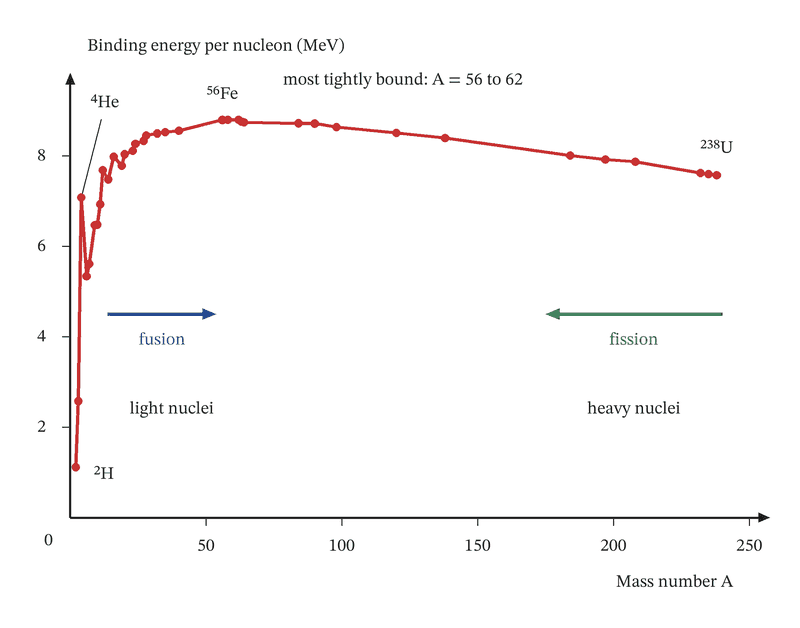
Therefore, heavy nuclei split because the lighter fragments have a higher binding energy per nucleon, so they are more stable and energy is released.