
Opening your dashboard
Class 12 Maths Chapter 10: Maxima and Minima Solutions
60 textbook questions with step-by-step answers, free to read, for ISC 2026-27.
Get talked through Ch 10, not just shown the answer
Reading a finished solution is not the same as being able to do it. The AI tutor takes one question at a time and works it with you, in your own words, until you can.
- Ask it out loud, in your own words
- It gives you the next step, not the answer
- Stuck on part (ii)? Start there
60 questions with solutions
3 marks · Mixed difficulty
The first 7 solutions are on this page. This chapter is a long one, so the rest open on their own page to keep this one quick to load.
- 13 marks
Question 1
Find the turning values of the following functions, distinguishing in each case whether the value is a maximum, minimum, or inflexional:
(i)
(ii)
(iii)
(iv)
Solve with AIWritten solution
Solution:
Key idea: A turning value occurs where . If there, the value is a maximum; if , it is a minimum. If , we look at the sign of on both sides: a change from to gives a maximum, from to a minimum, and no change of sign gives an inflexional value.
Step 1 — Part (i): find the stationary points of .
We differentiate term by term with the power rule.
We take out the common factor 2 and then factorise the quadratic.
Putting gives the two stationary points.
Step 2 — Part (i): decide the nature of each point with .
We differentiate once more.
At we substitute into .
This is negative, so gives a maximum.
At we substitute in the same way.
This is positive, so gives a minimum.
Step 3 — Part (i): work out the maximum and minimum values.
We put into ; the cube of is , and its square is .
As a mixed number this is .
Next we put into and write every term over 27.
Step 4 — Part (ii): find the stationary points of .
We differentiate and factorise.
Putting gives the stationary points.
Step 5 — Part (ii): test each point and find the values.
The second derivative is found by differentiating again.
At the second derivative is negative, so this point gives a maximum.
We find the maximum value by substituting .
At the second derivative is positive, so this point gives a minimum.
We find the minimum value by substituting .
Step 6 — Part (iii): find the stationary points of .
We differentiate and take out the common factor .
Putting gives the stationary points.
Step 7 — Part (iii): use the sign of , because .
We find the second derivative and work it out at .
A zero second derivative cannot decide, so we use signs instead. Since , the sign of is the sign of (apart from the points where it is zero).
At : for slightly less than 0, , and for slightly more than 0, . The sign changes from to , so gives a minimum.
At : just to the left and just to the right of , is negative, so on both sides. The sign does not change, so gives an inflexional value.
Step 8 — Part (iv): find the stationary points of .
We differentiate and factorise.
Putting gives the stationary points.
Step 9 — Part (iv): test each point and find the values.
The second derivative is found by differentiating again.
At the second derivative is negative, so this point gives a maximum.
We substitute into and write every term over 27.
At the second derivative is positive, so this point gives a minimum.
We substitute into .
Watch out: When at a stationary point, the test gives no answer; always go back to the sign of on both sides, as in part (iii).
Therefore, (i) maximum value (that is, ) at and minimum value at ; (ii) maximum value at and minimum value at ; (iii) minimum value at and inflexional value at ; (iv) maximum value at and minimum value at .
- 23 marks
Question 2
If , where is positive, determine the greatest value of .
Solve with AIWritten solution
Solution:
Key idea: To find the greatest value of for , we find where , check that the point is a maximum, and make sure rises before it and falls after it, so that no other positive gives a larger value.
Step 1 — Expand so that it is easy to differentiate.
We multiply out the bracket.
Step 2 — Find the stationary point for .
We differentiate with respect to and factorise.
The derivative is zero at and . Since must be positive, the only stationary point we use is .
Step 3 — Check that gives a maximum.
We differentiate once more.
At we substitute.
This is negative, so has a maximum at .
Step 4 — Make sure it is the greatest value for all positive .
For , both and are positive, so and is increasing. For , is negative, so and is decreasing. Hence no positive gives a larger value than .
Step 5 — Work out the greatest value.
We substitute into the original expression.
Therefore, the greatest value of is , reached when .
- 33 marks
Question 3
Find the coordinates of the turning points on the curve , distinguishing between maximum and minimum points.
Solve with AIWritten solution
Solution:
Key idea: Turning points are where . A negative second derivative there means a maximum point and a positive one means a minimum point. We then find the -coordinate from the equation of the curve.
Step 1 — Find where the gradient is zero.
We differentiate and factorise.
Putting gives the -coordinates of the turning points.
Step 2 — Find the second derivative.
We differentiate again.
Step 3 — Test the point where .
At the second derivative is negative, so this is a maximum point.
We find its -coordinate from the curve.
Step 4 — Test the point where .
At the second derivative is positive, so this is a minimum point.
We find its -coordinate from the curve.
Therefore, is a maximum point and is a minimum point.
- 43 marks
Question 4
Find the minimum value of .
Solve with AIWritten solution
Solution:
Key idea: We find where the derivative is zero and use the second derivative to confirm a minimum. The expression is not defined at , and this minimum is a local (turning-point) minimum.
Step 1 — Write the expression with a negative power.
Let , with . Writing as lets us use the power rule.
Step 2 — Find the stationary point.
We differentiate term by term.
Putting gives an equation for .
Step 3 — Check that it is a minimum.
We differentiate again.
At we substitute.
This is positive, so has a minimum at .
Step 4 — Work out the minimum value.
We substitute into .
Note: This is a local minimum. For negative the expression can be smaller than 3 (for example, it equals at , and it decreases without limit as becomes large and negative), so 3 is the least value only for .
Therefore, the minimum value of is , at .
- 53 marks
Question 5
If , show that the ordinate at the point is neither a maximum nor a minimum, though , when .
Solve with AIWritten solution
Solution:
Key idea: A stationary point gives a maximum or minimum only if changes sign there. If keeps the same sign on both sides, the point is a point of inflexion, and the ordinate is neither a maximum nor a minimum.
Step 1 — Find and factorise it.
We differentiate each term with the power rule; the constant has derivative 0.
Step 2 — Check that the derivative is zero at .
We substitute into the factorised form.
So is a stationary point.
Step 3 — See that the second-derivative test does not decide.
We differentiate again.
At we substitute.
A zero second derivative gives no decision, so we look at the sign of near .
Step 4 — Look at the sign of on both sides of .
Near the factor is positive, and is positive on both sides because it is a square. So just to the left and just to the right of . The sign does not change, so keeps increasing through .
Step 5 — Confirm with the third derivative.
We differentiate once more and put .
The first non-zero derivative at is of odd order (the third), which again shows that is a point of inflexion.
Therefore, at the derivative is zero but does not change sign, so is a point of inflexion and the ordinate there is neither a maximum nor a minimum.
- 63 marks
Question 6
Find the points at which the function given by has
(i) local maxima
(ii) local minima
(iii) point of inflexion
Solve with AIWritten solution
Solution:
Key idea: At a stationary point (where ), a change of sign of from to gives a local maximum, from to a local minimum, and no change of sign gives a (stationary) point of inflexion. For powers of factors, the sign test is easier than the second derivative.
Step 1 — Differentiate with the product rule.
We treat and as the two factors.
Step 2 — Take out the common factors.
Both terms contain , so we take it out.
Step 3 — Find the stationary points.
Each factor can be zero, so at three points.
Step 4 — Test the sign of at .
The factor is never negative. Just to the left and just to the right of , and , so their product is positive and on both sides. There is no change of sign, so is a point of inflexion.
Step 5 — Test the sign of at .
Just to the left, and , so . Just to the right, while , so . The sign changes from to , so gives a local maximum.
Step 6 — Test the sign of at .
Just to the left, and , so . Just to the right, , so . The sign changes from to , so gives a local minimum.
Note: The point is a local minimum, not a point of inflexion, because changes sign there; an answer that also lists as a point of inflexion is incorrect.
Apart from the stationary point , the curve also changes the direction of its bending (where changes sign) at the non-stationary points .
Therefore, (i) local maximum at ; (ii) local minimum at ; (iii) the stationary point of inflexion is at .
- 73 marks
Question 7
Discuss the maxima and minima of the expression .
Solve with AIWritten solution
Solution:
Key idea: When the numerator is almost a multiple of the denominator, we first divide. This turns the expression into a constant minus a simple fraction, whose maxima and minima follow from those of the denominator.
Step 1 — Divide the numerator by the denominator.
Let . Three times is , and this is 1 more than the numerator.
So the expression can be written as follows.
Step 2 — Differentiate .
The derivative of is by the chain rule.
Since wherever is defined, has the same sign as . So has a maximum where has a maximum, and a minimum where has a minimum.
Step 3 — Find the turning points of .
We differentiate and factorise.
So the derivative is zero at and at .
Step 4 — Decide the nature of each turning point.
We differentiate again.
At the second derivative is negative, so (and hence ) has a maximum there.
At the second derivative is positive, so (and hence ) has a minimum there.
Step 5 — Find the maximum value of .
We first work out .
Then we put it into .
Step 6 — Find the minimum value of .
We first work out .
Then we put it into .
Note: These are local values. The denominator is zero at one value of between and (about ), where the expression is not defined; there becomes very large in size, which is why the local maximum is only slightly more than the local minimum .
Therefore, the expression has a maximum at with value and a minimum at with value .
- 83 marks
Question 8
Find the turning values of the function , distinguishing whether the value is a maximum, minimum or inflexional.
- 93 marks
Question 9
Find the local maximum and local minimum, if any, of the following function:
- 103 marks
Question 10
Find the local maximum and local minimum, if any, of the following function:
- 113 marks
Question 11
Find the local maximum and local minimum, if any, of the following function:
- 123 marks
Question 12
Find the local maximum and local minimum, if any, of the following function:
- 133 marks
Question 13
Find the local maximum and local minimum, if any, of the following function:
- 143 marks
Question 14
Find the local maximum and local minimum, if any, of the following function:
- 153 marks
Question 15
Find the local maximum and local minimum, if any, of the following function:
- 163 marks
Question 16
Find the local maximum and local minimum, if any, of the following function:
- 173 marks
Question 17
The function has extreme values at and . Find and .
- 183 marks
Question 18
Show that has a maximum value at and find its value.
- 193 marks
Question 19
A quadratic function in has the value , when and has a maximum value when . Find the function.
- 203 marks
Question 20
Find the absolute maximum and absolute minimum value of the following functions in the given interval:
(i) in .
(ii) in .
(iii) on .
(iv) on the interval .
(v) in .
(vi) in .
(vii) in .
(viii) , .
- 213 marks
Question 21
Show that , is maximum at .
- 223 marks
Question 22
Find the maximum and minimum values of in .
- 233 marks
Question 23
Find the maximum profit that a company can make, if the profit function is given by .
- 243 marks
Question 24
(i) Find the point on the parabola which is closest to the point .
(ii) Find the point on the curve which is nearest to the point .
(iii) Find the point on the curve which is nearest to the point .
- 253 marks
Question 25
An enemy jet is flying along the curve . A soldier is placed at the point . Find the nearest distance between the soldier and the jet.
- 263 marks
Question 26
Find the coordinates of a point on the parabola which is closest to the straight line .
- 273 marks
Question 27
A straight line is drawn through a given point . Determine the least value of the sum of the intercepts on the coordinate axes.
- 283 marks
Question 28
Find the maximum slope of the curve .
- 293 marks
Question 29
(i) Find two positive numbers whose sum is 24 and whose product is as large as possible.
(ii) Find the maximum value of subject to .
(iii) Find two positive numbers and such that and is maximum.
(iv) Let and be two variables such that and . Find the minimum value of .
- 303 marks
Question 30
Determine two positive real numbers whose sum is 15 and the sum of whose squares is minimum.
- 313 marks
Question 31
Find two numbers whose sum is 15 and the square of one multiplied by the cube of the other is maximum.
- 323 marks
Question 32
Divide 64 into two parts such that the sum of cubes of two parts is minimum.
- 333 marks
Question 33
The difference between two positive numbers is 10. Find the numbers, if the square of the greater exceeds twice the square of the smaller by the maximum amount.
- 343 marks
Question 34
Divide the number 4 into two positive numbers such that the sum of the square of the one and the cube of the other is minimum.
- 353 marks
Question 35
The sum of three positive numbers is 26. The second number is 3 times as large as the first. If the sum of the squares of these numbers is least, find the numbers.
- 363 marks
Question 36
Three numbers are given whose sum is 180 and the ratio of the first two of them is 1 : 2. If the product of these numbers is greatest, find the numbers.
- 373 marks
Question 37
Find the shortest distance of the point from the parabola , where .
- 383 marks
Question 38
Find the points on the curve which are the nearest to the point .
- 393 marks
Question 39
(i) Show that the rectangle of maximum perimeter which can be inscribed in a circle of radius is a square of side .
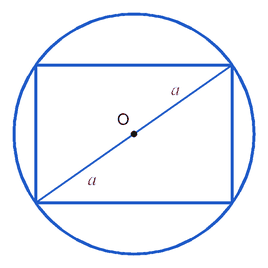
(ii) Find the dimensions of the rectangle of area 96 sq cm whose perimeter is the least. Find also its perimeter.
- 403 marks
Question 40
(i) Of all the rectangles each of which has perimeter 40 cm, find the one having maximum area. Also, find that area.
(ii) Show that the rectangle of maximum area that can be inscribed in a circle of radius is the square of side .

- 413 marks
Question 41
The volume of a closed rectangular metal box with a square base is . The cost of polishing the outer surface of the box is ₹ 4 per . Find the dimensions of the box for the minimum cost of polishing it.
- 423 marks
Question 42
(i) Find the largest possible area of a right-angled triangle whose hypotenuse is 5 cm long.
(ii) Show that of all right triangles inscribed in a circle, the triangle with maximum perimeter is isosceles.
(iii) is a diameter of a circle and is any point on the circle. Show that the area of is maximum, when it is isosceles.
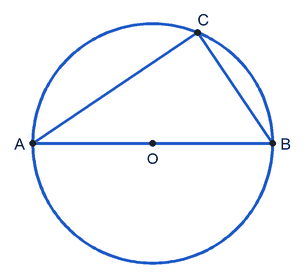
- 433 marks
Question 43
(i) The section of a window consists of a rectangle surmounted by an equilateral triangle. If the perimeter is given to be 16 metres, find the width of the window in order that the maximum amount of light may be admitted.
(ii) A figure consists of semi-circle with a rectangle on its diameter. If its perimeter is cm, find its dimensions so that its area is maximum.
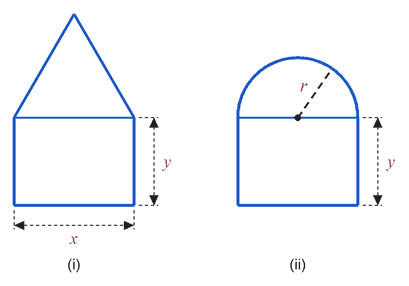
- 443 marks
Question 44
The perimeter of a sector of a circle is constant. What will be the angle of the sector, if the area of the sector were to be maximum?
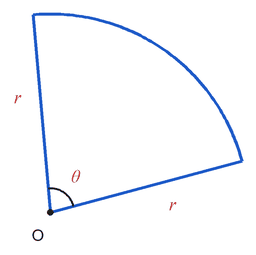
- 453 marks
Question 45
Show that the surface area of a closed cuboid with square base and given volume is minimum when it is a cube.
- 463 marks
Question 46
An open box with a square base is to be made out of a given quantity of cardboard of area square units. Show that the maximum volume of the box is cubic units.
- 473 marks
Question 47
A cylinder is such that sum of its height and the circumference of its base is 10 metres. Find the greatest volume of the cylinder.
- 483 marks
Question 48
A right circular cylinder is to be made so that the sum of its radius and its height is 6 metres. Find the maximum volume of the cylinder.
- 493 marks
Question 49
Show that the height of an open cylinder of given surface and the greatest volume is equal to the radius of the base.
- 503 marks
Question 50
A wire of length '' is cut into two parts which are bent respectively in the form of a square and a circle. Show that the least value of the sum of the areas so formed is .
- 513 marks
Question 51
Given the total surface of a cone, show that when the volume of the cone is maximum, the semi-vertical angle will be .

- 523 marks
Question 52
An enemy vehicle is moving along the curve . Find the shortest distance between the vehicle and our artillery located at . Find the coordinates of the vehicle when the distance is shortest.
- 533 marks
Question 53
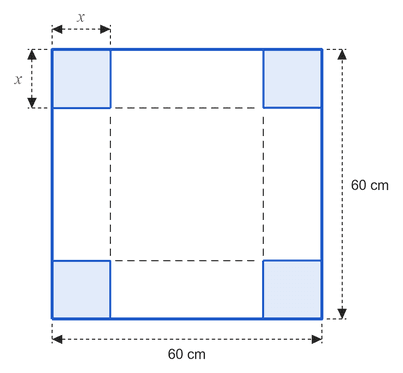
A box is to be constructed from a square metal sheet of side 60 cm by cutting out identical squares from the four corners and turning up the sides. Find the length of the side of the square to be cut out so that the box has maximum volume.
- 543 marks
Question 54
A closed right circular cylinder has volume 2156 cubic units. What should be the radius of the base so that the total surface area may be minimum? .
- 553 marks
Question 55
A rectangular sheet of tin 45 cm by 24 cm is to be made into box without top, by cutting off squares from the corners and folding up the flaps. What should be the side of the square to be cut off so that the volume of the box is maximum possible?

- 563 marks
Question 56
Prove that the right circular cone of maximum volume which can be inscribed in a sphere of radius has its altitude equal to .

- 573 marks
Question 57
Find the volume of the largest right circular cylinder that can be inscribed in a sphere of radius .

- 583 marks
Question 58
A tank with rectangular base and rectangular sides, open at the top is to be constructed so that its depth is 2 m and volume is . If building of the tank costs ₹ 70 per square metre for the base and ₹ 45 per square metre for the sides, what is the cost of the least expensive tank?
- 593 marks
Question 59
Assuming that the stiffness of a beam of rectangular cross-section varies as the breadth and as the cube of the depth, what must be the breadth of the stiffest beam that can be cut from a log of diameter .

- 603 marks
Question 60
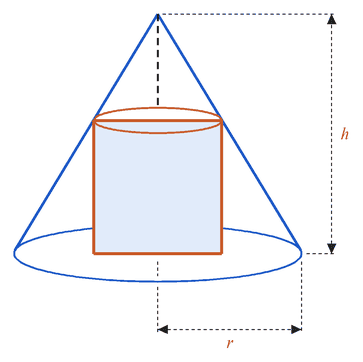
Show that the radius of the right circular cylinder of greatest curved surface which can be inscribed in a cone is half of that of the cone.
What Class 12 Maths Ch 10 covers
The sections of the chapter, in the order the book takes them. Every question above comes from one of these.
- 01Local Maxima and Minima
- 02Points of Inflexion and Tests for Turning Points
- 03Absolute Maximum and Minimum in a Closed Interval
- 04Practical Problems on Maxima and Minima
More ways to study this chapter
The same chapter asked three other ways. Practise it, revise it, and see what the board has set on Ch 10 before.
- Competency-Based Questions (CBQ)Case study questions: a situation, and the part of the chapter that answers it.42questionsOpen
- Previous Year QuestionsQuestions that have actually appeared in board papers, each tagged with its year.19questionsOpen
- Practice QuestionsExtra questions per chapter, for when one attempt at a method is not enough.119questionsOpen
Ch 10 in past ISC papers
The same chapter as the board has actually asked it. These are worded differently from the textbook exercise, which is the point of reading them.
- 15 marks
Board paper question 1
Show that the rectangle of maximum perimeter which can be inscribed in a circle of radius 10 cm is a square of side cm.
Solve with AIWritten solution
Solution:
Key idea: A rectangle inscribed in a circle has the diameter as its diagonal (the right angle at a corner stands on a diameter). We write the perimeter as a function of one side, find where its derivative is zero, and confirm a maximum with the second derivative.
Step 1 — Relate the two sides.
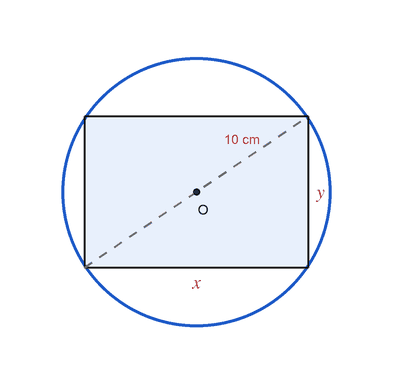
Let the sides of the rectangle be cm and cm. Its diagonal is a diameter of the circle, so the diagonal is cm. By Pythagoras' theorem, .
Step 2 — Write the perimeter in terms of x.
The perimeter is twice the sum of the sides.
Step 3 — Find the critical point.
We differentiate with respect to and set the derivative equal to zero.
Squaring both sides (both sides are positive) gives the value of .
Step 4 — Check that it is a maximum.
We differentiate once more. The derivative of is .
This is negative for every between and , so has a maximum at .
Step 5 — Find the other side.
We put into the relation from Step 1.
Both sides equal cm, so the rectangle is a square.
Therefore, the rectangle of maximum perimeter inscribed in a circle of radius 10 cm is a square of side cm.
- 25 marks
Board paper question 2
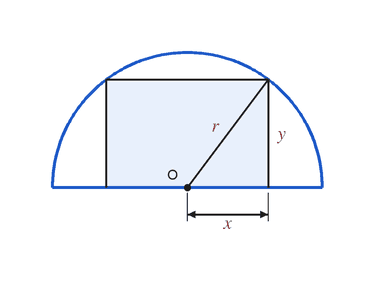
A rectangle is inscribed in a semicircle of radius r with one of its sides on the diameter of the semicircle. Find the dimensions of the rectangle to get maximum area. Also, find the maximum area.
Solve with AIWritten solution
Solution:
Key idea: Place the rectangle symmetrically on the diameter, with its top corners on the semicircle. Expressing the area in one variable and maximising its square (which is largest exactly when is largest, since ) avoids differentiating a square root.
Step 1 — Choose the variables.
Let the centre of the semicircle be . Let the side on the diameter be , with on each side of , and let the height be . A top corner lies on the semicircle, so .
Step 2 — Write the area.
The area is length times height.
We work with instead.
Step 3 — Find the critical point.
We differentiate and set the derivative equal to zero.
Since , we get .
Step 4 — Check that it is a maximum.
We find the second derivative and put .
This is negative, so , and hence , is greatest at .
Step 5 — Find the dimensions and the area.
The length is , and the height comes from Step 1.
The maximum area is the product of these two lengths.
Therefore, the rectangle of maximum area has length (along the diameter) and breadth , and the maximum area is square units.
- 35 marks
Board paper question 3
Show that the surface area of a closed cuboid with square base and given volume is minimum when it is a cube.
Solve with AIWritten solution
Solution:
Key idea: Use the fixed volume to remove the height, so the surface area becomes a function of the base side alone. Then a zero first derivative and a positive second derivative give the minimum.
Step 1 — Set up the variables.
Let the square base have side and let the height be . The volume is fixed.
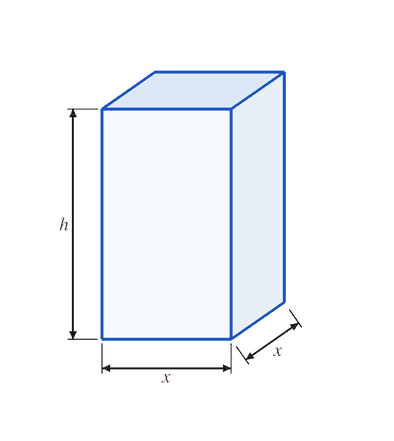
Step 2 — Write the surface area in terms of x.
A closed cuboid has two square faces (top and base) and four rectangular faces.
Step 3 — Find the critical point.
We differentiate with respect to and set the derivative equal to zero.
Step 4 — Check that it is a minimum.
We differentiate again.
This is positive for every , so has a minimum where .
Step 5 — Compare the height with the side.
We put into the expression for .
The height equals the side of the base, so all edges are equal and the cuboid is a cube.
Therefore, the surface area of a closed cuboid with a square base and given volume is least when the cuboid is a cube.
- 46 marks
Board paper question 4
A cone is inscribed in a sphere of radius 12 cm. If the volume of the cone is maximum, find its height.
Solve with AIWritten solution
Solution:
Key idea: For a cone inscribed in a sphere, the vertex is on the sphere and the base circle lies on the sphere. If the height is and the sphere's radius is , the base radius satisfies . The volume then depends on alone, and we maximise it.
Step 1 — Relate r and h.
Let be the centre of the sphere, with cm. Put the vertex on the sphere, and let the base centre be on the diameter through , so and . A point of the base circle is at distance from , so by Pythagoras' theorem .

Step 2 — Write the volume in terms of h.
The volume of a cone is .
Step 3 — Find the critical point.
We differentiate and set the derivative equal to zero.
Since , the critical point is .
Step 4 — Check that it is a maximum.
We find the second derivative at .
This is negative, so the volume is greatest when cm.
For this height, the base radius follows from Step 1.
Watch out: The height is of the sphere's radius, not its diameter; the base lies below the centre, at cm from it.
Therefore, the height of the cone of maximum volume is 16 cm.
- 56 marks
Board paper question 5
The volume of a closed rectangular metal box with a square base is . The cost of polishing the outer surface of the box is Rs 4 per cm. Find the dimensions of the box for the minimum cost of polishing it.
Solve with AIWritten solution
Solution:
Key idea: The cost of polishing is ₹ 4 for every square centimetre, so the cost is least exactly when the outer surface area is least. We use the fixed volume to write the surface area in one variable and minimise it.
Step 1 — Set up the variables.
Let the square base have side cm and let the height be cm. The volume is .
Step 2 — Write the surface area in terms of x.
The closed box has two square faces and four rectangular faces.
The cost is rupees, so it is least when is least.
Step 3 — Find the critical point.
We differentiate and set the derivative equal to zero.
Step 4 — Check that it is a minimum.
We differentiate again.
This is positive for , so (and the cost) is least at .
Step 5 — Find the height and the least cost.
We put into the expression for .
The least surface area and its cost follow.
At ₹ 4 per , we multiply the least area by 4 to get the least cost in rupees.
So the least cost is ₹ 6144.
Therefore, the box should be a cube of side 16 cm (base 16 cm by 16 cm, height 16 cm); the least polishing cost is ₹ 6144.
- 66 marks
Board paper question 6
Find the point on the straight line 2x+3y=6, which is closest to the origin.
Solve with AIWritten solution
Solution:
Key idea: The point closest to the origin makes the distance least. Minimising the square of the distance gives the same point and is easier, because there is no square root.
Step 1 — Write y in terms of x.
A point on the line satisfies the equation below.
Step 2 — Write the square of the distance.
Let be the square of the distance of from the origin.
Step 3 — Find the critical point.
We differentiate with respect to and set the derivative equal to zero.
Step 4 — Check that it is a minimum.
We differentiate again.
This is positive, so is least at .
Step 5 — Find y.
We put into the expression from Step 1.
Step 6 — Check with geometry.
The least distance is also the perpendicular distance from the origin to the line .
For our point, we compute the square of the distance directly.
Since is also , the two methods agree.
Therefore, the point of the line closest to the origin is .
All 19 board paper questions for this chapter, solved the same way.
Class 12 Maths Ch 10 questions students ask
How many questions are there in Class 12 Maths Ch 10?
60 questions. Every one is solved step by step on this page.
Are these Class 12 Maths solutions free?
Yes. Every question and its full working is free to read, with no account needed.
Can I download the Class 12 Maths Ch 10 solutions as a PDF?
There is no PDF to download. Every solution is on this page instead, which means it is searchable, always the current syllabus, and readable on a phone. Use your browser's print option if you want it on paper.