
Question 35 marksAsked 2017Medium
Show that the surface area of a closed cuboid with square base and given volume is minimum when it is a cube.
Confirming your payment
Sign up now and get 250 free tokens.
Previous Year Questions · Question 3 of 19
Show that the surface area of a closed cuboid with square base and given volume is minimum when it is a cube.
Solution:
Key idea: Use the fixed volume to remove the height, so the surface area becomes a function of the base side alone. Then a zero first derivative and a positive second derivative give the minimum.
Step 1 — Set up the variables.
Let the square base have side and let the height be . The volume is fixed.
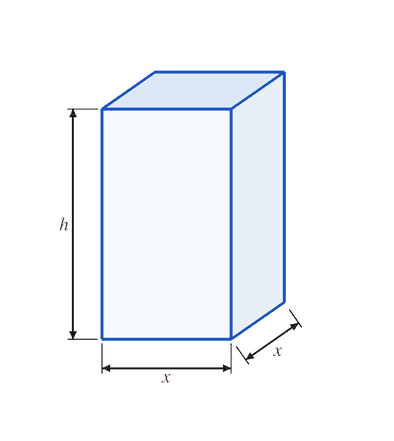
Step 2 — Write the surface area in terms of x.
A closed cuboid has two square faces (top and base) and four rectangular faces.
Step 3 — Find the critical point.
We differentiate with respect to and set the derivative equal to zero.
Step 4 — Check that it is a minimum.
We differentiate again.
This is positive for every , so has a minimum where .
Step 5 — Compare the height with the side.
We put into the expression for .
The height equals the side of the base, so all edges are equal and the cuboid is a cube.
Therefore, the surface area of a closed cuboid with a square base and given volume is least when the cuboid is a cube.