
Opening your dashboard
Class 12 Maths Chapter 10 Maxima and Minima: Previous Year Questions
19 questions on Chapter 10, each solved step by step. Class 12 Maths, ICSE 2026-27.
19 questions with solutions
1–6 marks · Mixed difficulty
The first 11 solutions are on this page. This chapter is a long one, so the rest open on their own page to keep this one quick to load.
- 15 marks
Question 1
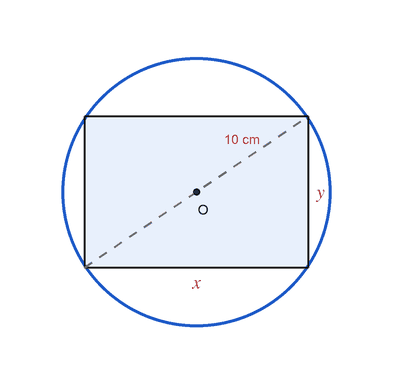
Show that the rectangle of maximum perimeter which can be inscribed in a circle of radius 10 cm is a square of side cm.
Solve with AIWritten solution
Solution:
Key idea: A rectangle inscribed in a circle has the diameter as its diagonal (the right angle at a corner stands on a diameter). We write the perimeter as a function of one side, find where its derivative is zero, and confirm a maximum with the second derivative.
Step 1 — Relate the two sides.
Let the sides of the rectangle be cm and cm. Its diagonal is a diameter of the circle, so the diagonal is cm. By Pythagoras' theorem, .
Step 2 — Write the perimeter in terms of x.
The perimeter is twice the sum of the sides.
Step 3 — Find the critical point.
We differentiate with respect to and set the derivative equal to zero.
Squaring both sides (both sides are positive) gives the value of .
Step 4 — Check that it is a maximum.
We differentiate once more. The derivative of is .
This is negative for every between and , so has a maximum at .
Step 5 — Find the other side.
We put into the relation from Step 1.
Both sides equal cm, so the rectangle is a square.
Therefore, the rectangle of maximum perimeter inscribed in a circle of radius 10 cm is a square of side cm.
- 25 marks
Question 2
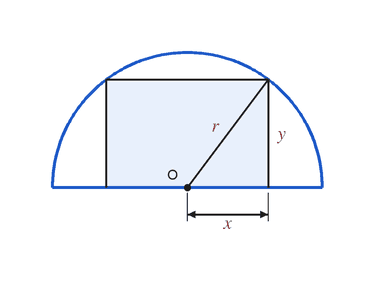
A rectangle is inscribed in a semicircle of radius r with one of its sides on the diameter of the semicircle. Find the dimensions of the rectangle to get maximum area. Also, find the maximum area.
Solve with AIWritten solution
Solution:
Key idea: Place the rectangle symmetrically on the diameter, with its top corners on the semicircle. Expressing the area in one variable and maximising its square (which is largest exactly when is largest, since ) avoids differentiating a square root.
Step 1 — Choose the variables.
Let the centre of the semicircle be . Let the side on the diameter be , with on each side of , and let the height be . A top corner lies on the semicircle, so .
Step 2 — Write the area.
The area is length times height.
We work with instead.
Step 3 — Find the critical point.
We differentiate and set the derivative equal to zero.
Since , we get .
Step 4 — Check that it is a maximum.
We find the second derivative and put .
This is negative, so , and hence , is greatest at .
Step 5 — Find the dimensions and the area.
The length is , and the height comes from Step 1.
The maximum area is the product of these two lengths.
Therefore, the rectangle of maximum area has length (along the diameter) and breadth , and the maximum area is square units.
- 35 marks
Question 3
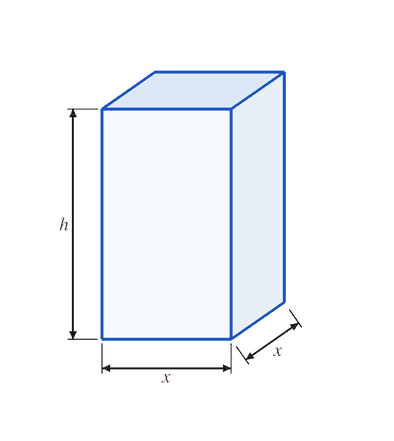
Show that the surface area of a closed cuboid with square base and given volume is minimum when it is a cube.
Solve with AIWritten solution
Solution:
Key idea: Use the fixed volume to remove the height, so the surface area becomes a function of the base side alone. Then a zero first derivative and a positive second derivative give the minimum.
Step 1 — Set up the variables.
Let the square base have side and let the height be . The volume is fixed.
Step 2 — Write the surface area in terms of x.
A closed cuboid has two square faces (top and base) and four rectangular faces.
Step 3 — Find the critical point.
We differentiate with respect to and set the derivative equal to zero.
Step 4 — Check that it is a minimum.
We differentiate again.
This is positive for every , so has a minimum where .
Step 5 — Compare the height with the side.
We put into the expression for .
The height equals the side of the base, so all edges are equal and the cuboid is a cube.
Therefore, the surface area of a closed cuboid with a square base and given volume is least when the cuboid is a cube.
- 46 marks
Question 4
A cone is inscribed in a sphere of radius 12 cm. If the volume of the cone is maximum, find its height.
Solve with AIWritten solution
Solution:
Key idea: For a cone inscribed in a sphere, the vertex is on the sphere and the base circle lies on the sphere. If the height is and the sphere's radius is , the base radius satisfies . The volume then depends on alone, and we maximise it.
Step 1 — Relate r and h.
Let be the centre of the sphere, with cm. Put the vertex on the sphere, and let the base centre be on the diameter through , so and . A point of the base circle is at distance from , so by Pythagoras' theorem .

Step 2 — Write the volume in terms of h.
The volume of a cone is .
Step 3 — Find the critical point.
We differentiate and set the derivative equal to zero.
Since , the critical point is .
Step 4 — Check that it is a maximum.
We find the second derivative at .
This is negative, so the volume is greatest when cm.
For this height, the base radius follows from Step 1.
Watch out: The height is of the sphere's radius, not its diameter; the base lies below the centre, at cm from it.
Therefore, the height of the cone of maximum volume is 16 cm.
- 56 marks
Question 5
The volume of a closed rectangular metal box with a square base is . The cost of polishing the outer surface of the box is Rs 4 per cm. Find the dimensions of the box for the minimum cost of polishing it.
Solve with AIWritten solution
Solution:
Key idea: The cost of polishing is ₹ 4 for every square centimetre, so the cost is least exactly when the outer surface area is least. We use the fixed volume to write the surface area in one variable and minimise it.
Step 1 — Set up the variables.
Let the square base have side cm and let the height be cm. The volume is .
Step 2 — Write the surface area in terms of x.
The closed box has two square faces and four rectangular faces.
The cost is rupees, so it is least when is least.
Step 3 — Find the critical point.
We differentiate and set the derivative equal to zero.
Step 4 — Check that it is a minimum.
We differentiate again.
This is positive for , so (and the cost) is least at .
Step 5 — Find the height and the least cost.
We put into the expression for .
The least surface area and its cost follow.
At ₹ 4 per , we multiply the least area by 4 to get the least cost in rupees.
So the least cost is ₹ 6144.
Therefore, the box should be a cube of side 16 cm (base 16 cm by 16 cm, height 16 cm); the least polishing cost is ₹ 6144.
- 66 marks
Question 6
Find the point on the straight line 2x+3y=6, which is closest to the origin.
Solve with AIWritten solution
Solution:
Key idea: The point closest to the origin makes the distance least. Minimising the square of the distance gives the same point and is easier, because there is no square root.
Step 1 — Write y in terms of x.
A point on the line satisfies the equation below.
Step 2 — Write the square of the distance.
Let be the square of the distance of from the origin.
Step 3 — Find the critical point.
We differentiate with respect to and set the derivative equal to zero.
Step 4 — Check that it is a minimum.
We differentiate again.
This is positive, so is least at .
Step 5 — Find y.
We put into the expression from Step 1.
Step 6 — Check with geometry.
The least distance is also the perpendicular distance from the origin to the line .
For our point, we compute the square of the distance directly.
Since is also , the two methods agree.
Therefore, the point of the line closest to the origin is .
- 76 marks
Question 7
Show that the radius of a closed right circular cylinder of given surface area and maximum volume is equal to half of its height.
Solve with AIWritten solution
Solution:
Key idea: With the total surface area fixed, write the height in terms of the radius, so the volume depends on the radius alone. At the maximum, the condition gives a relation between and .
Step 1 — Use the fixed surface area.
A closed cylinder of radius and height has two circular ends and a curved surface.

Step 2 — Write the volume in terms of r.
The volume is . We substitute the expression for .
Step 3 — Find the critical point.
We differentiate with respect to (remember that is a constant) and set the derivative equal to zero.
Step 4 — Check that it is a maximum.
We differentiate again.
This is negative for , so is greatest when .
Step 5 — Relate r and h.
We put into the surface-area formula of Step 1.
So .
Therefore, for a closed cylinder of given surface area and maximum volume, the radius equals half the height.
- 86 marks
Question 8
Prove that the area of right-angled triangle of given hypotenuse is maximum when the triangle is isosceles.
Solve with AIWritten solution
Solution:
Key idea: With the hypotenuse fixed, the two legs are linked by Pythagoras' theorem. Write the area in terms of one leg and maximise its square (the area is positive, so the square is largest at the same point).
Step 1 — Set up the variables.
Let the fixed hypotenuse be , and let the legs be and . By Pythagoras' theorem, .

Step 2 — Write the area and its square.
The area of a right-angled triangle is half the product of the legs.
Step 3 — Find the critical point.
We differentiate and set the derivative equal to zero.
Since , we get .
Step 4 — Check that it is a maximum.
We find the second derivative at .
This is negative, so , and hence the area, is greatest when .
Step 5 — Compare the legs.
We find from Step 1.
So , which means . The two legs are equal, so the triangle is isosceles.
Therefore, the area of a right-angled triangle with a given hypotenuse is greatest when the triangle is isosceles.
- 96 marks
Question 9
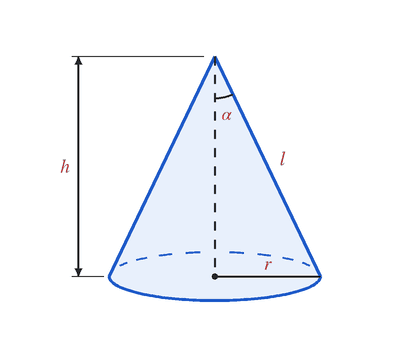
Prove that the semi-vertical angle of the right circular cone of given volume and least curved surface is .
Solve with AIWritten solution
Solution:
Key idea: With the volume fixed, write the curved surface area in terms of the radius alone, where the slant height is . Minimise , which avoids square roots, and then find the semi-vertical angle from .
Step 1 — Use the fixed volume.
Let the cone have radius and height .
Step 2 — Write the square of the curved surface area.
The slant height satisfies .
Step 3 — Find the critical point.
Let . We differentiate with respect to and set the derivative equal to zero.
Step 4 — Check that it is a minimum.
We differentiate again.
This is positive, so , and hence , is least at this point.
Step 5 — Relate h and r.
We replace by , so .
Step 6 — Find the semi-vertical angle.
The semi-vertical angle is the angle between the axis and a slant side, so .
Therefore, the curved surface is least when the semi-vertical angle is .
- 106 marks
Question 10
A running track of m is to be laid out enclosing a football field. The football field is in the shape of a rectangle with a semi-circle at each end. If the area of the rectangular portion is to be maximum, then find the length of its sides. Also calculate the area of the football field.
Solve with AIWritten solution
Solution:
Key idea: The track runs round the boundary of the field: two straight lengths of the rectangle and two semicircles. The width of the rectangle is the diameter of each semicircle. We express the rectangle's area in one variable and maximise it.
Step 1 — Set up the variables.
Let the length of the rectangle be m and the radius of each semicircle be m, so the width of the rectangle is m. The two semicircles together make one full circle, of circumference .

Step 2 — Write the area of the rectangle.
The area is length times width.
Step 3 — Find the critical point.
We differentiate and set the derivative equal to zero.
Step 4 — Check that it is a maximum.
We differentiate again.
This is negative, so the area of the rectangle is greatest at .
Step 5 — Find the sides of the rectangle.
We put into the expression for , and double for the width. Taking :
Step 6 — Find the area of the football field.
The field is the rectangle plus two semicircles of radius m (one full circle).
Note: With the exact value of , the width is m and the field's area is ; the values above use .
Therefore, the rectangle's sides are 110 m and 70 m, and the area of the football field is 11550 m² (taking π = 22/7).
- 116 marks
Question 11
Mrs. Roy designs a window in her son's study room so that the room gets maximum sunlight. She designs the window in the shape of a rectangle surmounted by an equilateral triangle. If the perimeter of the window is 12 m, find the dimensions of the window that will admit maximum sunlight into the room.
 Solve with AI
Written solution
Solution:
Key idea: Maximum sunlight means maximum area of the window. The window is a rectangle of width and height with an equilateral triangle of side on top. The perimeter (the outer boundary only) fixes a relation between and , so the area becomes a function of alone.
Step 1 — Use the perimeter.
The outer boundary is the base , the two vertical sides and , and the two slant sides of the triangle, each . The top side of the rectangle is inside the window, so it is not part of the perimeter.
Step 2 — Write the area.
The area of an equilateral triangle of side is .
Step 3 — Find the critical point.
We differentiate and set the derivative equal to zero.
Step 4 — Check that it is a maximum.
We differentiate again.
Since , this is negative, so the area is greatest at this value of .
Step 5 — Simplify x and find y.
We rationalise the denominator of by multiplying by , using .
Now we find from Step 1.
Numerically, m and m.
Therefore, for maximum sunlight the width of the window (the side of the triangle) is m and the height of the rectangular part is m.
- 126 marks
Question 12
Sumit has bought a closed cylindrical dustbin. The radius of the dustbin is 'r' cm and height is 'h' cm. It has a volume of .
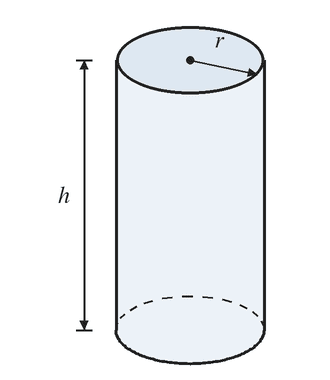
a. Express 'h' in terms of 'r', using the given volume.
b. Prove that the total surface area of the dustbin is
c. Sumit wants to paint the dustbin. The cost of painting the base and top of the dustbin is ₹ 2 per and the cost of painting the curved side is ₹ 25 per . Find the total cost in terms of 'r', for painting the outer surface of the dustbin including the base and top.
d. Calculate the minimum cost for painting the dustbin.
- 132 marks
Question 13
If , show that attains its minimum value at .
- 144 marks
Question 14
The graph of is given below:

(a) Find the slope of the above graph. [1]
(b) Find the co-ordinates of turning points, A and B. [2]
(c) Evaluate , and and arrange them in ascending order. [1]
- 151 mark
Question 15
A van is carrying a large amount of money in cash to deposit it in two ATM machines on a hill station. The location of these machines is at the turning points of the path traced by the van, given by the equation where is the height of the hill (in 100 m) at any point .
(i) Prove that the van is at the height of 300 m when it starts moving.
- 162 marks
Question 16
A van is carrying a large amount of money in cash to deposit it in two ATM machines on a hill station. The location of these machines is at the turning points of the path traced by the van, given by the equation where is the height of the hill (in 100 m) at any point .
(ii) Find the location of the two ATM machines.
- 171 mark
Question 17
A van is carrying a large amount of money in cash to deposit it in two ATM machines on a hill station. The location of these machines is at the turning points of the path traced by the van, given by the equation where is the height of the hill (in 100 m) at any point .
(iii) Calculate the difference between the heights of the location of the two ATM machines.
- 181 mark
Question 18
A van is carrying a large amount of money in cash to deposit it in two ATM machines on a hill station. The location of these machines is at the turning points of the path traced by the van, given by the equation where is the height of the hill (in 100 m) at any point .
(iv) If the difference in the height of the location of the two ATM machines is greater than 1 km, then an extra armed security guard will be required.
Based on the difference calculated in subpart (iii), determine if an extra armed guard will be required to protect the van.
- 191 mark
Question 19
A van is carrying a large amount of money in cash to deposit it in two ATM machines on a hill station. The location of these machines is at the turning points of the path traced by the van, given by the equation where is the height of the hill (in 100 m) at any point .
(v) Find the absolute maxima and absolute minima for in .