Solution:
Key idea: Use the fixed volume to remove h. The painting cost is (area of the two ends) × ₹ 2 + (curved area) × ₹ 25, which becomes a function of r alone; we then minimise it with the first and second derivatives.
Step 1 — Part a: express h in terms of r.
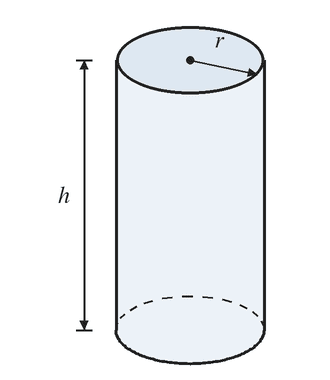
The volume of a cylinder is πr2h, and it equals 20π.
πr2h=20π
h=r220
Step 2 — Part b: total surface area.
A closed cylinder has two circular ends, of total area 2πr2, and a curved surface of area 2πrh. We substitute the value of h.
TSA=2πr2+2πr⋅r220
TSA=2πr2+r40π
This is the required result.
Step 3 — Part c: cost in terms of r.
The two ends cost ₹ 2 per cm2 and the curved side costs ₹ 25 per cm2. The curved area is r40π from Step 2. Let C be the cost in rupees.
C=2(2πr2)+25(r40π)
C=4πr2+r1000π
Step 4 — Part d: find the critical point.
We differentiate C with respect to r and set the derivative equal to zero.
drdC=8πr−r21000π
8r3=1000
r3=125
r=5
Step 5 — Check that it is a minimum.
We differentiate again.
dr2d2C=8π+r32000π
This is positive for r>0, so the cost is least at r=5 cm. The matching height comes from part a.
h=2520
h=0.8 cm
Step 6 — Calculate the minimum cost.
We put r=5 into the cost function.
C=4π(25)+51000π
C=100π+200π
C=300π
Taking π=722, the minimum cost is about ₹ 942.86 (with π≈3.1416 it is about ₹ 942.48).
Therefore, a. h=r220; b. TSA =2πr2+r40π; c. cost =4πr2+r1000π rupees; d. the minimum cost is 300π rupees, about ₹ 942.86, when r=5 cm.