
Question 15 marksAsked 2015Medium
Show that the rectangle of maximum perimeter which can be inscribed in a circle of radius 10 cm is a square of side cm.
Confirming your payment
Sign up now and get 250 free tokens.
Previous Year Questions · Question 1 of 19
Show that the rectangle of maximum perimeter which can be inscribed in a circle of radius 10 cm is a square of side cm.
Solution:
Key idea: A rectangle inscribed in a circle has the diameter as its diagonal (the right angle at a corner stands on a diameter). We write the perimeter as a function of one side, find where its derivative is zero, and confirm a maximum with the second derivative.
Step 1 — Relate the two sides.
Let the sides of the rectangle be cm and cm. Its diagonal is a diameter of the circle, so the diagonal is cm. By Pythagoras' theorem, .
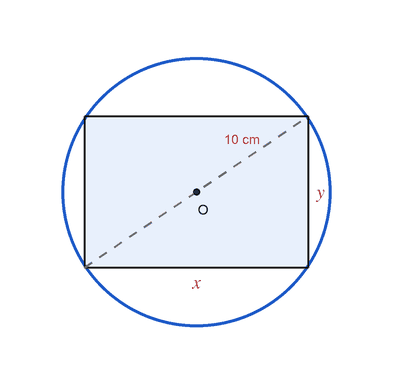
Step 2 — Write the perimeter in terms of x.
The perimeter is twice the sum of the sides.
Step 3 — Find the critical point.
We differentiate with respect to and set the derivative equal to zero.
Squaring both sides (both sides are positive) gives the value of .
Step 4 — Check that it is a maximum.
We differentiate once more. The derivative of is .
This is negative for every between and , so has a maximum at .
Step 5 — Find the other side.
We put into the relation from Step 1.
Both sides equal cm, so the rectangle is a square.
Therefore, the rectangle of maximum perimeter inscribed in a circle of radius 10 cm is a square of side cm.