
Question 603 marksMedium
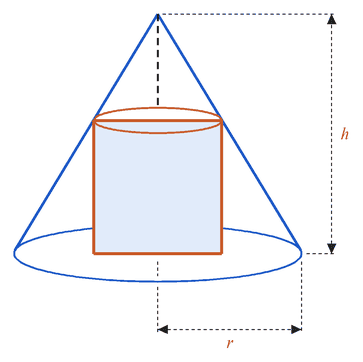
Show that the radius of the right circular cylinder of greatest curved surface which can be inscribed in a cone is half of that of the cone.
Confirming your payment
Sign up now and get 250 free tokens.
Maxima and Minima · Question 60 of 60
Show that the radius of the right circular cylinder of greatest curved surface which can be inscribed in a cone is half of that of the cone.
Solution:
Concept: In the vertical section through the axis, the inscribed cylinder appears as a rectangle standing on the base of the cone with its top corners on the slant sides. Similar triangles give the height of the cylinder in terms of its radius; then we maximise the curved surface .
Step 1 — Name the lengths.
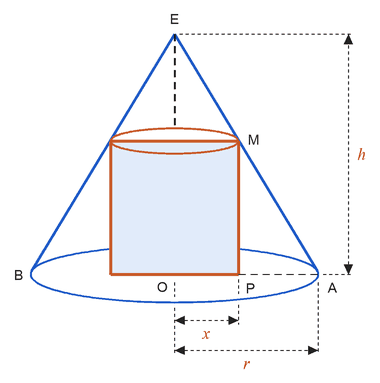
Let the cone have vertex , base centre , base radius , and height .
Let the cylinder have radius , where lies on , and let its top rim meet the slant side at , so its height is . Here .
Step 2 — Find the height of the cylinder.
The triangles and are similar, because both have a right angle at the base and they share the angle at . So their sides are in proportion, and .
Step 3 — Write the curved surface as a function of .
The curved surface of the cylinder is .
Step 4 — Find the critical point.
We differentiate ( and are constants) and set the derivative equal to zero.
Step 5 — Check that this gives a maximum.
We differentiate again. The result is a negative constant.
So the curved surface is greatest at .
Therefore, the cylinder of greatest curved surface inscribed in a cone has radius , half the radius of the cone. Hence proved.