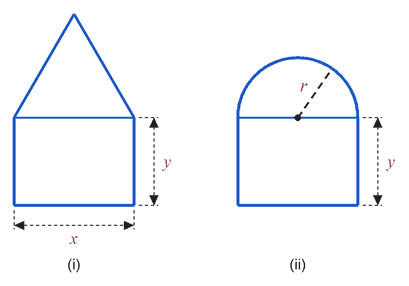
(i) The section of a window consists of a rectangle surmounted by an equilateral triangle.
Question 433 marksMedium
(i) The section of a window consists of a rectangle surmounted by an equilateral triangle. If the perimeter is given to be 16 metres, find the width of the window in order that the maximum amount of light may be admitted.
(ii) A figure consists of semi-circle with a rectangle on its diameter. If its perimeter is k cm, find its dimensions so that its area is maximum.
Solution:
Key idea: The light admitted is proportional to the area of the window (or figure). We use the fixed perimeter to write the area in one variable and then maximise it. Only the outer boundary counts in the perimeter; the common side inside the figure does not.
Step 1 — Part (i): use the perimeter to find the height.
Let the width be x m and the height of the rectangle be y m. The equilateral triangle on top has all its sides equal to x. The outer boundary is the base x, the two vertical sides 2y and the two slant sides 2x.
3x+2y=16
y=216−3x
Step 2 — Part (i): write the area.
The area is the rectangle plus the equilateral triangle (area 43x2).
A=xy+43x2
A=8x−23x2+43x2
Step 3 — Part (i): find the stationary point.
We differentiate with respect to x.
dxdA=8−3x+23x
Setting this to zero and multiplying by 2 gives the value of x.
(6−3)x=16
x=6−316
Step 4 — Part (i): check that it is a maximum and work out the width.
The second derivative is −3+23, which is about −2.13; it is negative, so the area (and the light) is greatest at this width. Using 3≈1.732 we get a decimal value.
x=4.26816
x≈3.75
The height of the rectangle is then 216−3x, about 2.38 m.
Step 5 — Part (ii): use the perimeter to find the other side.
Let the radius of the semicircle be r cm, so the side of the rectangle on the diameter is 2r, and let the other side of the rectangle be y cm. The outer boundary is the side 2r, the two sides 2y and the arc πr.
2r+2y+πr=k
y=2k−(2+π)r
Step 6 — Part (ii): write the area.
The area is the rectangle 2r×y plus the semicircle 21πr2.
A=2ry+21πr2
A=kr−(2+π)r2+2πr2
A=kr−(2+2π)r2
Step 7 — Part (ii): find the maximum.
We differentiate with respect to r.
drdA=k−(4+π)r
Setting this to zero gives the radius.
r=π+4k
The second derivative is −(4+π), which is negative, so the area is greatest at this radius.
Step 8 — Part (ii): find the dimensions.
The side on the diameter is 2r.
2r=π+42k
We put r=π+4k into the expression for y.
y=21[k−π+4(2+π)k]
y=21×π+42k
y=π+4k
So the other side of the rectangle equals the radius.
Therefore, (i) the width of the window should be 6−316≈3.75 m; (ii) the rectangle is π+42k cm long (along the diameter) and π+4k cm wide, and the radius of the semicircle is π+4k cm.