(i) Find the largest possible area of a right-angled triangle whose hypotenuse is 5 cm long.
Question 423 marksMedium
(i) Find the largest possible area of a right-angled triangle whose hypotenuse is 5 cm long.
(ii) Show that of all right triangles inscribed in a circle, the triangle with maximum perimeter is isosceles.
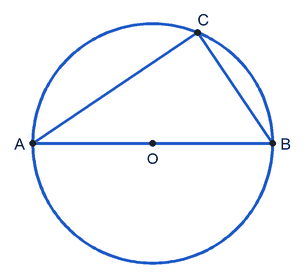
(iii)AB is a diameter of a circle and C is any point on the circle. Show that the area of ΔABC is maximum, when it is isosceles.
Solution:
Key idea: In a right-angled triangle with hypotenuse h and an acute angle θ, the legs are hcosθ and hsinθ. A right triangle inscribed in a circle has its hypotenuse along a diameter (the angle in a semicircle is a right angle), so its hypotenuse is fixed and only θ varies.
Step 1 — Part (i): write the area in terms of θ.
The hypotenuse is 5 cm. Let one acute angle be θ, with 0<θ<2π; the legs are 5cosθ and 5sinθ. We use 2sinθcosθ=sin2θ.
A=21×5cosθ×5sinθ
A=425sin2θ
Step 2 — Part (i): find the largest area.
We differentiate and set the derivative to zero.
dθdA=225cos2θ
Setting cos2θ to zero, with 0<2θ<π, gives θ=4π. We check with the second derivative.
dθ2d2A=−25sin2θ
At θ=4π this is −25. It is negative, so the area is greatest there.
A=425sin2π
A=425
Step 3 — Part (ii): write the perimeter in terms of θ.
Let the circle have radius r. The hypotenuse is a diameter, 2r. With an acute angle θ, the legs are 2rcosθ and 2rsinθ.
P=2r+2rcosθ+2rsinθ
Step 4 — Part (ii): find where the perimeter is greatest.
We differentiate with respect to θ; the constant 2r has derivative 0.
dθdP=2r(cosθ−sinθ)
Setting this to zero gives tanθ=1, so θ is 4π. We check with the second derivative.
dθ2d2P=−2r(cosθ+sinθ)
At θ=4π this is −22r. It is negative, so the perimeter is greatest there.
Step 5 — Part (ii): see that the triangle is isosceles.
At θ=4π, cosθ=sinθ, so the two legs 2rcosθ and 2rsinθ are equal. A triangle with two equal sides is isosceles.
Step 6 — Part (iii): write the area in terms of θ.
Let the radius be r, so AB=2r, and let ∠CAB=θ, as in the figure. Since AB is a diameter, ∠ACB=2π, so AC=2rcosθ and BC=2rsinθ.
Δ=21×AC×BC
Δ=2r2sinθcosθ
Δ=r2sin2θ
Step 7 — Part (iii): find where the area is greatest.
We differentiate with respect to θ.
dθdΔ=2r2cos2θ
Setting this to zero gives θ=4π. We check with the second derivative.
dθ2d2Δ=−4r2sin2θ
At θ=4π this is −4r2. It is negative, so the area is greatest there.
Step 8 — Part (iii): see that the triangle is isosceles.
At θ=4π, the third angle is found from the angle sum of the triangle.
∠ABC=2π−4π
∠ABC=4π
So ∠ABC equals ∠CAB. Sides opposite equal angles are equal, so AC=BC and ΔABC is isosceles.
Therefore, (i) the largest area is 425=6.25cm2; (ii) the right triangle of maximum perimeter inscribed in a circle has equal legs, so it is isosceles; (iii) the area of ΔABC is greatest when AC=BC, that is when the triangle is isosceles.