
Opening your dashboard
Class 12 Biology Chapter 18: Ecosystem Solutions
123 textbook questions with step-by-step answers, free to read, for ISC 2026-27.
Get talked through Ch 18, not just shown the answer
Reading a finished solution is not the same as being able to do it. The AI tutor takes one question at a time and works it with you, in your own words, until you can.
- Ask it out loud, in your own words
- It gives you the next step, not the answer
- Stuck on part (ii)? Start there
123 questions with solutions
1–5 marks · Mixed difficulty
- 11 mark
Question 1
What is an ecosystem?
Solve with AIWritten solution
Solution:
Key idea: The term ecosystem was introduced by the British ecologist A. G. Tansley in 1935. It joins the living community of an area with its non-living surroundings into one working unit.
Step 1 — Name the parts that interact.
An ecosystem has biotic (living) components, namely producers, consumers and decomposers, and abiotic (non-living) components such as water, air, soil, minerals, light and temperature.
Step 2 — Say how they work together.
The organisms interact with one another and with their physical surroundings. Through these interactions energy flows and nutrients cycle, so the unit can maintain and regulate itself.
Step 3 — Give the definition.
An ecosystem is therefore a self-sustaining and self-regulating structural and functional unit of the biosphere, in which living organisms interact among themselves and with their physical environment. A pond, a forest and a grassland are examples.
Therefore, an ecosystem is a self-sustaining, self-regulating functional unit of nature in which biotic and abiotic components interact with each other.
- 21 mark
Question 2
Name two important structural components of ecosystem?
Solve with AIWritten solution
Solution:
Key idea: The structure of an ecosystem means the parts it is made of and how they are arranged.
Step 1 — Name the non-living part.
The abiotic (non-living) components are inorganic substances such as water, CO₂ and minerals, organic substances in dead matter, and climatic factors such as light, temperature and rainfall.
Step 2 — Name the living part.
The biotic (living) components are the producers, the consumers and the decomposers.
Therefore, the two structural components of an ecosystem are the abiotic (non-living) and the biotic (living) components.
- 31 mark
Question 3
Name a man-made aquatic ecosystem?
Solve with AIWritten solution
Solution:
Key idea: Man-made (artificial or anthropogenic) ecosystems are set up and maintained by people, unlike natural ecosystems such as ponds and lakes.
Step 1 — Look for a water-based ecosystem made by people.
An aquarium holds water, water plants (producers), fish and snails (consumers) and microbes (decomposers), all chosen and kept by a person who adds food and keeps the water clean.
Step 2 — Name it.
So an aquarium is a man-made aquatic ecosystem. A fish farm pond is another example.
Therefore, an aquarium is a man-made aquatic ecosystem.
- 41 mark
Question 4
What name is given to man made ecosystems?
Solve with AIWritten solution
Solution:
Key idea: Ecosystems are grouped as natural ecosystems, such as forests and lakes, and ecosystems created and managed by humans.
Step 1 — Recall examples of man-made ecosystems.
Crop fields, gardens, orchards and aquariums are set up by people, who also control the inputs such as water, fertiliser and food.
Step 2 — Give the name.
Ecosystems made by humans are called anthropogenic (artificial) ecosystems.
Therefore, man-made ecosystems are called anthropogenic (artificial) ecosystems.
- 51 mark
Question 5
Name various types of consumers?
Solve with AIWritten solution
Solution:
Key idea: Consumers are heterotrophs: they cannot make their own food and obtain it by feeding on other organisms.
Step 1 — Group consumers by what they eat.
By their food, consumers are of three main types:
- Herbivores eat plants, for example cows, deer and grasshoppers.
- Carnivores eat other animals, for example frogs, lions and tigers.
- Omnivores eat both plants and animals, for example humans, bears and crows.
Step 2 — Group consumers by trophic level.
By their position in a food chain, consumers are primary consumers (herbivores), secondary consumers (carnivores that eat herbivores) and tertiary consumers (carnivores that eat other carnivores).
Therefore, the types of consumers are herbivores, carnivores and omnivores, which by trophic level are primary, secondary and tertiary consumers.
- 61 mark
Question 6
Which groups live directly on plants or autotrophs?
Solve with AIWritten solution
Solution:
Key idea: Autotrophs, mainly green plants, make their own food and form the first trophic level. Every other organism depends on them for food, directly or indirectly.
Step 1 — Find the group that eats autotrophs directly.
Animals such as cows, rabbits, deer and grasshoppers feed directly on green plants. These plant-eaters are the herbivores.
Step 2 — Place them in the food chain.
Because they are the first consumers of the food made by plants, herbivores are called primary consumers and form the second trophic level.
Therefore, herbivores (the primary consumers) feed directly on plants or autotrophs.
- 71 mark
Question 7
Do carnivores eat plants?
Solve with AIWritten solution
Solution:
Key idea: Consumers are grouped by their food: herbivores eat plants, carnivores eat animals, and omnivores eat both.
Step 1 — Recall what carnivores eat.
Carnivores, such as lions, tigers and frogs, feed on the flesh of other animals, either herbivores or other carnivores. Their teeth and digestive systems are suited to digesting meat, not plant matter.
Step 2 — Compare them with omnivores.
Animals that eat both plants and animals, such as humans and bears, are omnivores, not carnivores. So a carnivore does not take plants as its food.
Therefore, no: carnivores do not eat plants; they feed on herbivores or other animals.
- 81 mark
Question 8
What do decomposers eat?
Solve with AIWritten solution
Solution:
Key idea: Decomposers are the bacteria and fungi of an ecosystem. They break down dead organic matter and return its nutrients to the soil, so that producers can use them again.
Step 1 — Name the decomposers.
Decomposers are heterotrophic organisms, mainly bacteria and fungi, that get their food from dead organic matter rather than from living organisms.
Step 2 — Say what they feed on.
Their food is detritus: dead plant remains such as fallen leaves, bark, flowers and dead roots, the remains of dead animals, and faecal matter.
Step 3 — Explain how they take in this food.
Decomposers do not swallow their food. They secrete digestive enzymes onto the dead matter, break it down outside their bodies into simple soluble substances, and then absorb these substances. In doing so they release inorganic nutrients that green plants take up again.
Therefore, decomposers feed on dead and decaying plant and animal matter (detritus), which they digest outside their bodies and absorb.
- 91 mark
Question 9
What is another name given to decomposers?
Solve with AIWritten solution
Solution:
Key idea: Organisms are often named after the way they obtain food. The word part sapro means decaying or rotten and troph means nourishment.
Step 1 — Recall how decomposers feed.
Decomposers digest dead and decaying organic matter outside their bodies with secreted enzymes and absorb the soluble products.
Step 2 — Give the name for this way of feeding.
Organisms that feed by absorbing nutrients from dead and decaying matter are called saprotrophs. Older books call them saprophytes, but phyte means plant, and bacteria and fungi are not plants, so saprotroph is the term used today.
Step 3 — Give the ecological name as well.
In an ecosystem, decomposers are also called microconsumers, because they are mostly microscopic consumers of dead organic matter.
Therefore, decomposers are also called saprotrophs (older name: saprophytes), or microconsumers.
- 101 mark
Question 10
What does gross primary productivity refer to (GPP)?
Solve with AIWritten solution
Solution:
Key idea: Primary productivity is the production of organic matter by producers through photosynthesis. It is measured in two ways: gross (the total made) and net (what is left after the plants' own respiration).
Step 1 — Define gross primary productivity.
Gross primary productivity (GPP) is the rate at which producers make organic matter (biomass) by photosynthesis, in a given area over a given time.
Step 2 — Explain why it is called gross.
GPP counts all the organic matter made, including the part that the plants themselves break down in respiration to get energy for their own life processes. That part is never available to herbivores.
Step 3 — State how it is expressed.
GPP is expressed as weight of dry organic matter per unit area per year, for example in , or as energy per unit area per year, for example in .
Therefore, GPP is the total rate at which plants make organic matter by photosynthesis, including the part they use up in their own respiration.
- 111 mark
Question 11
What is NPP? What is it equal to?
Solve with AIWritten solution
Solution:
Key idea: Producers use part of the organic matter they make (gross primary productivity, GPP) in their own respiration. The part left over is stored in their bodies and is what the rest of the ecosystem can use.
Step 1 — Expand the term.
NPP stands for net primary productivity. It is the rate at which organic matter (energy) is stored in producers after their own respiratory use, in a given area over a given time.
Step 2 — Write the relation.
Here R stands for the organic matter (energy) that the producers use up in respiration.
Step 3 — State its importance.
NPP is the biomass actually available to the consumers (herbivores) and the decomposers, so it sets how much life an ecosystem can support.
Therefore, NPP is net primary productivity, and it equals gross primary productivity minus the respiration loss of the producers (NPP = GPP − R).
- 121 mark
Question 12
Is it GPP or NPP that serves as food for herbivores?
Solve with AIWritten solution
Solution:
Key idea: Herbivores can eat only the organic matter that is actually present in plant bodies, not the part that the plants have already broken down in their own respiration.
Step 1 — Look at what happens to GPP.
Gross primary productivity (GPP) is the total organic matter made by photosynthesis. Part of it is respired by the plants themselves, and the energy in that part is lost as heat while its carbon leaves as carbon dioxide.
Step 2 — Identify what is left for herbivores.
The organic matter that remains stored in the plant body after respiration is the net primary productivity (NPP = GPP − R). This stored matter is what herbivores eat and what decomposers use when plant parts die.
Therefore, it is NPP (net primary productivity) that serves as food for herbivores.
- 131 mark
Question 13
What is secondary productivity?
Solve with AIWritten solution
Solution:
Key idea: Productivity at the producer level is called primary productivity. Productivity at the consumer level is called secondary productivity, because consumers only rebuild organic matter that producers made first.
Step 1 — Define secondary productivity.
Secondary productivity is the rate at which new organic matter (biomass) is formed by consumers (heterotrophs), in a given area over a given time.
Step 2 — Show where this organic matter comes from.
Consumers cannot make organic matter from carbon dioxide and water. A herbivore, for example, digests the plant matter it eats and uses part of it to build its own body tissues; a carnivore does the same with the animals it eats.
Step 3 — Explain why it is called secondary.
Because this production depends on organic matter already made by producers, it is the second stage of production in the ecosystem, and it is always much smaller than primary productivity.
Therefore, secondary productivity is the rate of formation of new organic matter (biomass) by consumers.
- 141 mark
Question 14
What is primary productivity?
Solve with AIWritten solution
Solution:
Key idea: Green plants (producers) make organic matter from carbon dioxide and water using sunlight. The amount they make in a given area over a given time is the productivity of the ecosystem at its first level.
Step 1 — Define primary productivity.
Primary productivity is the amount of biomass (organic matter) produced per unit area over a period of time by plants during photosynthesis.
Step 2 — State how it is expressed.
It is expressed as weight of organic matter per unit area per year, for example in , or as energy per unit area per year, for example in .
Step 3 — Name its two forms.
Primary productivity is divided into gross primary productivity (GPP), the total made, and net primary productivity (NPP), the part left after the plants' own respiration. It varies with the plant species and with light, temperature, water and nutrients.
Therefore, primary productivity is the amount of biomass produced by plants through photosynthesis per unit area over a given period of time.
- 151 mark
Question 15
How much of food energy taken by a herbivore is utilised in respiration and how much is assimilated as secondary productivity.
Solve with AIWritten solution
Solution:
Key idea: Not all the food a herbivore eats becomes part of its body. Part of it is not digested and leaves as faeces, part is broken down in respiration to release energy, and only the rest builds new tissue, which is the secondary productivity.
Step 1 — Take the food energy eaten as 100%.
In the textbook's model, about 50% of the food energy a herbivore eats is not assimilated (not absorbed) and passes out as faeces, which go to the decomposers.
Step 2 — Find the part used in respiration.
About 30% of the food energy eaten is broken down in respiration to run the animal's body, and is finally lost as heat.
Step 3 — Find the part stored as new tissue.
The part left after faeces and respiration is stored as new body tissue.
Watch out: These shares are of the food energy eaten (ingested). Do not mix them up with shares of the energy assimilated, which is only the 50% that is absorbed; as a share of that, the respiration is 30 ÷ 50 = 60%.
Note: These are the textbook's rounded model figures. Real animals differ widely: warm-blooded herbivores such as cattle or deer spend most of their absorbed energy on keeping warm and moving, and store only a few per cent of their food energy as growth, while cold-blooded plant eaters such as caterpillars store a larger share.
Therefore, of the food energy taken in by a herbivore, about 30% is used in respiration and about 20% is stored as secondary productivity (the other about 50% leaves as faeces).
- 161 mark
Question 16
Name two ecosystems that are (a) highly productive and (b) least productive.
Solve with AIWritten solution
Solution:
Key idea: Primary productivity is highest where light, warmth, water and nutrients are all plentiful through the year, and lowest where one of them is in short supply.
Step 1 — Name two highly productive ecosystems and say why.
Tropical rainforests are warm, wet and well lit all year, so plants photosynthesise without a break. Coral reefs lie in warm, clear, sunlit water and recycle their nutrients very efficiently. Classic estimates put their net primary productivity at about 2,200 and 2,500 g of dry matter per m² per year respectively. Estuaries and marshes are also highly productive.
Step 2 — Name two least productive ecosystems and say why.
Deserts are short of water, and the tundra is cold with a very short growing season. Classic estimates put desert scrub at about 90 and tundra at about 140 g of dry matter per m² per year. The deep open ocean is also poor per unit area, because its sunlit surface water is short of nutrients (nitrogen, phosphorus and, in some regions, iron).
Therefore, (a) tropical rainforests and coral reefs are highly productive, and (b) deserts and the tundra are the least productive.
- 171 mark
Question 17
What is detritus?
Solve with AIWritten solution
Solution:
Key idea: Decomposition in an ecosystem starts from dead organic matter. This raw material for decomposers is called detritus.
Step 1 — Define detritus.
Detritus is dead organic matter: fallen dry leaves, bark, flowers, twigs and other dead parts of plants, the remains of dead animals, and faecal matter.
Step 2 — Name its two kinds.
Above-ground detritus is the litter that falls on the soil surface, and below-ground detritus is made of dead roots and other dead matter in the soil.
Step 3 — State its role.
Detritus is the starting point of decomposition and of the detritus food chain. Its nutrients are returned to the soil when detritivores and decomposers break it down.
Therefore, detritus is the dead organic matter of an ecosystem: dead leaves, bark, flowers and other plant parts, dead animal remains and faecal matter.
- 181 mark
Question 18
What are these animals called who feed on detritus?
Solve with AIWritten solution
Solution:
Key idea: Animals are named after their food, for example herbivores eat plants. The ending -vore means one that eats.
Step 1 — Identify their food.
These animals swallow and digest dead organic matter, that is, detritus.
Step 2 — Give their name and role.
Animals that feed on detritus are called detritivores. By chewing detritus into small pieces (fragmentation) they greatly increase its surface area, which speeds up the work of bacteria and fungi.
Therefore, animals that feed on detritus are called detritivores.
- 191 mark
Question 19
Name two detritivores.
Solve with AIWritten solution
Solution:
Key idea: Detritivores are animals that eat detritus (dead organic matter) and break it into small pieces, the first step of decomposition.
Step 1 — Give the first example.
The earthworm swallows soil together with dead leaves and other organic matter, digests part of it and leaves the rest as fine castings, which mixes organic matter into the soil.
Step 2 — Give the second example.
The millipede feeds on fallen leaves and rotting wood on the forest floor and breaks them into small fragments.
Step 3 — Add other examples.
Woodlice, termites, dung beetles and many land snails also feed on decaying plant matter.
Therefore, two detritivores are the earthworm and the millipede.
- 201 mark
Question 20
Name the process of decomposition in which extra cellular enzymes by bacteria and fungi decompose detritus.
Solve with AIWritten solution
Solution:
Key idea: Decomposition of detritus takes place through fragmentation, leaching, catabolism, humification and mineralisation. Each step has its own name.
Step 1 — Pick out the step done by enzymes.
In this step, bacteria and fungi secrete enzymes outside their cells (extracellular enzymes) onto the detritus.
Step 2 — Say what the enzymes do and name the step.
The enzymes break the complex organic compounds of detritus down into simpler inorganic substances. This enzymatic breakdown is called catabolism. It goes on at the same time as fragmentation and leaching.
Therefore, the process is catabolism.
- 211 mark
Question 21
What is mineralisation?
Solve with AIWritten solution
Solution:
Key idea: Near the end of decomposition, detritus is turned into humus (humification). Humus is then broken down slowly to release the nutrients locked in it.
Step 1 — Recall what humus is.
Humus is a dark, amorphous (shapeless), colloidal substance formed during decomposition. It resists microbial action and therefore breaks down only very slowly.
Step 2 — Describe mineralisation.
Some microbes slowly degrade the humus. As they do so, inorganic substances are released into the soil: carbon dioxide, water and mineral nutrients such as ammonium (), calcium (), magnesium () and potassium () ions. This release of inorganic nutrients is called mineralisation.
Step 3 — State its importance.
Mineralisation makes the nutrients available to plant roots again, completing the return of nutrients to the soil.
Therefore, mineralisation is the degradation of humus by microbes that releases inorganic substances and mineral nutrients into the soil.
- 221 mark
Question 22
What is leaching?
Solve with AIWritten solution
Solution:
Key idea: Leaching is one of the steps of decomposition that go on at the same time as fragmentation and catabolism. It depends on water passing down through the soil.
Step 1 — Identify what is carried.
When detritus has been broken into small pieces, its water-soluble substances, such as inorganic nutrients and simple sugars, dissolve in rain water.
Step 2 — Describe the movement.
The water seeps (percolates) down through the soil and carries these dissolved substances into the lower layers (horizons) of the soil. Some of the nutrients there are precipitated as salts that plants cannot use.
Therefore, leaching is the process in which water-soluble substances from the detritus, mainly inorganic nutrients, are carried down into the soil by percolating water.
- 231 mark
Question 23
How much of incident solar energy is available for photosynthesis?
Solve with AIWritten solution
Solution:
Key idea: Plants use only a band of wavelengths of sunlight for photosynthesis. This band, about 400 to 700 nm (visible light), is called photosynthetically active radiation (PAR).
Step 1 — Identify which light is usable.
Chlorophylls and carotenoids absorb mainly in the PAR band, and this is the light that drives photosynthesis. Most of the rest of sunlight is infrared, with a little ultraviolet, and is not used in photosynthesis.
Step 2 — Give the share.
PAR makes up about half of the solar radiation falling on plants: measured values are about 45%, which the textbook rounds to 50%. Only this part is available for photosynthesis.
Therefore, only about 50% of the incident solar radiation, the photosynthetically active radiation (PAR), is available for photosynthesis.
- 241 mark
Question 24
What happens to the rest of solar energy?
Solve with AIWritten solution
Solution:
Key idea: Sunlight reaching the Earth is shared out in two different ways. In the Earth's energy budget, part is reflected back to space, part is absorbed by the atmosphere and the rest reaches the surface. By wavelength, part is usable light (PAR) and the rest is mainly infrared.
Step 1 — Follow the sunlight that does not reach the ground.
Of all the sunlight arriving at the top of the atmosphere, about 30% is reflected back into space by clouds, dust, air and bright surfaces such as snow and ice. About 20% is absorbed by the atmosphere, mainly by water vapour, dust and ozone, which warms the air. The remaining roughly 50% is absorbed at the earth's surface by land, water and living things.
Step 2 — Follow the part of the light at the ground that is not PAR.
Of the sunlight that does reach plants, a little over half lies outside the PAR band, mainly as infrared; PAR itself is about 45% of this radiation, which the textbook rounds to 50%. Plants cannot use it in photosynthesis. It is absorbed as heat by leaves, soil and water, where it warms them and drives evaporation and transpiration, or it is reflected.
Note: Strictly, the figures of about 30% reflected and about 20% absorbed by the atmosphere describe what happens to all incoming sunlight (the Earth's energy budget). They do not describe only the half of sunlight that is not PAR.
Therefore, of the incident solar energy about 30% is reflected back into space and about 20% is absorbed by the atmosphere, while the non-PAR part that reaches plants is absorbed as heat or reflected.
- 251 mark
Question 25
How much of PAR is stored as NPP in plants?
Solve with AIWritten solution
Solution:
Key idea: Plants capture only a small part of photosynthetically active radiation (PAR) as gross primary productivity (GPP). Net primary productivity (NPP) is what is left after their own respiration, NPP = GPP − R.
Step 1 — Recall the share of PAR captured as GPP.
Plants capture only about 2% to 10% of PAR in photosynthesis as GPP.
Step 2 — Remove the producers' respiration.
In the textbook's model, producers use about 20% of their GPP in respiration, so about 80% (0.8) of GPP is stored as NPP. The lower limit is found first.
The upper limit is found in the same way.
Step 3 — Cross-check with the incident radiation.
Since PAR is about half of the incident radiation, 1.6% to 8% of PAR is the same as about 0.8% to 4% of the incident solar radiation.
Note: Real plants often use a larger share of their GPP in respiration (about half, averaged over the world), so the actual NPP of most ecosystems lies towards the lower end of this range.
Therefore, only about 1.6% to 8% of PAR is stored as NPP in plants (about 0.8% to 4% of the incident solar radiation).
- 261 mark
Question 26
At which trophic level are herbivores placed?
Solve with AIWritten solution
Solution:
Key idea: A trophic level is the feeding position an organism holds in a food chain, counted from the producers.
Step 1 — Place the producers.
Green plants make their own food and occupy the first trophic level.
Step 2 — Place the herbivores.
Herbivores feed directly on the producers, so they take the next step in the food chain. They are also called primary consumers.
Therefore, herbivores are placed at the second trophic level (as primary consumers).
- 271 mark
Question 27
What occupies the 1st trophic level?
Solve with AIWritten solution
Solution:
Key idea: Trophic levels are numbered from the organisms that bring energy into the food chain, moving up through the organisms that eat them.
Step 1 — Find where energy enters a food chain.
Energy enters a food chain only through organisms that make their own food from simple inorganic substances, mainly green plants using sunlight in photosynthesis.
Step 2 — Name these organisms.
Such organisms are called autotrophs or producers. Green plants on land, phytoplankton in water, and photosynthetic and chemosynthetic bacteria all belong here. Every other organism depends on them for food.
Therefore, the first trophic level is occupied by the autotrophs (producers), mainly green plants.
- 281 mark
Question 28
Give an arrow diagram of a simple grazing food chain.
Solve with AIWritten solution
Solution:
Key idea: A grazing food chain begins with living green plants. In an arrow diagram each arrow points from the food to the organism that eats it, which is the direction in which energy flows.
Step 1 — Write the general sequence.
The chain starts with producers, which are eaten by herbivores (primary consumers). These are eaten by carnivores (secondary consumers), which may in turn be eaten by other, larger carnivores (tertiary consumers).
Producers → Herbivores → Carnivores → Top carnivores
Step 2 — Give a real example.
In a grassland, grass is eaten by grasshoppers, grasshoppers by frogs, frogs by snakes and snakes by hawks.
Grass → Grasshopper → Frog → Snake → Hawk
Therefore, a simple grazing food chain is producers → herbivores → carnivores → top carnivores, for example grass → grasshopper → frog → snake → hawk.
- 291 mark
Question 29
What is a food chain?
Solve with AIWritten solution
Solution:
Key idea: In nature energy and nutrients pass from one organism to another when one is eaten by another.
Step 1 — Describe the sequence.
Green plants (producers) make food; herbivores eat the plants; carnivores eat the herbivores; and larger carnivores may eat those carnivores. Each step is one link.
Step 2 — Define the food chain.
This straight (linear) sequence of organisms, through which food energy is transferred by repeated eating and being eaten, is called a food chain.
Step 3 — Give an example.
A simple example is grass → goat → human.
Therefore, a food chain is a linear sequence of organisms through which food energy is transferred from producers to herbivores and then to carnivores by repeated eating and being eaten.
- 301 mark
Question 30
What is food web?
Solve with AIWritten solution
Solution:
Key idea: In nature most animals eat more than one kind of food, and most are eaten by more than one kind of animal, so separate food chains are linked.
Step 1 — See how food chains join.
A rabbit may be eaten by a fox, a snake or an eagle, and a snake may eat rats as well as frogs. Each such shared organism links two or more food chains.
Step 2 — Define the food web.
The network formed by many interconnected food chains in an ecosystem is called a food web.
Step 3 — State why it matters.
Because there are many alternative food paths, the loss of one species usually does not break the flow of energy, so a complex food web makes the ecosystem more stable.
Therefore, a food web is a network of interconnected food chains in an ecosystem.
- 311 mark
Question 31
How much percentage of energy is transferred from one trophic level to another?
Solve with AIWritten solution
Solution:
Key idea: The ten per cent law, proposed by Raymond Lindeman in 1942, states that on average only about one tenth of the energy at one trophic level passes on to the next.
Step 1 — State the transfer.
Only about 10% of the energy stored at a trophic level becomes stored at the next trophic level.
Step 2 — Apply it to a chain.
If the producers store 10,000 J, the herbivores that eat them store about one tenth of it.
The first carnivores then store about one tenth of that.
The second carnivores store about one tenth again.
Step 3 — Explain where the rest goes.
About 90% is lost at each step: much is used in respiration and lost as heat, and some is in parts that are not eaten or not digested, which pass to the decomposers.
Note: The 10% figure is an average. Measured transfer efficiencies range from about 5% to 20% in different ecosystems.
Therefore, about 10% of the energy is transferred from one trophic level to the next.
- 321 mark
Question 32
What does pyramid of number indicate and what is its shape with reference to aquatic ecosystem?
Solve with AIWritten solution
Solution:
Key idea: An ecological pyramid shows a quantity at each trophic level as a bar, with the producers at the base. A pyramid of numbers uses the count of organisms.
Step 1 — Say what the pyramid of numbers shows.
It shows the number of individual organisms at each trophic level in a given area at a given time.
Step 2 — Work out its shape in an aquatic ecosystem.
In a pond, the producers are enormous numbers of tiny phytoplankton such as diatoms and flagellates. They support fewer zooplankton, which support still fewer small fish, and only a few large fish are at the top. The numbers fall at each higher level, so the bars narrow upwards.
Step 3 — Contrast with an inverted case.
The pyramid of numbers is inverted where one large producer, such as a tree, supports many insects. This does not happen in a pond because its producers are small and numerous.
Therefore, the pyramid of numbers shows the number of organisms at each trophic level, and in an aquatic (pond) ecosystem it is upright.
- 331 mark
Question 33
What does an inverted pyramid of biomass represent?
Solve with AIWritten solution
Solution:
Key idea: A pyramid of biomass shows the standing crop, the mass of living matter present at each trophic level at one time. It is inverted when a higher level has more biomass than the level below it.
Step 1 — Say what the inverted shape means.
An inverted pyramid of biomass means that the standing biomass of the producers at the base is smaller than the biomass of the consumers above them.
Step 2 — Give the example and explain it.
This is seen in the open sea. The phytoplankton present at any moment have a small total biomass, but they multiply very fast and are eaten quickly. Their high rate of production supports a larger standing biomass of zooplankton and fish, which live longer.
Step 3 — Relate it to energy.
Even here, the pyramid of energy stays upright, because the energy flowing through the phytoplankton over time is far greater than that flowing through the consumers.
Therefore, an inverted pyramid of biomass represents an ecosystem, such as the open sea, in which the standing biomass of producers (phytoplankton) is less than that of the consumers they support.
- 341 mark
Question 34
Name the form in which carbon is present or stored in nature.
Solve with AIWritten solution
Solution:
Key idea: Carbon cycles between the air, water, living things and rocks, and it is stored in each of these in a different chemical form.
Step 1 — Carbon in the air and water.
Carbon is present as carbon dioxide gas in the atmosphere. It is also dissolved in the oceans as carbon dioxide and as bicarbonate and carbonate ions.
Step 2 — Carbon in living and dead organisms.
Carbon is the main element of the organic compounds (carbohydrates, proteins, fats and nucleic acids) of all organisms, and of their dead remains and soil humus.
Step 3 — Carbon in fossil fuels.
Carbon is stored in coal, petroleum and natural gas, formed over millions of years from the buried, partly decayed remains of organisms.
Step 4 — Carbon in rocks.
Carbon is stored as carbonates, mainly calcium carbonate, in limestone, chalk, shells and coral. This is by far the largest store, but its carbon returns to the cycle only very slowly.
Therefore, carbon is present as carbon dioxide in the air, dissolved carbon dioxide and bicarbonate in water, organic compounds in organisms, fossil fuels such as coal and petroleum, and carbonates in rocks.
- 351 mark
Question 35
How is CO₂ returned to atmosphere?
Solve with AIWritten solution
Solution:
Key idea: Carbon dioxide is taken out of the atmosphere by photosynthesis and put back by processes that break down or burn organic matter, or release carbon from the Earth.
Step 1 — Return by living organisms.
All organisms, plants included, release carbon dioxide in respiration when they break down food for energy.
Step 2 — Return by decomposers.
Bacteria and fungi release carbon dioxide as they decompose dead organisms and wastes.
Step 3 — Return by burning.
Burning of fossil fuels, wood and forests (combustion) releases large amounts of carbon dioxide.
Step 4 — Return from the Earth and oceans.
Volcanic eruptions release carbon dioxide from deep inside the Earth. Carbon dioxide also passes from the ocean surface to the air in some regions, although overall the oceans now take up more than they release.
Therefore, carbon dioxide is returned to the atmosphere by respiration, decomposition, combustion of fuels and forests, and volcanic activity.
- 361 mark
Question 36
Where is phosphorus in living organisms found?
Solve with AIWritten solution
Solution:
Key idea: Phosphorus is an essential element of living matter, found mostly as phosphate groups in important biomolecules and in hard tissues.
Step 1 — Phosphorus in molecules of heredity and energy.
Phosphorus is part of the nucleic acids DNA and RNA, which carry and use genetic information, and of ATP, the energy carrier of cells.
Step 2 — Phosphorus in membranes.
Phosphorus is part of phospholipids, which form the plasma membrane and the other membranes of cells.
Step 3 — Phosphorus in hard tissues.
Animals need large amounts of phosphorus to build bones and teeth, which contain calcium phosphate.
Therefore, in living organisms phosphorus is found in nucleic acids (DNA and RNA), ATP, the phospholipids of plasma membranes, and in bones and teeth.
- 371 mark
Question 37
From where does phosphorus come in soil?
Solve with AIWritten solution
Solution:
Key idea: The phosphorus cycle has no important gaseous phase. Its main reservoir is in rocks, so phosphorus reaches the soil from rocks and from dead organisms.
Step 1 — Input from rocks.
Phosphate rocks and natural phosphate deposits are slowly weathered. Small amounts of phosphate dissolve and enter the soil. This is the main natural input.
Step 2 — Input from dead organisms and wastes.
When plants and animals die, or when animals pass out wastes, decomposers (phosphate-solubilising bacteria) break down the organic matter and release its phosphorus into the soil as phosphate.
Step 3 — Input by people.
Farmers also add phosphorus to the soil as phosphate fertilisers.
Therefore, phosphorus comes into the soil mainly by weathering of phosphate rocks and by decomposition of dead plant and animal remains (with some added as fertiliser).
- 381 mark
Question 38
How is phosphate released from detritus into soil?
Solve with AIWritten solution
Solution:
Key idea: Phosphorus in detritus is locked in organic compounds. Plants can absorb it only after microbes release it as inorganic phosphate ions.
Step 1 — Identify the phosphorus in detritus.
Dead plant and animal matter contains phosphorus in organic compounds such as nucleic acids and phospholipids.
Step 2 — Name the microbes that release it.
Phosphate-solubilising bacteria (also called phosphatising bacteria), helped by some fungi, secrete enzymes called phosphatases that split phosphate groups off these organic compounds. This releases phosphate ions into the soil.
Step 3 — Say what happens next.
Plant roots absorb the dissolved phosphate ions and use them again, so phosphorus is recycled.
Therefore, phosphate is released from detritus into the soil by phosphate-solubilising (phosphatising) bacteria, which convert its organic phosphorus into phosphate ions.
- 391 mark
Question 39
Why are all the pyramids upright in most of the ecosystems?
Solve with AIWritten solution
Solution:
Key idea: At every transfer from one trophic level to the next, most of the energy is lost as heat in respiration (second law of thermodynamics). Only about 10% passes on.
Step 1 — Look at the energy available at each level.
Because about 90% of the energy is lost at each step, each higher trophic level receives much less energy than the level below it. The pyramid of energy therefore narrows upwards and is always upright.
Step 2 — Link energy to number and biomass.
Less energy can support fewer organisms and a smaller total mass of living matter. So in most ecosystems, such as a grassland, producers are more in number and biomass than herbivores, and herbivores more than carnivores.
Step 3 — Note the exceptions.
The pyramid of numbers is inverted for a single large tree that supports many insects, and the pyramid of biomass is inverted in the open sea, where fast-multiplying phytoplankton have a small standing biomass. The pyramid of energy is never inverted.
Therefore, pyramids are upright in most ecosystems because energy decreases at each higher trophic level (only about 10% passes on), so each level supports fewer organisms and less biomass than the level below it.
- 402 marks
Question 40
Define the term ecosystem.
Solve with AIWritten solution
Solution:
Key idea: Living organisms never live alone: they depend on one another and on non-living surroundings such as light, water, air and soil.
Step 1 — Name the two parts of an ecosystem.
An ecosystem has biotic parts (the community of plants, animals and microbes) and abiotic parts (light, temperature, water, air, soil and nutrients).
Step 2 — Describe how the parts interact.
The organisms interact with one another and with their physical surroundings. Energy flows through them from the producers to the consumers, and nutrients cycle between the organisms and the environment, so each part affects the properties of the others.
Step 3 — Give the definition.
An ecosystem is a functional unit of nature in which living organisms interact among themselves and with their physical environment. It is largely self-regulating, but it is an open system that needs a constant input of energy, usually from the sun. Examples range from a small pond to a whole forest.
Therefore, an ecosystem is a functional unit of nature in which living organisms interact with one another and with their physical environment, with energy flowing through it and nutrients cycling within it.
- 412 marks
Question 41
Who gave the term ecosystem?
Solve with AIWritten solution
Solution:
Key idea: The idea of treating living organisms and their surroundings as one unit was given a name by a British ecologist in the 1930s.
Step 1 — Name the scientist and the year.
The term ecosystem was introduced by the British ecologist Arthur George Tansley (later Sir Arthur Tansley) in a paper published in 1935.
Step 2 — Say what he meant by it.
Tansley used it for the whole system formed by the organisms of a place together with their physical environment, treated as one unit.
Note: The word itself is reported to have been suggested to Tansley by his younger colleague Arthur Roy Clapham.
Therefore, the term ecosystem was given by Sir Arthur Tansley in 1935.
- 422 marks
Question 42
Give examples of anthropogenic ecosystems.
Solve with AIWritten solution
Solution:
Key idea: Anthropogenic (human-made, artificial) ecosystems are created and maintained by people, unlike natural ecosystems such as forests, grasslands, ponds and seas.
Step 1 — Give terrestrial examples.
On land, people create crop fields, orchards, plantations, gardens, kitchen gardens and parks.
Step 2 — Give aquatic examples.
In water, people create aquariums, water reservoirs, fish ponds and tanks, and artificial lakes.
Step 3 — Note what makes them artificial.
In these ecosystems people choose the species and supply water, nutrients or protection, so the ecosystem depends on human care.
Therefore, examples of anthropogenic ecosystems are crop fields, gardens and parks on land, and aquariums, reservoirs and artificial lakes in water.
- 432 marks
Question 43
List basic components of an ecosystem?
Solve with AIWritten solution
Solution:
Key idea: Every ecosystem is made of non-living (abiotic) components and living (biotic) components, which interact all the time.
Step 1 — List the abiotic components.
The abiotic components fall into four groups.
(a) Inorganic substances: carbon, nitrogen, phosphorus, water, carbon dioxide, oxygen and mineral salts.
(b) Organic substances: carbohydrates, proteins, lipids and humus, which link the living and non-living parts.
(c) Climatic factors: light, temperature, rainfall, humidity and wind.
(d) Edaphic (soil) factors: soil texture, soil water and soil pH. Topographic factors (the slope and height of the land) are often listed alongside them, but they are a separate group, not edaphic factors.
Step 2 — List the biotic components.
The biotic components are the producers (green plants and other autotrophs), the consumers (herbivores, carnivores and omnivores) and the decomposers (bacteria and fungi).
Watch out: Soil is an edaphic factor, not a climatic factor.
Therefore, the basic components of an ecosystem are the abiotic components (inorganic substances, organic substances, climatic factors and soil factors) and the biotic components (producers, consumers and decomposers).
- 442 marks
Question 44
What are macrophytes?
Solve with AIWritten solution
Solution:
Key idea: The producers of a pond or lake are of two main kinds: microscopic phytoplankton floating in the water, and large plants called macrophytes.
Step 1 — Define macrophytes.
Macrophytes are large aquatic plants that can be seen with the naked eye. Most of them are rooted in the mud at the bottom of shallow water, though some float freely.
Step 2 — Give examples of each kind.
Rooted submerged plants include Hydrilla and Vallisneria. Rooted plants with floating leaves include the water lily (Nymphaea) and the lotus (Nelumbo). Emergent plants such as the cattail (Typha) stand above the water. Free-floating plants include duckweed (Lemna) and water hyacinth, Pontederia crassipes (formerly Eichhornia crassipes).
Step 3 — State their role.
The rooted macrophytes are the major producers in the shallow water near the edges of ponds and lakes. In deep, open water the phytoplankton are the main producers.
Therefore, macrophytes are large aquatic plants, mostly rooted ones, that are the major producers in shallow water.
- 452 marks
Question 45
Why are consumers called heterotrophic?
Solve with AIWritten solution
Solution:
Key idea: The word heterotroph comes from hetero (other) and troph (nourishment): an organism that gets its food from other organisms.
Step 1 — Explain why consumers cannot make food.
Consumers have no chlorophyll and cannot photosynthesise, so they cannot make organic food from carbon dioxide and water.
Step 2 — Explain where their food comes from.
They obtain food by eating other organisms. Herbivores eat producers directly, while carnivores get the producers' energy indirectly by eating herbivores or other carnivores.
Step 3 — Give their other name.
Because they ingest (swallow) their food, consumers are also called phagotrophs (phago, to eat) or macroconsumers.
Therefore, consumers are called heterotrophic because they cannot make their own food and depend directly or indirectly on producers for it.
- 462 marks
Question 46
How do decomposers, decompose the food?
Solve with AIWritten solution
Solution:
Key idea: Decomposers (mainly bacteria and fungi) are saprotrophs. They feed on dead organic matter by digesting it outside their bodies and then absorbing the dissolved products.
Step 1 — Note that decomposers do not swallow their food.
Bacteria and fungi have no mouth or gut, so they cannot ingest dead leaves or animal remains. Instead they grow on, or into, the dead and decaying matter (detritus).
Step 2 — Describe how the food is digested outside the body.
Decomposers secrete digestive enzymes into the detritus. These extracellular enzymes break complex compounds such as cellulose, starch, proteins and fats into simple soluble molecules such as sugars, amino acids and fatty acids.
Step 3 — Describe absorption and the release of nutrients.
The decomposers absorb these simple soluble molecules through their cell surface and use them for energy and growth. Their respiration and the further breakdown of the matter (mineralisation) release CO₂, water and inorganic nutrients such as NH₄⁺, K⁺, Ca²⁺ and phosphate into the soil, where producers take them up again.
Note: The food that decomposers absorb is mainly simple organic molecules (sugars, amino acids). The inorganic substances (CO₂, water, mineral ions) are what they release back to the environment.
Therefore, decomposers secrete enzymes onto dead matter, digest it outside their bodies into simple soluble molecules, absorb these molecules, and release inorganic nutrients that producers reuse.
- 472 marks
Question 47
What is meant by 'standing crop'?
Solve with AIWritten solution
Solution:
Key idea: Each trophic level of an ecosystem contains a certain amount of living material at any given moment. Ecologists call this amount the standing crop.
Step 1 — State what standing crop means.
Standing crop is the amount of living material (biomass) present in a trophic level at a particular time.
Step 2 — State how it is measured.
It is expressed either as the number of organisms or as the biomass per unit area, for example grams per square metre (g m⁻²). Dry weight is preferred to fresh weight because the water content of organisms varies a great deal.
Step 3 — Compare it with productivity.
Standing crop is an amount present at one moment, whereas productivity is a rate of production over time. For example, a grassland that is grazed heavily can have a high productivity but only a small standing crop.
Therefore, standing crop is the living biomass (or number of organisms) present in a trophic level per unit area at a particular time.
- 482 marks
Question 48
Define the terms gross primary productivity and net primary productivity.
Solve with AIWritten solution
Solution:
Key idea: Primary productivity is the rate at which producers make organic matter by photosynthesis. It is given per unit area per unit time, for example g m⁻² yr⁻¹ (dry matter) or kcal m⁻² yr⁻¹ (energy).
Step 1 — Define gross primary productivity.
Gross primary productivity (GPP) is the rate of total production of organic matter by photosynthesis, that is, the total energy fixed by the producers. It includes the part that the plants themselves use up in respiration.
Step 2 — Define net primary productivity.
Plants spend part of their GPP on their own respiration (R). The organic matter that remains, and is stored in plant tissues, is the net primary productivity (NPP).
Step 3 — State why NPP matters.
NPP is always less than GPP. It is the NPP that builds up plant biomass and is available as food to herbivores and decomposers.
Therefore, GPP is the total rate of production of organic matter by photosynthesis, including the part used in respiration, and NPP is the part left after the producers' respiration (NPP = GPP − R).
- 492 marks
Question 49
What is secondary productivity?
Solve with AIWritten solution
Solution:
Key idea: Consumers cannot photosynthesise. They build their bodies from food that the producers have already made.
Step 1 — Define secondary productivity.
Secondary productivity is the rate of production of new organic matter (biomass) by heterotrophs (consumers), per unit area per unit time. In other words, it is the net rate of increase in the biomass of the consumers.
Step 2 — Show where it comes from in a herbivore.
In the textbook model of a herbivore, about 50 % of the food energy eaten is not assimilated and leaves as faeces to the decomposers. About 30 % of the food energy eaten (60 % of the energy assimilated) is used in respiration. Only about 20 % is built into new body tissue (growth), and this part is the secondary productivity.
Step 3 — State why it matters.
The new consumer biomass is the food that is available to the next trophic level, so secondary productivity links one level of the food chain to the next.
Note: These percentages are a simple teaching model, and measured values vary widely between animals. Warm-blooded mammals and birds turn only a few per cent of their food into growth, because they spend most of the energy on keeping the body warm.
Therefore, secondary productivity is the rate at which consumers form new biomass from the food they eat; it is the energy stored as their growth and passed on to the next trophic level.
- 502 marks
Question 50
What is detritus?
Solve with AIWritten solution
Solution:
Key idea: Decomposition begins with dead organic matter. This raw material is called detritus.
Step 1 — Define detritus.
Detritus is dead organic matter: fresh and fallen dried leaves, bark, flowers and other dead plant parts, together with the dead remains of animals, including faecal matter.
Step 2 — Describe its two forms.
Above-ground detritus (litter fall) is the dead plant and animal material that drops onto the soil surface. Below-ground detritus (root detritus) is mainly the dead roots of plants and other dead remains present beneath the soil surface.
Step 3 — State its role.
Detritus is the starting material of decomposition and of the detritus food chain. When decomposers break it down, the nutrients locked in it are returned to the soil for plants to use again.
Therefore, detritus is the dead remains of plants and animals (leaves, bark, flowers, dead roots, animal remains and faeces), present as above-ground and below-ground detritus.
- 512 marks
Question 51
Name three important processes that take place during decomposition.
Solve with AIWritten solution
Solution:
Key idea: Decomposition of detritus involves fragmentation, leaching, catabolism, humification and mineralisation. The first three of these go on together on the detritus.
Step 1 — Describe fragmentation.
Detritivores such as earthworms, millipedes and snails eat detritus and break it into smaller particles. This greatly increases the surface area on which microbes can act.
Step 2 — Describe leaching.
Water percolating through the soil dissolves water-soluble substances, such as sugars (organic compounds) and inorganic nutrients, out of the fragmented detritus. These substances are carried down into the deeper soil layers.
Step 3 — Describe catabolism.
Bacteria and fungi release extracellular enzymes that break the detritus down into simpler compounds and finally into simple inorganic substances.
Step 4 — State what happens next.
These three processes occur simultaneously on the detritus. They are followed by humification (formation of humus) and mineralisation (release of inorganic nutrients from humus).
Therefore, three important processes of decomposition are fragmentation, leaching and catabolism.
- 522 marks
Question 52
Define the 1st and the 2nd law of thermodynamics.
Solve with AIWritten solution
Solution:
Key idea: The flow of energy through every ecosystem obeys the two laws of thermodynamics.
Step 1 — State the first law.
The first law of thermodynamics states that energy can neither be created nor destroyed, but it can be transformed from one form into another. For example, green plants transform light energy into the chemical energy of food, and the energy is not lost but changed into food energy and heat.
Step 2 — State the second law.
The second law of thermodynamics states that whenever energy is transformed from one form into another, some of it is always degraded into heat that spreads into the surroundings. So no energy transformation is 100 % efficient, and disorder (entropy) increases.
Step 3 — Apply the second law to an ecosystem.
At every transfer of food from one trophic level to the next, much of the energy is lost as heat in respiration. That is why only about 10 % of the energy passes on to the next level, and why an ecosystem needs a constant input of energy from the sun.
Therefore, the first law says energy is neither created nor destroyed, only transformed; the second law says that every energy transformation loses some energy as heat.
- 532 marks
Question 53
What percentage of incident solar radiation is available for photosynthesis? What is another term for visible light?
Solve with AIWritten solution
Solution:
Key idea: Only part of the sunlight reaching the Earth is of wavelengths that chlorophyll can absorb and use.
Step 1 — Give the share available for photosynthesis.
Of the solar radiation reaching plants, only the visible band can drive photosynthesis. It carries a little less than half of the energy, about 45 % in measured values, which the textbook rounds to 50 %. This part is available for photosynthesis.
Step 2 — Give the other term for visible light.
This usable part is the visible light of wavelength about 400–700 nm. It is called photosynthetically active radiation (PAR).
Therefore, about 50 % (a little less than half) of the incident solar radiation is available for photosynthesis, and visible light is also called photosynthetically active radiation (PAR).
- 542 marks
Question 54
How much of PAR is used in net primary productivity?
Solve with AIWritten solution
Solution:
Key idea: Plants capture only about 2–10 % of PAR as gross primary productivity (GPP). Part of GPP is used in their own respiration, and only the rest is stored as net primary productivity (NPP).
Step 1 — Recall the share of PAR captured as GPP.
Depending on conditions, plants capture only about 2–10 % of PAR (that is, about 1–5 % of the incident solar radiation) as GPP.
Step 2 — Remove the producers' respiration.
On the textbook average, producers use about 20 % of their GPP in respiration, so NPP is about 80 % of GPP. For the lower end of the range:
For the upper end of the range:
Step 3 — Express this as a share of the incident radiation.
PAR is about half of the incident solar radiation, so each value is halved. Half of 1.6 % is 0.8 %, and half of 8 % is 4 %. So NPP is about 0.8–4 % of the incident solar radiation.
Step 4 — State what this NPP is used for.
It is this NPP that is available as food to the herbivores, the next trophic level.
Note: The 20 % respiration figure is the textbook's average. In many real ecosystems plants respire roughly half of their GPP, so the real NPP share is often smaller.
Therefore, only about 1.6–8 % of PAR (about 0.8–4 % of the incident solar radiation) is stored as net primary productivity.
- 552 marks
Question 55
Explain the components of a simple detritus food chain.
Solve with AIWritten solution
Solution:
Key idea: A detritus food chain (DFC) begins with dead organic matter instead of living green plants.
Step 1 — Identify the first link.
The chain starts with dead and decaying organic matter (detritus), such as fallen leaves, dead animals and faeces. This is the source of energy for the whole chain.
Step 2 — Identify the detritus feeders.
Microorganisms such as bacteria and fungi (saprotrophs) feed on the detritus. They secrete digestive enzymes that break it down outside their bodies, and then absorb the simple products.
Step 3 — Identify the organisms feeding on detritus feeders.
Animals such as earthworms, mites, millipedes and aquatic worms eat these microorganisms together with the dead organic matter.
Step 4 — Show how the chain continues.
These animals are in turn eaten by small carnivores, so the detritus food chain joins the grazing food chain. In land ecosystems a much larger share of energy flows through the detritus food chain than through the grazing food chain.
Dead organic matter → detritus feeders (bacteria, fungi) → organisms feeding on detritus feeders (earthworms, mites, millipedes) → small carnivores
Note: Earthworms eat detritus as well as the microbes on it, so they are also called detritivores; the textbook model places them at the level of organisms feeding on detritus feeders.
Therefore, a simple detritus food chain runs from dead organic matter to microbial detritus feeders (bacteria and fungi), then to the animals that eat them (earthworms, mites, millipedes) and on to small carnivores.
- 562 marks
Question 56
How much energy is consumed in respiration in herbivores and carnivores?
Solve with AIWritten solution
Solution:
Key idea: The share of energy spent on respiration increases sharply at higher trophic levels.
Step 1 — Give the respiration cost of herbivores.
On the textbook's model average, respiration of a herbivore uses about 30 % of the food energy it eats. In the textbook's herbivore budget 50 % of the food passes out in the faeces, so this 30 % equals 60 % of the energy the herbivore actually assimilates.
Step 2 — Give the respiration cost of carnivores.
On the textbook's model average, respiration of a carnivore uses about 60 % of its assimilated energy, the highest figure in the model. Carnivores spend more because they must move about, hunt and capture their prey.
Step 3 — State the result.
Together with the producers' own respiration (about 20 % of their gross productivity), these losses mean that energy falls steeply from one trophic level to the next. This is why food chains are usually limited to 4–5 trophic levels.
Note: These are the textbook's average figures, and measured values vary widely. Cold-blooded animals such as insects spend roughly half or more of their assimilated energy on respiration, while warm-blooded mammals and birds spend well over 90 %, because they use energy to keep their bodies warm.
Therefore, on the textbook's model averages, respiration uses about 30 % of the food energy eaten by herbivores (60 % of what they assimilate) and about 60 % of the assimilated energy of carnivores.
- 572 marks
Question 57
What does an upright pyramid of number signify?
Solve with AIWritten solution
Solution:
Key idea: A pyramid of numbers shows the number of individual organisms at each trophic level, with the producers at the base.
Step 1 — Describe an upright pyramid.
In an upright pyramid of numbers the base is the widest tier, and each higher tier is narrower than the one below it.
Step 2 — State what it signifies.
It signifies that the number of organisms decreases progressively at higher trophic levels: producers are more numerous than herbivores, and herbivores are more numerous than carnivores. This happens because only a small part of the energy passes from one level to the next, so each higher level can support fewer individuals.
Step 3 — Give an example.
A grassland ecosystem shows an upright pyramid of numbers. In one textbook count there were about 58,42,000 producers, 7,08,000 primary consumers, 3,54,000 secondary consumers and only 3 tertiary consumers.
Therefore, an upright pyramid of numbers signifies that the number of organisms falls at each higher trophic level (producers > herbivores > carnivores), as in a grassland.
- 582 marks
Question 58
In which ecosystem is the pyramid of number inverted?
Solve with AIWritten solution
Solution:
Key idea: A pyramid of numbers is inverted when a few large producers support a very large number of small herbivores.
Step 1 — Identify the ecosystem.
The pyramid of numbers is inverted in a tree-dominated ecosystem, such as a forest or a single large tree.
Step 2 — Explain why it is inverted.
A single tree (the producer) supports numerous leaf-eating insects (the herbivores). So the number of organisms at the base is much smaller than the number at the herbivore level, and the pyramid stands on a narrow base.
Step 3 — Give another example.
A parasitic food chain gives an inverted pyramid as well: one tree may support many birds, and each bird may carry a great many parasites such as lice.
Therefore, the pyramid of numbers is inverted in a tree-dominated ecosystem, where one tree supports numerous leaf-eating insects.
- 592 marks
Question 59
What type of pyramid of biomass is seen in an aquatic ecosystem?
Solve with AIWritten solution
Solution:
Key idea: A pyramid of biomass shows the standing crop (dry weight of living matter per unit area) at each trophic level at one moment.
Step 1 — State the type of pyramid.
In some aquatic ecosystems, such as the open sea, the pyramid of biomass is inverted: the producer tier at the base is smaller than the tiers above it.
Step 2 — Explain why it is inverted.
The producers here are phytoplankton. They are tiny, live only a short time and multiply very quickly, but they are eaten almost as fast as they are produced. So at any one moment their standing crop is small, even though their productivity over a year is high. Zooplankton and fishes live longer and build up a larger biomass.
Step 3 — Give the textbook example.
In the textbook example the biomass is 4 units for phytoplankton, 21 units for zooplankton and 30 units for small and large fishes, so the base is the smallest tier.
Step 4 — Compare with the pyramid of energy.
Even in such an ecosystem the pyramid of energy stays upright, because the energy flowing through each successive trophic level always decreases.
Note: The textbook labels these values in kg m⁻². Real plankton standing crops are only a few grams per square metre (a classic sea survey found about 4 g m⁻² of phytoplankton against about 21 g m⁻² of zooplankton and bottom animals, dry weight), so the numbers show the relative sizes of the tiers rather than real kilograms.
Therefore, in some aquatic ecosystems the pyramid of biomass is inverted: a small standing crop of fast-multiplying phytoplankton supports a larger biomass of zooplankton, which supports a still larger biomass of fishes.
- 602 marks
Question 60
What is meant by net production efficiency?
Solve with AIWritten solution
Solution:
Key idea: Ecological efficiencies compare the output of energy with the input, as a ratio multiplied by 100 to give a percentage.
Step 1 — State what net production efficiency measures.
Net production efficiency measures the net ability of plants to store energy. It is the percentage of the gross primary productivity (GPP) that remains as net primary productivity (NPP) after the plants' own respiration.
Step 2 — Write the formula.
The efficiency is NPP divided by GPP, expressed as a percentage.
Step 3 — Work an example.
Suppose a crop has GPP = 20 t ha⁻¹ yr⁻¹ and uses 8 t ha⁻¹ yr⁻¹ in respiration (hypothetical data). We first find the NPP.
Now we put NPP and GPP into the formula.
Step 4 — State how it varies.
Net production efficiency varies greatly among species. Trees with a large non-photosynthetic biomass (trunk, branches, roots) spend much of their GPP on respiration, so they show a lower net production efficiency.
Therefore, net production efficiency is the percentage of gross production that plants keep as net production: (NPP ÷ GPP) × 100.
- 612 marks
Question 61
How many types of nutrient cycles are present in ecosystems?
Solve with AIWritten solution
Solution:
Key idea: Nutrient (biogeochemical) cycles are grouped by where the main reservoir of the nutrient lies.
Step 1 — Describe gaseous cycles.
In gaseous cycles the reservoir of the nutrient is the atmosphere or the water (hydrosphere). Examples are the carbon, nitrogen, oxygen and hydrogen (water) cycles.
Step 2 — Describe sedimentary cycles.
In sedimentary cycles the reservoir is the lithosphere, that is, the rocks and sediments of the Earth's crust. The nutrient is released slowly by weathering. Examples are the phosphorus, calcium and sulphur cycles.
Therefore, there are two types of nutrient cycles in ecosystems: gaseous cycles and sedimentary cycles.
- 622 marks
Question 62
Where is the reservoir of sedimentary nutrient cycles?
Solve with AIWritten solution
Solution:
Key idea: A sedimentary cycle is a nutrient cycle whose main store lies in the solid Earth, not in the air.
Step 1 — Name the reservoir.
The reservoir of a sedimentary nutrient cycle is the lithosphere, that is, the rocks, soil and sediments of the Earth's crust.
Step 2 — Explain how the nutrient leaves the reservoir.
Weathering and erosion of rocks slowly release the nutrient as ions (for example phosphate or calcium ions) into soil and water, where plants absorb them. Some of it is later washed into the sea and locked up in deep ocean sediments for very long periods.
Step 3 — Give examples.
The phosphorus, calcium and sulphur cycles are sedimentary cycles. The sulphur cycle also has a gaseous phase (SO₂, H₂S), but its main store is in rocks and sediments.
Therefore, the reservoir of sedimentary nutrient cycles is the lithosphere (Earth's crust: rocks, soil and sediments).
- 632 marks
Question 63
Why are nutrient cycles called biogeochemical cycles?
Solve with AIWritten solution
Solution:
Key idea: Nutrients are not used up. They move in cycles between the living and the non-living parts of an ecosystem.
Step 1 — Follow nutrients into living organisms.
Producers take nutrients from the non-living environment, for example CO₂ from air and water, and nitrate and phosphate from the soil. The nutrients then pass to consumers through food.
Step 2 — Follow nutrients back to the environment.
Wastes and dead bodies of organisms are broken down by decomposers, and the nutrients return to the soil, water and air, ready to be used again.
Step 3 — Explain the name.
Because the cycle passes through living organisms ("bio") and the non-living Earth, that is rocks, soil, air and water ("geo"), and involves chemical elements and compounds ("chemical"), it is called a biogeochemical cycle.
Therefore, nutrient cycles are called biogeochemical cycles because nutrients cycle between living organisms (bio) and the non-living environment (geo) as chemical substances.
- 642 marks
Question 64
What do you understand by wet and dry deposition?
Solve with AIWritten solution
Solution:
Key idea: Atmospheric input is one of the ways nutrients enter an ecosystem from outside. It takes two forms: wet deposition and dry deposition.
Step 1 — Explain wet deposition.
In wet deposition, nutrients reach the soil dissolved in precipitation, mainly rain (also snow and fog). For example, nitrate, ammonium and sulphate ions are brought down with rain water.
Step 2 — Explain dry deposition.
In dry deposition, nutrients settle on the soil and vegetation in a dry particulate state, from dust and other fine particles in the air, without any rain.
Therefore, wet deposition is the input of nutrients dissolved in rain, and dry deposition is the input of nutrients as dry particles from dust.
- 652 marks
Question 65
What is the term retention mean in nutrient cycling?
Solve with AIWritten solution
Solution:
Key idea: Inside an ecosystem, nutrients move between the soil and the plants by two processes, uptake and recycle. Retention is the difference between them.
Step 1 — Describe uptake.
Plants constantly take nutrients from the soil. This transfer of nutrients from soil to plants is called uptake.
Step 2 — Describe recycle.
Plants return a part of what they took up back to the soil as detritus: above-ground litter fall (leaves, twigs, flowers) and below-ground root detritus (dead roots).
Step 3 — Define retention.
The remaining part of the nutrients is kept in the plant body as standing crop. This part is called retention.
Step 4 — State its effect.
Retention builds up the store of nutrients held in the living biomass, as in a growing forest, so it increases the nutrient content of the ecosystem's standing crop.
Therefore, retention is the part of the nutrients taken up by plants that is kept in their bodies as standing crop: Retention = Uptake − Recycle.
- 662 marks
Question 66
Name the ultimate source of nitrogen in ecosystem?
Solve with AIWritten solution
Solution:
Key idea: The nitrogen cycle is a gaseous cycle; its reservoir is the atmosphere.
Step 1 — Name the ultimate source.
The ultimate source of nitrogen is atmospheric nitrogen gas (N₂), which makes up about 78 % of the air by volume.
Step 2 — Explain why it must be fixed first.
Most organisms cannot use N₂ directly, because its two atoms are held by a very strong triple bond. It must first be converted (fixed) into ammonia, ammonium or nitrate.
Step 3 — State how it enters the ecosystem.
Nitrogen enters the ecosystem by nitrogen fixation: atmospheric fixation by lightning, industrial fixation (fertiliser manufacture), and biological fixation by bacteria such as Rhizobium in legume root nodules, Azotobacter, and cyanobacteria such as Anabaena and Nostoc.
Therefore, the ultimate source of nitrogen in an ecosystem is atmospheric nitrogen (N₂), which enters the ecosystem through nitrogen fixation.
- 672 marks
Question 67
What is the role of Nitrosomonas in nitrogen cycle?
Solve with AIWritten solution
Solution:
Key idea: Nitrification is the two-step oxidation of ammonia to nitrate by chemoautotrophic soil bacteria.
Step 1 — State the role of Nitrosomonas.
Nitrosomonas (along with Nitrosococcus) carries out the first step of nitrification. It oxidises ammonia (NH₃) or ammonium ions (NH₄⁺) in the soil into nitrite ions (NO₂⁻).
Step 2 — Explain how it benefits.
Nitrosomonas is a chemoautotroph. It uses the energy released by this oxidation to fix CO₂ and make its own food.
Step 3 — State what happens next.
Nitrobacter then oxidises the nitrite into nitrate (NO₃⁻). Plants absorb this nitrate (and some ammonium) from the soil and use it to make proteins and nucleic acids.
Note: Some Nitrospira bacteria, first reported in 2015, can carry out both steps of nitrification on their own.
Therefore, Nitrosomonas carries out the first step of nitrification in the nitrogen cycle: it oxidises ammonia into nitrite, which Nitrobacter then converts into nitrate.
- 682 marks
Question 68
Name the most common denitrifying bacteria.
Solve with AIWritten solution
Solution:
Key idea: Denitrification returns fixed nitrogen from the soil to the atmosphere as nitrogen gas, completing the nitrogen cycle.
Step 1 — Name the bacterium.
Pseudomonas (for example Pseudomonas stutzeri) is the most common denitrifying bacterium. Thiobacillus denitrificans is another example.
Step 2 — Describe what it does.
In poorly aerated, waterlogged soils rich in detritus, these bacteria use nitrate in place of oxygen for respiration. They reduce nitrate step by step, through nitrite, nitric oxide and nitrous oxide, to free nitrogen gas (N₂), which escapes into the air.
Step 3 — State its significance.
Denitrification returns nitrogen to the atmosphere, but it also removes useful nitrate from the soil (a gaseous output of nutrients).
Therefore, the most common denitrifying bacterium is Pseudomonas, which reduces soil nitrate to free nitrogen gas.
- 692 marks
Question 69
Which bacteria release phosphate ions from detritus?
Solve with AIWritten solution
Solution:
Key idea: In the phosphorus cycle, phosphorus returns to the soil when dead plant and animal matter (detritus) is decomposed.
Step 1 — Name the bacteria.
Phosphate ions are released from detritus by phosphatising (phosphate-solubilising) bacteria, for example species of Bacillus and Pseudomonas.
Step 2 — Describe what they do.
These bacteria produce phosphatase enzymes that split phosphate ions off the organic phosphorus compounds in detritus, such as nucleic acids and phospholipids. Some of them also dissolve insoluble calcium phosphate by secreting organic acids.
Step 3 — State why this matters.
In this way they maintain the supply of soluble phosphate ions in the soil, which plant roots absorb, helped by mycorrhizae.
Therefore, phosphatising (phosphate-solubilising) bacteria release phosphate ions from the organic phosphorus in detritus.
- 702 marks
Question 70
What are pioneer species?
Solve with AIWritten solution
Solution:
Key idea: Ecological succession on a bare area begins with organisms that can survive its harsh conditions.
Step 1 — Define pioneer species.
Pioneer species are the first species (organisms) that colonise a bare area, where no community existed before.
Step 2 — Describe their features.
Pioneers tolerate harsh conditions, show a high rate of growth and have a short life span. As they grow, die and decay, they add organic matter, moisture and nutrients, and so make the area suitable for the next seral community.
Step 3 — Give examples.
Lichens are the pioneers on bare rock (xerarch), and phytoplankton are the pioneers in water (hydrarch).
Note: Lichens (a fungus living with an alga or a cyanobacterium) and phytoplankton are not true plants, so "first species" is more exact than "first plant species".
Therefore, pioneer species are the first species to colonise a bare area, such as lichens on bare rock and phytoplankton in water.
- 712 marks
Question 71
Define xerarch.
Solve with AIWritten solution
Solution:
Key idea: A succession is named by the water condition of the habitat in which it begins.
Step 1 — Define xerarch.
Xerarch is ecological succession that begins in a dry habitat with very little moisture, such as bare rock or a sand dune.
Step 2 — State the direction of change.
The succession series progresses from xeric (dry) conditions to mesic (medium-moisture) conditions.
Step 3 — Outline its stages.
On bare rock the usual sequence is lichens, then mosses, then annual and perennial herbs and grasses, then shrubs, and finally trees as the climax community.
Therefore, xerarch is succession that starts in a dry habitat, such as bare rock or sand, and progresses from xeric to mesic conditions.
- 722 marks
Question 72
What is a sere?
Solve with AIWritten solution
Solution:
Key idea: During ecological succession one community replaces another in an orderly series until a stable community is reached.
Step 1 — Define a sere.
A sere is a complete succession: the whole sequence of communities that replace one another on a site, from the pioneer community to the climax community.
Step 2 — State what it is made of.
A sere is made up of a number of seral stages taken together. Each stage has its own seral community.
Step 3 — Give examples.
A sere that begins in water is a hydrosere, and one that begins in a dry habitat is a xerosere (for example a lithosere on bare rock or a psammosere on sand).
Therefore, a sere is a complete succession, made up of all the seral stages from the pioneer to the climax community taken together.
- 732 marks
Question 73
Name the pioneer community in a xerarch.
Solve with AIWritten solution
Solution:
Key idea: A xerarch begins on a dry, bare surface such as rock, where there is no soil and very little water.
Step 1 — Name the pioneers.
The pioneer community in a xerarch on bare rock is formed by lichens, first the flat crustose lichens and then the leafy foliose lichens.
Step 2 — Explain why lichens can live there.
A lichen is a fungus living with an alga or a cyanobacterium. The fungal part holds the lichen to the rock and absorbs water, while the alga makes food by photosynthesis, so lichens survive where plants cannot.
Step 3 — Explain how they prepare the way for others.
Lichens form a crust on the rock and secrete acids that slowly break down (weather) the rock surface. Rock particles, trapped dust and dead lichen remains build up a thin layer of soil, in which mosses can grow next.
Therefore, lichens form the pioneer community in a xerarch on bare rock; they begin soil formation and are followed by mosses.
- 742 marks
Question 74
What is hydrarch?
Solve with AIWritten solution
Solution:
Key idea: A succession is named by the water condition of the habitat in which it begins.
Step 1 — Define hydrarch.
Hydrarch is ecological succession that begins in a water body, such as a pond, lake or marsh.
Step 2 — State the direction of change.
The succession series progresses from hydric (wet) conditions to mesic (medium-moisture) conditions. Its sere is called a hydrosere.
Step 3 — Outline its stages.
The stages are the phytoplankton stage, the submerged rooted plant stage, the floating plant stage, the reed-swamp stage, the marsh-meadow stage, the scrub stage and finally the forest (climax) stage. Over a long time silt and humus fill the water body, and it turns into land.
Therefore, hydrarch is succession that starts in a water body, such as a pond or lake, and progresses from hydric to mesic conditions.
- 752 marks
Question 75
Name the pioneer community in a hydrarch.
Solve with AIWritten solution
Solution:
Key idea: A hydrarch begins in open water, where only very small floating organisms can live at first.
Step 1 — Name the pioneer community.
The pioneer community in a hydrarch is the phytoplankton stage: phytoplankton together with zooplankton.
Step 2 — Describe the organisms.
These are microscopic algae (such as diatoms and green algae), cyanobacteria and other bacteria, together with protozoans such as Paramecium and Amoeba.
Step 3 — State how they prepare the way for others.
These organisms multiply quickly, die and settle on the bottom. Their remains add organic matter to the bottom mud, so that submerged rooted plants can establish themselves in the next stage.
Note: Paramecium and Amoeba are protists (protozoans), not animals, and they are consumers rather than producers.
Therefore, the pioneer community in a hydrarch is the phytoplankton stage, made of phytoplankton with zooplankton.
- 762 marks
Question 76
When does secondary succession takes place?
Solve with AIWritten solution
Solution:
Key idea: Secondary succession is the re-establishment of a community on a site where one existed before.
Step 1 — State where it takes place.
Secondary succession takes place in an area where a community had existed, but the natural vegetation has been destroyed or removed. The soil is still present.
Step 2 — Give the causes.
The vegetation may be destroyed by fire, an earthquake or a flood, or by humans clearing a forest (deforestation) or abandoning farmland.
Step 3 — Explain why it is faster than primary succession.
Soil, seeds, spores and underground stems (rhizomes) are already present, so grasses, herbs and weeds appear quickly. A destroyed grassland may recover in about 50–100 years and a forest in about 200 years, whereas primary succession on bare rock may take about 1,000 years.
Therefore, secondary succession takes place where an existing community has been destroyed or removed (by fire, earthquake, flood or forest clearing) but the soil remains.
- 772 marks
Question 77
What is climax community?
Solve with AIWritten solution
Solution:
Key idea: Ecological succession ends when a community develops that is in balance with the local climate and soil.
Step 1 — Define the climax community.
The climax community is the last (final) stage of succession, reached after several seral communities have replaced one another.
Step 2 — Describe its features.
It is a stable community in equilibrium with its environment. Its species composition stays about the same as long as the environmental conditions remain the same. It is usually dominated by large, long-lived species, has a high biomass, many niches and complex food webs.
Step 3 — Give examples.
In a moist tropical region the climax is usually a forest. In a drier region it may be a grassland or a scrub.
Therefore, a climax community is the final, stable community of a succession, in equilibrium with its environment, whose species composition stays about the same while conditions remain unchanged.
- 782 marks
Question 78
What do you understand by seral stages?
Solve with AIWritten solution
Solution:
Key idea: A succession passes through a series of communities between its first and last stages.
Step 1 — Define seral stages.
Seral stages are the intermediate stages of a succession, from the pioneer community to the climax community.
Step 2 — Explain how one stage leads to the next.
Each seral stage has its own community, called a seral community. By its activities it changes the environment (for example by adding soil, humus and moisture). The changed conditions suit new species better, so the stage is replaced by the next one.
Step 3 — Give an example.
In a xerarch on bare rock, the lichen pioneers are followed by seral stages of mosses, then herbs, then shrubs, before trees form the climax.
Therefore, seral stages are the intermediate stages of a succession from the pioneer to the climax community, each with its own seral community that is replaced by the next.
- 792 marks
Question 79
What happens in a reed-swamp stage?
Solve with AIWritten solution
Solution:
Key idea: In a hydrarch the water body becomes shallower stage by stage as silt and humus build up on the bottom.
Step 1 — Describe the water conditions.
By the reed-swamp stage the water is only about 1–4 ft deep (about 0.3–1.2 m), because earlier stages have filled the bottom with humus and silt.
Step 2 — Name the plants that colonise.
Amphibious plants that are partly emerged now colonise: their roots are in the bottom mud and their aerial shoots and leaves rise above the water. Important examples are reed grass (Phragmites), arrowhead (Sagittaria) and cattail (Typha).
Step 3 — Name the animals that invade.
Dragonflies, crustaceans and other small animals invade the reed-swamp.
Step 4 — Describe how the habitat changes.
The dense growth of reeds traps silt, and their remains add humus rapidly. The water becomes even shallower and the bottom becomes marshy, which suits the plants of the next stage, the marsh-meadow stage.
Therefore, in the reed-swamp stage, partly emerged rooted plants such as reed grass and arrowhead colonise water about 1–4 ft deep, and by trapping silt and adding humus they make it shallow enough for the marsh-meadow stage.
- 802 marks
Question 80
What determines the species composition at the climax stage?
Solve with AIWritten solution
Solution:
Key idea: Every succession in a region tends towards the community best suited to that region's conditions.
Step 1 — Name the main factor.
The species composition at the climax stage is determined mainly by the regional climate, especially temperature and rainfall.
Step 2 — Name the local factors.
It also depends on local conditions of soil, topography (slope and height of the land) and water availability, which can make the climax differ from place to place within the same climate.
Step 3 — Give an example.
In a hot, wet region the climax is usually a tropical forest, whereas in a drier region it may be a grassland or scrub.
Therefore, the species composition at the climax stage is determined by the regional climate, together with local conditions of soil, topography and water availability.
- 813 marks
Question 81
What is the significance of phytoplanktons, heterotrophs and saprophytes in an ecosystem?
Solve with AIWritten solution
Solution:
Key idea: Every ecosystem has producers, consumers and decomposers. Energy flows from producers to consumers, while decomposers return nutrients to the environment.
Step 1 — Explain the significance of phytoplankton.
Phytoplankton are microscopic photosynthetic organisms (algae such as diatoms, and cyanobacteria) that float in water. They are the producers (autotrophs) of the ecosystem. In deep water bodies such as oceans and deep lakes, where rooted plants cannot grow, they are the major producers. They trap solar energy by photosynthesis, make the food on which all the other organisms there depend, and release oxygen into the water.
Step 2 — Explain the significance of heterotrophs.
Heterotrophs (consumers) cannot make their own food. They obtain it from producers either directly (herbivores) or indirectly (carnivores and omnivores). In this way they pass food energy along the trophic levels of the food chain, and their respiration returns CO₂ to the environment.
Step 3 — Explain the significance of saprotrophs.
Saprotrophs (decomposers; older name saprophytes), mainly bacteria and fungi, feed on dead and decaying plant and animal matter. They break it down into simpler substances and release inorganic nutrients into the soil and water. Producers reuse these nutrients, so saprotrophs keep nutrients cycling in the ecosystem.
Therefore, phytoplankton make the food and oxygen as producers, heterotrophs pass food energy along the food chain, and saprotrophs decompose dead matter and recycle its nutrients for reuse by producers.
- 823 marks
Question 82
Why are consumers called heterotrophic? How do decomposers, decompose the food?
Solve with AIWritten solution
Solution:
Key idea: The word heterotroph means "feeding on others". Decomposers are a special group of heterotrophs that digest their food outside their bodies.
Step 1 — Explain why consumers are called heterotrophic.
Consumers cannot make their own food from simple inorganic substances, because they cannot photosynthesise. They meet their food needs by feeding on other organisms: herbivores feed on producers directly, and carnivores feed on them indirectly by eating herbivores. Because they take in food by eating, consumers are also called phagotrophs.
Step 2 — Note that decomposers do not swallow their food.
Decomposers (bacteria and fungi) do not ingest food. Instead they grow on, or into, the dead and decaying matter.
Step 3 — Describe how they digest it.
Decomposers secrete enzymes into the dead matter. These enzymes break complex organic matter, such as cellulose, proteins and fats, into simple soluble molecules such as sugars and amino acids.
Step 4 — Describe absorption and the release of nutrients.
Decomposers absorb these simple soluble molecules through their body surface and use them for energy and growth. Their respiration and the further breakdown of the matter release CO₂, water and inorganic nutrients, which producers reuse, so nutrients are recycled in the ecosystem.
Note: The food that decomposers absorb is mainly simple organic molecules; the inorganic substances are what they release back to the environment.
Therefore, consumers are heterotrophic because they depend on other organisms for food, and decomposers digest dead matter outside their bodies with secreted enzymes, absorb the simple products and release inorganic nutrients for producers to reuse.
- 833 marks
Question 83
What are the reasons for low productivity in an ecosystem? List different processes involved in decomposition.
Solve with AIWritten solution
Solution:
Key idea: Net primary productivity (NPP) depends on light, temperature, moisture and nutrients. Wherever one of these is in short supply, productivity is low.
Step 1 — Explain why light limits productivity in oceans.
Light fades quickly as it passes down through water, so photosynthesis is possible only in the upper sunlit layer, at most about 200 m deep. The deep ocean is virtually dark, so it has almost no primary production.
Step 2 — Explain why nutrients limit productivity in oceans.
In much of the open ocean, nutrients (nitrogen, phosphorus and, in some regions, iron) are scarce in the sunlit surface water where the producers live. Dead organisms and wastes sink and carry nutrients down into the dark deep water. So, although oceans cover about 70 % of the Earth's surface, their NPP per unit area is far lower than that of land; the textbook estimate is about 55 billion tonnes (dry weight) of the biosphere's annual NPP of about 170 billion tonnes (1970s estimates).
Step 3 — Explain the limits on land.
In temperate forests, tundra and alpine regions, cold climate and snow shorten the growing season. In deserts, shortage of water limits photosynthesis, and extreme deserts and snow regions have virtually zero productivity. Poor soils with few nutrients also lower productivity.
Step 4 — List the processes of decomposition.
Decomposition involves five processes:
- fragmentation: detritivores such as earthworms break detritus into small particles;
- leaching: water carries water-soluble substances down into the soil;
- catabolism: enzymes of bacteria and fungi break detritus into simpler substances;
- humification: a dark, amorphous substance called humus forms, which decays very slowly and acts as a reservoir of nutrients;
- mineralisation: humus is broken down further, releasing CO₂, water and inorganic nutrients such as NH₄⁺, Ca²⁺, Mg²⁺ and K⁺.
Step 5 — State how these processes are related.
The first three processes (fragmentation, leaching and catabolism) occur simultaneously on the detritus. Humification and mineralisation follow them.
Note: Nutrient levels in the ocean are lowest in the sunlit surface layer and higher in the deeper water, where there is no light for producers to use them. The 55 and 170 billion tonne figures are 1970s dry-weight estimates; satellite estimates since 1998, in carbon, put ocean NPP at nearly half of global NPP, which is still low for its huge area.
Therefore, productivity is low where light, nutrients, warmth or water are scarce (deep and open oceans, cold regions, deserts), and decomposition involves fragmentation, leaching, catabolism, humification and mineralisation.
- 843 marks
Question 84
What is primary and secondary productivity? How is GPP different from NPP?
Solve with AIWritten solution
Solution:
Key idea: Productivity is the rate at which organic matter (biomass) is produced per unit area in a given time. It is expressed as dry matter (g m⁻² yr⁻¹) or as energy (kcal m⁻² yr⁻¹).
Step 1 — Define primary productivity.
Primary productivity is the amount of biomass or organic matter produced by plants (producers) through photosynthesis per unit area during a given period. It can also be described as the rate at which sunlight is stored by producers in energy-rich organic compounds.
Step 2 — Define secondary productivity.
Secondary productivity is the rate of production of new organic matter by heterotrophs (consumers), that is, the net rate of increase in their biomass. Consumers cannot photosynthesise, so they build this biomass from food made by the producers. For example, in the textbook's model a herbivore turns only about 20 % of the food energy it eats into new body tissue; this is its secondary productivity.
Step 3 — Explain gross primary productivity (GPP).
GPP is the total organic matter (or energy) fixed by plants in photosynthesis in a given time and area. It includes the part that the plants themselves use up in respiration, so it measures total photosynthesis.
Step 4 — Explain net primary productivity (NPP) and how it differs from GPP.
Plants burn part of what they make in their own respiration (R). What remains is stored as new plant biomass, and this is the NPP:
So GPP is always larger than NPP. Only the NPP is available as food to herbivores and, through them, to all other heterotrophs.
Therefore, primary productivity is the rate of biomass production by producers through photosynthesis and secondary productivity is the rate of new biomass production by consumers; GPP is the total organic matter fixed in photosynthesis, while NPP is what remains after the plants' respiration (NPP = GPP − R) and is the food available to heterotrophs.
- 853 marks
Question 85
What is the fate of incident solar radiation on plants? Explain with reference to PAR and net primary productivity also.
Solve with AIWritten solution
Solution:
Key idea: Only a very small part of the sunlight reaching an ecosystem ends up stored as food. Most of it is reflected, absorbed as heat or lost in the plants' own respiration. PAR (photosynthetically active radiation) is the 400–700 nm band of sunlight that chlorophyll can use.
Step 1 — Follow the incident radiation through the atmosphere.
Sunlight reaches the earth as ultraviolet, visible and infrared radiation. In the textbook's round values, about 30 % of the incoming solar radiation is reflected back into space (by clouds, dust and the surface) and about 20 % is absorbed by gases, water vapour and dust in the atmosphere.
Step 2 — Identify the part that plants can use (PAR).
Only visible light of wavelength 400–700 nm can drive photosynthesis, and this band is called PAR. Of the radiation falling on plants, less than half, about 50 % in round figures, is PAR. The rest, mainly infrared, only warms the leaves and the surroundings.
Step 3 — Find the share captured as gross primary productivity.
Plants capture only about 2–10 % of the PAR in photosynthesis. Since PAR is about half of the incident radiation, the lower limit as a fraction of incident radiation is:
The upper limit is:
So the GPP equals about 1–5 % of the incident radiation. The remaining PAR is reflected, transmitted through the leaves or dissipated as heat.
Step 4 — Subtract the respiration loss to get net primary productivity.
Producers use about one-fifth of their GPP in respiration. Measured against the incident radiation, this loss amounts to 0.2–1 %. Since NPP = GPP − R, the lower limit is:
The upper limit is:
So the NPP is about 0.8–4 % of the incident radiation, which is 1.6–8 % of the PAR. This NPP is the food available to the herbivores and, through them, to every other trophic level.
Note: The 50 % that is neither reflected nor absorbed in the air is not all PAR, because nearly half of the energy in sunlight at the ground is infrared. Measured values put PAR at about 45 % of the solar radiation reaching the surface; the textbook rounds this to 50 %.
Therefore, of the incident solar radiation about 30 % is reflected and 20 % absorbed by the atmosphere, and less than half (about 50 %) is PAR; plants fix only 2–10 % of the PAR (1–5 % of incident radiation) as GPP, and after respiration only 1.6–8 % of the PAR (0.8–4 % of incident radiation) is stored as NPP, the food available to herbivores.
- 863 marks
Question 86
How is a food chain related to trophic levels? Name various trophic levels and their significance.
Solve with AIWritten solution
Solution:
Key idea: A trophic level is a feeding level: the position an organism occupies in a food chain, counted from the producers. Every link of a food chain is one trophic level.
Step 1 — Relate a food chain to trophic levels.
A food chain is the sequence of organisms through which food energy passes by repeated eating and being eaten. Each step or link in this sequence is a trophic level, and energy moves one way, from each level to the next higher one. For example, in Grass → Grasshopper → Frog → Snake, the grass is at the first level, the grasshopper at the second, the frog at the third and the snake at the fourth.
Step 2 — Name the trophic levels with examples.
The table lists the trophic levels in order from the base of a food chain.
Trophic level Name Examples First Producers (autotrophs) Phytoplankton, grass, trees Second Herbivores (primary consumers) Zooplankton, grasshopper, cow Third Carnivores (secondary consumers) Birds, fishes, wolf Fourth Top carnivores (tertiary consumers) Humans, lion Step 3 — Explain the significance of each level.
Producers fix solar energy into food by photosynthesis, so they are the source of food for every other level. Herbivores convert plant matter into animal tissue, which then becomes food for carnivores. Carnivores and top carnivores feed on the levels below and help keep the numbers of herbivores and smaller carnivores in check, so the community stays in balance. Decomposers break down dead matter from every level and return nutrients to the producers.
Step 4 — Explain why the number of levels is limited.
At each transfer most of the energy is used in respiration and lost as heat, and only about 10 % passes on to the next level. Very little energy is therefore left after four or five steps, so food chains are usually limited to 4–5 trophic levels.
Therefore, each step of a food chain is a trophic level: producers (first), herbivores (second), carnivores (third) and top carnivores (fourth); producers supply food energy to all, consumers pass it on and keep populations in balance, and the 90 % loss at each step limits a chain to about 4–5 levels.
- 873 marks
Question 87
Make a simple grazing food chain and relate it to various trophic levels. Draw a simple detritus food chain.
Solve with AIWritten solution
Solution:
Key idea: A grazing food chain (GFC) starts with living green plants, while a detritus food chain (DFC) starts with dead organic matter. Each link of a food chain is one trophic level.
Step 1 — Make a simple grazing food chain.
A grassland chain begins with grass, which is eaten by a grazing herbivore, and goes on to a series of carnivores:
Grass → Grasshopper → Frog → Snake → Eagle
Step 2 — Relate each organism to its trophic level.
Each organism is placed at the level that matches its position in the chain.
Organism Trophic level Role Grass First Producer Grasshopper Second Herbivore (primary consumer) Frog Third Carnivore (secondary consumer) Snake Fourth Carnivore (tertiary consumer) Eagle Fifth Top carnivore Step 3 — Draw a simple detritus food chain.
A detritus food chain begins with dead and decaying organic matter such as fallen leaves. Bacteria and fungi decompose it, and detritus feeders such as earthworms, mites and millipedes eat the detritus together with the microorganisms growing on it:
Dead and decaying organic matter (fallen leaves) → Microorganisms (bacteria, fungi) → Detritus feeders (earthworms, mites, millipedes)
These detritus feeders are in turn eaten by small carnivores such as frogs and birds, so the detritus food chain joins the grazing food chain.
Therefore, the grazing food chain Grass → Grasshopper → Frog → Snake → Eagle has the producer at the first level, the herbivore at the second and carnivores at the third, fourth and fifth levels, and a simple detritus food chain is Dead organic matter → Bacteria and fungi → Earthworms, mites and millipedes.
- 883 marks
Question 88
Why is there stepwise decline of energy in a food chain? Give three important aspects of trophic levels.
Solve with AIWritten solution
Solution:
Key idea: By the second law of thermodynamics, every time energy is transformed, some of it is lost as heat. So each transfer of food energy along a food chain passes on only a small part of the energy.
Step 1 — Explain why energy declines at each step.
An organism uses most of the energy in its food for respiration, that is, for movement, growth processes and keeping its body working, and this energy finally leaves as heat. Part of the food is also never eaten or never digested, and it goes to the decomposers. Only the energy stored as new body tissue can be eaten by the next level, which is only about 10 % of the energy of the level below.
Step 2 — Show that the respiration cost rises at higher levels.
The textbook's model values show the respiration cost rising sharply up the chain. Producers use about 20 % of their GPP in respiration, herbivores about 30 % of the food energy they eat (in the textbook's 50/30/20 herbivore budget this equals 60 % of the energy they assimilate), and carnivores about 60 % of the energy they assimilate, because they spend much energy hunting. So even less energy is left over at each higher level. (These are textbook model values; real warm-blooded animals respire more than 90 % of the energy they assimilate.)
Step 3 — State three important aspects of trophic levels.
Three aspects of energy flow through trophic levels follow from this:
(a) Energy flows in a single direction: sun → producers → herbivores → carnivores. It never flows back to a lower level and is not recycled.
(b) There is a stepwise decline of energy: about 90 % is lost at each level and only about 10 % passes on.
(c) As a result, the number of trophic levels is limited to about 4–5, and the shorter a food chain, the more energy is available to its last member.
Therefore, energy declines stepwise because at each level most of it is used in respiration and lost as heat (second law of thermodynamics), so only about 10 % reaches the next level; three aspects of trophic levels are one-way flow of energy, a stepwise decline of about 90 % per level, and a limit of about 4–5 levels.
- 893 marks
Question 89
What is the meaning of 10% law of energy transfer? Explain.
Solve with AIWritten solution
Solution:
Key idea: The 10 % law, proposed by Raymond Lindeman (1942), states that on average only about 10 % of the energy at one trophic level is passed on to the next higher trophic level.
Step 1 — State the 10 % law.
When energy is transferred from one trophic level to the next, only about 10 % of it becomes the body tissue of the organisms at the higher level. The remaining about 90 % is lost at each step.
Step 2 — Explain where the 90 % goes.
Producers use part of the fixed energy for their own respiration and store only part of it as food. Herbivores eating them again spend most of this energy on life processes such as movement and growth, and it leaves as heat. Some food is not eaten or not digested and passes to the decomposers. Energy lost as heat cannot be passed on to any organism, so only the remaining small part moves up.
Step 3 — Work out an example.
Suppose the producers of an area store 10,000 J of energy. The herbivores then receive:
The carnivores feeding on the herbivores receive:
The top carnivores receive:
Step 4 — State the consequence of the law.
Since the energy shrinks to a tenth at every step, very little is left after four or five transfers. This is why food chains are limited to about 4–5 trophic levels.
Note: The 10 % figure is an average. Measured transfer efficiencies in real ecosystems range from about 5 % to 20 %.
Therefore, the 10 % law (Lindeman, 1942) states that only about 10 % of the energy of one trophic level is transferred to the next, the rest being lost mainly as heat in respiration; for example, 10,000 J in producers gives 1,000 J in herbivores, 100 J in carnivores and 10 J in top carnivores.
- 903 marks
Question 90
Explain the ecological pyramid with reference to number, biomass and energy. Give an example of each.
Solve with AIWritten solution
Solution:
Key idea: An ecological pyramid shows a feature of the successive trophic levels as stacked bars, with the producers at the base and the top carnivores at the apex. It can show the number of organisms, their biomass or the energy at each level.
Step 1 — Explain the pyramid of numbers with an example.
The pyramid of numbers shows the number of individual organisms at each trophic level. In a grassland it is upright, because producers are far more numerous than herbivores, and herbivores more numerous than carnivores. The textbook's grassland example is: producers 58,42,000 → primary consumers 7,08,000 → secondary consumers 3,54,000 → tertiary consumers 3. In a tree-dominated ecosystem it is inverted, because one tree supports a very large number of leaf-eating insects.
Step 2 — Explain the pyramid of biomass with an example.
The pyramid of biomass shows the total biomass (dry weight), or standing crop, at each trophic level at a particular time. On land it is usually upright; the textbook's typical example is producers 1500 g m⁻² → herbivores 1 g m⁻² → primary carnivores 0.1 g m⁻² → secondary carnivores 0.01 g m⁻². In some aquatic ecosystems it is inverted: phytoplankton 4 → zooplankton 21 → fishes 30 (relative units). A small standing crop of phytoplankton can support a larger biomass of zooplankton because phytoplankton live only a short time but multiply very fast.
Step 3 — Explain the pyramid of energy with an example.
The pyramid of energy shows the energy passed from one trophic level to the next. It is always upright, because energy is lost as heat at every transfer and only about 10 % moves up. For example, 1,000,000 J of sunlight → producers 10,000 J → herbivores 1,000 J → carnivores 100 J → top carnivores 10 J.
Note: The textbook prints these aquatic values in kg m⁻², but plankton biomass in the sea is only a few grams per square metre: in the classic English Channel study, phytoplankton were about 4 g m⁻² and zooplankton about 21 g m⁻² (dry weight). So the numbers 4, 21 and 30 are best read as relative units.
Therefore, the pyramid of numbers (grassland: 58,42,000 → 7,08,000 → 3,54,000 → 3; inverted for a tree) and the pyramid of biomass (1500 → 1 → 0.1 → 0.01 g m⁻²; inverted in the sea, phytoplankton 4 → zooplankton 21 in relative units) can be upright or inverted, while the pyramid of energy (10,000 → 1,000 → 100 → 10 J) is always upright.
- 913 marks
Question 91
What is ecological succession? Explain the terms (i) seral stages and (ii) xerarch succession.
Solve with AIWritten solution
Solution:
Key idea: Ecological succession is the orderly, gradual and predictable change in the species of a community in an area, ending in a stable climax community. The whole sequence of communities is called a sere.
Step 1 — Define ecological succession.
Ecological succession is the orderly and progressive replacement of one community by another in an area until a relatively stable community, the climax community, is established. Each community changes the soil, light and moisture conditions so that the next community can establish itself.
Step 2 — Explain seral stages.
Seral stages are the intermediate stages between the pioneer community and the climax community. Each stage has its own community, called a seral community, which changes the environment and is then replaced by the next stage. Together, all the seral stages from the pioneer to the climax make up the sere.
Step 3 — Explain xerarch succession.
Xerarch succession is succession that begins in a dry habitat with very little water, such as a bare rock or a sand dune. It progresses from xeric (dry) to mesic (moderate moisture) conditions. Lichens are the pioneers: they corrode the rock and start soil formation. They are followed by mosses, then annual and perennial herbs, then shrubs and finally trees:
Bare rock → Lichens → Mosses → Annual herbs → Perennial herbs → Shrubs → Trees (climax)
Therefore, ecological succession is the orderly replacement of one community by another until a stable climax community forms; seral stages are the intermediate communities between the pioneer and the climax, and xerarch succession is succession on a dry habitat such as bare rock, going from xeric to mesic conditions through lichens, mosses, herbs, shrubs and trees.
- 923 marks
Question 92
When does secondary succession takes place? How are the pioneer and climax communities formed?
Solve with AIWritten solution
Solution:
Key idea: Secondary succession starts in an area where a community already existed and was destroyed, but where soil is still present. It is therefore much faster than primary succession on bare rock.
Step 1 — State when secondary succession takes place.
Secondary succession takes place in an area where a community had existed but has been disrupted, so that the surface is completely or largely bare of vegetation. Causes include a forest fire, a flood or an earthquake, the felling of a forest by humans, or farmland that has been abandoned.
Step 2 — Explain how the pioneer community forms.
The soil still holds spores, seeds and rhizomes (organs of vegetative reproduction) of earlier plants. These sprout quickly, so fast-growing herbs, weeds and grasses are the first to appear and form the pioneer community.
Step 3 — Follow the seral stages.
The pioneers are replaced in turn by grasses, then shrubs and then trees, each stage changing the conditions for the next:
Destroyed forest → Herbs and weeds → Grasses → Shrubs → Trees → Thick forest trees (climax)
Step 4 — Explain how the climax community forms.
Finally a stable community of tall forest trees develops that is in balance with the local climate and soil. This is the climax community. Since soil is already present, the process is much faster than primary succession: a destroyed grassland may recover in about 50–100 years and a destroyed forest in about 200 years.
Therefore, secondary succession takes place where a community existed but was destroyed (by fire, flood, earthquake or clearing), so soil is present; seeds, spores and rhizomes in the soil give a pioneer community of herbs, weeds and grasses, which is replaced by shrubs and trees until a stable climax forest forms.
- 933 marks
Question 93
Name the ultimate source of nitrogen in ecosystem. What is nitrogen fixation? Name various ways it is fixed in nature.
Solve with AIWritten solution
Solution:
Key idea: Nitrogen gas (N₂) forms about 78 % of the air, but most organisms cannot use it directly because the two atoms are held by a very strong triple bond. Nitrogen must first be fixed into compounds such as ammonia or nitrate.
Step 1 — Name the ultimate source of nitrogen.
The ultimate source of nitrogen in an ecosystem is atmospheric nitrogen (N₂). The atmosphere is the main reservoir of the nitrogen cycle.
Step 2 — Define nitrogen fixation.
Nitrogen fixation is the conversion of free atmospheric nitrogen (N₂) into nitrogen compounds, such as ammonia, ammonium ions and nitrates, that plants can absorb and use to make proteins and nucleic acids.
Step 3 — Describe fixation by lightning.
The high energy of lightning makes nitrogen combine with oxygen to form oxides of nitrogen:
These oxides dissolve in rain water and reach the soil as nitrates.
Step 4 — Describe industrial fixation.
In the Haber process, nitrogen and hydrogen combine at high temperature and pressure over an iron catalyst to form ammonia, which is used to make fertilisers:
Step 5 — Describe biological fixation.
Some prokaryotes have the enzyme nitrogenase, which reduces N₂ to ammonia. These include free-living bacteria such as Azotobacter and Clostridium, cyanobacteria such as Anabaena and Nostoc, and symbiotic bacteria such as Rhizobium in the root nodules of legumes. Biological fixation is the largest natural route of nitrogen fixation.
Therefore, the ultimate source of nitrogen is atmospheric N₂; nitrogen fixation is the conversion of N₂ into usable compounds such as ammonia and nitrates, and it occurs by lightning, by industrial fixation (Haber process) and by biological fixation by free-living and symbiotic bacteria and cyanobacteria.
- 943 marks
Question 94
Where is phosphorus found in nature? How does it get decomposed? Which type of phosphorus remain outside the natural cycle for long?
Solve with AIWritten solution
Solution:
Key idea: The phosphorus cycle is a sedimentary cycle: its reservoir is in rocks, and it has no gaseous phase of any significance, so phosphorus moves only through soil, water and organisms.
Step 1 — State where phosphorus is found in nature.
The main reservoir of phosphorus is phosphate rock and natural phosphate deposits in the earth's crust. In the soil and in water it occurs as dissolved phosphate ions (mainly orthophosphate). In living organisms it is a part of DNA, RNA and ATP, the phospholipids of cell membranes, and bones and teeth (as calcium phosphate).
Step 2 — Explain how phosphorus is released by decomposition.
When plants and animals die, their remains and wastes form detritus. Bacteria and fungi decompose this detritus, and enzymes called phosphatases split the organic phosphorus compounds. Phosphate-solubilising bacteria (called phosphatising bacteria in the textbook) release the phosphorus as phosphate ions, which return to the soil and can again be absorbed by plant roots.
Step 3 — Identify the phosphorus that stays out of the cycle for a long time.
Some phosphorus is held back for very long periods. Phosphate in bones and teeth decays very slowly. Phosphate that combines with aluminium or iron (in acidic soils) or calcium (in alkaline soils) forms insoluble compounds that roots cannot take up. Phosphate washed by run-off into the sea settles in deep ocean sediments, where it stays locked up until geological uplift brings the rocks back to the surface millions of years later.
Therefore, phosphorus occurs mainly in phosphate rocks and deposits, as phosphate ions in soil and water, and in DNA, ATP, membranes, bones and teeth; decomposers and phosphate-solubilising bacteria release it from dead matter as phosphate ions, while phosphate in bones and teeth, insoluble aluminium, iron and calcium phosphates and deep ocean sediments stays out of the cycle for a long time.
- 952 marks
Question 95
Differentiate between: Abiotic and Biotic components.
Solve with AIWritten solution
Solution:
Key idea: Every ecosystem has two kinds of components: abiotic (non-living) and biotic (living). They interact all the time, and energy and nutrients pass between them.
Step 1 — Compare the two components feature by feature.
The table compares abiotic and biotic components on their nature, what they include, examples and role.
Feature Abiotic components Biotic components Nature Non-living part of the ecosystem Living part of the ecosystem Includes Inorganic substances, dead organic matter and climatic factors Producers, consumers and decomposers Examples Air, water, soil, sunlight, temperature, nutrients such as nitrogen and phosphorus Plants, animals, bacteria, fungi Role Decide which organisms, and how many, can live in the ecosystem Make, eat and decompose food, so energy flows and nutrients cycle Step 2 — State the main difference in one sentence.
The basic difference is whether the component is alive. Abiotic components are the non-living physical and chemical surroundings, whereas biotic components are the living organisms that depend on and change those surroundings.
Therefore, abiotic components are the non-living parts of an ecosystem (air, water, soil, sunlight, nutrients) that decide what can live there, while biotic components are its living organisms (producers, consumers, decomposers) through which energy flows and nutrients cycle.
- 962 marks
Question 96
Differentiate between: Producers and Decomposers.
Solve with AIWritten solution
Solution:
Key idea: Producers make organic food from inorganic substances, while decomposers break dead organic matter back down into inorganic substances. Together they keep nutrients cycling in an ecosystem.
Step 1 — Compare producers and decomposers feature by feature.
The table compares the two groups on nutrition, process, role and examples.
Feature Producers Decomposers Nutrition Autotrophs: make their own food Saprotrophs (heterotrophs): feed on dead and decaying matter Process Photosynthesis (a few bacteria use chemosynthesis) Secrete digestive enzymes onto dead matter, absorb the simple organic molecules and release inorganic nutrients Position First trophic level Act on dead matter from every trophic level Role Fix solar energy and are the source of food for all Release nutrients back to the soil for reuse by producers Examples Green plants, phytoplankton, macrophytes Bacteria and fungi Step 2 — State the main difference in one sentence.
The basic difference lies in the direction of the change they bring about. Producers build complex organic food from simple inorganic substances using energy, whereas decomposers break complex organic matter down into simple inorganic substances.
Therefore, producers are autotrophs (green plants, phytoplankton) that make food by photosynthesis and feed all other organisms, while decomposers are saprotrophs (bacteria, fungi) that digest dead matter with secreted enzymes and return its nutrients to the soil.
- 972 marks
Question 97
Differentiate between: Gross primary productivity and Net primary productivity.
Solve with AIWritten solution
Solution:
Key idea: Plants use part of the food they make in their own respiration (R). GPP is all the organic matter they make, and NPP is what is left over:
Step 1 — Compare GPP and NPP feature by feature.
The table compares the two on meaning, respiration, share of incident solar radiation and use.
Feature Gross primary productivity (GPP) Net primary productivity (NPP) Meaning Total organic matter (energy) fixed by plants in photosynthesis Organic matter remaining after respiration by the plants Respiration Includes the part used in respiration Excludes it Size Always larger Smaller than GPP Share of incident solar radiation About 1–5 % About 0.8–4 % Use Measures total photosynthesis Available as food to herbivores and other heterotrophs Step 2 — State the main difference in one sentence.
The difference between the two is the respiration of the plants themselves. GPP counts everything the plants fix, whereas NPP counts only what is stored as new plant biomass after respiration has been paid for.
Therefore, GPP is the total organic matter fixed by plants in photosynthesis (about 1–5 % of incident radiation), while NPP is what remains after the plants' own respiration (NPP = GPP − R, about 0.8–4 %) and is the food available to heterotrophs.
- 982 marks
Question 98
Differentiate between: Humification and Mineralisation.
Solve with AIWritten solution
Solution:
Key idea: Humification and mineralisation are the last two steps of decomposition. Humification builds humus from decomposing matter, and mineralisation breaks humus down to release inorganic nutrients.
Step 1 — Compare humification and mineralisation feature by feature.
The table compares the two processes on meaning, product, speed and role.
Feature Humification Mineralisation Meaning Formation of dark-coloured, amorphous humus from dead and decomposing matter Breakdown of humus by microbes, releasing inorganic substances Product Humus (a colloidal substance) CO₂, water and nutrient ions such as NH₄⁺, Ca²⁺, Mg²⁺ and K⁺ Speed Humus is highly resistant to microbes and decomposes very slowly Slow, because it acts on humus Order Comes first Follows humification Role Humus holds water and acts as a reservoir of nutrients Makes the nutrients available to plants Step 2 — State the main difference in one sentence.
The two processes differ in what they produce. Humification produces humus, a store of nutrients, whereas mineralisation releases those nutrients as simple inorganic ions that plants can absorb.
Therefore, humification is the formation of slowly decomposing, colloidal humus that stores nutrients, while mineralisation is the later breakdown of humus by microbes that releases inorganic nutrients such as NH₄⁺, Ca²⁺, Mg²⁺ and K⁺ for plants.
- 992 marks
Question 99
Differentiate between: Food chain and Food web.
Solve with AIWritten solution
Solution:
Key idea: A food chain is one linear path of who eats whom. In nature most organisms eat, and are eaten by, several kinds of organisms, so many chains interlink to form a food web.
Step 1 — Compare a food chain and a food web feature by feature.
The table compares the two on meaning, feeding, complexity, stability and examples.
Feature Food chain Food web Meaning A single linear sequence of organisms through which food passes A network of interconnected food chains Feeding Each organism eats one kind of organism and is eaten by one kind Each organism may eat several kinds and be eaten by several kinds Complexity Simple Complex Stability Loss of one link breaks the flow of energy Alternative food paths make the community more stable Example Grass → deer → tiger Grass eaten by grasshoppers, rabbits and deer, which are eaten by frogs, snakes, birds and tigers Step 2 — State the main difference in one sentence.
The main difference is in the number of feeding paths. A food chain has only one path, whereas a food web has many interconnected paths, which gives the community alternative routes of food and so greater stability.
Therefore, a food chain is a single linear sequence of who eats whom (grass → deer → tiger), while a food web is a complex network of interconnected food chains in which each organism has several food sources and predators, making the community more stable.
- 1002 marks
Question 100
Differentiate between: Grazing food chain and Detritus food chain.
Solve with AIWritten solution
Solution:
Key idea: Food chains on land are of two types: the grazing food chain (GFC), which starts from living green plants, and the detritus food chain (DFC), which starts from dead organic matter.
Step 1 — Compare the two food chains feature by feature.
The table compares the GFC and the DFC on their starting point, first consumers, energy flow and examples.
Feature Grazing food chain (GFC) Detritus food chain (DFC) Begins with Living green plants or algae Dead organic matter (detritus) First consumers Grazing herbivores Decomposers (bacteria, fungi) and detritus feeders (earthworms, mites) Energy source Sunlight fixed by the plants Energy left in dead matter Importance for energy flow Major path of energy flow in aquatic ecosystems Larger share of energy flows through it in terrestrial ecosystems Example Grass → grasshopper → frog → snake → eagle Dead leaves → bacteria and fungi → earthworms Step 2 — State the main difference in one sentence.
The two chains differ in their starting point. The GFC starts with living plants eaten by herbivores, whereas the DFC starts with dead matter broken down by decomposers and detritus feeders, which are later eaten by carnivores, so the DFC joins the GFC.
Therefore, the grazing food chain starts with living green plants eaten by herbivores (grass → grasshopper → frog → snake → eagle) and is the main energy path in water, while the detritus food chain starts with dead organic matter used by decomposers and detritus feeders (dead leaves → bacteria and fungi → earthworms) and carries most of the energy on land.
- 1012 marks
Question 101
Differentiate between: Pyramid of numbers and Pyramid of energy.
Solve with AIWritten solution
Solution:
Key idea: Both are ecological pyramids with the producers at the base. The pyramid of numbers counts individuals at each trophic level, while the pyramid of energy shows the energy passed to each level.
Step 1 — Compare the two pyramids feature by feature.
The table compares the two pyramids on what they show, their shape, the reason for the shape and examples.
Feature Pyramid of numbers Pyramid of energy Shows Number of organisms at each trophic level Energy passed from one trophic level to the next Shape Usually upright; inverted in a tree-dominated ecosystem Always upright Reason for shape Counts individuals only, whatever their size, so one large tree counts as one Energy is lost as heat at every transfer, so it always decreases upwards Example Grassland: 58,42,000 → 7,08,000 → 3,54,000 → 3 10,000 J → 1,000 J → 100 J → 10 J Step 2 — State the main difference in one sentence.
The key difference is whether the pyramid can be inverted. A pyramid of numbers can be inverted because it ignores the size of organisms, whereas a pyramid of energy can never be inverted because energy always decreases from one level to the next.
Therefore, the pyramid of numbers shows the number of organisms at each trophic level and is usually upright but inverted for a single tree with many insects, while the pyramid of energy shows the energy passed to each level and is always upright because energy is lost at every step.
- 1022 marks
Question 102
Differentiate between: Primary and secondary succession.
Solve with AIWritten solution
Solution:
Key idea: Primary succession starts on a surface where no community ever existed and there is no soil, while secondary succession starts where a community was destroyed but the soil remains.
Step 1 — Compare the two kinds of succession feature by feature.
The table compares primary and secondary succession on the area, soil, pioneers, time and examples.
Feature Primary succession Secondary succession Area Where no community had existed before Where a community had existed but was destroyed Soil Absent at the start; has to be formed Already present, with seeds, spores and rhizomes Pioneers Lichens on rock; phytoplankton in water Herbs, weeds and grasses Time Very slow: hundreds to thousands of years (about 1,000 years) Faster: about 50–100 years (grassland), about 200 years (forest) Examples of sites Bare rock, sand dunes, new volcanic islands, cooled lava, new ponds Land after a forest fire, flood or earthquake, a felled forest, abandoned farmland Step 2 — State the main difference in one sentence.
The key difference is the presence of soil at the start. Primary succession must first build soil, which takes a very long time, whereas secondary succession begins on existing soil and so proceeds much faster.
Therefore, primary succession begins on a lifeless area with no soil (bare rock, new pond) with lichens or phytoplankton as pioneers and takes hundreds to thousands of years, while secondary succession begins where a community was destroyed but soil remains, with herbs and grasses as pioneers, and is much faster.
- 1032 marks
Question 103
Differentiate between: Pioneer and Climax community.
Solve with AIWritten solution
Solution:
Key idea: In a succession the pioneer community is the first to colonise a bare area, and the climax community is the final, stable community in balance with the climate.
Step 1 — Compare the two communities feature by feature.
The table compares pioneer and climax communities on their stage, growth, stability, diversity and examples.
Feature Pioneer community Climax community Stage First community to invade a bare area Last community of the succession Growth and life span Fast growing, short lived Slow growing, long lived Stability Unstable; changes the habitat and is replaced Stable; species composition stays the same while conditions remain the same Diversity and biomass Few species, low biomass Many species, high biomass, many niches Example Lichens (xerarch), phytoplankton (hydrarch) A forest dominated by large trees (in a moist climate) Step 2 — State the main difference in one sentence.
The two communities differ mainly in stability. The pioneer community is temporary and prepares the habitat for others, whereas the climax community is stable and stays in equilibrium with its environment.
Therefore, the pioneer community (lichens on rock, phytoplankton in water) is the first, fast-growing, short-lived community that is soon replaced, while the climax community is the final, slow-growing, stable and species-rich community, such as a forest of large trees.
- 1042 marks
Question 104
Differentiate between: Seral and Climax stage.
Solve with AIWritten solution
Solution:
Key idea: Seral stages are the temporary communities of a developing succession, and the climax stage is its mature, stable end point. The community changes in size, structure and efficiency as it matures.
Step 1 — Compare seral and climax stages feature by feature.
The table compares the two stages on the size of organisms, niches, food webs, efficiency and stability.
Feature Seral stage Climax stage Size of individuals Small (herbs, shrubs) Large (trees) Niches Few and generalised Many and specialised Food chains and webs Simple, mostly linear Complex webs Energy use and nutrient conservation Low efficiency; nutrients easily lost High efficiency; nutrients conserved Stability Temporary; replaced by the next stage Stable while conditions remain the same Step 2 — State the main difference in one sentence.
The main difference is maturity. A seral stage is an immature, changing community, whereas the climax stage is a mature community that uses energy and conserves nutrients efficiently and remains stable.
Therefore, seral stages have small organisms, few generalised niches, simple food chains and low efficiency and are soon replaced, while the climax stage has large organisms, many specialised niches, complex food webs and high efficiency and is stable.
- 1052 marks
Question 105
Differentiate between: Gaseous and Sedimentary nutrient cycling.
Solve with AIWritten solution
Solution:
Key idea: Biogeochemical (nutrient) cycles are grouped by where the main reservoir of the nutrient lies: in the atmosphere or hydrosphere (gaseous cycles) or in the earth's crust (sedimentary cycles).
Step 1 — Compare the two kinds of cycle feature by feature.
The table compares gaseous and sedimentary cycles on the reservoir, examples, gaseous exchange and speed.
Feature Gaseous cycle Sedimentary cycle Reservoir Atmosphere (or the oceans) Lithosphere (rocks and sediments of the earth's crust) Examples Carbon, nitrogen and oxygen cycles; water cycle Phosphorus, calcium and sulphur cycles Gaseous exchange with organisms Large Negligible for phosphorus and calcium Speed of recycling Fairly quick Slow; nutrients can be locked in sediments for very long periods Step 2 — State the main difference in one sentence.
The basic difference is the location of the reservoir. Gaseous cycles draw on a reservoir in the air or water and exchange gases readily with organisms, whereas sedimentary cycles draw on rocks and release nutrients only slowly by weathering.
Note: The sulphur cycle is usually grouped as sedimentary because its main reservoir is in rocks, but it also has a gaseous phase (sulphur dioxide and hydrogen sulphide).
Therefore, gaseous cycles (carbon, nitrogen, oxygen) have their reservoir in the atmosphere or oceans with large gaseous exchange, while sedimentary cycles (phosphorus, calcium, sulphur) have their reservoir in the earth's crust and recycle slowly with little or no gaseous exchange.
- 1062 marks
Question 106
Differentiate between: Nitrogen cycle and Phosphorus cycle.
Solve with AIWritten solution
Solution:
Key idea: The nitrogen cycle is a gaseous cycle with its reservoir in the atmosphere (N₂), while the phosphorus cycle is a sedimentary cycle with its reservoir in rocks.
Step 1 — Compare the two cycles feature by feature.
The table compares the nitrogen and phosphorus cycles on reservoir, main input, gaseous exchange, availability in soil and microbial steps.
Feature Nitrogen cycle Phosphorus cycle Reservoir Atmosphere (about 78 % N₂) Phosphate rocks and deposits Main input to ecosystems Fixation of atmospheric N₂ (biological, lightning, industrial); a little arrives as nitrate in rain Weathering of rocks; input from the atmosphere (dust) is very small Gaseous exchange Large: N₂ is fixed from and returned to the air Negligible: no gaseous phase of significance Availability in soil Nitrate is soluble and easily available (also easily leached) Much is fixed as insoluble Al, Fe or Ca phosphates in acidic and alkaline soils Changes and microbes Many changes of form (N₂, NH₃, NO₂⁻, NO₃⁻) by many kinds of bacteria Few changes of form; phosphate is released by decomposers Step 2 — State the main difference in one sentence.
The basic difference is the reservoir and the gaseous phase. Nitrogen cycles mainly through the air with many bacterial steps, whereas phosphorus cycles only between rocks, soil, water and organisms, with no gaseous phase of significance.
Therefore, the nitrogen cycle is a gaseous cycle with an atmospheric reservoir, large gaseous exchange and many bacterial changes of form, while the phosphorus cycle is a sedimentary cycle with a rock reservoir, input mainly by weathering, negligible gaseous exchange and much phosphate fixed in soils.
- 1075 marks
Question 107
Name various abiotic and biotic factors in an ecosystem. Explain their significance.
Solve with AIWritten solution
Solution:
Key idea: An ecosystem is a functional unit in which living organisms (biotic factors) interact with their non-living surroundings (abiotic factors). Energy flows through it and nutrients cycle within it.
Step 1 — Describe the inorganic abiotic substances and their significance.
The inorganic substances include nutrients such as carbon, nitrogen, phosphorus and sulphur, together with water and carbon dioxide. Producers take them up from the soil, water and air to build their bodies, and decomposers return them, so these substances are the raw material of nutrient cycling.
Step 2 — Describe the organic abiotic substances and their significance.
The organic substances are carbohydrates, proteins, lipids and humus present in the environment, mostly in dead organic matter. They link the living and non-living parts, because they come from dead organisms and are broken down by decomposers into inorganic nutrients.
Step 3 — Describe the climatic factors and their significance.
Climatic (atmospheric) factors are sunlight, temperature, rainfall, humidity and wind. Alongside them are edaphic (soil) factors (soil texture, composition, pH and water) and topographic factors (slope and altitude of the land), which are a separate group, not edaphic. They decide the types, numbers and behaviour of organisms that can live in an ecosystem; for example, rainfall and temperature decide whether a region becomes a forest, a grassland or a desert.
Step 4 — Describe the producers and their significance.
Producers (autotrophs) are green plants, phytoplankton, macrophytes and photosynthetic and chemosynthetic bacteria. They make organic food from inorganic substances, so they trap the energy that enters the ecosystem and are the source of food for all other organisms.
Step 5 — Describe the consumers and their significance.
Consumers (heterotrophs) are herbivores (grasshopper, rabbit, goat), carnivores (hawk, lion, tiger) and omnivores (humans, cockroach, fox). They pass food energy from one trophic level to the next and keep the numbers of the organisms they eat in check.
Step 6 — Describe the decomposers and their significance.
Decomposers (saprotrophs) are mainly bacteria and fungi. They secrete enzymes onto dead plants and animals, absorb the simple organic molecules formed and release inorganic nutrients into the soil and water, where producers use them again.
Step 7 — Explain why the interaction matters.
The abiotic factors decide which organisms can live in a place, and the organisms in turn change the soil, water and air around them. This interaction gives each ecosystem its structure and keeps it self-sustaining, as long as the sun keeps supplying energy.
Therefore, the abiotic factors of an ecosystem are inorganic substances (nutrients, water, CO₂) that cycle, organic substances (dead organic matter, humus) that link living and non-living parts, and climatic, edaphic (soil) and topographic factors that decide what can live there, while the biotic factors are producers that make food, consumers that pass energy along and decomposers that return nutrients for reuse.
- 1085 marks
Question 108
What is primary productivity? Give the range of primary productivity in different ecosystems of the world.
Solve with AIWritten solution
Solution:
Key idea: Primary productivity is the rate of production of organic matter by producers in photosynthesis per unit area in a given time. It is measured as dry matter (g m⁻² yr⁻¹, or tonnes per hectare per year) or as energy (kcal m⁻² yr⁻¹).
Step 1 — Define primary productivity.
Primary productivity is the amount of biomass or organic matter produced per unit area during a given period by plants during photosynthesis. Only about 1–5 % of the solar energy falling on plants is stored in chemical bonds in this way.
Step 2 — Distinguish GPP and NPP.
Gross primary productivity (GPP) is all the organic matter fixed in photosynthesis. The plants use part of it in respiration (R), and what remains is the net primary productivity (NPP):
NPP is the food available to the heterotrophs, so it is used to compare ecosystems.
Step 3 — Describe the highly productive ecosystems.
Ecosystems with plenty of light, warmth, water and nutrients are the most productive. They include tropical rainforests, coral reefs, intertidal communities, swamps and marshes, and crops such as rice and sugarcane; their NPP may exceed 20 tonnes per hectare per year.
Step 4 — Describe the less productive ecosystems.
Ecosystems limited by a cold season, by water or by nutrients for part of the year are less productive. They include most temperate forests, many agricultural crops, lakes, streams and grasslands, with NPP of about 7–15 tonnes per hectare per year in the textbook's ranges.
Step 5 — Describe the least productive ecosystems.
Ecosystems where cold, dryness or lack of nutrients severely limits plant growth are the least productive. They include tundra, alpine regions, deserts and the open ocean, with NPP of about 1 tonne per hectare per year or less.
Step 6 — Compare mean values for some ecosystems.
The textbook gives these mean NPP values in tonnes per hectare per year:
Ecosystem Mean NPP (t ha⁻¹ yr⁻¹) Tropical rainforest 20 Tropical deciduous forest 15 Temperate deciduous forest 12 Savanna 9 Temperate coniferous forest 8 Temperate grassland 5 Desert shrub 0.7 These means show that grasslands span the lower two groups: savanna falls in the less productive range, while dry temperate grassland is close to the least productive range.
Step 7 — Compare land and oceans for the whole biosphere.
The textbook puts the annual NPP of the whole biosphere at about 170 billion tonnes (dry weight), of which the oceans contribute about 55 billion tonnes. The land therefore contributes:
Although the oceans cover about 70 % of the earth's surface, their productivity per unit area is low, because light falls off quickly with depth, while in the sunlit surface layer of the open ocean nutrients (nitrogen, phosphorus and, in some regions, iron) are scarce. Nutrients are more plentiful in deeper water, but there is too little light there for photosynthesis.
Note: The 170 and 55 billion tonne figures are older estimates from the 1970s. Satellite-based estimates (1998 onwards) put global NPP at about 105 billion tonnes of carbon a year, roughly half of it in the oceans.
Therefore, primary productivity is the rate of organic matter production by plants per unit area in a given time; NPP exceeds 20 t ha⁻¹ yr⁻¹ in highly productive ecosystems (tropical rainforests, coral reefs, marshes, rice and sugarcane), is about 7–15 t ha⁻¹ yr⁻¹ in less productive ones (temperate forests, lakes, grasslands) and about 1 t ha⁻¹ yr⁻¹ or less in the least productive ones (tundra, deserts, open ocean).
- 1095 marks
Question 109
Explain pond as an ecosystem with reference all abiotic and biotic components.
Solve with AIWritten solution
Solution:
Key idea: A pond is a small, shallow and fairly self-sustaining ecosystem. Its structure (abiotic and biotic components) and functions (productivity, energy flow, decomposition and nutrient cycling) can all be studied in one place.
Step 1 — Describe the abiotic components of the pond.
The abiotic part is the water, with the inorganic and organic substances dissolved in it, and the soil deposit rich in nutrients at the bottom. Dissolved oxygen, carbon dioxide and minerals such as nitrates and phosphates are taken up by the organisms.
Step 2 — Explain the role of solar input and climate.
Energy enters the pond as sunlight. The daily and seasonal cycles of light, temperature and day length regulate the rate of photosynthesis and of every other function of the pond.
Step 3 — Describe the producers.
The producers are the phytoplankton, other algae, and the floating, submerged and marginal rooted plants at the edges. They make food by photosynthesis and form the first trophic level.
Step 4 — Describe the consumers.
The consumers are the zooplankton and the free-swimming and bottom-dwelling animals. Primary consumers such as zooplankton, tadpoles and some insect larvae eat the producers; secondary consumers such as small fish eat the primary consumers; and tertiary consumers such as large fish eat the small fish.
Step 5 — Describe the decomposers.
The decomposers are bacteria, fungi and flagellates, found in large numbers in the mud at the bottom of the pond. They break down dead plants and animals and release nutrients into the water.
Step 6 — Explain how the components work together.
The pond performs all the functions of an ecosystem:
(a) The autotrophs convert inorganic materials into organic matter using the sun's energy.
(b) The heterotrophs eat the autotrophs and one another.
(c) The decomposers break down dead organic matter and release mineral nutrients, which the producers use again, so nutrients cycle.
(d) Energy moves in one direction to the higher trophic levels and is lost as heat at each step, so the pond depends on a continuous supply of sunlight.
In short, sunlight → producers (phytoplankton, algae, rooted plants) → primary consumers (zooplankton, tadpoles, insect larvae) → secondary consumers (small fish) → tertiary consumers (large fish), with bacteria and fungi in the bottom mud returning nutrients to the water.
Therefore, a pond ecosystem consists of abiotic components (water with dissolved substances and the nutrient-rich bottom soil, powered by sunlight) and biotic components (producers such as phytoplankton and rooted plants, consumers such as zooplankton and fish, and decomposers such as bacteria and fungi), through which energy flows one way and nutrients are recycled.
- 1105 marks
Question 110
Define primary and secondary productivity. Explain highly productive, less productive and least productive ecosystems with one example of each.
Solve with AIWritten solution
Solution:
Key idea: Productivity is the rate of production of biomass per unit area in a given time. Producers carry out primary production and consumers carry out secondary production; ecosystems differ greatly in their primary productivity.
Step 1 — Define primary productivity.
Primary productivity is the amount of biomass or organic matter produced by plants through photosynthesis per unit area in a given period. Its total is the GPP, and what remains after the plants' respiration (R) is the NPP:
The NPP is the food available to heterotrophs.
Step 2 — Define secondary productivity.
Secondary productivity is the rate of production of new organic matter by heterotrophs (consumers), that is, the net rate of increase in their biomass. In the textbook's model for a herbivore, about 50 % of the food energy eaten passes out undigested in the faeces, about 30 % is used in respiration and only about 20 % becomes new body tissue. This 20 % is the secondary productivity; the 30 % and 20 % together make up the energy actually assimilated, so the 30 % respired is 60 % of the assimilated energy.
Step 3 — Explain a highly productive ecosystem with an example.
A tropical rainforest is highly productive. Light, warmth and moisture are available all year, so photosynthesis can go on throughout the year, and its NPP may exceed 20 tonnes per hectare per year.
Step 4 — Explain a less productive ecosystem with an example.
A temperate forest is less productive, with NPP of about 7–15 tonnes per hectare per year. Its growth is limited by the cold winter and snow, when photosynthesis slows or stops.
Step 5 — Explain a least productive ecosystem with an example.
A desert is among the least productive ecosystems (with tundra and the open ocean), with NPP of about 1 tonne per hectare per year or less. Lack of water limits plant growth in deserts; in the open ocean light falls off quickly with depth, and the sunlit surface layer has too few nutrients (nitrogen, phosphorus and, in some regions, iron).
Therefore, primary productivity is the rate of biomass production by producers through photosynthesis and secondary productivity is the rate of new biomass production by consumers; a tropical rainforest is highly productive (NPP above 20 t ha⁻¹ yr⁻¹), a temperate forest is less productive (about 7–15 t ha⁻¹ yr⁻¹) and a desert is least productive (about 1 t ha⁻¹ yr⁻¹ or less).
- 1115 marks
Question 111
What is detritus? Name the processes involved in decomposition. Explain leaching, humification and mineralisation.
Solve with AIWritten solution
Solution:
Key idea: Decomposition is the breakdown of complex organic matter of dead organisms into inorganic substances such as CO₂, water and nutrient ions, mainly by bacteria and fungi. It returns nutrients to the soil for reuse by plants.
Step 1 — Define detritus.
Detritus is the raw material of decomposition. It is made up of dead plant remains such as fallen leaves, bark and flowers, and dead remains of animals, including faecal matter. It is found above ground as litter and below ground as dead roots.
Step 2 — Name the processes involved in decomposition.
Decomposition passes through five processes: fragmentation, leaching, catabolism, humification and mineralisation. Fragmentation, leaching and catabolism go on at the same time on the detritus. In fragmentation, detritivores such as earthworms break detritus into smaller particles; in catabolism, bacterial and fungal enzymes break it down into simpler inorganic substances.
Step 3 — Explain leaching.
As water percolates through the soil, it dissolves the water-soluble substances, such as sugars (organic compounds) and inorganic nutrients, out of the fragmented detritus. These substances are carried down into the deeper soil layers, where some are precipitated as unavailable salts.
Step 4 — Explain humification.
Humification is the formation of a dark-coloured, amorphous substance called humus from the decomposing matter. Humus is highly resistant to microbial action and decomposes very slowly. Being colloidal, it holds water and nutrients and so acts as a reservoir of nutrients in the soil.
Step 5 — Explain mineralisation.
Mineralisation is the slow breakdown of humus by some microbes. It releases inorganic substances such as CO₂ and water and nutrient ions such as NH₄⁺, Ca²⁺, Mg²⁺ and K⁺ into the soil, where plants can absorb them.
Step 6 — State the factors that control the rate of decomposition.
Decomposition is faster when the detritus is rich in nitrogen and water-soluble substances such as sugars, and when conditions are warm and moist. It is slower when the detritus is rich in lignin and chitin, and when temperatures are low or oxygen is scarce (anaerobic conditions).
Therefore, detritus is dead plant and animal matter, including litter, dead roots and faeces; decomposition involves fragmentation, leaching, catabolism, humification and mineralisation, in which leaching washes soluble nutrients down into the soil, humification forms slowly decaying humus that stores nutrients, and mineralisation breaks humus down to release inorganic nutrients.
- 1125 marks
Question 112
What is the first law of thermodynamics? How much energy is available for photosynthesis? What is PAR and its significance?
Solve with AIWritten solution
Solution:
Key idea: Energy flow in an ecosystem follows the laws of thermodynamics. Only the visible part of sunlight, called PAR (photosynthetically active radiation, 400–700 nm), can be used in photosynthesis.
Step 1 — State the first law of thermodynamics.
The first law states that energy can neither be created nor destroyed, but can be transformed from one form to another. For example, in photosynthesis solar energy is transformed into the chemical energy of food, and part of it ends up as heat. (The second law adds that at every transformation some energy is always lost as heat.)
Step 2 — Trace the solar energy reaching the earth.
The sun is the source of energy for almost all ecosystems; deep-sea hydrothermal vent ecosystems, which run on chemosynthesis, are the exception. In the textbook's round values, about 30 % of the incoming solar radiation is reflected back into space and about 20 % is absorbed by the atmosphere.
Step 3 — State how much energy is available for photosynthesis.
Of the radiation falling on plants, less than half, about 50 % in round figures, is visible light that can drive photosynthesis. The rest, mainly infrared, only heats the leaves and the surroundings.
Step 4 — Define PAR.
This visible part of the radiation (400–700 nm), which chlorophyll can absorb and use, is called photosynthetically active radiation (PAR).
Step 5 — Explain the significance of PAR.
PAR is the only energy input that producers can turn into food. Plants capture only about 2–10 % of the PAR as GPP (1–5 % of the incident radiation). After their respiration, about 1.6–8 % of the PAR (0.8–4 % of the incident radiation) is stored as NPP. This NPP is the food for herbivores and, through them, supports every other trophic level. The rest of the PAR is reflected, transmitted or dissipated as heat.
Note: The 50 % of radiation that is neither reflected nor absorbed in the air is not all PAR, because nearly half of the energy in sunlight at the ground is infrared. Measured values put PAR at about 45 % of the solar radiation reaching the surface; the textbook rounds this to 50 %.
Therefore, the first law of thermodynamics states that energy can neither be created nor destroyed but only transformed; less than half (about 50 %) of the incident solar radiation is available for photosynthesis as PAR, the 400–700 nm visible light, and its significance is that plants fix only 2–10 % of it as GPP, which is the energy source of all trophic levels.
- 1135 marks
Question 113
Give an account of energy flow in an ecosystem. What are trophic levels? Why are they limited to 3–4?
Solve with AIWritten solution
Solution:
Key idea: Energy flows through an ecosystem in one direction, from the sun to producers and then to consumers, and decreases at every step. This stepwise loss limits the number of trophic levels.
Step 1 — Describe how energy enters the living world.
Solar energy enters the living world through the producers, which trap it in photosynthesis. They use part of this energy in their own respiration and store only part of it as food.
Step 2 — Describe how energy passes up the food chain.
The stored energy passes to the herbivores when they eat the plants. Again a major part is used in life processes or lost as heat, and only about 10 % is made available to the next higher level (the 10 % law). Energy lost as heat cannot be passed on to any organism, so energy flow is non-cyclic:
Sun → Producers → Herbivores → Carnivores
Step 3 — Define trophic levels.
Trophic levels are the feeding levels in a food chain. The first level is the producers, the second the herbivores (primary consumers), the third the carnivores (secondary consumers) and the fourth the top carnivores (tertiary consumers).
Step 4 — Explain why the number of trophic levels is limited.
About 90 % of the energy is lost at each level, and the respiration cost rises at higher levels: in the textbook's model values, about 20 % of GPP in producers, 30 % of the food eaten in herbivores (60 % of what they assimilate) and 60 % of assimilated energy in carnivores (real warm-blooded animals respire more than 90 % of the energy they assimilate). Starting with 1,000 units in the producers, only 100 units reach the herbivores, 10 the carnivores and 1 the top carnivores. Too little energy is left to support a population at any further level.
Step 5 — State the usual length of food chains.
For this reason most food chains have only 3–4 trophic levels, and the textbook gives 4–5 as the maximum. The shorter the food chain, the greater the energy available to its last member.
Therefore, energy flows one way from the sun through producers to consumers, with only about 10 % passing to each next feeding level (trophic level: producers, herbivores, carnivores, top carnivores); since about 90 % is lost at every step, too little energy remains after 3–4 levels, so food chains rarely exceed 4–5 levels.
- 1145 marks
Question 114
What is a grazing food chain? How is it different from detritus food chain, explain. Give one example of both.
Solve with AIWritten solution
Solution:
Key idea: Terrestrial ecosystems have two types of food chain: the grazing food chain (GFC), which starts with living green plants, and the detritus food chain (DFC), which starts with dead organic matter.
Step 1 — Define the grazing food chain.
A grazing food chain is a simple food chain that extends from producers to herbivores to carnivores:
Producers → Herbivores (primary consumers) → Carnivores (secondary consumers) → Other carnivores (tertiary consumers)
Green plants or algae form its base and are eaten by grazing herbivores, which convert the stored energy into animal tissue.
Step 2 — Define the detritus food chain.
A detritus food chain begins with dead organic matter such as fallen leaves and dead animals. Bacteria and fungi (decomposers) secrete enzymes that break down the detritus, absorb the simple organic molecules formed and release inorganic nutrients. Detritus feeders such as earthworms, mites and millipedes eat the detritus together with the microorganisms growing on it. These detritus feeders are in turn eaten by small carnivores, so the DFC joins the GFC.
Step 3 — Explain how the two chains differ.
The GFC starts with living plants, whereas the DFC starts with dead matter. The GFC is the major path of energy flow in aquatic ecosystems, whereas in terrestrial ecosystems a much larger fraction of energy flows through the DFC. The DFC is also important in recycling nutrients back to the soil.
Step 4 — Give an example of a grazing food chain.
A grassland example is:
Grass → Grasshopper → Frog → Snake → Eagle
Step 5 — Give an example of a detritus food chain.
A forest-floor example is:
Dead leaves → Bacteria and fungi → Earthworms, mites and millipedes
Therefore, a grazing food chain runs from living producers through herbivores to carnivores (grass → grasshopper → frog → snake → eagle), whereas a detritus food chain starts with dead organic matter used by decomposers and detritus feeders (dead leaves → bacteria and fungi → earthworms); the GFC dominates energy flow in water and the DFC on land.
- 1155 marks
Question 115
What is a 10% law of energy? Give five important features of energy flow through various trophic levels. Draw a generalised model of energy flow through a food chain.
Solve with AIWritten solution
Solution:
Key idea: The 10 % law (Raymond Lindeman, 1942) states that on average only about 10 % of the energy at one trophic level is transferred to the next. Energy flow through a food chain is one-way and declines at every step.
Step 1 — State the 10 % law.
Only about 10 % of the energy stored at one trophic level is passed on to, and stored by, the next higher trophic level. About 90 % is lost at each step, mainly as heat in respiration. For example, 10,000 J in producers gives about 1,000 J in herbivores and 100 J in carnivores.
Step 2 — Feature 1: energy enters through the producers.
Solar energy enters the living world only through the producers, which capture just about 1–5 % of the solar radiation falling on them. They use some of it in respiration and store only part as food.
Step 3 — Feature 2: the producers' energy is divided three ways.
The GPP of the producers is partly used in their own respiration (R), partly eaten by herbivores (herbivory), and partly not utilised (NU): this last part dies and passes to the decomposers as detritus.
Step 4 — Feature 3: the herbivores' energy is divided in the same way.
Of the food a herbivore eats, a part is not assimilated (NA) and passes out in the faeces to the decomposers. Of the energy assimilated (A), part is used in respiration and the rest is stored in the body, where it is available to carnivores (carnivory).
Step 5 — Feature 4: the respiration cost rises at higher levels.
In the textbook's model values, producers use about 20 % of their GPP in respiration, herbivores about 30 % of the food energy they eat (in the textbook's 50/30/20 herbivore budget this equals 60 % of the energy they assimilate) and carnivores about 60 % of the energy they assimilate, because hunting is costly. So a smaller share of energy is stored at each higher level. (These are textbook model values; real warm-blooded animals respire more than 90 % of the energy they assimilate.)
Step 6 — Feature 5: energy flow is one-way and limits food chains.
Energy lost as heat cannot be passed on or reused, so energy flows in one direction only, with a stepwise reduction at each level. This limits food chains to about 4–5 trophic levels.
Step 7 — Describe the generalised model of energy flow to be drawn.
The generalised model is drawn as a row of boxes joined by arrows. Solar radiation enters a box for the producers (GPP); an arrow labelled herbivory leads to a box for the herbivores (A), and an arrow labelled carnivory leads on to a box for the carnivores (A). From each box an upward arrow shows the respiration (R) loss (about 20 %, 30 % and 60 % in the textbook's model). From each box a downward arrow, labelled NU (not utilised) for producers and NA (not assimilated) for consumers, leads to a box for the decomposers, which also lose energy in respiration. The boxes and the arrows passing on become narrower at each step to show the decline.

Note: The 10 % figure (Lindeman, 1942) is an average. Measured transfer efficiencies in real ecosystems range from about 5 % to 20 %.
Therefore, the 10 % law states that only about 10 % of the energy at one trophic level passes to the next; energy enters only through producers (1–5 % of sunlight), is divided at each level into respiration, food for the next level and unused or unassimilated matter for decomposers, with textbook-model respiration costs of 20 %, 30 % and 60 %, and it flows one way with stepwise loss, limiting food chains to 4–5 levels.
- 1165 marks
Question 116
What are ecological pyramids? Explain the pyramids of number and pyramid of biomass with one example of each.
Solve with AIWritten solution
Solution:
Key idea: Ecological pyramids (Charles Elton, 1927) show the relationship between successive trophic levels as stacked bars, with the producers at the base and the top consumers at the apex. They can show numbers, biomass or energy.
Step 1 — Define ecological pyramids.
An ecological pyramid is a diagram in which each trophic level is drawn as a horizontal bar whose length represents the number, biomass or energy of that level. The base is the producers, the tier above it the herbivores, and the upper tiers the carnivores, with the top carnivores at the apex. There are three types: pyramids of numbers, biomass and energy.
Step 2 — Explain the pyramid of numbers.
The pyramid of numbers shows the number of individual organisms at each trophic level. In a stable grassland community the numbers fall at each higher level, so the pyramid is upright. The textbook's grassland example is: producers 58,42,000 → primary consumers 7,08,000 → secondary consumers 3,54,000 → tertiary consumers 3.
Step 3 — Point out the limitation of the pyramid of numbers.
A pyramid of numbers counts individuals but ignores their size, so it does not show the actual mass of the organisms. In a tree-dominated ecosystem it becomes inverted, because one tree (a single producer) supports a very large number of leaf-eating insects.
Step 4 — Explain the pyramid of biomass.
The pyramid of biomass shows the total biomass (dry weight), or standing crop, at each trophic level at a particular time. On land it is usually upright; the textbook's typical example is producers 1500 g m⁻² → herbivores 1 g m⁻² → primary carnivores 0.1 g m⁻² → secondary carnivores 0.01 g m⁻².
Step 5 — Explain the inverted pyramid of biomass.
In some aquatic ecosystems the pyramid of biomass is inverted, for example phytoplankton 4 → zooplankton 21 → fishes 30 (relative units). The phytoplankton have short life spans but multiply very rapidly, so a small standing crop at any moment can support a larger biomass of zooplankton, which in turn is less than that of the large, long-lived fishes.
Note: The textbook prints these aquatic values in kg m⁻², but plankton biomass in the sea is only a few grams per square metre: in the classic English Channel study, phytoplankton were about 4 g m⁻² and zooplankton about 21 g m⁻² (dry weight). So the numbers 4, 21 and 30 are best read as relative units.
Therefore, ecological pyramids show successive trophic levels as stacked bars with producers at the base; the pyramid of numbers (grassland: 58,42,000 → 7,08,000 → 3,54,000 → 3) is upright but inverted for a tree, and the pyramid of biomass (1500 → 1 → 0.1 → 0.01 g m⁻²) is usually upright but inverted in some seas (phytoplankton 4 → zooplankton 21 in relative units).
- 1175 marks
Question 117
What is ecological efficiency? How is it calculated? Explain its significance with examples.
Solve with AIWritten solution
Solution:
Key idea: Ecological efficiency (trophic-level efficiency) is the percentage of the energy at one trophic level that is turned into biomass at the next trophic level. It is always an output divided by an input, multiplied by 100.
Step 1 — Define ecological efficiency.
Ecological efficiency measures how efficiently energy is transferred from one trophic level to the next, that is, how well organisms at a level use their food and convert it into their own biomass.
Step 2 — Write the formula for ecological efficiency.
It is calculated as the ratio of the energy in biomass production at a trophic level to the energy in biomass production at the trophic level below it, multiplied by 100:
Step 3 — Write the formulae for the related efficiencies.
Efficiencies within one trophic level are worked out in the same way. The photosynthetic efficiency of producers is:
The net production efficiency of producers is:
The assimilation efficiency of consumers is:
Step 4 — Work out an example.
In an ideal pyramid of energy, producers store 10,000 J and herbivores 1,000 J. The ecological efficiency of the herbivores is:
In the same way, the steps 1,000 J → 100 J and 100 J → 10 J each have an efficiency of 10 %.
Step 5 — Explain the significance of ecological efficiency.
Ecological efficiency shows that only a small fraction of energy, on average about 10 % (usually 5–20 %), passes up each level. This explains why the pyramid of energy is always upright and why food chains are limited to about 4–5 levels. It also lets ecosystems and species be compared. For example, trees tend to have a lower net production efficiency than herbs, because their large trunks, branches and roots respire but do not photosynthesise. Similarly, warm-blooded animals spend much of their assimilated energy keeping their body temperature steady, so their production efficiency is lower than that of cold-blooded animals.
Therefore, ecological efficiency is the efficiency of energy transfer between two trophic levels, calculated as (production at a level ÷ production at the level below) × 100; for example, 1,000 J from 10,000 J gives 10 %, and its significance is that it shows how little energy passes up each level, explaining the upright energy pyramid and the short length of food chains.
- 1185 marks
Question 118
Explain the ecological succession on a bare rock formed by volcanic activity.
Solve with AIWritten solution
Solution:
Key idea: A bare rock formed by volcanic activity has no soil and no life, so the succession on it is a primary xerarch succession. Each community changes the habitat, mainly by building soil, until a stable climax community forms.
Step 1 — Identify the type of succession.
Freshly cooled volcanic rock is dry and lifeless, and trees, herbs or shrubs cannot grow on it because there is no soil. Succession here begins from nothing and proceeds from xeric (dry) to mesic conditions, so it is a primary xerarch succession.
Step 2 — Explain the lichen (pioneer) stage.
Lichens are the pioneer organisms. In a lichen, the fungus holds water and anchors the lichen, and the alga or cyanobacterium makes food. Crustose lichens grow as a crust on the rock and secrete acids that corrode and weather the rock surface. Their dead remains mix with the rock particles and begin soil formation; foliose lichens follow on this thin layer.
Step 3 — Explain the moss stage.
Mosses grow on the thin soil left by the lichens. They speed up soil building by trapping wind-blown particles and adding their own dead remains, and the soil layer becomes thicker and holds more water. The lichen–moss carpet gives a suitable surface for ferns and grasses, and small animals such as insects and mites appear.
Step 4 — Explain the herb and shrub stages.
Annual herbs and then perennial herbs invade the deeper soil, followed by shrubs, which shade out and replace the earlier vegetation. Dead shoots and fallen leaves keep enriching the soil, and new animals continue to arrive.
Step 5 — Explain the climax stage.
Finally, large seed-bearing plants and trees establish themselves. This stable, self-perpetuating community of trees, in balance with the climate and supporting many kinds of animals, is the climax community.
Step 6 — Summarise the sequence and the time taken.
The whole sere runs:
Bare rock → Lichens → Mosses → Annual herbs → Perennial herbs → Shrubs → Trees (climax)
Because soil has to be built from rock, the change from the pioneer to the climax community takes hundreds of years, often a thousand or more.
Therefore, succession on bare volcanic rock is a primary xerarch succession in which lichens (pioneers) weather the rock and start soil formation, mosses add to the soil, herbs and shrubs follow and enrich it, and finally trees form a stable climax community over hundreds of years.
- 1195 marks
Question 119
How does succession differ in terrestrial and aquatic system? Give salient features.
Solve with AIWritten solution
Solution:
Key idea: Succession on land starting from dry rock is xerarch (xeric → mesic), and succession in water is hydrarch (hydric → mesic). Both build up soil or fill in water and end in a mesic climax community.
Step 1 — Describe terrestrial (xerarch) succession.
Terrestrial primary succession takes place in dry areas such as bare rock and sand dunes, where water is scarce. Its main problem is the lack of soil, so the early stages break down rock and build soil, and conditions change from xeric to mesic.
Step 2 — List the stages of xerarch succession.
The stages follow one another as the soil deepens:
Lichens (pioneers, start soil formation) → Mosses (trap particles) → Annual and perennial herbs → Shrubs → Trees (climax forest)
Step 3 — Describe aquatic (hydrarch) succession.
Aquatic succession takes place in ponds, lakes and marshes, where there is too much water. Silt and the remains of dead organisms gradually fill the water body, making it shallower until it turns into land, so conditions change from hydric to mesic. Its stages are called hydroseres.
Step 4 — List the stages of hydrarch succession.
The stages follow one another as the water becomes shallower (depths are the textbook's values):
Stage Typical organisms Water depth Phytoplankton stage (pioneers) Phytoplankton, with zooplankton Deep, open water Submerged stage Hydrilla, Vallisneria, Ceratophyllum Deep water Floating stage Water lilies (Nymphaea), lotus About 8–10 ft (about 2.5–3 m) Reed-swamp stage Reed grass, Typha, arrowhead (Sagittaria) About 1–4 ft (about 0.3–1.2 m) Marsh-meadow stage Sedges and rushes About 2–4 inches (about 5–10 cm) Scrub stage Grasses, shrubs and small trees such as willows Soil above water Forest stage (climax) Trees, such as oak and ash in temperate regions Mesic soil Step 5 — Compare the two kinds of succession.
The two differ in their starting point and pioneers. Xerarch succession starts with too little water and lichens as pioneers, whereas hydrarch succession starts with too much water and phytoplankton as pioneers. In both, each seral stage changes the habitat and is replaced by the next, and both end in a similar mesic climax community (a forest in a moist climate), neither too dry nor too wet.
Therefore, terrestrial (xerarch) succession goes from dry rock to mesic conditions through lichens, mosses, herbs, shrubs and trees, while aquatic (hydrarch) succession goes from open water to mesic land through phytoplankton, submerged, floating, reed-swamp, marsh-meadow, scrub and forest stages; both end in a mesic climax forest.
- 1205 marks
Question 120
Outline the salient features of nitrogen cycling in an ecosystem.
Solve with AIWritten solution
Solution:
Key idea: The nitrogen cycle is a gaseous cycle. Its reservoir is atmospheric N₂ (about 78 % of air), and bacteria carry out most of the steps that move nitrogen between the air, the soil and living organisms.
Step 1 — Identify the reservoir.
The reservoir of the nitrogen cycle is atmospheric nitrogen (N₂). Most organisms cannot use N₂ directly, because its atoms are joined by a very strong triple bond.
Step 2 — Explain nitrogen fixation.
Nitrogen fixation converts N₂ into ammonia, ammonium or nitrate that plants can use. It happens by lightning (oxides of nitrogen reach the soil as nitrates in rain), by industrial fixation (the Haber process, which makes fertilisers) and by biological fixation: free-living bacteria such as Azotobacter, cyanobacteria such as Anabaena and Nostoc, and symbiotic Rhizobium in legume root nodules use the enzyme nitrogenase to reduce N₂ to ammonia.
Step 3 — Explain uptake by plants and animals.
Plants absorb nitrate (and ammonium) ions from the soil and use them to make amino acids, proteins and nucleic acids. Animals get their nitrogen by eating plants and convert it into animal proteins.
Step 4 — Explain ammonification.
When plants and animals die, or excrete wastes such as urea, ammonifying bacteria, actinomycetes and fungi decompose the organic nitrogen compounds and release ammonia or ammonium ions.
Step 5 — Explain nitrification.
Nitrification is a two-step oxidation carried out by chemoautotrophic bacteria. First, Nitrosomonas (and Nitrococcus) oxidise ammonia to nitrite:
Then Nitrobacter oxidises nitrite to nitrate, which plants absorb:
Step 6 — Explain denitrification.
In waterlogged or poorly aerated soil, denitrifying bacteria such as Pseudomonas and Thiobacillus denitrificans use nitrate instead of oxygen. They reduce it through nitrite, nitric oxide (NO) and nitrous oxide (N₂O) to free nitrogen (N₂), which returns to the atmosphere and completes the cycle.
Step 7 — State the overall features of the cycle.
The nitrogen cycle has a large gaseous exchange between organisms and the atmosphere, many changes in the chemical form of nitrogen (N₂, NH₃, NO₂⁻, NO₃⁻, organic N), and many kinds of bacteria taking part.
Therefore, the nitrogen cycle is a gaseous cycle in which atmospheric N₂ is fixed (by lightning, industry and nitrogen-fixing bacteria), absorbed by plants as nitrate or ammonium and passed to animals, returned as ammonia by ammonification, oxidised to nitrite and nitrate by nitrifying bacteria, and released back to the air as N₂ by denitrifying bacteria.
- 1215 marks
Question 121
What are biogeochemical cycles? Explain phosphorus cycle and draw a simple diagram of this cycle in a terrestrial ecosystem.
Solve with AIWritten solution
Solution:
Key idea: Biogeochemical cycles move nutrients between the living world and the non-living environment. The phosphorus cycle is a sedimentary cycle: its reservoir is in rocks, and it has no gaseous phase of significance.
Step 1 — Define biogeochemical cycles.
Biogeochemical cycles are the cyclic movement of nutrient elements between the non-living environment (air, water, rocks and soil) and living organisms. They involve living things (bio-), the earth (geo-) and chemical changes (-chemical), hence the name. They are of two types: gaseous cycles, with the reservoir in the atmosphere or oceans (carbon, nitrogen), and sedimentary cycles, with the reservoir in the earth's crust (phosphorus, sulphur).
Step 2 — State the reservoir and input of phosphorus.
The main reservoir of phosphorus is phosphate rock and natural phosphate deposits. Weathering of these rocks slowly releases soluble phosphate into the soil, and this is the main natural input. Humans add more as phosphate fertiliser.
Step 3 — Explain how phosphorus enters and moves through organisms.
Plants absorb soluble phosphate (mainly orthophosphate) through their roots, helped by mycorrhizal fungi, and build it into their bodies. Animals obtain phosphorus by eating plants or other animals. In organisms phosphorus is part of DNA, RNA, ATP, membrane phospholipids, and bones and teeth.
Step 4 — Explain how phosphorus returns to the soil.
Wastes and dead plants and animals form detritus. Bacteria and fungi decompose it, and phosphate-solubilising bacteria (called phosphatising bacteria in the textbook) release the organic phosphorus as phosphate ions, which return to the soil for reuse.
Step 5 — Explain how phosphorus is lost from the cycle.
Phosphate in bones and teeth decays very slowly. Phosphate that combines with aluminium, iron or calcium becomes insoluble, and phosphate carried by run-off into the sea settles in deep ocean sediments, where it remains locked up until geological uplift exposes the rocks again.
Step 6 — Describe the simple diagram of the phosphorus cycle to be drawn.
The diagram is a loop of labelled boxes joined by arrows: rock minerals → (weathering) → soluble phosphate in soil → (uptake by roots) → producers (plants) → (food) → consumers (animals); producers and consumers → (litter fall, death, wastes) → detritus → (decomposition) → back to soluble phosphate in soil; and a side arrow from soluble phosphate → (run-off) → deep ocean sediments (insoluble phosphates).
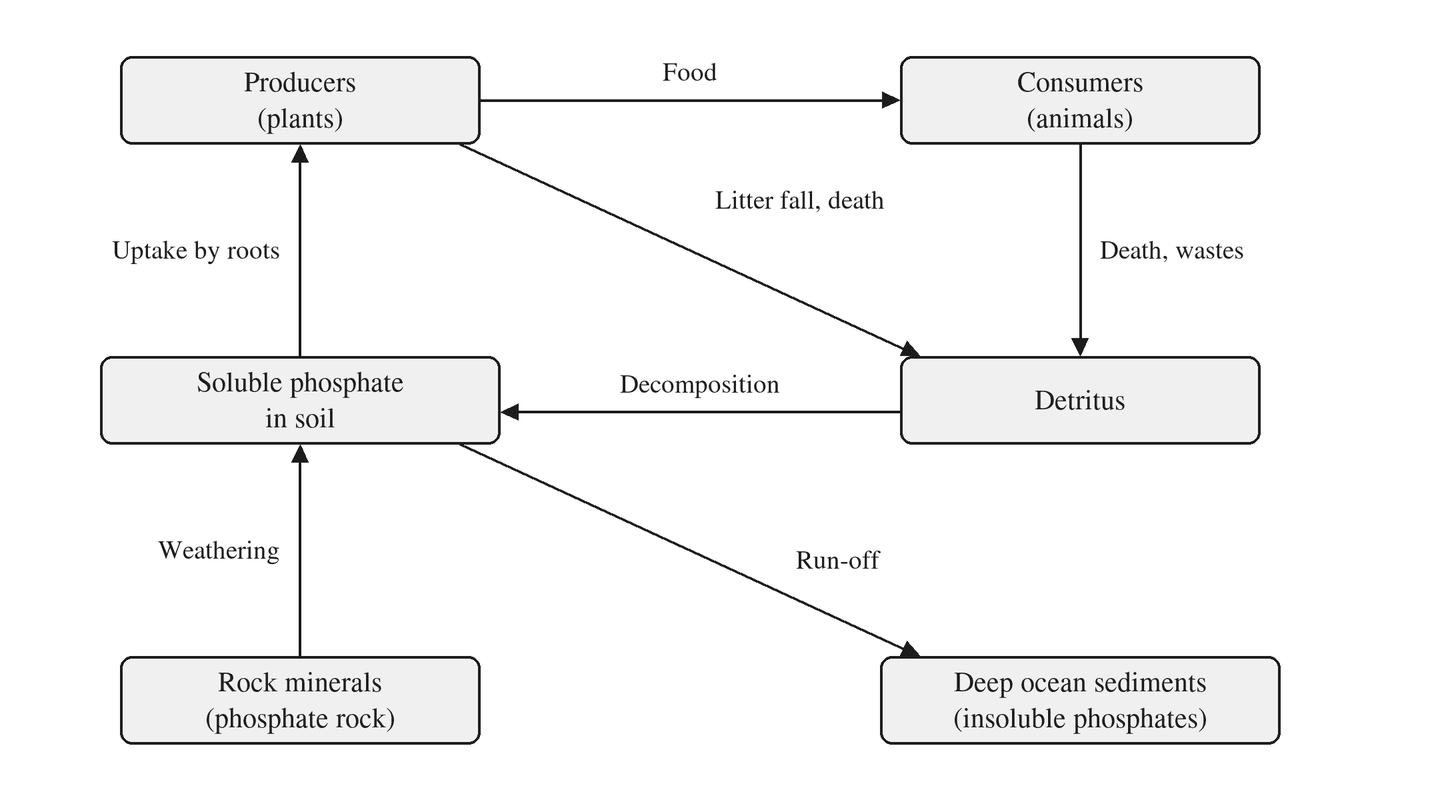
Therefore, biogeochemical cycles are the cyclic movements of nutrients between the non-living environment and living organisms; in the sedimentary phosphorus cycle, weathering of phosphate rocks releases soluble phosphate that plants absorb and pass to animals, decomposers return it from detritus to the soil, and some is lost to deep ocean sediments.
- 1223 marks
Question 122
Study the following web and answer the questions given as follows:
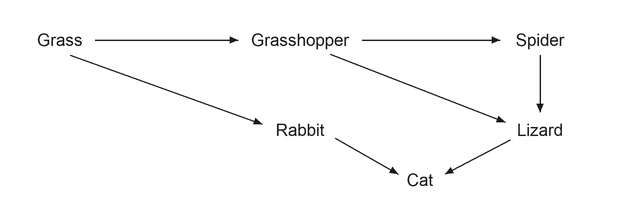
(i) Name the producer.
(ii) Name the herbivores.
(iii) Name the secondary consumers.
Solve with AIWritten solution
Solution:
Key idea: In a food web each arrow points from the food to the organism that eats it. The producer is the green plant that makes its own food by photosynthesis, herbivores (primary consumers) eat the producer, and secondary consumers eat the herbivores.
Step 1 — Find the producer.
Grass is the only organism with no arrow pointing into it, so it does not feed on any other organism. It is the green plant that makes its own food by photosynthesis, so it is the producer.
(i) The producer is grass.
Step 2 — Find the herbivores.
The two arrows that leave grass go to the grasshopper and to the rabbit, so these two animals feed directly on the producer. Animals that feed on plants are herbivores, also called primary consumers.
(ii) The herbivores are the grasshopper and the rabbit.
Step 3 — Find the secondary consumers.
Next we look for the animals that eat a herbivore. The arrows show that the spider and the lizard both eat the grasshopper, and the cat eats the rabbit, so all three feed at the secondary-consumer level.
(iii) The secondary consumers are the spider, the lizard and the cat.
Note: Some animals in this web feed at more than one level. The lizard also eats the spider, which is itself a secondary consumer, so the lizard also acts as a tertiary consumer; the cat eats the lizard, so it too feeds at a higher level as well.
Therefore, (i) the producer is grass, (ii) the herbivores are the grasshopper and the rabbit, and (iii) the secondary consumers are the spider, the lizard and the cat.
- 1235 marks
Question 123
Fill in the appropriate words signifying the process involved in the nitrogen cycle given below:
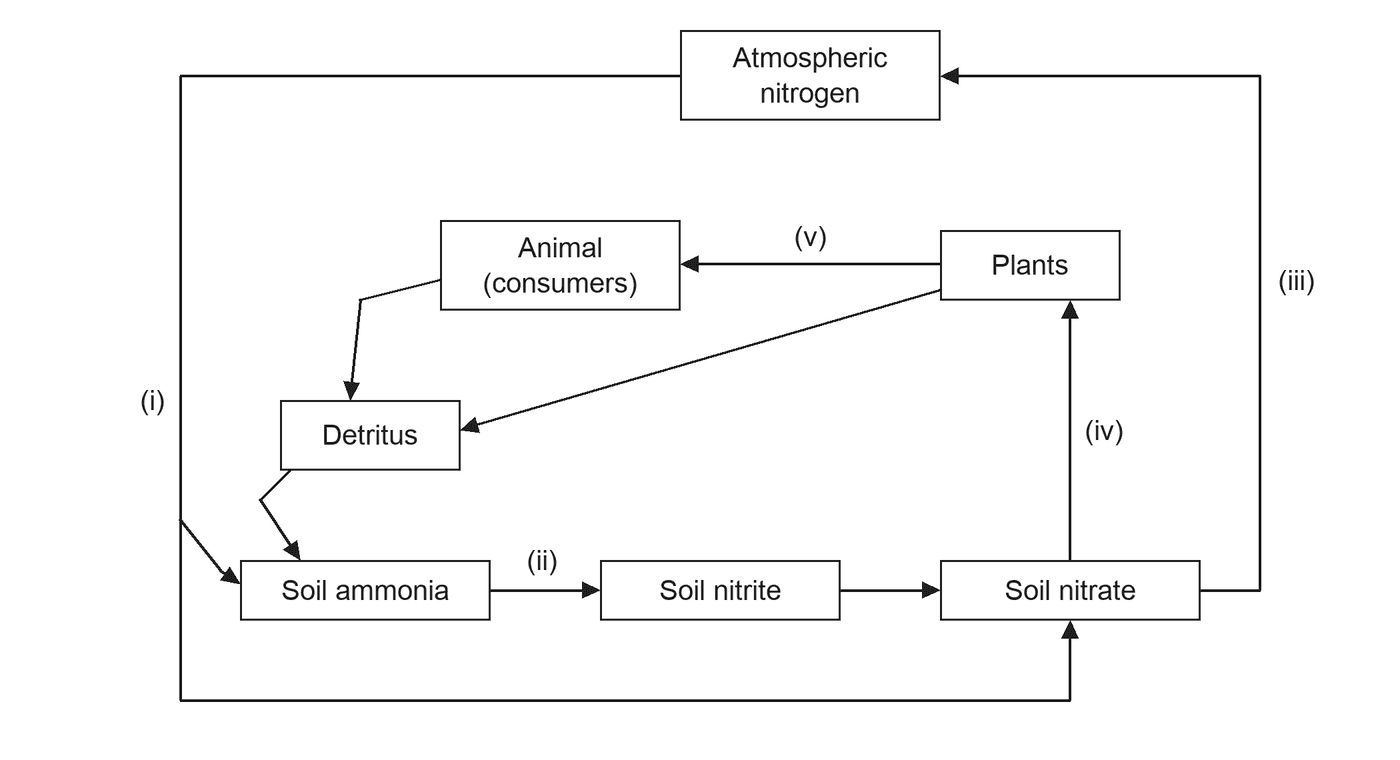 Solve with AI
Written solution
Solution:
Key idea: In the nitrogen cycle, nitrogen gas of the air is first fixed into compounds that living things can use. Ammonia in the soil is oxidised to nitrite and then nitrate (nitrification), plants absorb the nitrate, animals get nitrogen by eating plants, dead matter returns ammonia to the soil (ammonification), and denitrifying bacteria return nitrogen gas to the air (denitrification).
Step 1 — Name process (i).
Arrow (i) carries nitrogen from the atmospheric nitrogen box into the soil as ammonia and nitrate. Turning free nitrogen gas into such compounds is nitrogen fixation. Most of it is biological: nitrogen-fixing bacteria such as Rhizobium in legume root nodules, free-living Azotobacter and cyanobacteria reduce N₂ to ammonia. Lightning forms nitrogen oxides that reach the soil as nitrate, and industry fixes nitrogen into ammonia for fertilisers.
(i) Nitrogen fixation.
Step 2 — Name process (ii).
Arrow (ii) changes soil ammonia into soil nitrite, and the next arrow changes nitrite into nitrate. This oxidation is nitrification: Nitrosomonas oxidises ammonia to nitrite, and Nitrobacter then oxidises nitrite to nitrate.
(ii) Nitrification.
Step 3 — Name process (iii).
Arrow (iii) returns nitrogen from soil nitrate to the atmosphere. Under poorly aerated (low-oxygen) conditions, denitrifying bacteria such as Pseudomonas and Thiobacillus denitrificans reduce nitrate to nitrogen gas, which escapes into the air.
(iii) Denitrification.
Step 4 — Name process (iv).
Arrow (iv) runs from soil nitrate to plants. Plants absorb nitrate through their roots and use it to build amino acids, proteins and nucleic acids.
(iv) Absorption (uptake) by plants.
Step 5 — Name process (v).
Arrow (v) runs from plants to animals. Animals cannot use nitrate or nitrogen gas, so they obtain nitrogen by eating plant proteins, which pass to them as food.
(v) Feeding (transfer of plant proteins to animals as food).
Note: The unlabelled arrows from plants and animals to detritus, and from detritus to soil ammonia, show death and ammonification, in which decomposers turn organic nitrogen of dead matter back into ammonia.
Therefore, the processes are (i) nitrogen fixation, (ii) nitrification, (iii) denitrification, (iv) absorption of nitrate by plants and (v) feeding, by which plant proteins pass to animals.
What Class 12 Biology Ch 18 covers
The sections of the chapter, in the order the book takes them. Every question above comes from one of these.
- 01Ecosystem - Structure and Function
- 02Productivity
- 03Decomposition
- 04Energy Flow
- 05Trophic Levels, Food Chain and Food Web
- 06Ecological Pyramids
- 07Ecological Efficiencies
More ways to study this chapter
The same chapter asked three other ways. Practise it, revise it, and see what the board has set on Ch 18 before.
- Competency-Based Questions (CBQ)Case study questions: a situation, and the part of the chapter that answers it.40questionsOpen
- Previous Year QuestionsQuestions that have actually appeared in board papers, each tagged with its year.14questionsOpen
- Practice QuestionsExtra questions per chapter, for when one attempt at a method is not enough.132questionsOpen
Ch 18 in past ISC papers
The same chapter as the board has actually asked it. These are worded differently from the textbook exercise, which is the point of reading them.
- 11 mark
Board paper question 1
Answer the following questions briefly and to the point:
Which organisms constitute the last trophic level?
Solve with AIWritten solution
Solution:
Key idea: A food chain runs from producers through herbivores and carnivores; each feeding step is a trophic level.
Step 1 — Find the end of the chain.
The last trophic level is occupied by animals that eat other animals but are not themselves eaten by any other animal in that chain.
Step 2 — Name them.
These are the top carnivores (tertiary or top consumers), for example the tiger, lion or hawk.
Note: Decomposers break down dead matter from every level, so they are not given a separate trophic level of their own.
Therefore, the last trophic level is made up of the top carnivores (top consumers).
- 21 mark
Board paper question 2
Answer the following questions briefly to the point.
What does Detritus food chain begin with?
Solve with AIWritten solution
Solution:
Key idea: A detritus food chain is the chain based on dead organic matter, in contrast to the grazing food chain that begins with green plants.
Step 1 — State the starting point.
The detritus food chain (DFC) begins with dead organic matter (detritus): dead leaves, dead plant and animal remains and faecal matter.
Step 2 — Say what feeds on it.
The detritus is eaten by decomposers and detritivores, mainly bacteria and fungi (saprotrophs) and animals such as earthworms, which are in turn eaten by other animals.
Therefore, the detritus food chain begins with dead organic matter (detritus).
- 31 mark
Board paper question 3
Give reason for each of the following.
Climax stage is achieved quickly in secondary succession as compared to primary succession.
Solve with AIWritten solution
Solution:
Key idea: Primary succession begins on bare land where no soil exists, while secondary succession begins where the natural community has been destroyed but the soil remains.
Step 1 — State what secondary succession starts with.
Secondary succession takes place in areas such as abandoned farmland, burnt or cut forests and flooded land. Here soil is already present, often with seeds, roots, spores and other living organisms left in it.
Step 2 — Compare with primary succession.
In primary succession (for example on bare rock) the pioneers must first build up soil, which can take hundreds to thousands of years. Secondary succession skips this slow step.
Therefore, the climax is reached faster in secondary succession because soil (with seeds and other propagules) is already present, so the slow process of soil formation is not needed.
- 45 marks
Board paper question 4
Give a graphic representation of Carbon Cycle in Nature.
Solve with AIWritten solution
Solution:
Key idea: Carbon makes up about 49 % of the dry weight of organisms. It cycles between the atmosphere (as CO₂), living organisms, dead matter, fossil fuels and the oceans. Textbooks state that about 71 % of carbon is found dissolved in the oceans, which help regulate the CO₂ in the air.
Step 1 — Draw the cycle.
The graphic below shows the main reservoirs as boxes and the processes as labelled arrows.
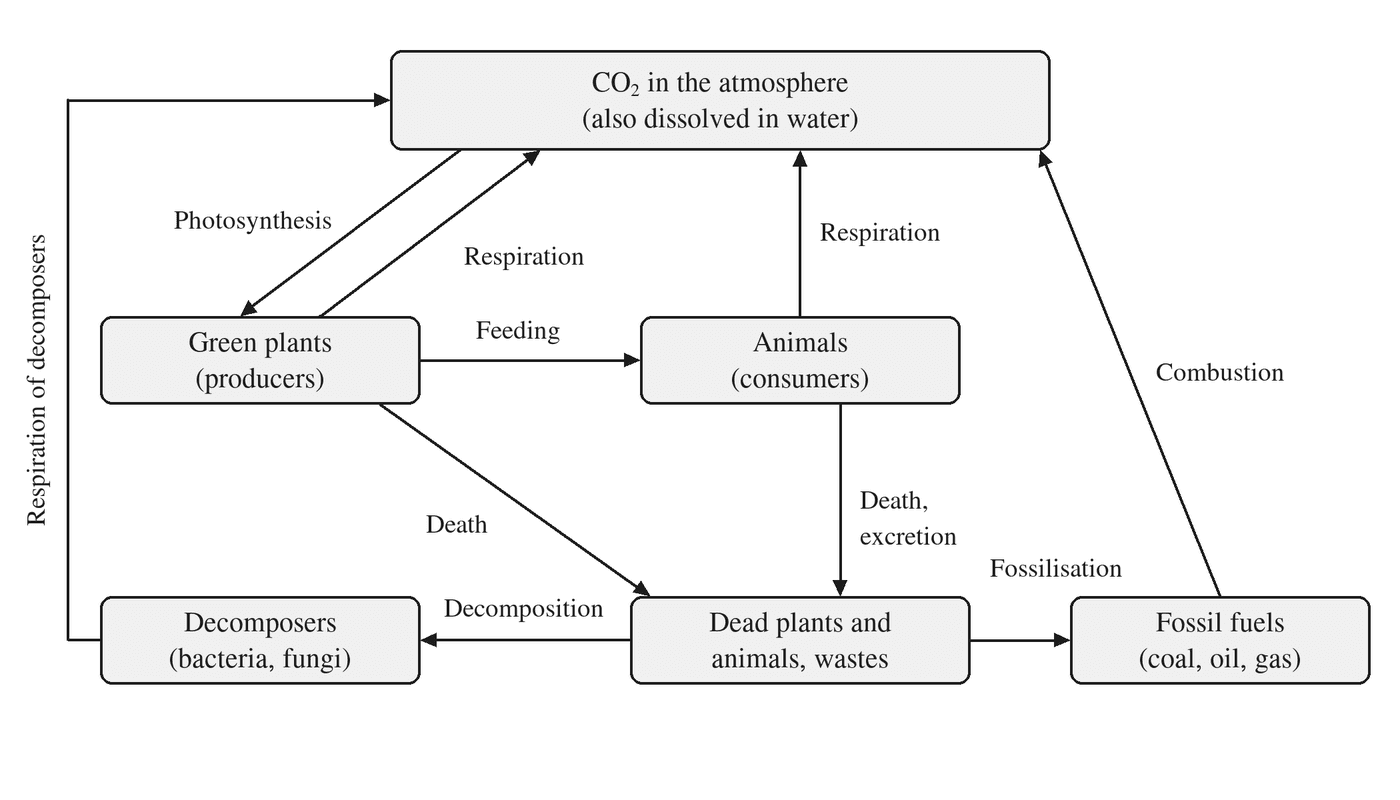
Step 2 — Carbon fixation by photosynthesis.
Green plants (producers) take in CO₂ from the atmosphere (and aquatic plants take dissolved CO₂) and fix it as sugars by photosynthesis. This is the only main route by which carbon enters living organisms.
Step 3 — Transfer through food chains.
Carbon in plants passes to animals (consumers) when they feed on plants or on other animals.
Step 4 — Return of CO₂ by respiration.
Plants and animals release CO₂ back to the atmosphere by respiration.
Step 5 — Decomposition.
When plants and animals die, their bodies and wastes become dead organic matter. Decomposers (bacteria and fungi) break it down, and their respiration returns CO₂ to the atmosphere.
Step 6 — Fossil fuels and combustion.
Some dead organic matter is buried before it fully decays and, over millions of years, the partly decayed remains turn into fossil fuels (coal, oil, natural gas). Burning of fossil fuels and wood, forest fires and volcanic activity release CO₂ into the atmosphere.
Note: Human activities such as deforestation and the burning of fossil fuels add CO₂ faster than it is removed, so the CO₂ in the air had risen to over 420 ppm (about 0.04 %) by 2024, compared with about 280 ppm before industrialisation.
Note: The figure of 71 % is a textbook value. Current estimates put about 38,000 billion tonnes of carbon in the oceans, roughly nine-tenths of the carbon that moves among the air, oceans, soils and living things, while far more is locked away in rocks such as limestone.
Therefore, carbon cycles from atmospheric CO₂ into plants by photosynthesis, through animals by feeding, back to the air by respiration and decomposition, and through fossil fuels that release CO₂ on combustion, with the oceans, fossil fuels and carbonate rocks acting as stores.
- 55 marks
Board paper question 5
Give a graphic representation of Phosphorus Cycle in Nature
Solve with AIWritten solution
Solution:
Key idea: Phosphorus is a part of DNA, RNA, ATP, cell membranes (phospholipids), bones and teeth. Its natural reservoir is rock, and it has no significant gaseous phase, so it cycles between rocks, soil, water and organisms (a sedimentary cycle).
Step 1 — Draw the cycle.
The graphic below shows the reservoirs as boxes and the processes as labelled arrows.
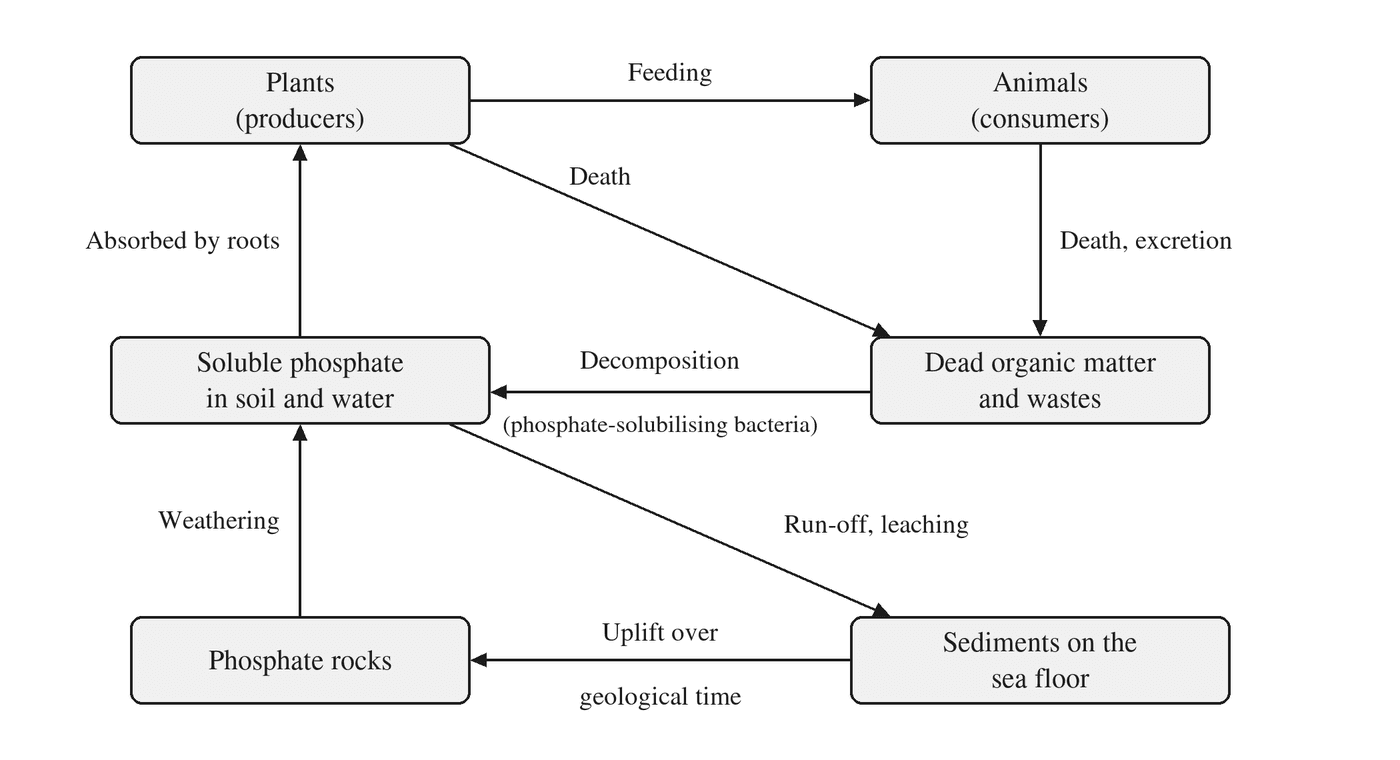
Step 2 — Weathering of rocks.
Phosphate rocks contain phosphorus as phosphates. When the rocks are weathered, small amounts of these phosphates dissolve into the soil solution and water.
Step 3 — Uptake by producers.
Plants absorb soluble phosphate from the soil through their roots and use it to build their own compounds.
Step 4 — Transfer to consumers.
Herbivores get phosphorus by eating plants, and carnivores by eating herbivores.
Step 5 — Return by decomposition.
The wastes and dead bodies of plants and animals are decomposed by phosphate-solubilising bacteria, which release phosphorus back into the soil as soluble phosphate.
Step 6 — Loss to the sea and uplift.
Some phosphate is carried by run-off and leaching into rivers and the sea, where it settles as sediments. Over geological time these sediments become rock and are lifted up to form new land, where weathering starts the cycle again.
Note: Unlike the carbon cycle, there is no respiratory release of phosphorus into the atmosphere, and the atmospheric input of phosphorus through rain is much smaller than that of carbon.
Therefore, phosphorus cycles from phosphate rocks by weathering into soluble phosphate, into plants and animals, back to the soil by decomposition, and through sea sediments that become rock again over geological time.
- 61 mark
Board paper question 6
Give a reason for each of the following:
The shape of the pyramid of biomass in an aquatic ecosystem is inverted.
Solve with AIWritten solution
Solution:
Key idea: A pyramid of biomass compares the standing crop (living biomass present at one time) at each trophic level.
Step 1 — Look at the producers in water.
In a pond or sea the producers are mostly tiny phytoplankton. They are short-lived and are eaten quickly, so their standing biomass at any one time is small, even though they reproduce very fast and their total production over time is high.
Step 2 — Compare with the consumers.
The consumers, such as zooplankton and especially fishes, live longer and accumulate biomass, so their standing crop is larger than that of the phytoplankton they feed on.
Therefore, the pyramid of biomass in water is inverted because the small standing crop of fast-multiplying phytoplankton supports a larger biomass of longer-lived consumers such as fishes.
All 14 board paper questions for this chapter, solved the same way.
Class 12 Biology Ch 18 questions students ask
How many questions are there in Class 12 Biology Ch 18?
123 questions. Every one is solved step by step on this page.
Are these Class 12 Biology solutions free?
Yes. Every question and its full working is free to read, with no account needed.
Can I download the Class 12 Biology Ch 18 solutions as a PDF?
There is no PDF to download. Every solution is on this page instead, which means it is searchable, always the current syllabus, and readable on a phone. Use your browser's print option if you want it on paper.