
Opening your dashboard
Class 12 Biology Chapter 18 Ecosystem: Competency-Based Questions (CBQ)
40 questions on Chapter 18, each worked through on its own page with the AI tutor. Class 12 Biology, ICSE 2026-27.
40 questions
1–5 marks · Mixed difficulty
- 13 marks
Question 1
For a science exhibition in Pune, students fill a glass bottle with pond water, a layer of pond mud, a few sprigs of a green water plant and four small water snails, and then seal it. The bottle is kept near a sunny window. Six months later the plant and the snails are still alive, although nothing has been added to the bottle. (Hypothetical observations.)
(a) Name the producer and the consumers in the bottle, and the organisms in the pond mud that act as decomposers.
(b) Only light has entered the sealed bottle. Using the way energy and nutrients move in an ecosystem, explain how the plant and snails have survived for six months.
(c) A second bottle is set up in the same way, but its mud is first heated strongly to kill all the microbes in it. Predict what will happen to the plant's supply of nutrients over the months, and give a reason.
- 23 marks
Question 2
A fish farmer near Kolleru Lake, Andhra Pradesh, keeps fish in a pond of 0.5 hectare. The fish feed only on the plankton growing in the pond. At the start of the season the total fish biomass in the pond was 800 kg; 200 days later it was 1,200 kg. No fish were removed or died during this time. (Hypothetical data.)
(a) Calculate the secondary productivity of the fish in kg per hectare per day.
(b) Explain why the gain in fish biomass depends on the primary productivity of the pond.
(c) In the next season the farmer adds a fertiliser to the pond water and changes nothing else. Explain how this may increase the fish harvest.
- 34 marks
Question 3
Students in a moist forest in Kerala place several identical wire cages on the forest floor, each holding 100 g (dry weight) of freshly fallen leaves. At each time below, one cage is collected and the material left in it is dried and weighed. In the first week of the rains, the water draining out below the cages contained sugars and potassium. (Hypothetical data.)
Time (months) 0 1 3 6 12 24 Dry mass left (g) 100 80 62 48 34 28 (a) What percentage of the original litter was lost in the first 3 months, and in the last 12 months (month 12 to month 24)? What does this show about the rate of decomposition with time?
(b) Name the process that removed the sugars and potassium from the litter, and state where these substances go.
(c) At 24 months most of the material left is a dark-coloured, amorphous substance. Name it, give the reason its mass falls so slowly, state why it is important for the soil, and name the process by which its nutrients are finally released.
- 44 marks
Question 4
An ecologist works out a yearly energy budget for 1 m² of a grassland in Madhya Pradesh with the simple food chain grass → grasshoppers → frogs. (Hypothetical data, in kJ/m²/year.)
Item Energy (kJ/m²/year) Gross primary productivity (GPP) of grass 10,000 Grass eaten by grasshoppers 2,000 Energy assimilated by grasshoppers 1,000 Grasshoppers eaten by frogs 200 Energy assimilated by frogs 100 The ecologist uses the average respiration costs for each group: respiration uses 20% of the GPP of the producers, 30% of the assimilated energy of the herbivores and 60% of the assimilated energy of the carnivores.
(a) Using these respiration costs, calculate the energy used in respiration by the grass, the grasshoppers and the frogs.
(b) Calculate (i) the energy of the grass that is neither respired nor eaten, (ii) the grasshoppers' energy that is not assimilated, and (iii) the grasshoppers' assimilated energy that is neither respired nor eaten by frogs. Which group of organisms finally receives all three, and how much energy is this in total?
(c) Why can none of the respiration energy in part (a) ever be passed on to the decomposers, while the energy in part (b) can?
- 53 marks
Question 5
On a school field trip to a village pond in West Bengal, students note these feeding relations:
- phytoplanktons are eaten by zooplanktons;
- zooplanktons are eaten by small fishes;
- small fishes are eaten by kingfishers and by ducks;
- water plants are eaten by snails;
- snails are eaten by ducks.
The snails were also seen feeding on dead plant matter lying on the pond bottom.
(a) Write the two food chains in this web that end with the duck.
(b) The number of zooplanktons suddenly falls. Which bird, the kingfisher or the duck, is likely to be affected more? Explain using the web.
(c) Which type of food chain begins with the dead plant matter on the pond bottom? Name the organisms, other than animals such as the snails, that break this matter down.
- 63 marks
Question 6
A hill farm in Kodagu (Coorg), Karnataka was made by clearing a forest. After some years of farming, parts of it were abandoned at different times. Ecologists studied plots of different ages. (Hypothetical data.)
Years since farming stopped Main vegetation Number of plant species 1 herbs and weeds 12 5 grasses with some herbs 20 25 shrubs 34 70 young trees among shrubs 45 180 thick forest of tall trees 60 220 thick forest of tall trees — the same species as at 180 years 60 (a) Is this a primary or a secondary succession? Give one reason from the history of the site.
(b) Name the pioneer community and the climax community in the table. Which observation shows that the 180-year-old community has reached the climax?
(c) On a nearby slope a landslide has left bare rock. Which organisms are expected to colonise it first, and why will this slope take much longer to reach a climax forest than the abandoned farm?
- 74 marks
Question 7
A farmer in Madhya Pradesh grows gram, a legume whose roots carry nitrogen-fixing bacteria. After harvest the farmer ploughs the crop remains into the soil and sows maize six weeks later. Soil samples were tested for nitrogen compounds. (Hypothetical data.)
Time of test Ammonium (mg per kg soil) Nitrate (mg per kg soil) Just before ploughing in the remains 4 10 2 weeks after ploughing 18 12 6 weeks after ploughing 6 26 (a) Nitrogen entered this soil through the association of nitrogen-fixing bacteria with the gram roots. Name this kind of nutrient input.
(b) Name the process that produced the ammonium from the crop remains in the first two weeks, and the microorganisms that carry it out.
(c) Between week 2 and week 6 the ammonium fell while the nitrate rose. Name this two-step process, and the bacterium that carries out each step together with the product of that step.
- 83 marks
Question 8
In a school laboratory in Shimla, two pots are filled with the same sterilised soil mixed with the same amount of chopped dead leaves. Pot A is given a pinch of fresh garden soil containing living bacteria; pot B is not. After 8 weeks the soluble phosphate in the soil is measured. A piece of goat bone buried in pot A at the start is also dug out. (Hypothetical observations.)
Pot Soluble phosphate after 8 weeks Goat bone after 8 weeks A (with living bacteria) much higher than at the start almost unchanged B (sterile) the same as at the start — (a) Explain why soluble phosphate rose only in pot A.
(b) Why was the bone almost unchanged, and what does this mean for the phosphorus it contains?
(c) Seedlings are then grown in pot A. Those whose roots have mycorrhizae take up more phosphate than those without. What does this show?
- 93 marks
Question 9
Foresters estimate the carbon budget of 1 hectare of a sal forest in Jharkhand for one year. (Hypothetical data, tonnes of carbon per hectare per year.)
Process Carbon (t/ha/year) Taken up by photosynthesis 20 Released by respiration of plants and animals 12 Released by decomposition of litter and dead bodies 6 (a) Calculate the carbon stored in the forest during the year. Is the forest removing CO₂ from the atmosphere or adding it?
(b) The forest is cut down and the wood is burnt as fuel. Name the process by which this carbon returns to the atmosphere, and explain how the carbon budget of the cleared land will change.
(c) Trace how carbon taken up by the sal trees could finally reach a tiger in this forest and then return to the atmosphere.
- 103 marks
Question 10
Two villages in Meghalaya lie at the foot of hills. Above village P the hills still have their natural forest. Above village Q the forest was cut 15 years ago and the slopes are now bare. The villages kept these records for the last 10 years. (Hypothetical data.)
Record (last 10 years) Village P Village Q Years with floods in the monsoon 1 6 Months each year that the village stream had water 12 7 Stream water after heavy rain clear muddy with soil (a) Name two ecological services of the forest that the records show.
(b) Explain why such work done by the forest is called an ecological service.
(c) The people of village Q plan to cover the bare slopes with a plantation of a single fast-growing timber tree. Name one service of the natural forest that such a plantation is unlikely to provide fully, and give a reason.
- 111 mark
Question 11
Assertion (A): Bacteria that make their food from inorganic compounds, without using light, are counted among the producers of an ecosystem.
Reason (R): All producers synthesise their food by photosynthesis, using light energy.
- 121 mark
Question 12
Assertion (A): A sugarcane field is one of the highly productive ecosystems.
Reason (R): Primary productivity can be expressed as the dry matter produced per unit area in a given period of time.
- 131 mark
Question 13
Assertion (A): Bacteria and fungi can break down dead leaves without ingesting them.
Reason (R): Decomposers release enzymes into the dead and decaying matter and absorb the soluble, simpler products through their body surface.
- 141 mark
Question 14
Assertion (A): The chemical energy released when decomposers break down dead bodies is passed back to the producers for photosynthesis.
Reason (R): Even the decomposition of dead plants and animals releases chemical energy.
- 151 mark
Question 15
Assertion (A): A food chain that starts with fallen leaves on a forest floor is a detritus food chain.
Reason (R): The detritus food chain is important for recycling nutrients.
- 161 mark
Question 16
Assertion (A): The pyramid of energy of a pond is upright.
Reason (R): The phytoplanktons of a pond have a long life span and increase slowly in number.
- 171 mark
Question 17
Assertion (A): The calcium cycle is a gaseous cycle.
Reason (R): The reservoir of a sedimentary cycle is the lithosphere (earth's crust).
- 181 mark
Question 18
Assertion (A): Forests help to keep the balance of oxygen and carbon dioxide in the atmosphere.
Reason (R): In photosynthesis, plants take in carbon dioxide and release oxygen.
- 191 mark
Question 19
To describe the trophic structure of a grassland, an ecologist counts all the grass plants, grasshoppers and frogs in sample plots on one day in August. What is the ecologist recording at each trophic level?
- 201 mark
Question 20
A student records that, of 100 units of light energy falling on a leaf, 2 units are stored in food made by photosynthesis and 98 units leave the leaf as heat. (Hypothetical data.) Which statement about this record is correct?
- 211 mark
Question 21
A fisher in Kerala eats rice and also sardines. The sardines feed on zooplankton, which feed on phytoplankton. At which trophic levels does the fisher feed?
- 221 mark
Question 22
Two crops are grown side by side for one season. Crop P has a GPP of 3,000 kJ/m² and an NPP of 2,400 kJ/m²; crop Q has a GPP of 5,000 kJ/m² and an NPP of 3,500 kJ/m². (Hypothetical data.) Which statement is correct?
- 231 mark
Question 23
On the same hill range, a climax forest on a cool, moist slope with deep soil has quite different tree species from a climax forest on a dry, rocky slope with thin soil. Which statement best explains this?
- 241 mark
Question 24
In one district a grassland, and in another a forest, are completely cleared: all the plants are removed, but the soil is left in place. Both areas are then left alone. About how long is each expected to take to return to its original community by secondary succession?
- 251 mark
Question 25
Rain water collected in a clean vessel just after a severe thunderstorm over a forest, far from towns and factories, contains a small amount of nitrate. By which route did this nitrogen most likely come from the atmosphere?
- 265 marks
Question 26
Read the sources given and answer any four from the questions given below.
A pyramid of biomass represents the total biomass or 'standing crop' (dry weight) of organisms at each trophic level at a particular time. The pyramid of biomass is always upright as given below but in some aquatic ecosystems it could be inverted also.
Inverted pyramid means that the biomass of producers is less than that of the next trophic level, i.e., herbivores. It occurs in some aquatic ecosystems in which the producers are algae and phytoplanktons, which have short life-spans but rapid increasing rate. Hence the biomass of producers, i.e., phytoplanktons is smaller than the biomass of zooplanktons it supports.
Also the biomass of zooplanktons is less than the biomass (dry weight) of large and long-lived fishes they support.
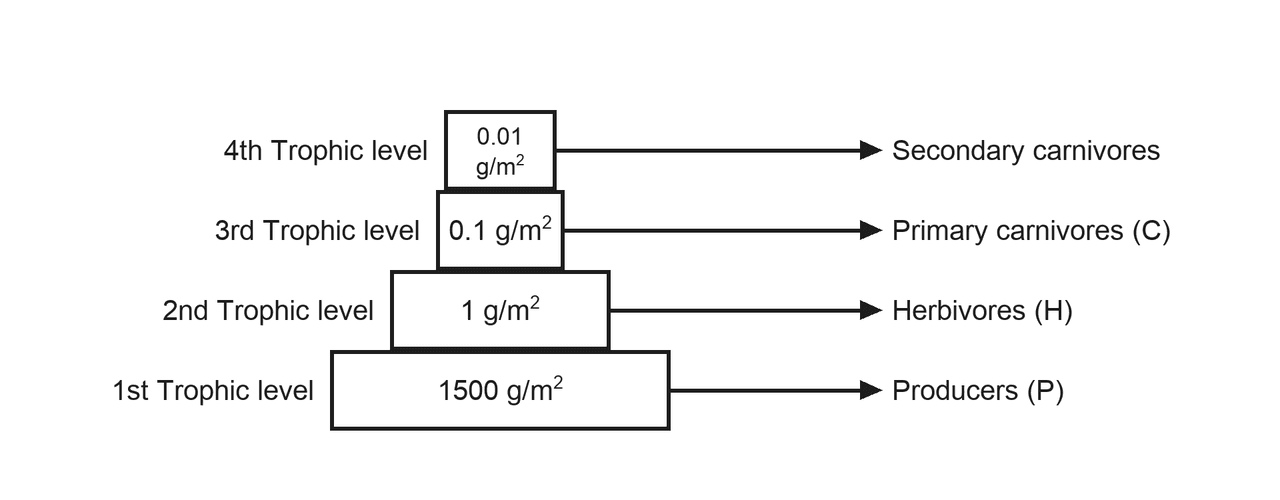
1. In the above pyramid of biomass, which trophic level represents the more biomass than primary carnivores?
(a) producers and carnivores (b) herbivores and secondary carnivores (c) producers and herbivores (d) both (a) and (c)
2. In an aquatic ecosystem the pyramid of biomass is
(a) upright (b) triangular (c) inverted (d) squarish
3. The biomass of zooplanktons in an aquatic ecosystem is
(a) more than phytoplanktons (b) less than phytoplanktons (c) more than large fish in water (d) both (b) and (c)
4. The pyramid of biomass of an aquatic system is inverted, where the producers are algae and phytoplanktons because
(a) short life span and rapid increasing rate of zooplanktons than phytoplanktons (b) short life span and rapid increasing rate of phytoplanktons than zooplanktons (c) biomass of algae and phytoplanktons is maximum (d) biomass of zooplanktons is more than that of phytoplanktons
5. In the trophic levels the second trophic level is always occupied by
(a) carnivores (b) herbivores (c) producers (d) decomposers
- 275 marks
Question 27
Read the sources given and answer any four from the questions given below.
In a primary succession on a bare rock the first organisms often called pioneer organisms are lichens that invade the rocky area. The fungal component holds moisture and green algae provides food. The lichens form a crust over the bare rocks and begin to form soil from their organic remains and by stimulating chemical breakdown of the rocks. The erosion of rock, dead and decayed lichens provide sufficient soil for larger plant species to invade. Lichens are normally followed by mosses which grow in bunches and together with lichens, form a mat over the rock surface. This provides a suitable surface for the ferns and grasses to grow. Certain insects and small animals are also seen along with vegetation. Then the herbs, shrubs and trees replace the earlier vegetation and new animals continue to invade. Then dead shoots and fallen leaves enrich the soil. Ultimately these plants are succeeded by large seed-bearing plants which also support different kinds of animals. This final stable and self-growing community of trees is called as climax community. The changes in the biotic community from the pioneer to the climax community may take hundreds to thousands of years.
1. The pioneer organisms in a primary succession on a bare rock are
(a) fungi (b) lichens (c) grasses (d) mosses
2. The community of tall trees and different types of animals on a bare rock can be seen after
(a) 10 years (b) 100 years (c) 200 years (d) much more than 200 years
3. The sequence of communities on a bare rock is
(a) mosses—algae—lichens—ferns—trees (b) mosses—lichens—ferns—trees (c) lichens—mosses—ferns—trees (d) lichens—ferns—mosses—trees
4. In a primary succession, small animals and certain insects are usually seen when
(a) algae spread on rock (b) lichens spread on rock (c) ferns and grasses grow (d) both (a) and (b)
5. In a primary succession, climax community is the one which is
(a) replaced by tall trees (b) forms stable ecosystem (c) gives rise to another primary succession (d) both (b) and (c)
- 283 marks
Question 28
What is primary productivity? Give brief description of factors that affect primary productivity.
- 293 marks
Question 29
Define decomposition and describe the processes and products of decomposition.
- 305 marks
Question 30
The following is the diagrammatic representation of decomposition cycle in a terrestrial ecosystem, answer and complete the cycle.

- 313 marks
Question 31
In a simple ecosystem, there exists a field of clover. Mice eat the clover and skunks eat the mice. The skunks are in turn eaten by wolves. If 10,000 calories are available from clover plants, how much energy would each of the organism in the food chain receive? Also make a pyramid of energy signifying these.
- 323 marks
Question 32
Define decomposition. Explain main steps involved in the process of decomposition.
- 335 marks
Question 33
Give a graphic representation of carbon cycle in nature.
- 345 marks
Question 34
Give a graphic representation of phosphorus cycle in nature.
- 355 marks
Question 35
Describe the mechanism of decomposition by explaining the various processes involved in it.
- 361 mark
Question 36
A team studying a lake in Kerala measures the rate of photosynthesis of the phytoplanktons at four depths on a clear, sunny day. At each depth it also measures the nitrate in the water and the water temperature. (Hypothetical data.)
Depth (m) Carbon fixed (mg per litre per day) Nitrate (mg per litre) Temperature (°C) 0.5 1.8 0.1 28 2 1.1 0.1 28 4 0.5 0.3 27 8 0.1 0.6 27 Which factor best explains why the primary productivity falls with depth in this lake?
- 371 mark
Question 37
Assertion (A): A carnivore such as a tiger usually assimilates a larger share of the food energy it eats than a herbivore such as a chital (spotted deer) does.
Reason (R): Plant food contains much cellulose and lignin, which animals digest only partly, while animal tissue, made mainly of protein and fat, is digested more completely.
- 382 marks
Question 38
In a village pond in Assam, students watch the tadpoles of a common frog scraping green algae off the stones. On the grassy bank nearby, adult frogs of the same species catch grasshoppers, which feed on the grass. (Hypothetical observations.)
(a) At which trophic level does the tadpole feed? At which trophic level does the adult frog feed when it eats grasshoppers?
(b) A classmate's food web of the pond and its bank shows the frog in a single box at the third trophic level. What does this frog show about how a trophic level is decided, and how should the food web show it?
- 393 marks
Question 39
Ecologists study a lake for one year. For its phytoplanktons (producers) and zooplanktons (primary consumers) they record the standing crop on one day in June and the total dry mass each group produced during the whole year. Each gram of dry mass of either group holds about 20 kJ of energy. (Hypothetical data.)
Trophic level Standing crop on one day (g dry mass per m²) Dry mass produced in the year (g per m²) Energy in the new biomass (kJ per m² per year) Zooplanktons 18 180 3,600 Phytoplanktons 5 1,500 30,000 (a) State whether the pyramid of biomass and the pyramid of energy of this lake are upright or inverted.
(b) Calculate how many times the standing crop of each group is replaced during the year. Use your answer to explain how so small a standing crop of phytoplanktons can support the zooplanktons.
(c) A student says: "The zooplanktons outweigh the phytoplanktons, so they must receive more energy than the phytoplanktons fix. The pyramid of energy of this lake must be inverted too." Evaluate this claim using the data.
- 405 marks
Question 40
In Punjab, paddy is harvested in October and wheat must be sown within a few weeks. To clear the fields quickly, many farmers set fire to the paddy straw left behind. The smoke adds to the winter smog over north India. A soil-science class burnt a sample of dry paddy straw in the open and compared the nutrients in the straw with those left in its ash, per tonne of dry straw. Potassium, like phosphorus, cycles mainly through rocks and soil. Soil microbes that decompose dead matter need about 1 part of nitrogen for every 25 parts of carbon they use. (Hypothetical data.)
Nutrient In 1 tonne of dry straw (kg) Left in the ash (kg) Carbon 380 15 Nitrogen 6.0 0.6 Phosphorus 1.0 0.75 Potassium 15.0 12.0 (a) Calculate the percentage of each nutrient that was lost from the field during burning. Which two nutrients were lost the most?
(b) Using the idea of gaseous and sedimentary nutrient cycles, explain why most of the carbon and nitrogen were lost but most of the phosphorus and potassium stayed in the ash.
(c) Another farmer ploughs the straw into the moist soil instead of burning it. Explain how decomposition will return its nutrients to the soil. Use the table to explain why the wheat sown soon afterwards may at first get less nitrogen from the soil.