
Question 45 marksAsked 2019Medium
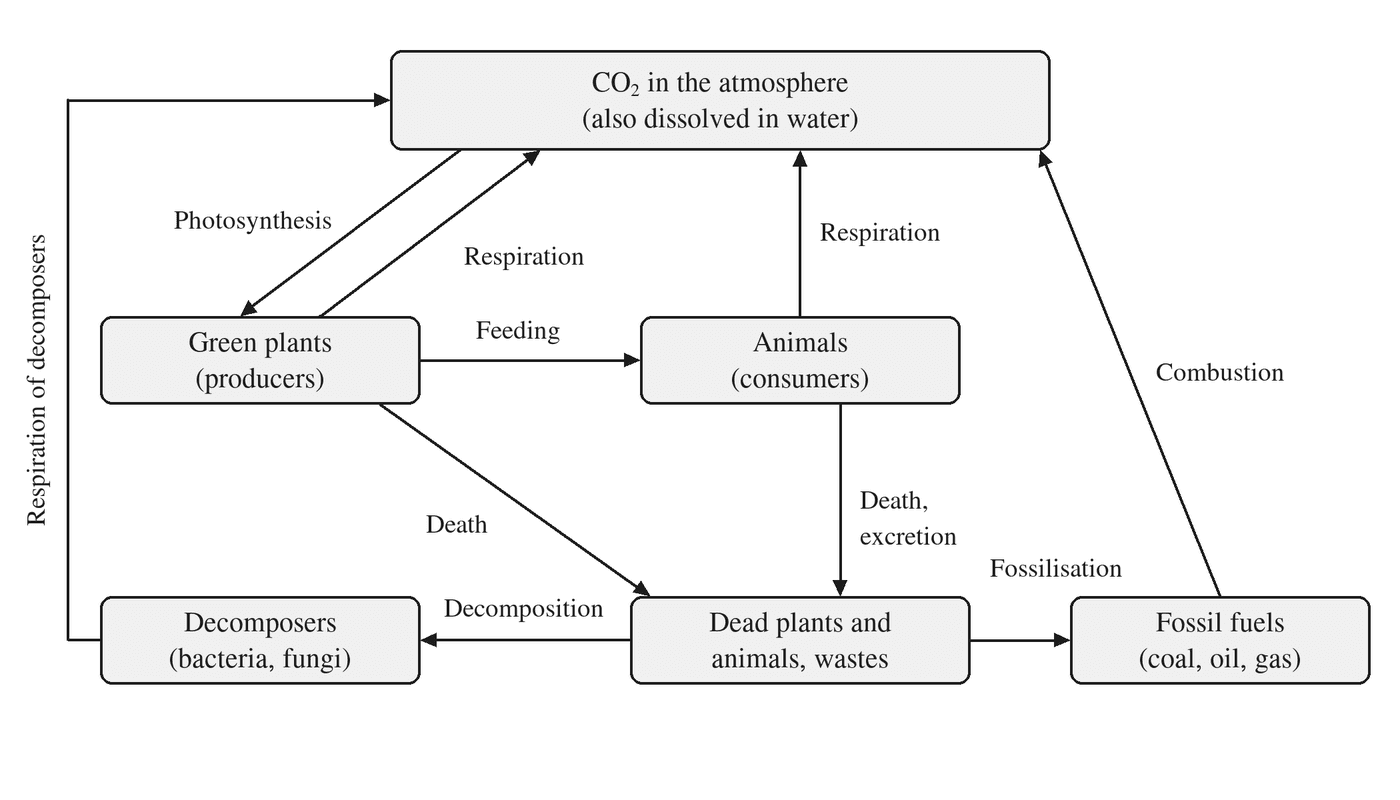
Give a graphic representation of Carbon Cycle in Nature.
Confirming your payment
Sign up now and get 250 free tokens.
Previous Year Questions · Question 4 of 14
Give a graphic representation of Carbon Cycle in Nature.
Solution:
Key idea: Carbon makes up about 49 % of the dry weight of organisms. It cycles between the atmosphere (as CO₂), living organisms, dead matter, fossil fuels and the oceans. Textbooks state that about 71 % of carbon is found dissolved in the oceans, which help regulate the CO₂ in the air.
Step 1 — Draw the cycle.
The graphic below shows the main reservoirs as boxes and the processes as labelled arrows.
Step 2 — Carbon fixation by photosynthesis.
Green plants (producers) take in CO₂ from the atmosphere (and aquatic plants take dissolved CO₂) and fix it as sugars by photosynthesis. This is the only main route by which carbon enters living organisms.
Step 3 — Transfer through food chains.
Carbon in plants passes to animals (consumers) when they feed on plants or on other animals.
Step 4 — Return of CO₂ by respiration.
Plants and animals release CO₂ back to the atmosphere by respiration.
Step 5 — Decomposition.
When plants and animals die, their bodies and wastes become dead organic matter. Decomposers (bacteria and fungi) break it down, and their respiration returns CO₂ to the atmosphere.
Step 6 — Fossil fuels and combustion.
Some dead organic matter is buried before it fully decays and, over millions of years, the partly decayed remains turn into fossil fuels (coal, oil, natural gas). Burning of fossil fuels and wood, forest fires and volcanic activity release CO₂ into the atmosphere.
Note: Human activities such as deforestation and the burning of fossil fuels add CO₂ faster than it is removed, so the CO₂ in the air had risen to over 420 ppm (about 0.04 %) by 2024, compared with about 280 ppm before industrialisation.
Note: The figure of 71 % is a textbook value. Current estimates put about 38,000 billion tonnes of carbon in the oceans, roughly nine-tenths of the carbon that moves among the air, oceans, soils and living things, while far more is locked away in rocks such as limestone.
Therefore, carbon cycles from atmospheric CO₂ into plants by photosynthesis, through animals by feeding, back to the air by respiration and decomposition, and through fossil fuels that release CO₂ on combustion, with the oceans, fossil fuels and carbonate rocks acting as stores.