
Opening your dashboard
Class 12 Biology Chapter 18 Ecosystem: Previous Year Questions
14 questions on Chapter 18, each solved step by step. Class 12 Biology, ICSE 2026-27.
14 questions with solutions
1–5 marks · Mixed difficulty
- 11 mark
Question 1
Answer the following questions briefly and to the point:
Which organisms constitute the last trophic level?
Solve with AIWritten solution
Solution:
Key idea: A food chain runs from producers through herbivores and carnivores; each feeding step is a trophic level.
Step 1 — Find the end of the chain.
The last trophic level is occupied by animals that eat other animals but are not themselves eaten by any other animal in that chain.
Step 2 — Name them.
These are the top carnivores (tertiary or top consumers), for example the tiger, lion or hawk.
Note: Decomposers break down dead matter from every level, so they are not given a separate trophic level of their own.
Therefore, the last trophic level is made up of the top carnivores (top consumers).
- 21 mark
Question 2
Answer the following questions briefly to the point.
What does Detritus food chain begin with?
Solve with AIWritten solution
Solution:
Key idea: A detritus food chain is the chain based on dead organic matter, in contrast to the grazing food chain that begins with green plants.
Step 1 — State the starting point.
The detritus food chain (DFC) begins with dead organic matter (detritus): dead leaves, dead plant and animal remains and faecal matter.
Step 2 — Say what feeds on it.
The detritus is eaten by decomposers and detritivores, mainly bacteria and fungi (saprotrophs) and animals such as earthworms, which are in turn eaten by other animals.
Therefore, the detritus food chain begins with dead organic matter (detritus).
- 31 mark
Question 3
Give reason for each of the following.
Climax stage is achieved quickly in secondary succession as compared to primary succession.
Solve with AIWritten solution
Solution:
Key idea: Primary succession begins on bare land where no soil exists, while secondary succession begins where the natural community has been destroyed but the soil remains.
Step 1 — State what secondary succession starts with.
Secondary succession takes place in areas such as abandoned farmland, burnt or cut forests and flooded land. Here soil is already present, often with seeds, roots, spores and other living organisms left in it.
Step 2 — Compare with primary succession.
In primary succession (for example on bare rock) the pioneers must first build up soil, which can take hundreds to thousands of years. Secondary succession skips this slow step.
Therefore, the climax is reached faster in secondary succession because soil (with seeds and other propagules) is already present, so the slow process of soil formation is not needed.
- 45 marks
Question 4
Give a graphic representation of Carbon Cycle in Nature.
Solve with AIWritten solution
Solution:
Key idea: Carbon makes up about 49 % of the dry weight of organisms. It cycles between the atmosphere (as CO₂), living organisms, dead matter, fossil fuels and the oceans. Textbooks state that about 71 % of carbon is found dissolved in the oceans, which help regulate the CO₂ in the air.
Step 1 — Draw the cycle.
The graphic below shows the main reservoirs as boxes and the processes as labelled arrows.
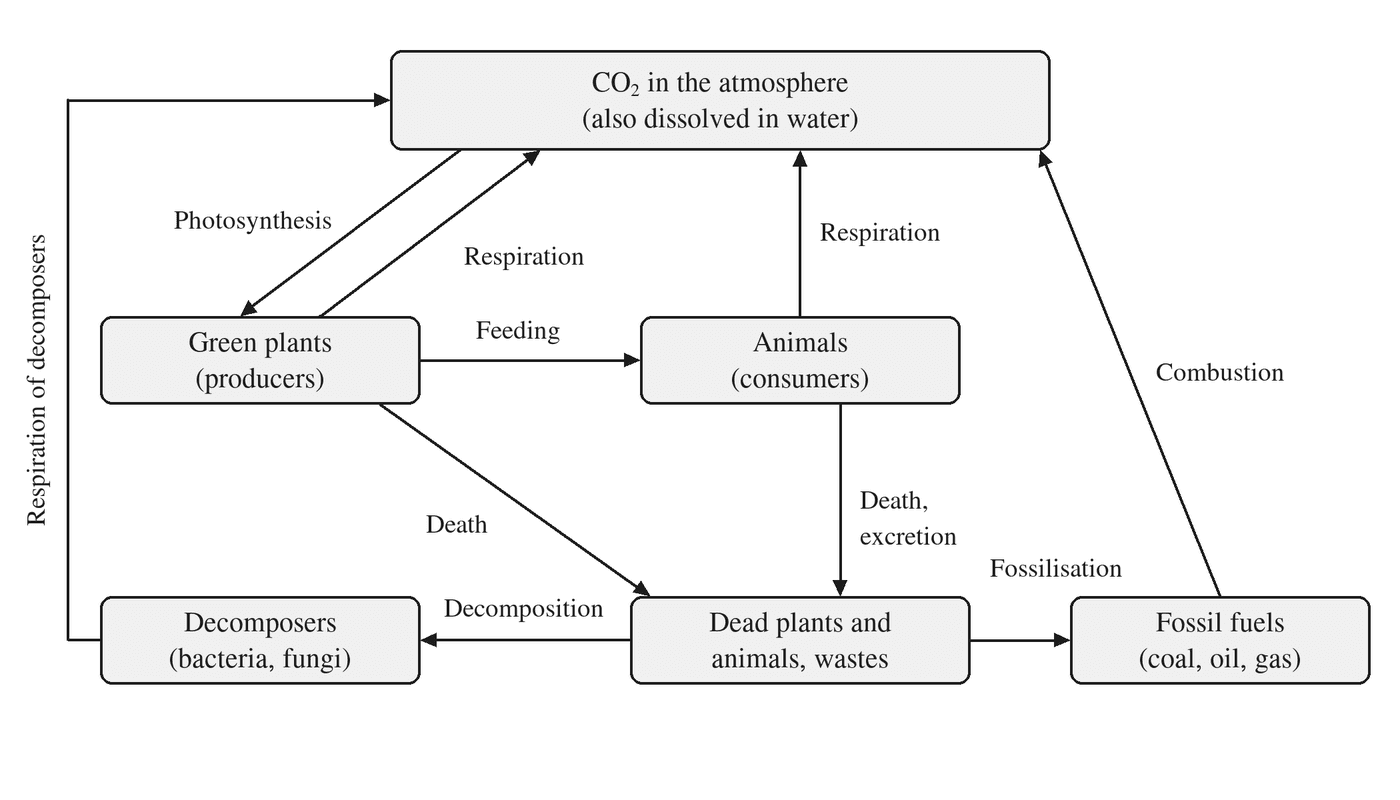
Step 2 — Carbon fixation by photosynthesis.
Green plants (producers) take in CO₂ from the atmosphere (and aquatic plants take dissolved CO₂) and fix it as sugars by photosynthesis. This is the only main route by which carbon enters living organisms.
Step 3 — Transfer through food chains.
Carbon in plants passes to animals (consumers) when they feed on plants or on other animals.
Step 4 — Return of CO₂ by respiration.
Plants and animals release CO₂ back to the atmosphere by respiration.
Step 5 — Decomposition.
When plants and animals die, their bodies and wastes become dead organic matter. Decomposers (bacteria and fungi) break it down, and their respiration returns CO₂ to the atmosphere.
Step 6 — Fossil fuels and combustion.
Some dead organic matter is buried before it fully decays and, over millions of years, the partly decayed remains turn into fossil fuels (coal, oil, natural gas). Burning of fossil fuels and wood, forest fires and volcanic activity release CO₂ into the atmosphere.
Note: Human activities such as deforestation and the burning of fossil fuels add CO₂ faster than it is removed, so the CO₂ in the air had risen to over 420 ppm (about 0.04 %) by 2024, compared with about 280 ppm before industrialisation.
Note: The figure of 71 % is a textbook value. Current estimates put about 38,000 billion tonnes of carbon in the oceans, roughly nine-tenths of the carbon that moves among the air, oceans, soils and living things, while far more is locked away in rocks such as limestone.
Therefore, carbon cycles from atmospheric CO₂ into plants by photosynthesis, through animals by feeding, back to the air by respiration and decomposition, and through fossil fuels that release CO₂ on combustion, with the oceans, fossil fuels and carbonate rocks acting as stores.
- 55 marks
Question 5
Give a graphic representation of Phosphorus Cycle in Nature
Solve with AIWritten solution
Solution:
Key idea: Phosphorus is a part of DNA, RNA, ATP, cell membranes (phospholipids), bones and teeth. Its natural reservoir is rock, and it has no significant gaseous phase, so it cycles between rocks, soil, water and organisms (a sedimentary cycle).
Step 1 — Draw the cycle.
The graphic below shows the reservoirs as boxes and the processes as labelled arrows.
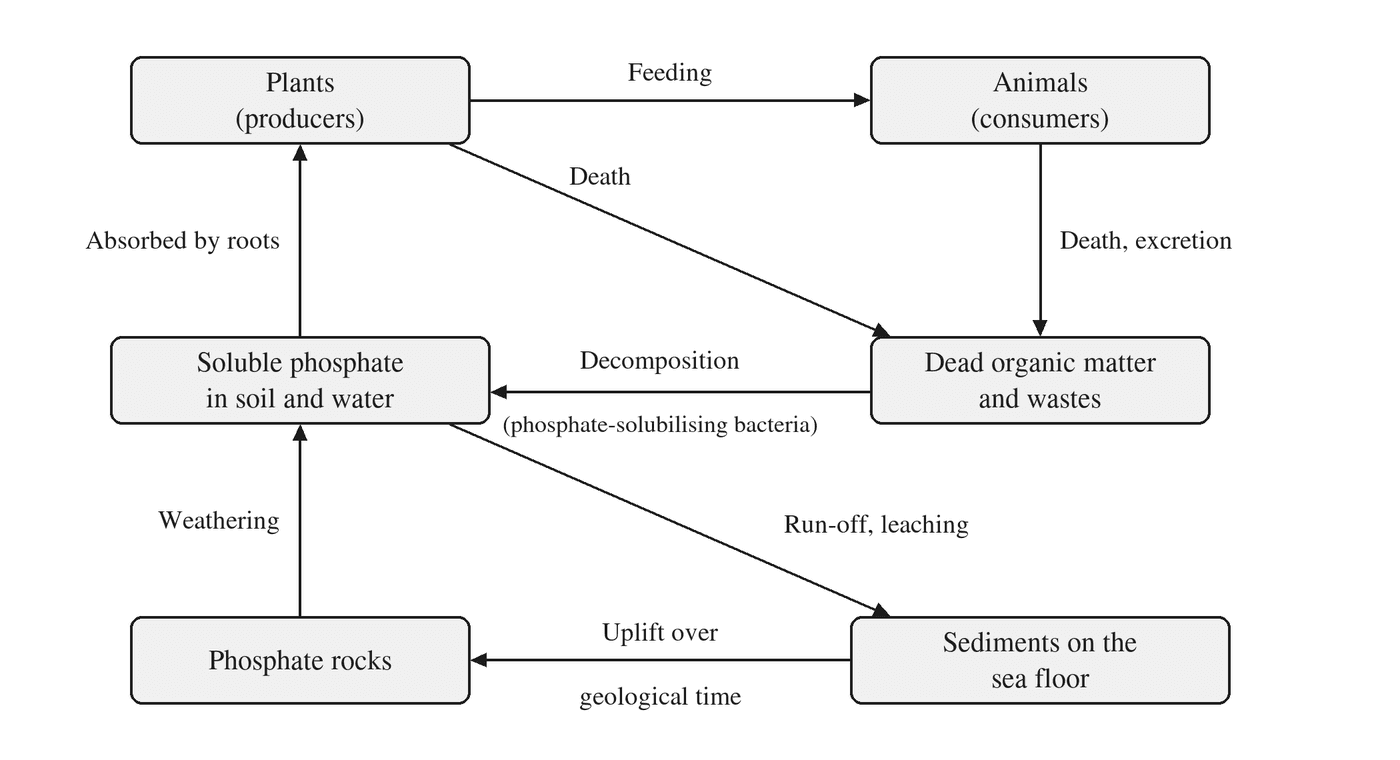
Step 2 — Weathering of rocks.
Phosphate rocks contain phosphorus as phosphates. When the rocks are weathered, small amounts of these phosphates dissolve into the soil solution and water.
Step 3 — Uptake by producers.
Plants absorb soluble phosphate from the soil through their roots and use it to build their own compounds.
Step 4 — Transfer to consumers.
Herbivores get phosphorus by eating plants, and carnivores by eating herbivores.
Step 5 — Return by decomposition.
The wastes and dead bodies of plants and animals are decomposed by phosphate-solubilising bacteria, which release phosphorus back into the soil as soluble phosphate.
Step 6 — Loss to the sea and uplift.
Some phosphate is carried by run-off and leaching into rivers and the sea, where it settles as sediments. Over geological time these sediments become rock and are lifted up to form new land, where weathering starts the cycle again.
Note: Unlike the carbon cycle, there is no respiratory release of phosphorus into the atmosphere, and the atmospheric input of phosphorus through rain is much smaller than that of carbon.
Therefore, phosphorus cycles from phosphate rocks by weathering into soluble phosphate, into plants and animals, back to the soil by decomposition, and through sea sediments that become rock again over geological time.
- 61 mark
Question 6
Give a reason for each of the following:
The shape of the pyramid of biomass in an aquatic ecosystem is inverted.
Solve with AIWritten solution
Solution:
Key idea: A pyramid of biomass compares the standing crop (living biomass present at one time) at each trophic level.
Step 1 — Look at the producers in water.
In a pond or sea the producers are mostly tiny phytoplankton. They are short-lived and are eaten quickly, so their standing biomass at any one time is small, even though they reproduce very fast and their total production over time is high.
Step 2 — Compare with the consumers.
The consumers, such as zooplankton and especially fishes, live longer and accumulate biomass, so their standing crop is larger than that of the phytoplankton they feed on.
Therefore, the pyramid of biomass in water is inverted because the small standing crop of fast-multiplying phytoplankton supports a larger biomass of longer-lived consumers such as fishes.
- 73 marks
Question 7
Define decomposition. Explain main steps involved in the process of decomposition.
Solve with AIWritten solution
Solution:
Key idea: Decomposition is carried out mainly by decomposers (bacteria and fungi) together with detritivores; it recycles nutrients from dead matter back to the soil.
Step 1 — Define decomposition.
Decomposition is the process by which decomposers break down complex organic matter (detritus) into inorganic substances such as carbon dioxide, water and nutrients. Detritus includes dead leaves, bark, flowers, dead animal remains and faecal matter.
Step 2 — Fragmentation.
Detritivores such as earthworms (and millipedes, woodlice and termites) eat the detritus and break it into smaller particles. This increases the surface area on which microbes can act.
Step 3 — Leaching.
Water percolating through the soil carries water-soluble substances, such as sugars (organic compounds) and inorganic nutrients (mineral salts), out of the detritus and down into the soil horizons. Some of the inorganic nutrients are precipitated there as unavailable salts for the time being, while others are taken up again by roots.
Step 4 — Catabolism.
Bacterial and fungal enzymes break the detritus down into simpler inorganic substances, for example carbon dioxide, water and mineral ions.
Step 5 — Humification.
The remaining matter builds up as humus, a dark, amorphous substance that is highly resistant to microbial action, so it decomposes very slowly. Being colloidal, humus holds water and nutrients and acts as a reservoir of nutrients in the soil.
Step 6 — Mineralisation.
Humus is finally degraded by some microbes, and inorganic nutrients are released into the soil, where plants can absorb them again.
Therefore, decomposition is the breakdown of detritus into inorganic substances by decomposers, and its main steps are fragmentation, leaching, catabolism, humification and mineralisation.
- 81 mark
Question 8
Answer the following questions briefly.
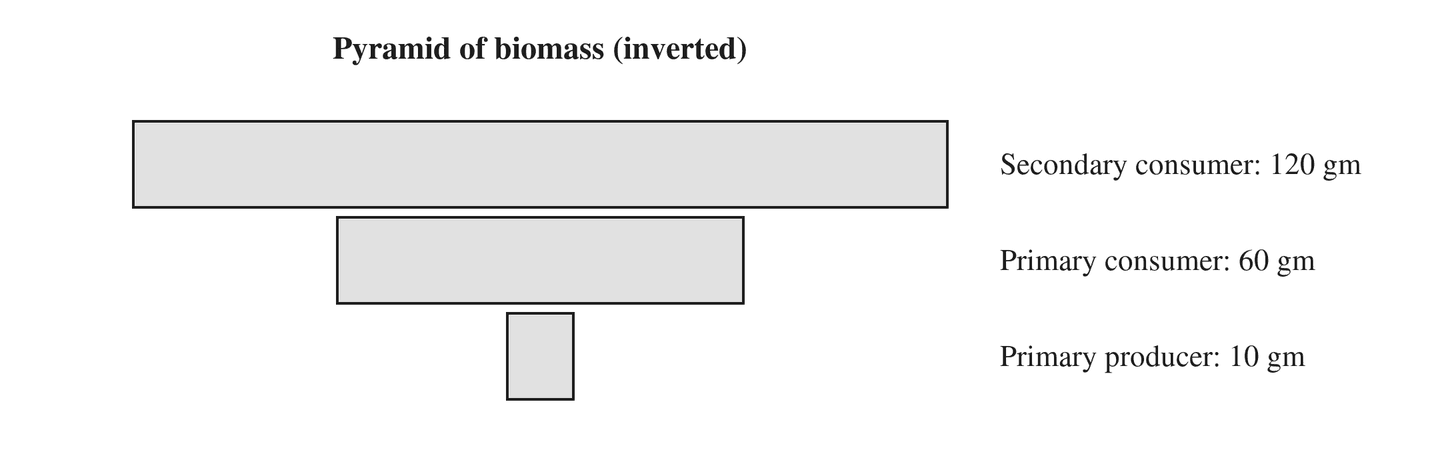
What type of ecological pyramid would be obtained from the following data?
Secondary consumer: 120 gm
Primary consumer: 60 gm
Primary producer: 10 gm
Solve with AIAnswer
- Correct
(A) Inverted pyramid of biomass
(B) Pyramid of energy
(C) Upright pyramid of numbers
(D) Upright pyramid of biomass
Answer: (A) Inverted pyramid of biomass
Key idea: The data are masses (gm) of living matter at each trophic level, so they give a pyramid of biomass. The pyramid is upright when biomass falls from producers upwards, and inverted when it rises.
Step 1 — Identify the kind of pyramid.
The values are in grams, which is biomass, not number of individuals and not energy.
Step 2 — See how the biomass changes up the levels.
The producers have 10 gm, the primary consumers 60 gm and the secondary consumers 120 gm. The biomass increases at each higher level, and the top level is 12 times the base.
Step 3 — Read the shape.
A narrow base with wider levels above is an inverted pyramid. Such pyramids occur in water, where a small standing crop of phytoplankton supports larger consumers.
Why the others are wrong:
- (B) A pyramid of energy uses energy units (such as kJ), not grams; it is also always upright, since energy falls at each step.
- (C) A pyramid of numbers would need counts of individuals, but the data are masses; and these values rise upwards, which is not upright.
- (D) An upright pyramid of biomass needs the producers to have the most biomass, but here they have the least (10 gm).
Therefore, the data give an inverted pyramid of biomass, option (A).
- 95 marks
Question 9
Describe the mechanism of decomposition by explaining the various processes involved in it.
Solve with AIWritten solution
Solution:
Key idea: Decomposers (bacteria and fungi) break down detritus into simple inorganic substances, so that nutrients locked in dead bodies return to the soil. The process has several steps that go on at the same time.
Step 1 — Say what is decomposed and by whom.
Detritus (dead leaves, bark, flowers, dead remains of animals and faecal matter) is the raw material. It is broken down by detritivores and by decomposers, which are mainly bacteria and fungi.
Step 2 — Fragmentation.
Detritivores such as earthworms (and millipedes, woodlice and termites) eat the detritus and break it into smaller particles. This increases the surface area on which microbes can act.
Step 3 — Leaching.
Water percolating through the soil carries water-soluble substances, such as sugars (organic compounds) and inorganic nutrients (mineral salts), out of the detritus and down into the soil horizons. Some of the inorganic nutrients are precipitated there as unavailable salts for the time being, while others are taken up again by roots.
Step 4 — Catabolism.
Bacterial and fungal enzymes break the detritus down into simpler inorganic substances, for example carbon dioxide, water and mineral ions.
Step 5 — Humification.
The remaining matter builds up as humus, a dark, amorphous substance that is highly resistant to microbial action, so it decomposes very slowly. Being colloidal, humus holds water and nutrients and acts as a reservoir of nutrients in the soil.
Step 6 — Mineralisation.
Humus is finally degraded by some microbes, and inorganic nutrients are released into the soil, where plants can absorb them again.
Step 7 — State the factors that control the rate.
The rate depends on the chemical make-up of the detritus and on climate. Detritus rich in lignin and chitin decomposes slowly, while detritus rich in nitrogen and water-soluble sugars decomposes fast. Warm and moist conditions speed up decomposition, while low temperature and lack of oxygen (as in waterlogged soil) slow it down, so organic matter builds up.
Therefore, decomposition works through fragmentation, leaching, catabolism, humification and mineralisation, at a rate set by the chemical nature of the detritus, temperature, moisture and oxygen.
- 105 marks
Question 10
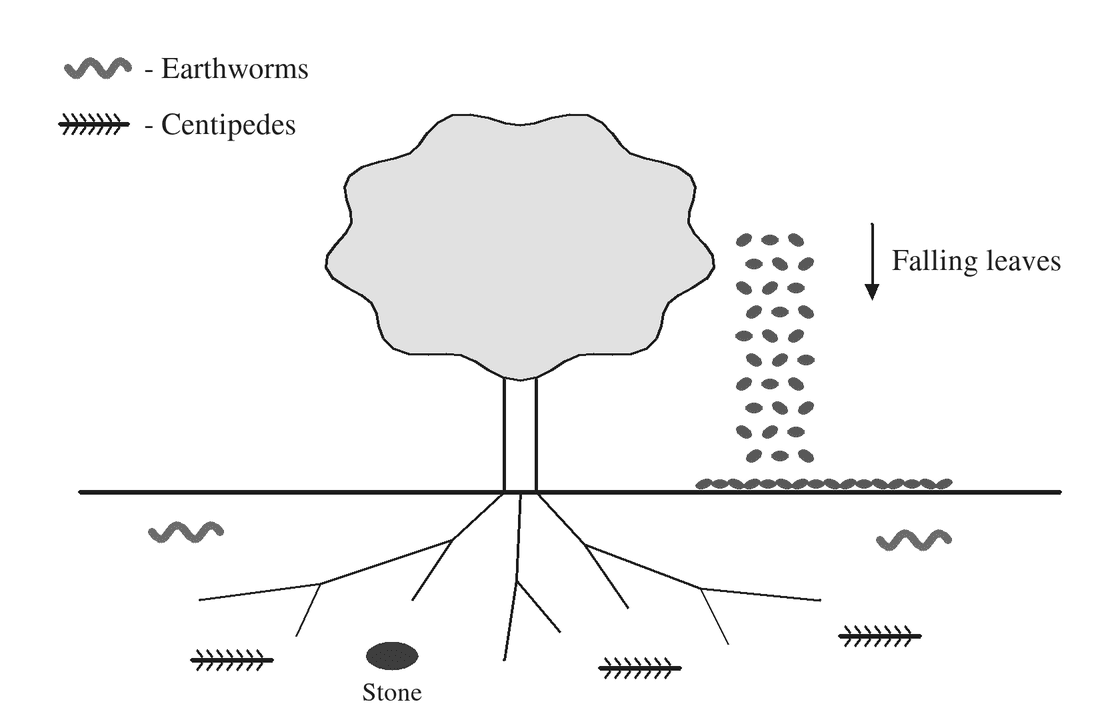
The diagram given below shows the process of decomposition in the forest ecosystem.
Observe the diagram carefully and answer the questions that follow.
(i) Why is the breaking down of complex organic matter an important event in the ecosystem?
(ii) The forest soil has a higher humus content than the desert soil. Give a reason to justify this statement.
(iii) Earthworms and centipedes play an important role in the decomposition process of forest ecosystems. At which stage of the decomposition are these organisms involved?
(iv) The net annual primary productivity of a particular wetland ecosystem is found to be 8,000 per year. If respiration by the aquatic producers is 11,000 per year, calculate the gross primary productivity for this ecosystem.
Solve with AIWritten solution
Solution:
Key idea: Decomposition releases the nutrients locked in dead organic matter, and its rate depends on how much detritus reaches the soil and on warmth, moisture and oxygen. Gross primary productivity (GPP) is shared between respiration (R) and net primary productivity (NPP), so GPP = NPP + R.
Step 1 — (i) Explain why breaking down organic matter is important.
Plants and animals take up nutrients (nitrogen, phosphorus, potassium and others) and lock them into their bodies. When they die, decomposition breaks the complex organic matter into simple inorganic nutrients and CO₂ that return to the soil and air. Producers can then reuse them, so nutrients cycle and the ecosystem keeps working. Without decomposition, nutrients would stay locked in dead matter and dead remains would pile up.
Step 2 — (ii) Explain why forest soil has more humus than desert soil.
A forest has dense vegetation, so a large amount of litter (falling leaves, twigs, dead remains) reaches the soil every year, and the soil is moist, which supports many detritivores and decomposers. Much of this matter is turned into humus, which decomposes only slowly and so builds up. A desert has sparse vegetation, so very little litter is added, and the dryness limits the activity of decomposers, so little humus is formed.
Step 3 — (iii) Name the stage.
Earthworms are detritivores that take part in fragmentation, the first stage of decomposition: they eat detritus and break it into smaller pieces.
Note: Centipedes are actually predators that eat other soil animals; they help the decomposer food web by controlling its animal populations rather than by breaking up detritus themselves. Detritivores such as millipedes and woodlice do the fragmenting.
Step 4 — (iv) Calculate the gross primary productivity.
The GPP is the total energy fixed by the producers; part is used in their respiration and the rest is the NPP. So we add the two:
Therefore, (i) decomposition returns nutrients for reuse, (ii) forest soil gets more litter and has moister conditions that form humus, (iii) earthworms work at the fragmentation stage, and (iv) the GPP is 19,000 kcal/m² per year.
- 111 mark
Question 11
Answer the following questions briefly.
Given below are two statements marked Assertion and Reason. Read both the statements carefully and choose the correct option.
Assertion: In a pond ecosystem, pyramid of biomass shows a sharp decrease in the biomass at higher trophic levels.
Reason: Primary producers convert only 10% of the energy of sunlight into net primary productivity.
Solve with AIAnswer
(A) Both Assertion and Reason are true and Reason is the correct explanation for Assertion.
(B) Both Assertion and Reason are true but Reason is not the correct explanation for Assertion.
(C) Assertion is true and Reason is false.
- Correct
(D) Both Assertion and Reason are false.
Answer: (D) Both Assertion and Reason are false.
Key idea: In a pond, the producers are tiny phytoplankton with a small standing crop, so the pyramid of biomass is inverted. Plants fix only a small share of the sunlight that falls on them, about 1–5 % (2–10 % of the photosynthetically active radiation); the "10 %" figure belongs to the transfer of energy from one trophic level to the next.
Step 1 — Judge the Assertion.
A sharp decrease in biomass at higher trophic levels would give an upright pyramid. In a pond the small standing crop of phytoplankton supports a larger biomass of zooplankton and fishes, so the biomass pyramid is inverted. The Assertion is false.
Step 2 — Judge the Reason.
Producers convert only about 1–5 % of the incident sunlight into chemical energy, and the share left as net primary productivity is even smaller. The 10 % law (Lindeman) describes the energy passed from one trophic level to the next, not the share of sunlight fixed. The Reason is false.
Step 3 — Choose the option.
Since the Assertion is false, options (A), (B) and (C), which all call it true, cannot be correct. With the Reason also false, the answer is (D).
Why the others are wrong:
- (A) It calls both statements true, but the pond pyramid of biomass is inverted, not sharply decreasing.
- (B) It also calls the Assertion true, which it is not for a pond.
- (C) It calls the Assertion true; and although it rightly rejects the Reason, the Assertion is false, so this option fails.
Note: The key often printed for this item is "Assertion true, Reason false"; that would need the pond's biomass pyramid to be upright, which it is not, so the correct answer is (D).
Therefore, both Assertion and Reason are false, option (D).
- 121 mark
Question 12
Answer the following questions briefly.
A forest has a GPP of , and 40% of this energy is used for respiration. Calculate the amount of energy available as NPP.
Solve with AIWritten solution
Solution:
Key idea: Net primary productivity (NPP) is what is left of the gross primary productivity (GPP) after the producers' own respiration (R): NPP = GPP − R.
Step 1 — Find the energy used in respiration.
We take 40 % of the GPP:
Step 2 — Subtract it from the GPP.
The rest of the fixed energy is the NPP:
Therefore, the energy available as NPP is 12,000 kcal/m²/year (60 % of the GPP).
- 132 marks
Question 13
(a) Which trophic level has the most energy in an ecosystem?
(b) Expand PAR.
Solve with AIWritten solution
Solution:
Key idea: Energy flows one way through an ecosystem and decreases at each trophic level, because much of it is used in respiration and lost as heat.
Step 1 — (a) Find the level with the most energy.
The first trophic level, the producers (green plants), has the most energy. Only about 10 % of the energy at one level reaches the next level, so every higher level has less.
Step 2 — (b) Expand PAR.
PAR stands for Photosynthetically Active Radiation. It is the part of sunlight (wavelengths about 400–700 nm) that plants can use for photosynthesis, and it is a little less than half of the incident solar radiation.
Therefore, (a) the producers (first trophic level) have the most energy, and (b) PAR is Photosynthetically Active Radiation.
- 142 marks
Question 14
The amount of energy at the fourth trophic level in the food chain given below is .
Grass Zebra Crocodile Vulture
What will be the amount of energy available at the sunlight and transducer level?
Solve with AIWritten solution
Solution:
Key idea: By Lindeman's 10 % law, only about 10 % of the energy at one trophic level passes on to the next. Producers (the "transducers", which change light energy into chemical energy) trap only about 1 % of the sunlight falling on them.
Step 1 — Set out the levels.
Grass is the first trophic level (producer), zebra the second, crocodile the third and vulture the fourth, with 4 J. Going down one level means multiplying by 10.
Step 2 — Work back to the producer level.
The third level, the crocodile, has ten times the vulture's energy:
The second level, the zebra, has ten times that:
The first level, the grass (transducer), has ten times that again:
Step 3 — Work back to the sunlight.
Taking the producers to trap about 1 % of the sunlight, the sunlight must be 100 times the energy fixed by the grass:
Note: The share of sunlight fixed by plants is only about 1–5 % in reality, so the sunlight value depends on the percentage assumed; 1 % is the usual textbook value.
Therefore, the energy at the transducer (producer) level is 4,000 J, and the sunlight energy is about 4,00,000 J (taking 1 % capture).