Solution:
Key idea: Decomposition releases the nutrients locked in dead organic matter, and its rate depends on how much detritus reaches the soil and on warmth, moisture and oxygen. Gross primary productivity (GPP) is shared between respiration (R) and net primary productivity (NPP), so GPP = NPP + R.
Step 1 — (i) Explain why breaking down organic matter is important.
Plants and animals take up nutrients (nitrogen, phosphorus, potassium and others) and lock them into their bodies. When they die, decomposition breaks the complex organic matter into simple inorganic nutrients and CO₂ that return to the soil and air. Producers can then reuse them, so nutrients cycle and the ecosystem keeps working. Without decomposition, nutrients would stay locked in dead matter and dead remains would pile up.
Step 2 — (ii) Explain why forest soil has more humus than desert soil.
A forest has dense vegetation, so a large amount of litter (falling leaves, twigs, dead remains) reaches the soil every year, and the soil is moist, which supports many detritivores and decomposers. Much of this matter is turned into humus, which decomposes only slowly and so builds up. A desert has sparse vegetation, so very little litter is added, and the dryness limits the activity of decomposers, so little humus is formed.
Step 3 — (iii) Name the stage.
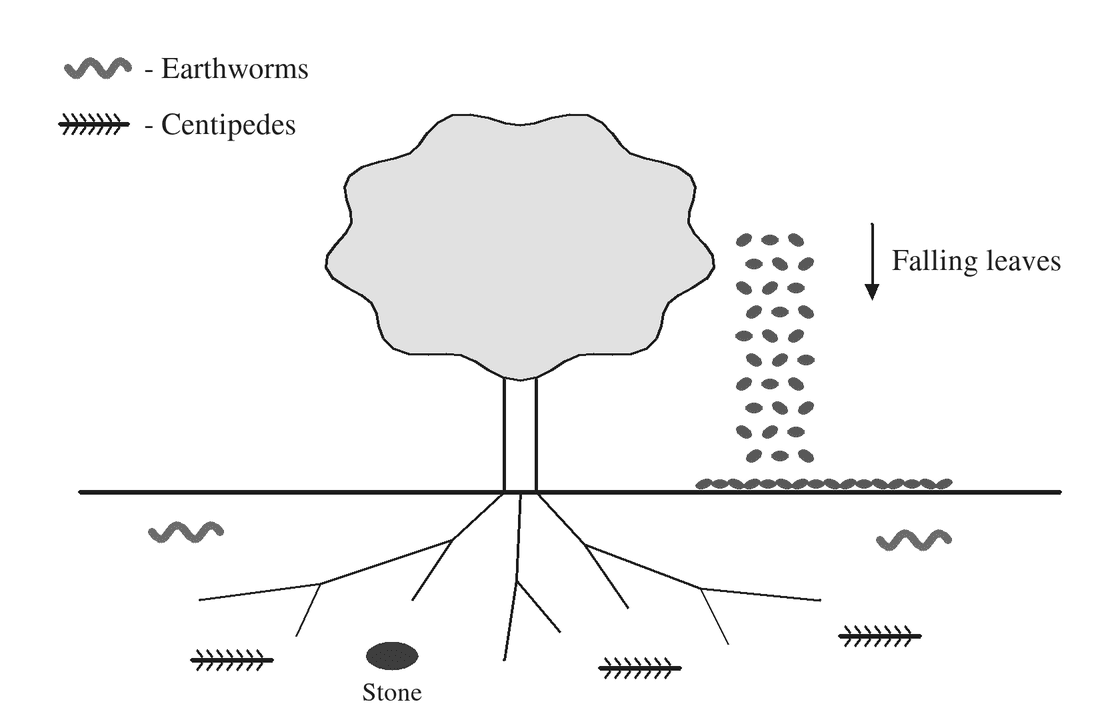
Earthworms are detritivores that take part in fragmentation, the first stage of decomposition: they eat detritus and break it into smaller pieces.
Note: Centipedes are actually predators that eat other soil animals; they help the decomposer food web by controlling its animal populations rather than by breaking up detritus themselves. Detritivores such as millipedes and woodlice do the fragmenting.
Step 4 — (iv) Calculate the gross primary productivity.
The GPP is the total energy fixed by the producers; part is used in their respiration and the rest is the NPP. So we add the two:
GPP=NPP+R
GPP=8000+11000
GPP=19000 kcal m−2 year−1
Therefore, (i) decomposition returns nutrients for reuse, (ii) forest soil gets more litter and has moister conditions that form humus, (iii) earthworms work at the fragmentation stage, and (iv) the GPP is 19,000 kcal/m² per year.